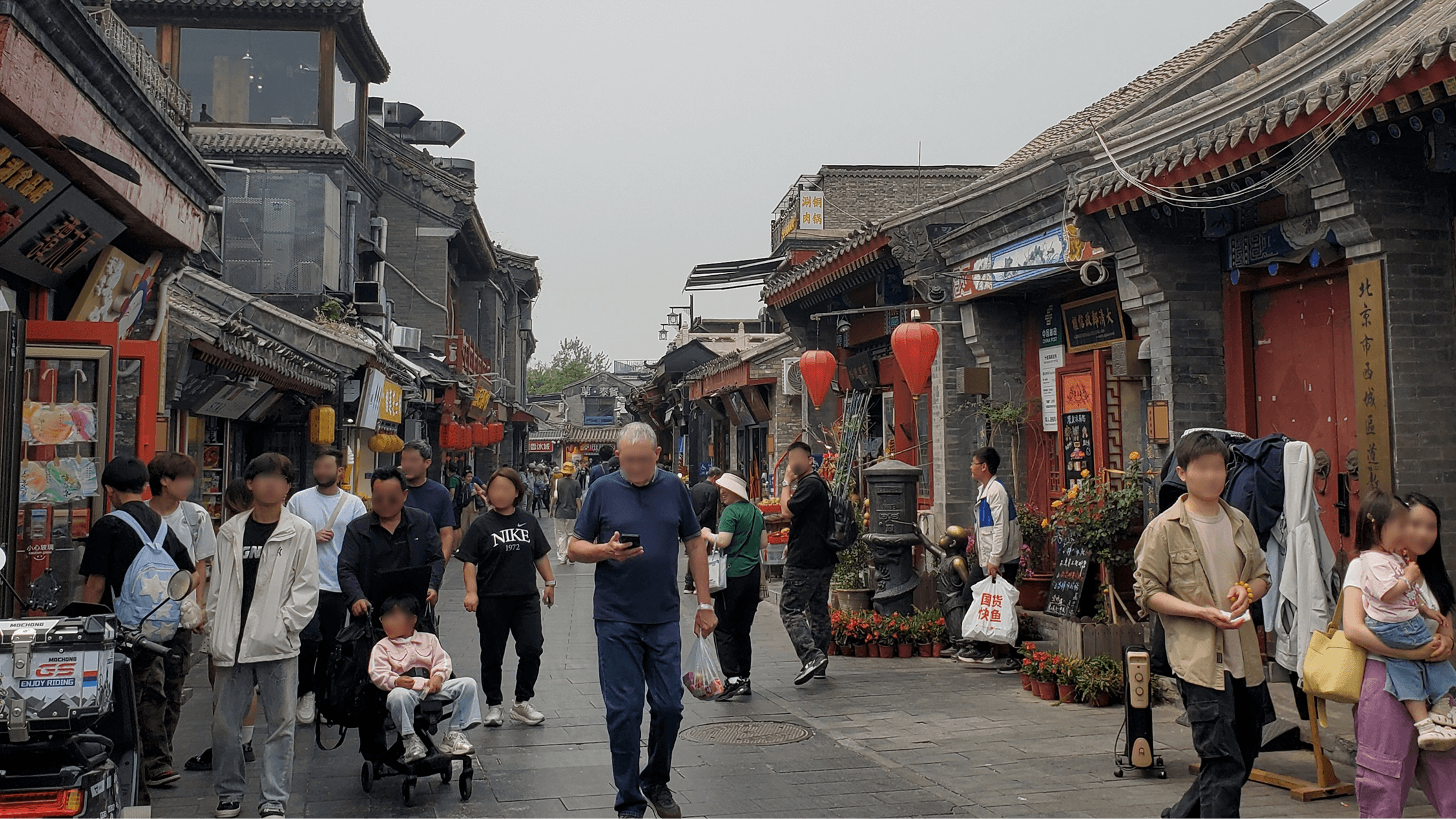
Ready to indulge in some matcha ice cream or grilled meat skewers generously dusted with spicy seasoning? Let’s head to Shichahai food street! I used to wonder why so many travel blogs and vlogs focus so much on trying local food — until I traveled to Beijing. That’s when I truly understood just how diverse and flavorful Chinese cuisine is. Let me tell you, it was tough going back to my own bland cooking after that.
One of the best ways to experience food in China is through its street food. We got our first taste of juicy, meat-filled buns in one of the Beijing’s famous tourist attractions Shichahai — a lively food district that not only offers an incredible variety of local delicacies, but also picturesque views of three of Beijing’s famous “seas”: Lake Xihai, Lake Houhai, and Lake Qianhai.
During the day, the area around the three lakes in Shichahai is wonderfully peaceful. The calm, blue waters are shaded by tall trees with delicate, dangling branches — I think they’re weeping willows? The lakes are bordered by elegant white stone railings, and the surface is dotted with wooden boats. Some glide gently across the water, carrying tourists, while others rest quietly, waiting.
Let’s pause here for a moment and soak in the serenity of Shichahai while I share a fun fact of the day. Why did I call these lakes seas? Well, if you translate the names from Chinese to English you get: Qianhai – Front sea, Houhai – Back sea and Xihai – Western sea. It’s a little hint on how huge these lakes are.
The Chill Vibe of Shichahai Snack Street During the Day
From the lakes, we wander into the nearby streets of Shichahai, which are filled with all kinds of souvenir shops and street food stalls. You’ll see everything from spiky durians to crispy rice snacks, calamari tentacles, and so much more. Meat skewers are grilled right in front of you, and some of the drink stalls have glasses that are mysteriously smoking — can someone explain to me what’s going on there?
Choosing what to try is a challenge in the best way. Eventually, we settle on a warm, juicy meat bun, a bucket of crispy fried calamari, and oil-fied stinky tofu. This one wasn’t too stinky though.
Snacks in hand, we wander further into the heart of the street, watching others nibble, sip, and snack their way through the afternoon.
And just to clear up a common misconception — you won’t find scorpions in Shichahai snack street. While some food streets in China might feature exotic offerings for curious tourists, our guide explained to us that Chinese themselves don’t actually eat scorpions.
With so much still left to taste, I’m already thinking: we’ll definitely be back for dinner.
The Upbeat Atmosphere in Shichahai Snack Street After Dark
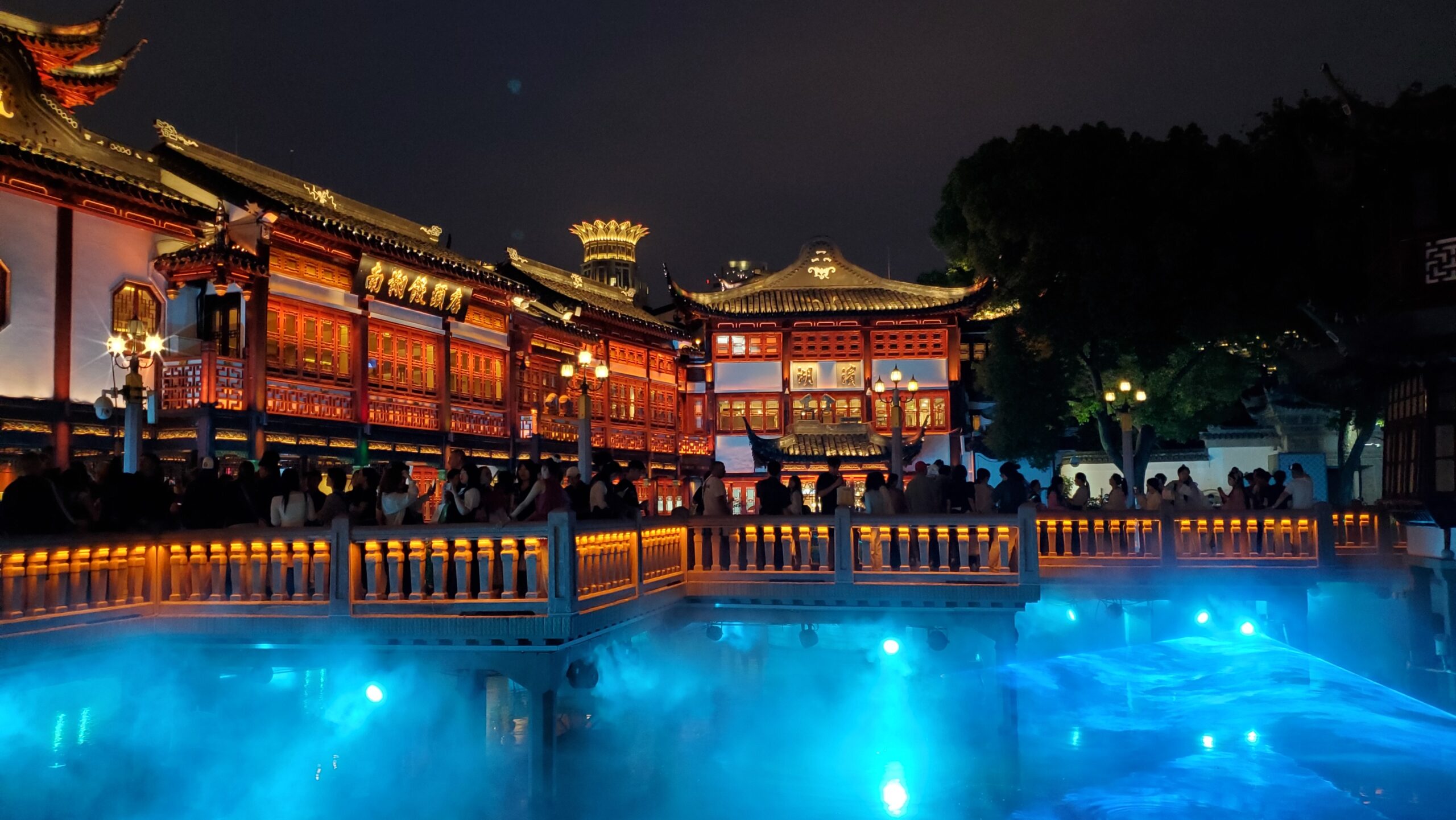
As the sun dips below the Beijing skyline, Shichahai undergoes a transformation — and begins to glow. Neon lights buzz to life, casting shimmering pinks and electric blues across the surface of the quiet lake. What was a laid-back street just hours ago is now pulsing with energy. Every bar seems to be in a friendly rivalry, each one trying to outdo the other with live music that spills into the street and draws customers in.
The change in pace is unmistakable. Where there was space and quiet earlier, now there are waves of people moving from one snack stand of Shichahai to another, drawn in by the sizzling aromas and tempting displays. Vendors, mellow by day, have turned up the volume — calling out to passersby, advertising their specialties with contagious enthusiasm.
At first, it might feel like pure chaos — glowing signs, clashing sounds, the buzz of the crowd — but somehow, it all blends into something magical. It’s a vibe. And honestly, I’m here for it.
Now the only question is: what are we having for dinner?
Thoughts?
I found the area of Shichahai to be very beautiful by day and very fun by night. There is just something about the buzz and endless possibilities of foods you have never tried that draws you in.
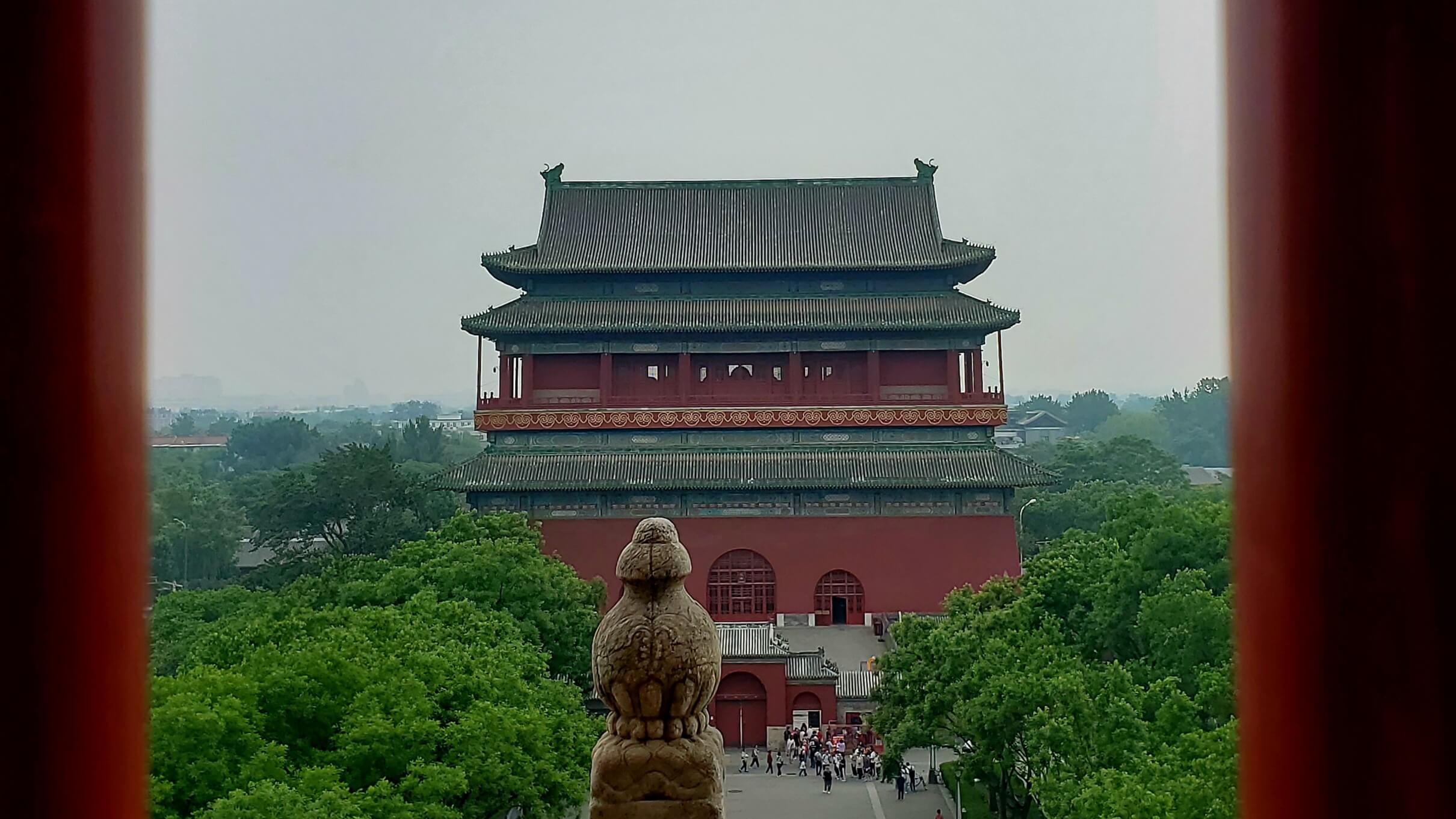
Have you ever heard of the 108 beats? In ancient China, time was measured using their own intricate system—one deeply rooted in numerology and traditional Chinese worldviews. Just as church bells once marked the hours in European cities, ancient Chinese cities like Beijing relied on Drum Towers and Bell Towers to keep the rhythm of society in sync. The deep, resonating sounds of the drums were traditionally used to mark time during the night, while the Bell Tower took over during the day. But the system was more complex than it might seem—ancient China didn’t follow the 24-hour format we use today.
If this topic piques your interest and you’d like to explore it further, a visit to Beijing Drum Tower is a must. And even if you’re just here for the views, it’s well worth a stop—both towers are stunning architectural landmarks in their own right.
First Impressions: Beijing Drum Tower’s Striking Exterior
As we approach the Beijing Drum Tower, its grand façade immediately commands attention. Like many historic Chinese structures, it’s rich in intricate detail—elaborate painted patterns trace the roofline, and golden golden lace gleams against the deep red backdrop. Those iconic, slightly upturned roof corners are adorned with rows of tiny statuettes, a feature you’ll spot on many ancient buildings across China.
Fun fact: these roof figurines weren’t just decorative—the number of them once signified how important the building was.
Across the square stands the Bell Tower, like a quiet sibling to the Drum Tower. It mirrors some of the architectural features, but with a contrasting gray stone façade and a more subdued presence.
You can purchase a ticket to explore both towers or choose to visit just one. Personally, I found Beijing Drum Tower more intriguing—and here’s why.
The Museum on the First Floor of Beijing Drum Tower
Here, you’ll learn all about those mysterious 108 beats, ancient Chinese timekeeping methods, and the tower’s architectural evolution. A few interactive displays let you tap out rhythms on virtual drums or ring a digital bell—simple, but fun.
But it’s the second floor of Beijing’s Drum Tower that I’m really here for. The catch? You have to conquer one of the steepest staircases I’ve ever encountered. Let’s just say—the climb is nothing short of thrilling.
The Drum Performance in Beijing Drum Tower
The second floor opens into a spacious hall with towering red columns and brightly painted ceilings. Lined up along one wall are massive drums, with a colossal central drum taking the spotlight. While these are modern replicas, off to the side lies the aged carcass of a real ancient drum—faded, cracked, and full of stories.
The real highlight of Beijing Drum Tower is the drum performance, which happens several times a day. Judging by the growing crowd, we’ve arrived just in time.
Three drummers stride in, take their places at the central drums—and suddenly, the room is alive with a pump-up rhythm that is sure to get you excited. The performers strike different parts of the drums to create varied tones, working in perfect sync to build a rhythm that will stick in your head for hours.
The performance isn’t long, but somehow it feels like there were way more than 108 beats… Maybe I just lost count! Either way, the drum show at Beijing’s Drum Tower was a lot of fun. But before we head out, let’s step onto the balcony to take in the views.
The Panoramic Views from Beijing Drum Tower
It turns out the Drum Tower also serves as an observation deck, offering sweeping panoramic views of Beijing. On this particular day, a soft veil of smog hangs in the air, turning the distant skyline into a fading watercolor. I think there are some high-rises far off in the distance, but they’re barely distinguishable. From here, it’s mostly a labyrinth of rooftops from Beijing’s historic hutongs—a unique sight you won’t find anywhere else.
With that we have seen everything that Beijing drum tower has to offer and are ready to go explore the next attraction in Beijing.
Thoughts?
If you’re the kind of traveler who loves diving deep into history and the stories behind the places you visit, then the Beijing Drum Tower is a perfect stop. As the story of Beijing’s Drum tower is what makes the experience unique. Just make sure to time your visit so you don’t miss the drum performance.
The Great Wall of China needs no introduction, right? But let me try to blow your mind anyway.
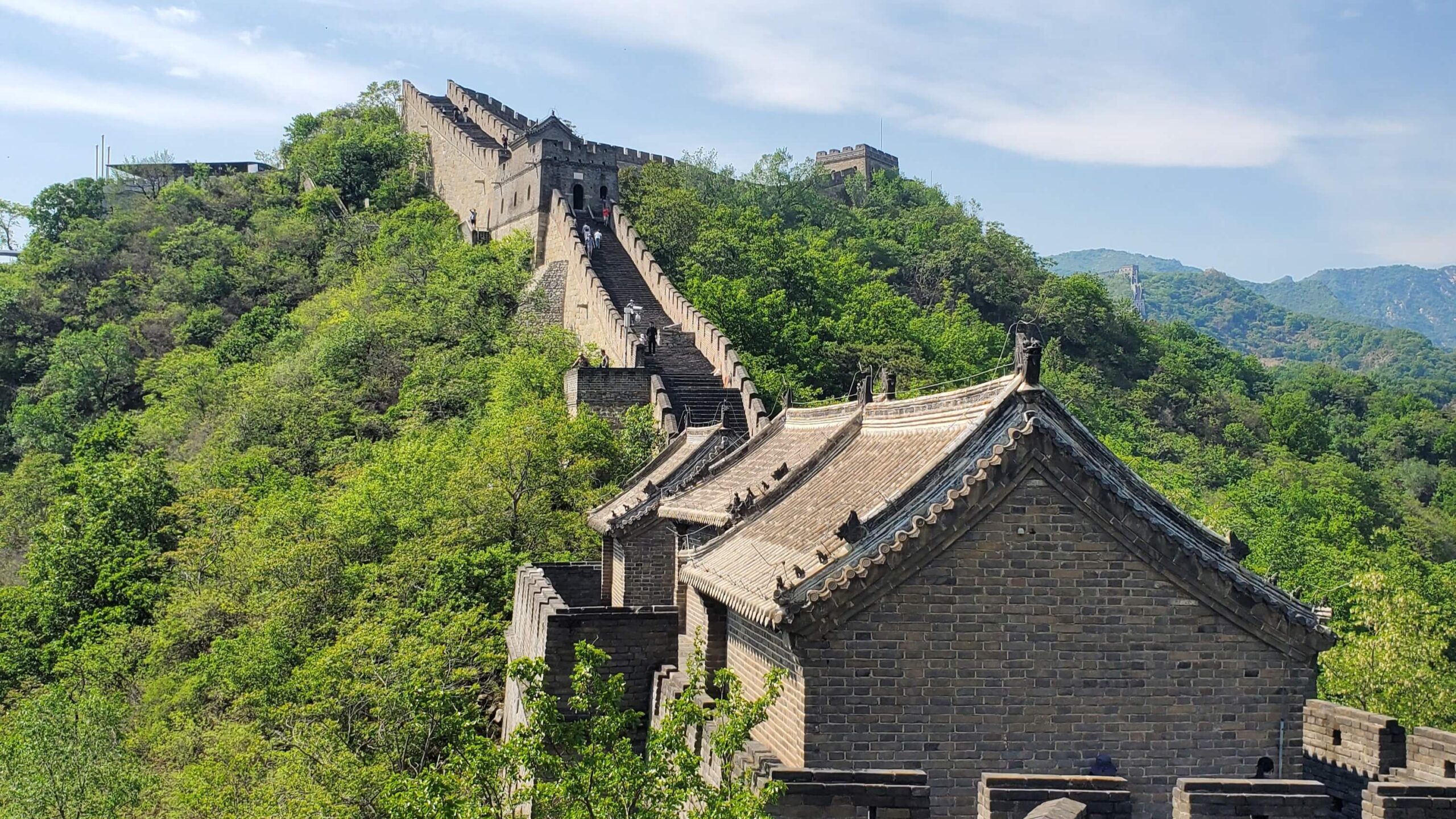
Picture this: you’re surrounded by layers of misty mountains stretching into the distance. And winding between them, like the spine of a sleeping dragon, is a long, ancient wall. It’s dotted with people who, from far away, look like tiny specks drifting along its ridges.
What you may not realize is that the Great Wall wasn’t built as one continuous structure. It was first made by connecting multiple defence structures already built and then rebuilt, and extended over centuries by various dynasties — eventually becoming the longest military structure in the world, spanning more than 20,000 kilometers.
Today, we’re going on a day trip to the Mutianyu section of the Great Wall of China to take on the Hero’s Slope — and I can’t wait to show you why it’s worth the trip… and the sweat.
Why We Chose to Visit the Mutianyu Section of the Great Wall of China
As we were based in Beijing, we had two logical options for our Great Wall visit — Badaling or Mutianyu. I had read that, while Badaling is easier to reach by public transport, it also tends to be the most crowded. Mutianyu, on the other hand, is a bit trickier to get to — but that also means fewer tourists. And “less crowded” sealed the deal for us. And getting there isn’t complicated if you choose to go by a tourist bus…
Visiting Mutianyu Great Wall of China By Tourist Buss
I wanted our day trip to Mutianyu Great Wall be as hassle-free as possible. While it’s technically doable by public transport, I wasn’t quite confident about navigating local buses in China just yet. So, I opted for a tourist buss service that goes directly to and from the Mutianyu Great Wall.
This option was more expensive than doing everything yourself via public transit, but still cheaper than a fully guided tour or hiring a private driver. A perfect middle ground!
Overall, I was very satisfied with the experience. We went to the designated pickup point in the morning, where the Mubus staff welcomed us onboard. On the way to the wall, they gave us a brief but helpful introduction to the Great Wall and explained the different hiking routes we could take once there.
We also bought our entrance tickets through them, which made things even easier. Once we arrived, they dropped us off at the Great Wall shuttle bus station (included in the tour price), and from there we were free to explore on our own for about five hours — plenty of time!
At the end of the day, we returned to the same pickup spot, and the same bus took us back to Beijing. A truly smooth and stress-free experience.
Best Advice About Visiting The Great Wall of China I’ve Heard
This one came from our tour guide.
Don’t visit the Great Wall on Monday. Because on Mondays all the museums in Beijing are closed, this is when most of the tourists plan to visit the Great wall of China making it very crowded. So better to pick any other workday.
I don’t know if you knew but there are actually 2 routes you could take when visiting the Mutianye great wall. And both of them require separate tickets as they are operated by different companies (at least that’s what they told us on the tourist bus). Today we are taking both starting with the West section.
What to Expect on the West route of Mutianyu Great Wall?
This section is considered to be steeper and more challenging than its eastern counterpart, but it also holds the highest viewpoint.
Cable Car up the Mutianyu Great Wall
We wait in line for a little while, but before long, we’re stepping into a glass-sided cable car, ready to take us up to the Great Wall. As we begin our ascent, the view below us is mostly a dense sea of treetops—green and endless—but not particularly exciting.
What is exciting, though, is the glimpse of the Wall itself that starts to appear in the corner of your eye. A pale line stretching along the ridge, growing larger with every second.
And then it hits me — we’re actually about to set foot on the Great Wall of China. After all the reading, researching, and dreaming… we’re here. I can’t hide my excitement!
Unforgettable Views of West Route of Mutianyu Great Wall
The next moment, you find yourself standing on top of the Mutianyu Great Wall.
There’s a bit of a crowd near the entrance, but once we get past that initial bottleneck, the wall opens up beautifully. Fortunately, it’s not too crowded today, so there’s plenty of space for everyone to explore at their own pace.
You’re surrounded by rolling green mountains, fading into the misty distance like a layered painting. The stone wall snakes along the ridges, interrupted time after time by watchtowers positioned at regular intervals.
In the past, these served as vantage points to monitor the surroundings and protect the wall. Today, they act as little resting oases during the hike—dark, empty, and slightly cooler than the air outside thanks to their thick stone walls.
Here’s an interesting fact I came across during my research: in addition to the watchtowers, beacon towers were built at strategically important points along the Great Wall and played a vital role in communication. Soldiers would send coded messages using smoke signals by day and fire by night, sometimes also using flags or drums. Isn’t that fascinating?
I’m not sure if any of the towers we’re seeing today were used for that purpose, but the idea of this ancient, large-scale messaging system is very intriguing.
The surface of the wall is rough and uneven, with lots of steep ups and downs. It’s definitely not an easy walk, and I can’t help but worry about the tourists who showed up in sundresses and flip-flops—they might not have known what they were in for.
Honestly, the Great Wall is brilliant. It was originally built to protect China from the attacks of northern nomads. I consider myself in pretty decent shape, but if I had to climb this in full armor… I think I would just give up and turn around.
But the views from Mutianyu Great Wall are absolutely spectacular—so we just keep going. As the biggest challenge of the Wall is yet in front of us.
Conquering the Hero Slope of Mutianyu Great Wall
Have you heard of Watchtower 20?
It’s the highest point on the Mutianyu section of the Great Wall that tourists can reach — and getting there is no joke. The final climb from Tower 19 to Tower 20 is so steep that it’s nicknamed the Hero Slope. Climbing it is seen as a symbol of perseverance, strength, and determination.
And let me tell you — it lives up to the name!
The stairs are relentless, and I have to stop more than once to catch my breath. My leg muscles are pulsing, and the incline feels almost vertical at times. But I know I can make it.
Just before reaching the top, there’s a bit of a bottleneck as the steps get very narrow. But everyone handles it gracefully, forming two lines — one for climbers heading up, the other for those coming down.
One final push and… we make it!
We’re standing at Watchtower 20. At the top, there’s a large stone with something written in Chinese on it — a popular photo spot for triumphant hikers — and a vendor selling cold water and beer. That’s a smart business move! And of course, you get to enjoy the views: endless ridgelines and the Great Wall stretching like a ribbon across the mountains.
To descend, you have to turn back the way you came and head back toward the cable car station.
They say the west route of Mutianyu takes around 2.5 hours on average, but we finished a bit faster — perhaps carried by the thrill of the challenge.
What is the Hiking East route of Mutianyu Great Wall Like?
This section is shorter (the average estimated time is about 1.5 hours, though we completed it faster) and generally less challenging—and at the end, you get to enjoy a toboggan ride down.
Ski Lift Up The Mutianyu Great Wall
The ski lift on the eastern side of the Mutianyu Great Wall feels a bit more thrilling — it’s an open lift, so your legs dangle freely in the air as you’re carried up toward the wall. The views are much the same as on the western cable car: a seemingly endless sea of green treetops rolling beneath you.
Slight Differences Between the West and East Sections on Mutianyu
Once you’re up top, though, you’ll notice some unique features. This side of the Mutianyu has slightly different watchtower designs — one of the highlights is a cluster of three towers sitting side by side, each topped with gently sloping roofs that look almost like hats. Apparently, this configuration is quite rare along the Great Wall.
And while walking you can hear ambient background music that makes you feel like you’re the main character in your own adventure movie.
The walk may be shorter, but I’m not entirely sure it’s any easier — the stairs here get pretty steep, too. It all culminates in a large watchtower, though unlike Watchtower 20, you don’t climb on top of it — instead, you step inside.
After a short rest in its cool stone chambers and snapping a few dramatic window shots, it’s time to turn around. But don’t worry — the adventure isn’t over yet.
Driving a Toboggan Down the Great Wall of China
The real highlight of this section of the wall is the toboggan ride down. You get to speed down the Great Wall on a little “car” that runs along a metal track. How cool is that!
Usually, my biggest complaint with toboggan rides is that they’re over in a blink — but not this one. At 1,580 meters long, it’s the longest I’ve ever been on, letting you glide through turn after turn. It’s a lot of fun!
With that thrilling ride, our adventure at the Mutianyu Great Wall comes to an end. We take the shuttle back to the tourist area to browse the souvenir shops and enjoy a Great Wall-shaped ice cream before boarding the tourist bus back to Beijing.
Thoughts?
Although I had dreamed of visiting the Great Wall, I was a bit nervous—everyone’s seen those photos of crowds packed like sardines at the top. But for us, the experience was nothing like that. It turned out to be a fun (though physically demanding) hike, capped off with a thrilling toboggan ride. I loved the views, the sheer scale, and the feeling of standing on something so historically important. I think the key is timing your visit right to avoid the crowds.
Looking for a Suzhou travel itinerary that goes beyond the typical stroll through the famous gardens? Then stick around—this one’s for you.
While many travelers visit Suzhou as a day trip from Shanghai, this ancient city actually predates its modern neighbor—making it one of the oldest cities in China. It’s home to a centuries-old pagoda and streets that appear on stone-carved maps dating back over 700 years. But Suzhou is far from frozen in time.
Today, it’s a thriving economic and commercial hub. With its elegant green spaces, winding historic alleys, and bold futuristic architecture, Suzhou seamlessly blends the ancient and the modern into a vibrant, living tapestry.
So join me on a virtual journey to Suzhou, China, where I’ll share my travel story and a 1-day Suzhou travel itinerary.
We’ll start bright and early—right after a bowl of delicious breakfast noodles. And the first stop on our Suzhou travel itinerary is one that blends nature, architecture, and culture. But here’s the twist: it’s not a garden.
Many Surprises of Tiger Hill Scenic Area in Suzhou, China
Chinese name for navigation: 虎丘山风景名胜区
Imagine stepping into a historic and picturesque park in China, filled with legends, traces of a long-gone temple, and stunning landscapes. While most visitors come for the iconic leaning pagoda, Tiger Hill in Suzhou holds many more trumps hidden in its pocket. Here, you’ll discover serene bamboo groves, elegant traditional architecture, Buddha statues, and bonsai trees shaped like miniature living artworks. If you visit this Suzhou attraction, I’m sure you’ll find something that speaks to you — and most definitely, you’ll find peace.
After soaking up the peaceful vibes at Tiger Hill, it’s time to switch gears and dive into Suzhou’s lively urban scene. From now on the attractions in our Suzhou travel itinerary will get more fast paced and busy. But it will be a lot of fun!
So let’s head to the metro. It really is the best way to get around Suzhou.
Afternoon Part of My Suzhou Travel
This part of the Suzhou travel itinerary will give you a mix of traditional charm and contemporary energy through 3 different shopping experiences.
Temptations of the Guanqian Shopping Street in Suzhou, China
Chinease name for navigation: 观前街
In China, shopping isn’t just about ticking items off a list — it can be a whole experience. Even in this ultra-digital age, when you can order an air conditioner on your phone and have it installed the next day (true story, courtesy of our tour guide in Shanghai), lively shopping streets like this are still buzzing with energy.
And today, our Suzhou travel itinerary leads us straight to the 150-year-old Guanqian shopping street that has 3 parts – the trendy, the historic and the spiritual.
Shopping streets in China evoke such a feeling of wonder, as you can never know what treasures you’ll find browsing around. And before you know it, we’ve wandered to the far end of Guanqian shopping street. Luckily from here, the next attraction we will visit as part of our Suzhou travel itinerary is just around the corner.
Include Picturesque Pingjiang District on Your Suzhou Travel Itinerary
Chinease name for navigation: 州平江苏历史文化街区
Pingjiang Road is one of Suzhou’s most historic quarters — so old, in fact, that it appears on the earliest surviving map of the city, carved into a stone stele.
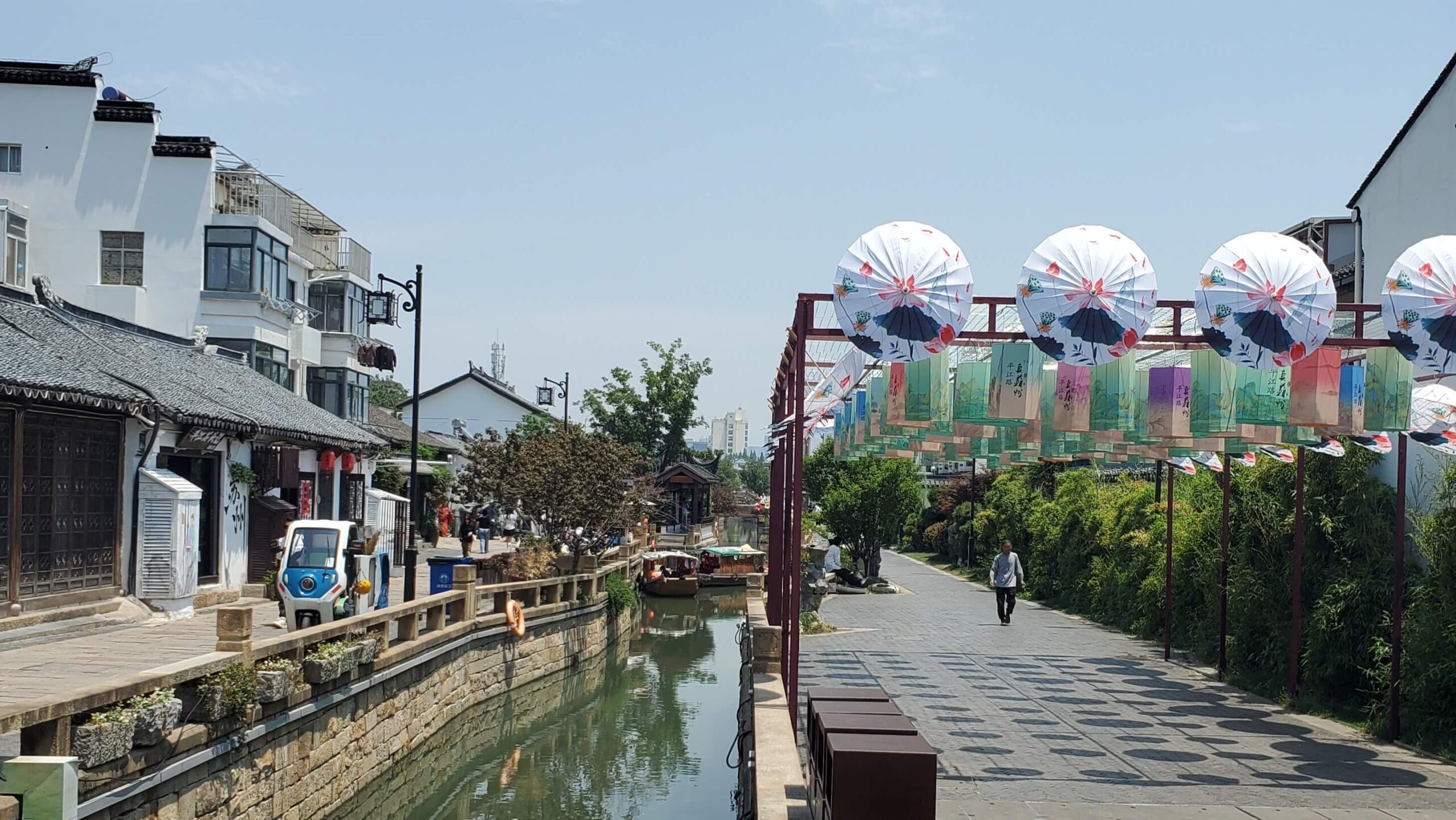
So, naturally, I pictured a quiet, postcard-perfect district with turquoise canals snuggled up to timeworn houses… and yes, it is all that. But step into the area and you’ll quickly realize it’s also a bustling shopping district.
And honestly? I don’t mind at all. From a marketing perspective, it’s a clever move — a way to preserve history while keeping it vibrant and alive.
At first, we come across a street lined with whitewashed houses that have that old-world feel. I don’t think we’ve reached the actual Pingjiang Road yet — the one that hugs the river — but the whole surrounding area is part of Suzhou’s historic core.
Some homes have hung laundry out to dry in the sun; others are dressed up with red lanterns and flower boxes. But almost all of them share one thing in common: the ground floors have been transformed into cozy cafés, little boutiques, and food stands.
As we stroll deeper into the district, we finally reach the famous Pingjiang Road. A narrow, charming canal runs alongside us, shaded by graceful old trees. Red lanterns hang above the path, swaying gently as crowds wander past — some browsing goods, others nibbling on mouth watering treats from the street stalls.
Every so often, a stone arch bridge invites you to cross to the other side or slip down a quiet side path to explore further. It’s all undeniably romantic — the kind of scene that gives you that classic Chinese water town experience, without the need for a long detour out of the city.
Next, our Suzhou travel itinerary is taking us from the lingering tales of the past to the bright and shiny present.
The Iconic Gate of Orient in Suzhou, China
Chinese name for navigation: 東方之門
No Suzhou travel itinerary would be complete without visiting the iconic Gate of the Orient. Throughout our Suzhou trip, we’ve been catching glimpses of this striking high-rise — its silhouette impossible to ignore. Now, it’s time to see it up close.
The symbolism behind it is pretty straightforward: this is the gateway to modern Suzhou.
Stepping out of the metro, you immediately find yourself beneath the looming structure of the Gate of the Orient. You have to tilt your head so far back to see the top, it feels like your neck might snap. From this angle, the shape looks almost like an hourglass — somehow that’s not at all what I expected. Some buildings are best admired from afar, and I think the Gate of Orient might be one of them.
Snap a photo, soak in the scale — but truthfully, this could be the quickest stop on your Suzhou itinerary. Unless… we also check out the Jinji Lake promenade, which is just on the other side.
The only thing between us and the lake? A very busy road. But don’t worry — if you’ll look around you’ll spot two skybridges stretching from this side to the waterfront. All that is left to do to get to the next chapter of our Suzhou itinerary is to find where exactly they start. Seems like they are coming out of a building?
The building the terraces originates from turns out to be the futuristically shaped Suzhou Center mall.
Explore Suzhou Center Mall – A Modern Highlight in Your Suzhou Travel Itinerary
Chinese name for navigation: 苏州中心购物中心
This mall feels like a maze. Everything is bright, shiny, and polished — with multiple levels spread across several interconnected buildings, all packed with trendy Western shops. If you’re into shopping you could spend hours here!
We wander through Suzhou Center Mall for quite a while. The only thing I’m absolutely sure of is this: in Chinese malls, the food court is always on the lowest floor — and yes, it’s completely normal to find full-on car dealerships inside. You know, just in case you came in for a pair of socks and leave with a new Tesla. Everything else about the layout? A total mystery. Which I love!
At some point, we find ourselves in a tunnel lined with endless rows of gachapon machines — those capsule toy dispensers where you tap your phone (because of course it’s mobile payment — this is China), and out rolls a plastic bubble with a surprise collectible inside. The little cats wearing watermelon hats are ridiculously tempting. Just as tempting as the crane machines I saw on the basement floor earlier.
But this isn’t where we meant to end up. So we gotta keep exploring!
Eventually, we do find a way to the sky bridges — and the moment we step onto the terrace, it’s hard not to be amazed. These elevated skybridges don’t just connect the mall to Jinji Lake — they double as suspended parks, with trees, bushes, and lush greenery all around. Shops in China really are on a whole different level.
Visiting Jinji Lake on Your Suzhou Trip
Chinese name for navigation: 金鸡湖音乐喷泉
The sky bridges takes us to the open area by the lake.
Water here appears to be dotted with small boxes—puzzling at first, until I realize this is where Suzhou’s famous fountain show takes place on Friday and Saturday nights. Today, however, the fountains are silently sleeping, and all we get to enjoy are the blurred silhouettes of Suzhou’s high-rises on the opposite side of the calm water.
The colors of the world around us seem faded. Even the lake has a pale, milky tint—almost as if someone applied an Instagram filter over the entire landscape.
Also – turns out that this might be the best place to take a picture of the Gate of the Orient, as you can nicely fit it all in the frame.
From here, we can stroll along Jinji Lake, or head back to our hotel for a break. We’ll need to wait until the sun goes down to enjoy the last attraction on our Suzhou travel itinerary.
Evening Part of My Suzhou Travel Itinerary
After dinner and a bit of rest, it’s time to experience the modern side of Suzhou.
End your Suzhou Travel With Admiring The Lights of SIP (Suzhou Industrial Park)
You can put the Art & culture center as the address in navigation: 苏州文化艺术中心
One thing I find fascinating about China is how the skyrises light up at night. Where I’m from, light shows are reserved for special occasions—maybe once in a blue moon. But here, the glowing facades and playful animations blend into the daily rhythm. One of the best places to enjoy Suzhou’s nighttime illuminations is in Suzhou Industrial Park, around the Suzhou Culture and Arts Centre.
On a warm summer evening like this, the whole area feels vibrant and full of life. As you step out of the metro, you’re greeted by the distant silhouette of the Suzhou Culture and Arts Centre, twinkling in shades of red and pink—like half the stars in the sky have fallen and settled on its surface.
Nearby, billboards flash playful animations, including a few mischievous cartoon cats.
As you stroll further, you’re met with bubbling fountains, neon-lit walkways, and tiny lights twinkling in the tree branches. The air is warm, the vibe is light, and the night is still young.
Then, you reach the lakefront—and the most spectacular view of Suzhou unfolds: the high-rises along the opposite shore shimmer in light, as if dancing in unison, all drawing the eye toward the Gate of the Orient, which rises at the center like a glowing portal, setting the rhythm for the skyline around it.
This is where our Suzhou travel itinerary comes to a close.
We were lucky enough to stay in a hotel with a direct view of the promenade, so we ended our night simply gazing out the window until our eyes were too heavy to stay open.
But don’t worry—you can enjoy this beautiful scene just as easily with an evening walk around the area.
Thoughts?
One day is definitely not enough to see everything Suzhou has to offer!
I visited many of the city’s most famous attractions as part of my Suzhou travel itinerary, yet I still feel like I only scratched the surface. But what I did see was absolutely mesmerizing. So I would love to go back.
Since Suzhou is only about 40 minutes from Shanghai by high-speed train, you should be able to follow this travel itinerary as a day trip if needed. However, what I did—and what I’d recommend if you have the time—is arrive the night before and stay an extra night after. That way, I was able to start exploring Suzhou’s attractions bright and early and didn’t have to skip out on hotel breakfast (which would have happened if I had traveled in the morning). Also this way I had a comfortable place to rest when the heat started to wear me out.
What’s The Best Way to Get Around When Traveling in Suzhou?
I was able to get to all Suzhou attractions listed in this Suzhou travel itinerary by using the metro and walking for a bit. The metro system in China is very convenient and very foreigner friendly (there are signs in English).
Also – you can find my tips and tricks about traveling in China here. It covers topics like payments, navigation & trip planning.
If you had limited time and had to pick only one attraction to see in Suzhou, what would it be?
For me the most memorable part of my Suzhu travel itinerary was the Tiger hill – it combined many of the things I associate with China and wanted to see in China as they are nowhere to be found where I live. And it also provides the most variety.
In China, shopping isn’t just about ticking items off a list — it can be a whole experience. Even in this ultra-digital age, when you can order an air conditioner on your phone and have it installed the next day (true story, courtesy of our tour guide in Shanghai), lively shopping streets like this are still buzzing with energy. And today, our Suzhou travel itinerary leads us straight to the 150-year-old Guanqian shopping street.
The Trendy Part of Guanqian Shopping Street in Suzhou
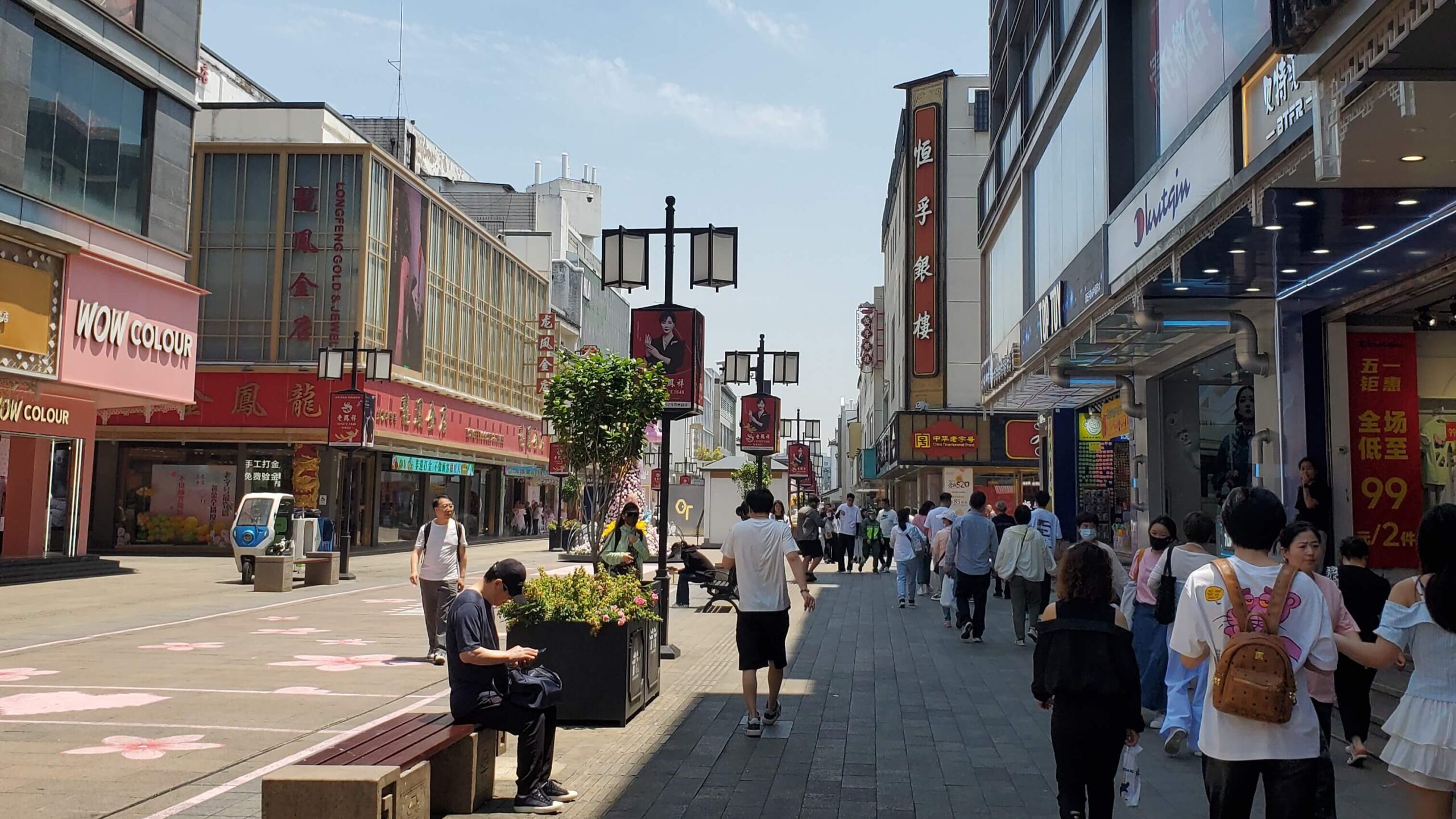
Stepping out of the metro, we follow the GPS until we find ourselves on a wide pedestrian avenue. Both sides of Guanqian Shopping Street are flanked by a vivid collage of signs and banners — Chinese characters mingling with English names, bright logos promising everything from ice cream to silk scarves. Clothing boutiques, souvenir shops, snack vendors, quirky toy stores… this part of Suzhou is a kaleidoscope of temptations.
If this isn’t quite the old-world Suzhou you pictured when I mentioned a 150-year-old shopping street, don’t worry — Guanqian Shopping Street has layers. It’s actually divided into three sections, and we just happened to start in the most modern one, that has the trendier shops.
So let’s lean into it. How about we grab a fun-flavored lemonade — the lychee-pomelo one is calling my name — and stroll through the crowd, peeking into colorful storefronts and soaking up the energy. The lemonade is icy cold and wildly sweet — maybe too sweet — but in this heat, it’s exactly what I need.
The Spiritual part of Guanqian Shopping Street: Xuanmiao Taoist Temple
Just as you’ve settled into the rhythm of browsing, something on your left catches your eye — a beautiful building with an upward-sloping black tile roof, quietly guarded by stone lions. That’s the Xuanmiao Taoist Temple.
Dating all the way back to 276 AD, this temple is one of Suzhou’s oldest spiritual landmarks. Naturally, it’s been rebuilt many times over the centuries — as ancient structures often are — but its silhouette remains quietly captivating. And here’s a fun detail: Guanqian Shopping Street actually takes its name from this very temple. “Guanqian” literally means “in front of the temple.”
The doors of the temple are wide open and inside you can see a golden statue shimmering through the dark. I don’t recognise the deity but it looks quite fierce holding a sword or something similar.
There’s a peaceful courtyard further in, with incense burners smoking away and more halls waiting to be explored, but sadly, I’m not dressed appropriately for temple entry, so I will have to skip deep diving into this Suzhou attraction today.
With a lingering hint of regret, let’s turn away and continue exploring the rest of Guanqian Shopping Street.
The Historic Soul of Guanqian Shopping Street
Here the atmosphere shifts.
The glossy, boxy buildings of Guanqian Shopping Street we passed earlier give way to charming structures that echo traditional Chinese architecture — wooden balconies and the upward-curving corners of tiled roofs creating graceful silhouettes. Lanterns shaped like slender rectangular columns line the street, each adorned with delicate artwork. I can’t help but wonder how magical they must look, glowing softly after dark.
Amid these beautiful details, shopfronts nestle comfortably. Many have been part of this street’s rhythm for generations. I love wandering into the snack shops, inhaling tempting aromas, and browsing souvenir stores filled with playful food-shaped magnets and other tiny tokens of Suzhou’s unique charm.
Thoughts?
When I am at home, I am not into shopping at all. But the shopping streets in China, like the Guanqian Shopping Street in Suzhou, has such a charm that they evoke the feeling of wonder. You can never know what treasures you’ll find, so browsing around is always an adventure.
Imagine stepping into a historic and picturesque park in China, filled with legends, traces of a long-gone temple, and stunning landscapes. Today, we’re traveling to Tiger Hill Scenic Area in Suzhou. While most visitors come for the iconic leaning pagoda, Tiger Hill holds many more trumps hidden in its pocket. Here, you’ll discover serene bamboo groves, elegant traditional architecture, Buddha statues, and bonsai trees shaped like miniature living artworks. If you visit, I’m sure you’ll find something that speaks to you — and most definitely, you’ll find peace.
So come with me on a virtual stroll down memory lane to the fascinating Tiger Hill Scenic Area in Suzhou.
Getting to the Tiger Hill Scenic Area from Suzhou’s city center is surprisingly simple. Just hop on the metro, follow the signs once you exit, and you’re on your way. But the adventure doesn’t begin at the entrance to Tiger Hill — it begins with the walk there.
As you join the steady stream of visitors, you’re eventually greeted by a tall, ornate gate topped with a red sign inscribed with Chinese characters. It feels like a portal to another world. Beyond it, a stone alley stretches ahead, and in the distance — peeking through the trees — the leaning pagoda of Tiger Hill rises above the canopy like a quiet guardian, offering a first glimpse of the journey to come.
But before you even reach the official entrance, Suzhou does its best to distract you with quiet, timeless charm. You find yourself beside a canal, surrounded by old houses with sloping tiled roofs and weathered stone walls. Wooden boats rest sleepily in the greenish-blue water. Further ahead, an old arched stone bridge spans the canal, its reflection gently rippling. And the nearby, narrow streets twist away, lined with small shops and food stalls that beckon you to linger. It’s tempting — but for now, we stay focused on the path to Tiger Hill.
Buying Tickets to Tiger hill in Suzhou as a Foreigner
I’m happy to report that when I visited one quiet morning in May, well outside the busy season, I was able to purchase my tickets right at the ticket office before the entrance without any trouble. But it seems like you can also buy them online in advance in 3rd party sites like Trip.com if you want to secure them before you go.
Tiger Hill Scenic Area in Suzhou is a Labyrinth of Winding Paths
To get to the Pagoda of Suzhou’s Tiger Hill Scenic area, you can choose from many paths, each leading to its own surprises and fun detours.
The main street climbing up looks like the shortest route, bustling with snack stalls and souvenir shops tempting visitors with their colorful wares. At one stand, a man rhythmically pounds something that looks like dough with a large wooden hammer — I wonder what that could be? But I prefer the quieter side paths. So let’s pick one at random and see what hidden wonders Tiger Hill will reveal.
Luck is on our side. Soon we find ourselves stepping into a rock garden, where porous, organically shaped stones nestle among the lush greenery like nature’s sculptures. In the distance, traditional Chinese buildings peek through the trees, inviting us to explore.
As we wander, it becomes clear that Tiger Hill in Suzhou is sprinkled with charming little structures, each crowned with gracefully curving roof edges, adorned with intricate woodwork, and decorated with red lanterns with dangling silky tassels. Peeking inside some, you discover peaceful interiors arranged with delicate works of calligraphy, fresh greenery, and beautiful paintings. It’s the China I had always dreamed of visiting: serene, historic, and quietly timeless.
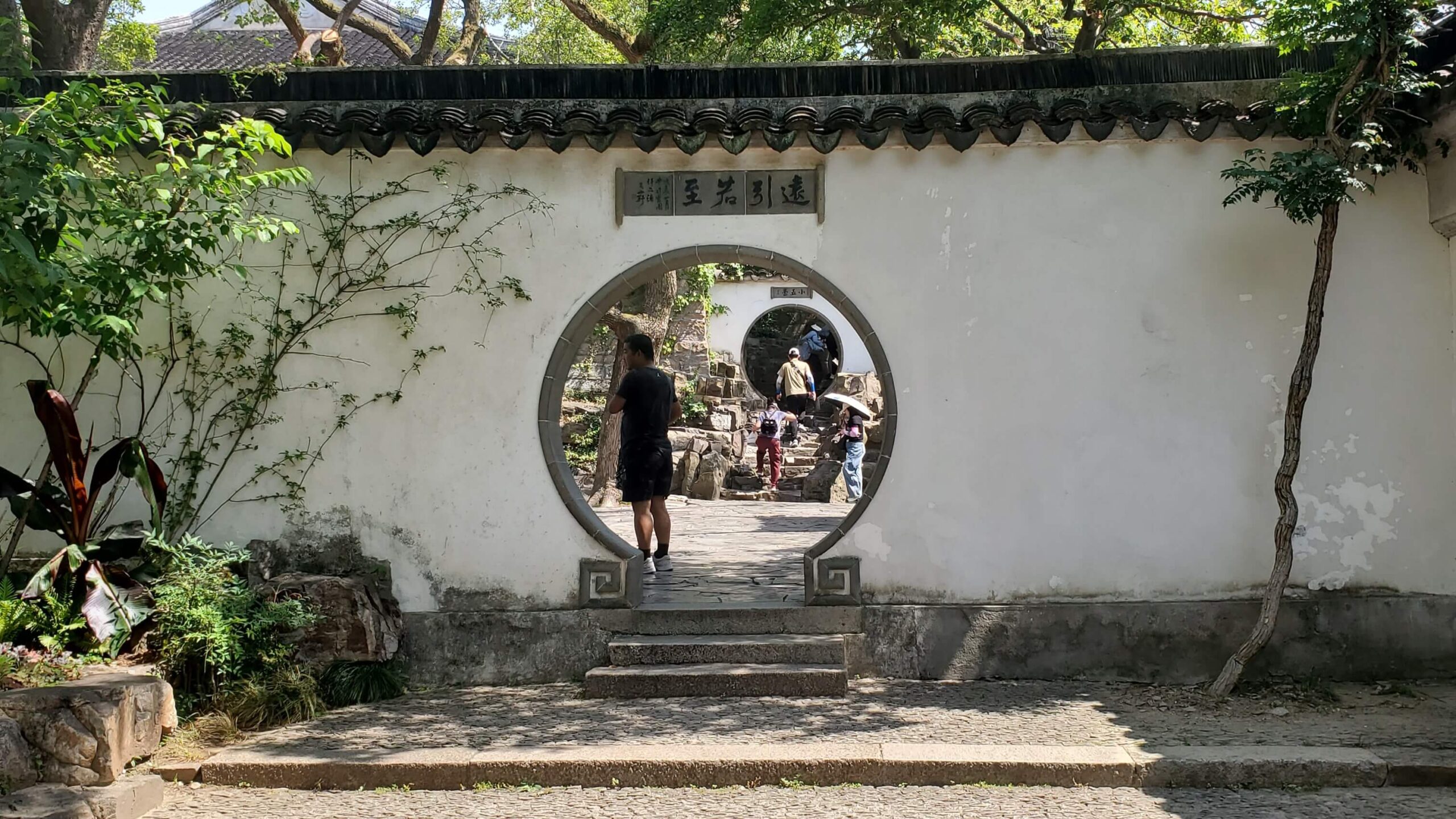
And time after time, we come across those iconic circular “moon gates,” framing the path like portals to another world. Already, I feel I’ve gotten my money’s worth — and this is just the beginning of our Tiger Hill adventure!
The Leaning Pagoda of Tiger Hill in Suzhou
The paths gradually lead uphill to the main attraction: the Tiger Hill Pagoda, also known as the Yunyan Pagoda, which has stood here for over a thousand years.
You can’t go inside — perhaps because the structure leans slightly (hence its nickname, the Leaning Pagoda), or maybe simply because pagodas aren’t typically meant to be entered. Traditionally, they’re built to house sacred relics, not for foot traffic. Still, you can walk around it and admire the intricate stonework of this octagonal tower. Each of its seven stories is separated by a carved stone belt and dotted with small, arched windows — details that reveal the craftsmanship of another time.
The Serene Bamboo Grow of Tiger Hill scenic area
We take one of the trails leading down from Tiger Hill and soon find ourselves in the most peaceful bamboo grove. On both sides of the winding, fenced path, tall bamboo stalks rise up — some leaning gently, as if reaching across to embrace their neighbors. Their green leaves filter the sunlight into a soft, dreamlike glow, and the ground below is carpeted with dry, rustling brown leaves.
It’s so still here, I can hear my own breath — and I love it. This might be my favorite part of the entire Tiger Hill Scenic Area in Suzhou. But there is more to explore, so let’s hold the judgement!
Buddhas and Wishes in Tiger Hill Scenic Area
After wandering through Tiger Hill’s labyrinth of winding paths for some time, I start to feel a bit disoriented. So let’s return to the leaning pagoda to reorient, then set off in the opposite direction from the bamboo grove.
This leads to another cluster of buildings — and near the entrance of one, you can spot a stand overflowing with hundreds upon hundreds of red ribbons. I believe they’re wishes.
What many foreign visitors, myself included, might not realize is that this part of Tiger Hill once housed the influential Yunyan Temple, a major Buddhist site. Though the original temple is long gone, subtle traces and references to it remain scattered throughout the area. Now that I know it all makes sense!
Inside the building, we find a serene prayer hall with a golden statue at its center, an altar in front of it, and rows of Buddha figures in various colors and expressions lining the wall. It’s quiet, calm, and deeply atmospheric.
But the Tiger hill in Suzhou just keeps giving! A nearby sign points toward a potted garden.
Living artworks of Suzhou Tiger Hills Bonsai Garden
Bonsai trees are one of the most fascinating forms of living art. They’re the same species as the full-sized trees we see every day, but carefully cultivated and shaped over time into miniature, often dramatic, versions of their natural selves.
At Tiger Hill in Suzhou, there’s an entire area dedicated to showcasing these beautiful creations. Some bonsai are planted between rocks, forming tiny landscapes that look like mountain valleys or dense forests in miniature. Others lean and twist downward in elegant shapes, while some simply sit there — lush, balanced, and perfectly shaped.
It’s a peaceful, playful part of the Tiger hill in Suzhou, and it’s surprisingly fun to wander through the garden in search of your favorite bonsai tree.
Tiger Hills Pools Are Shrouded in Legends
Lastly, we come to an area where pools of milky-blue water lie quietly between rocky ground and towering cliff walls — each one steeped in legend. The most famous of them, the one that draws visitors from across China, is the Sword Pool.
According to legend, King Helü — a powerful ruler and warrior — was buried beneath this pool, along with 3,000 precious swords. Over the centuries, many emperors and treasure hunters have tried to find his tomb, but none have succeeded.
Maybe that’s because King Helüs son ordered all the workers who built it to be killed on a nearby stone, to protect the secret of the tomb’s location. Their blood stained the rock so deeply that even today, when it rains, it’s said to turn a deep, haunting red.
Pretty horrific story to end our Suzhou Tiger Hill adventure, if you ask me! But the rest of it has been nothing but peaceful.
Thoughts?
If you want to feel at peace come to Tiger hill scenic area in Suzhou. Or if you have the spirit of a wanderer – also come to Suzhou’s Tiger hill. It is truly a very interesting area full of the things I as a foreigner tourist associate with China and much more.
Up and down, up and down we wander the colorful streets of Stockholm’s Old Town — chasing legends, chasing stories. Gamla Stan has stood here since the 13th century, and over the centuries it has collected layer upon layer of strange details, mysterious symbols, and tales that blur the line between history and myth. You’ll find cannonballs stuck in the walls, rune stones telling stories from the Viking Age, and stones that hold ghost stories born from real events — all hidden in plain sight.
And the best part? You can easily explore Stockholm Old Town on a self guided walk. I’ll just share a few clues and highlights of what to see in Stockholm Old Town — so you’ll know what to watch for as you follow the trail of legends.
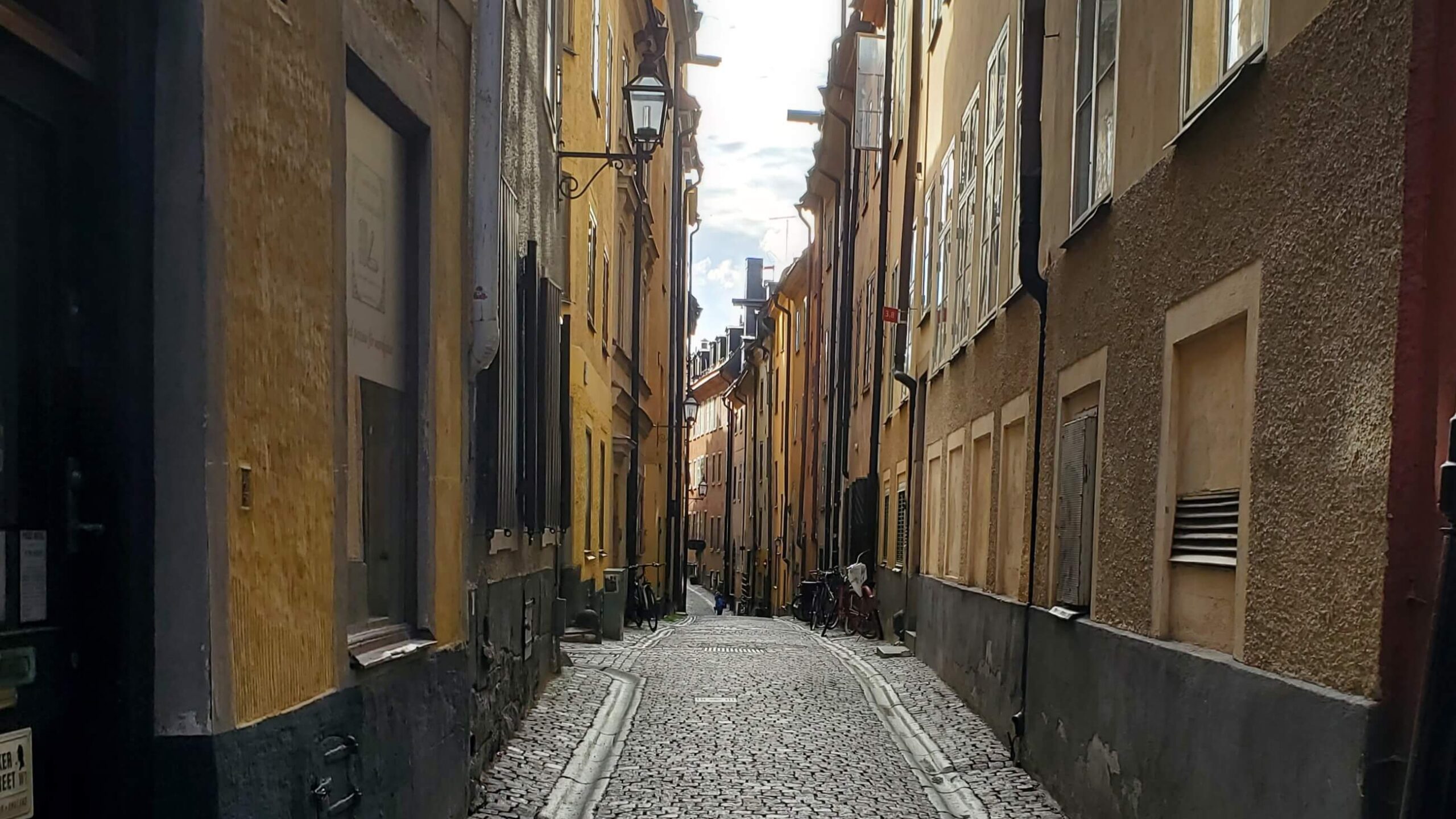
Since the main attractions in Stockholm Old Town tend to get crowded, it’s best to ease into your Stockholm self guided itinerary by wandering the quieter, cobblestone backstreets. These charming alleys wind between mustard yellow, pastel yellow, and pale peachy houses that look like they’ve soaked up centuries of sunlight — and now radiate it back with a gentle, golden warmth.
Despite countless fires and rebuilds, Stockholm Old Town still follows its original medieval layout: a tight maze of narrow lanes and densely packed buildings leaning into each other like old friends.
It’s easy to imagine stepping back in time… but be careful. Go too far back, and you’d find yourself in an era when Gamla Stan was an overcrowded slum, with raw sewage running down the streets and little of the charm we see today. So let’s stay in the present — where everything is picture-perfect.
Now that we’ve savored the quiet early morning charm, it’s time to seek out some of the most well-known attractions in Stockholm Old Town. Wondering how to find them on your Stockholm self guided tour through Gamla Stan? It’s simple —look for places where crowds of people are gathering.
Story of the Boy Watching the Moon in Stockholm Old Town
In a quiet courtyard of Stockholm old town, surrounded by curious tourists, you’ll find a tiny statue of a little boy sitting on a small bench, hugging his knees. In front of him lies a scattered collection of coins, offerings from passersby — but the little iron boy doesn’t seem to notice. He’s deep in thought, lost in his own quiet world.
This is Järnpojken, and at just 15 centimeters tall, he’s officially the smallest public monument in Stockholm.
Legend of the Järnpojken statue in Stockholm Old Town
They say if you pat the boy’s head three times and make a wish, it will come true within a year. Or… you’ll return to Stockholm. No one can quite agree on which one the legend promises — but really, it sounds like a win-win situation.*
Next, our Stockholm Old Town Self guided walk takes us to the bustling heart of the Gamla Stan, which also happens to be an epicenter of various legends and tales
I’m always amazed how the most beautiful places can carry the most horrific stories — ones most visitors have no idea they’re standing on. Following the steady stream of people, we arrive at what might just be the most picturesque square in Stockholm’s Old Town.
It’s framed by rows of colorful houses, the stately Nobel Prize Museum, and — right in the center — a dark stone fountain crowned with a cup. The stone is worn, scarred, and stained by centuries, and yet water still flows from the mouths of the carved stone monsters, as if time hasn’t dared to stop it.
Legend of the fountain
Turns out distances in Stockholm Old Town used to be measured from this old well. So you could say it is the very heart of the Gamla stan.*
White Stones That Remember: Haunting Tales of Stockholm’s Old Town
Now take a look at the brightly colored buildings surrounding the square. There’s a green one with a slight curve at the top, a red one shaped a bit like a multi-tiered cake, a narrow orange one, and a sunny yellow house. Beautiful, right? Almost like a cheerful little rainbow framing the square.
But don’t let the charm fool you — that red building, the one decorated with white stones and twisted iron ornaments, tells a horror story.
In 1520, this very square ran as red as the building itself. After luring Swedish nobles to a fake peace banquet, Christian II of Denmark turned on them — executing more than 80 people right here. The massacre became known as the Stockholm Bloodbath.
Legend of the white stones of Schantzka huset.
Years later, a man named John E. Schantz rebuilt the red house and chose to commemorate the horror. He added a white stone to the facade for every soul lost during the executions.
Legend says that as long as all the stones remain in place, the spirits will rest. But if even one is removed… the ghost it represents will rise — and haunt the streets of Stockholm Old Town forever.*
How Did a Cannonball Stuck in a Wall in Stockholm Old Town?
So far, you’ve been doing great on this Stockholm Old Town treasure hunt — but here’s your next challenge. Somewhere in Stortorget, there’s a cannonball stuck in a wall. Can you find it?
Legend of the cannon ball in the wall in the corner between Stortorget and Skomakargatan
Legend has it, the cannonball was fired during the Stockholm Siege and it’s been lodged in the wall ever since.
However, a more likely story is that the cannonball was placed there later to commemorate the event — a dramatic little historical prop. Then, a jealous neighbor decided, “If they can have one cannonball in their wall, why not a few more in mine?” and added three balls to the facade of his house as well.*
Now, let’s continue our self-guided journey through the streets of Stockholm Old Town to discover something even older than the medieval rivalries.
Rune Stone Mystery: Tracing Viking Legends in Stockholm Old Town
You spot a group of curious tourists staring at the facade of an otherwise ordinary building. What are they looking at?
There — set right into the wall — is a large stone, carved with what looks like a twisting bundle of snakes and some ancient script you can’t begin to decode. It’s a rune stone, a real relic from the Viking Age, quietly whispering a story that’s lasted for a thousand years.
What does it say? Most runestones were made to commemorate the dead—something like a Viking-era gravestone. This one, it turns out, was raised by Torsten and Frögunn in memory of their son. Which only makes it stranger: what is this thousand-year-old rune stone doing embedded in a wall in Stockholm Old Town?
The Legend of the Rune Stone in Stockholm Old Town
The most accepted explanation for how a rune stone — older than Stockholm itself — ended up in a wall is surprisingly mundane: it was simply reused as building material. Back in medieval times, people weren’t too concerned with preserving ancient relics. A stone was just a stone, and if it was big, solid, and conveniently nearby, it might just become part of a wall.*
Although not as magical as one might hope, the legend of the rune stone in Stockholm Old Town is still quietly intriguing. But now, let’s keep tracing those medieval footsteps — they’re about to lead us from ancient tales into more recent times.
Walking Where Merchants and Craftsmen Used to Walk: Västerlånggatan
What is now Stockholm Old Town’s prime tourist-shopping street has seen its fair share of ups and downs. It began as a simple path just outside the medieval city walls, eventually filling with blacksmiths and other craftsmen who were required to stay outside the city center due to fire hazards. Over time, it rose to prominence as the city’s main commercial street — bustling with trade and drawing in influential merchants.
Then came a decline, as modernization swept through Stockholm and large department stores shifted the city’s commercial heart elsewhere. But in the 20th century, the street found new life — and a new role as the colorful, shop-lined tourist destination we see today.
Today, the street is draped in flags and signs, each one pointing to a little shop or a lively restaurant. Between them, the cobbled path buzzes with people window shopping and soaking in the charm. Peek into any souvenir store and you’ll spot shelves packed with cheerful little trinkets — painted wooden horses, mugs, Christmas baubles, and toys of every kind.The prices are steep, but it is still fun to look around even if you don’t buy anything.
No legends to be found here, I’m afraid. So let’s move on as the next (and the last) attraction of Stockholm Old Town is in an arms reach.
Squeezing Through History on Stockholm Old Town’s Slimmest Street
There are many charming little lanes in Stockholm Old Town, but none capture people’s imagination quite like the narrowest one. At its tightest point, Mårten Trotzigs Gränd squeezes down to just 90 centimeters wide. With stairs leading upward, it feels less like a street and more like a secret passage — yet somehow, there are still lanterns tucked in, making it surprisingly picturesque.
It’s easy to imagine medieval townsfolk hurrying through here after dark, every footstep echoing, every creak in the shadows setting their nerves on edge.
And to add to the mystery? In the 19th century, this narrow gap in the city was closed off for years… and no one knows exactly why.
That’s the end of our Stockholm Old Town self guided itinerary.But if you’re getting hungry, just around the corner you’ll find Stockholm’s Viking restaurant — where you can feast by candlelight in true Norse style. You can find more about that in my full Stockholm trip itinerary!
Thoughts? Although I enjoy guided walking tours, traveling to Stockholm isn’t cheap, so it is always good to have a DIY option. Stockholms Old Town is gorgeous. But knowing the legends behind the various mysterious details of Gamla stan is what makes the self guided Stockholm Old Town walk so fascinating. So I hope this guide saved you some extra Googling.
*Please note these are all legends traveling through the internet, so they may or may not be true. Take it all in good fun and not as facts.
Looking for a place to soothe a restless mind or an aching heart? Ķemeri Sanatorium was once Latvia’s most prestigious rehabilitation center. Alongside mud baths and sulfur water, a key part of the healing process was believed to be quiet walks through the scenic Ķemeri Resort Park.
I am not a doctor and can’t speak for the science of healing—but from the experience I do know that a peaceful walk in a beautiful place can calm an overwhelmed mind and ease a heavy soul. Though the Ķemeri sanatorium has long since closed its doors, the park has been lovingly restored and is just as tranquil as ever.
So come—take a leisurely stroll with me through Ķemeri Resort Park. And while we’re here, let’s climb the old Ķemeri water tower as well.
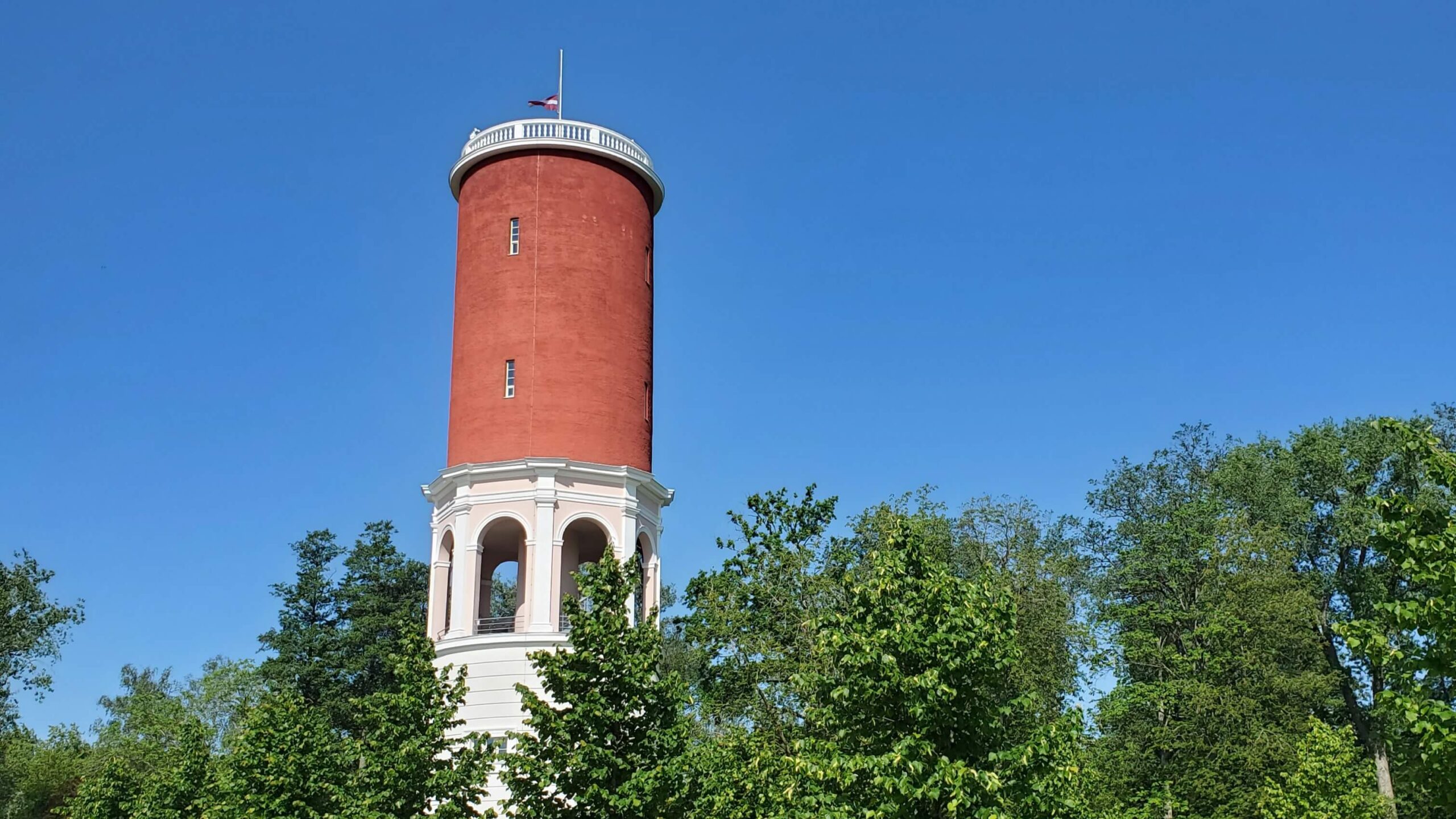
The silhouette of the Ķemeri Water Tower is hard to miss—you can spot it from a distance, rising above the treetops like a curious architectural puzzle. It almost looks as if it was sticked together from three different towers: a white, textured base; a pastel pink middle adorned with white trim that reminds me of a layer of wedding cake; and a tall, red cylindrical top, crowned by the Latvian flag fluttering proudly in the wind.
But before you decide to head to Ķemeri Water Tower, a word of warning: spontaneity won’t work here. Due to the limited capacity of the rooftop viewing platform, advance reservations by phone are mandatory. You can’t just swing by on a whim.
And another fair warning—this climb isn’t for the faint of heart. The stairs of the Ķemeri Water Tower are narrow and steep, the steps small, and to reach the rooftop, you’ll need to climb through a hatch. Unfortunately, this means the tower isn’t accessible to everyone.
But if you are up for a climb…
What’s Inside the Belly of the Ķemeri Water Tower?
Your visit begins with a small exhibit on the tower’s history and notable figures from the area. Then you’ll head to the first observation deck, offering panoramic views of the surrounding Ķemeri Resort Park.
From there, you can make your way to the fourth floor of Ķemeri Water Tower. Here, you might have to wait a bit before going up to the rooftop—only five people are allowed at the top observation deck of the Ķemeri Water Tower at a time, which is why reservations are needed.
The good news? You won’t be bored while waiting. This floor features some interactive displays. You can take a playful photo with a lady enjoying a mud bath (or choose from three other historic photo backdrops), and enjoy a ballad while seated in the musical chair.
Or you can take a closer look at the industrial interior and photographs lining the walls tell the story of how the park once looked—back at the days when ladies still strolled beneath parasols.
How Are the Views From the Top of Ķemeri Water Tower?
Once you’ve overcome your fears and climbed the narrow metal staircases, you’re rewarded with an open-air panorama from the top of the Ķemeri Water Tower.
Take a deep breath—and look around.
To one side, the quiet ruins of old sanatorium buildings sit half-hidden among the trees, slowly being reclaimed by nature.
To the other, a vast sea of treetops stretches all the way to the horizon. And nestled in between lies the restored Ķemeri Sanatorium Park, with many paths winding through the greenery.
“But where’s the real sea?” you might wonder.
Maybe it’s too far to see… or maybe not. If you look closely (or try one of the free binoculars), you might catch a faint, bluish line just above the horizon—slightly different from the sky. Maybe it’s the sea. Or maybe it’s just a trick of the light.
Stroll Through Ķemeri Resort Park
Between the woods and wide-open lawns—now, in early summer, dotted with hundreds of tiny white flowers—a peaceful network of winding paths stretches out before you. These trails are linked by picturesque bridges arching over the Veršupīte River, each one inviting you to slow down and take in the view.
This time of year, Ķemeri Resort Park feels especially romantic—perfect for a leisurely walk.
So, where shall we go first?
The Pavilion on Love Island of Ķemeri Resort Park
First, let’s head over to Love Island, tucked away in a quiet corner of Ķemeri Resort Park. Sitting pretty on the island is a dainty white pavilion where guests used to sip tea and coffee while listening to the radio.
These days, it looks like they are selling ice cream there instead. How cute!
The whole scene is delightfully charming—especially with the metallic bird sculptures near the front, where couples have hung love locks, to make their love eternal.
Hotel Ķemeri
Next, head over to the old building of Hotel Ķemeri, which in its golden days was one of Latvia’s most prestigious establishments. The rich, influential, and famous once stayed here.
Today, the hotel stands silent and empty, leaving visitors to wonder what secrets its walls might hold inside. From the outside, however, it still looks like a white castle—adorned with grand columns, arched windows, and delicate little balconies.
In front, a vast garden stretches out, where grass, trimmed bushes, and winding pathways form neat geometric patterns, quietly holding onto the elegance of a bygone era.
The Sulfur Spring of Ķemeri Resort Park
Our last stop in Ķemeri Resort Park is the sulfur spring known as the Little Lizard. You’ll find it by following your nose—because, well, the smell kind of leads the way!
From the mouth of this little stone reptile flows dark, sulfurous water. But your attention might quickly shift to the white canopy behind it. Beneath the glass dome sits what looks like a well, where dark water bubbles and foams together, creating a kind of witchy soup.
Can someone explain what I’m looking at? Because honestly, I’m not quite sure!
I can see there are more trails stretching out through Ķemeri Resort Park—if you have some extra time, you could easily explore a few more. But since I need to head to my next destination for the day, I’m sorry to say I have to end my adventure here.
That said, if what I’ve shared about Ķemeri Resort Park has sparked your curiosity, why not come and wander these paths yourself? There’s plenty here to discover.
Thoughts?
Since Ķemeri is only about 50 km from Riga city center, Ķemeri Resort Park makes a perfect spot for a leisurely weekend day trip. Just be sure to book the Ķemeri Water Tower in advance—it’s the highlight of the visit.
And if you want to extend your adventure, the area is full of nearby attractions: the Kaņieris Reed Trail, Sloka Lake Trail, and the mysterious Witches’ Swamp are all close by.
Looking for a peaceful road trip in Lithuania with a generous dose of nature and charm? Biržai might just surprise you. While it’s not home to the Seven Wonders of the World, it is full of hidden gems—like a moon-shaped observation tower, mysterious legends about karst sinkholes, and the longest wooden bridge in the country. And the best part – you can easily explore all of this in just one relaxed day.
So let’s go find out what to see in Biržai, Lithuania!
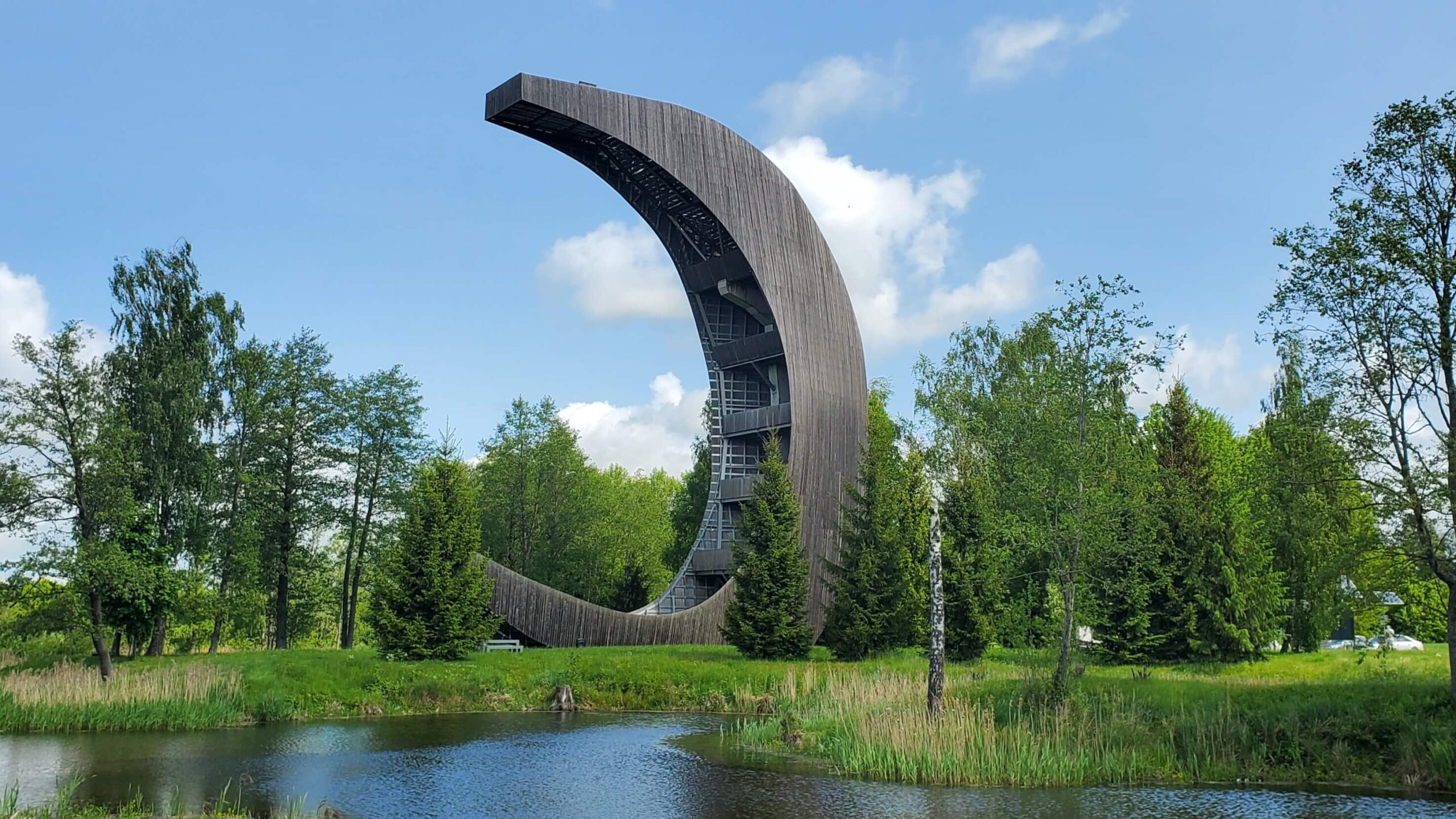
The moon-shaped observation tower in Biržai is truly iconic—but the real question is: will the view from it be as impressive as the view of it?
You can spot one end of the “moon” peeking through the trees right from the parking lot. But as you get closer, you’ll notice a small observation platform on the lower arc of Kirkilai Tower as well. It’s perfect for those who are a little nervous about heights—just enough of a climb to get a taste of the view.
Once we reach the top, it becomes clear: you can actually feel the tower gently swaying in the wind. A little unnerving? Maybe. But the view more than makes up for it. Spread out before you is a winding lake, curving and twisting like a ribbon, dotted with tiny reed-covered islands.
It’s a tough competition—Biržai’s observation tower versus the view from it. And honestly? I don’t think we’ve given Kirkilai Tower a fair shot to show off its unique shape. These kinds of structures are best appreciated from a distance. So let’s take a short stroll across the wooden walkway that crosses the lake and take another look.
The walk is short—just a gentle bend through nature—but all around is pure summer tranquility. The dark, still water mirrors the sky, creating a peaceful, dreamlike scene. And yes, from here, the Kirkilai Tower looks absolutely stunning—perfectly framed by the surrounding landscape.
Now, let’s jump back in the car and head towards the next attraction in Biržai – a large pit. What?
It may sound a bit unusual, but one of the most popular answers to what to see in Biržai is… large pits. But these aren’t just ordinary pits—they have a backstory! They are karst sinkholes!
So, what exactly is a karst sinkhole? It forms when water slowly dissolves the soft layers of minerals beneath the ground, creating hidden underground voids. Over time, the surface above collapses into these empty spaces, forming dramatic, crater-like sinkholes. You can see many of them near Biržai—it’s estimated that the region is home to over 9,000 of them!
You spot the first pits—I mean, sinkholes—right as you enter the area, marked by large rocks. The ground here is… well, a bit wavy and uneven.
As you walk further in, you’ll come across some larger sinkholes, like Ieva’s Pit (Ievos Dobe). One of them even has tall trees growing at the bottom, which tells you just how long these sinkholes have been part of the Biržai landscape.
I think the pits are pitting. But our main goal today is to check out the largest sinkhole you can see near Biržai—the legendary Cow’s Cave.
Imagine you’re herding cows one day, and suddenly the ground opens up and swallows one of them whole! Sounds like something out of an apocalyptic movie, right? But that’s actually the legend behind Cow’s Cave near Biržai.
This famous Biržai sinkhole is around 12.6 meters deep, and you can climb down into it. A set of stairs leads into the pit, giving you a chance to see it from the inside. The walls are lined with creeping plants, and you’ll spot small rock outcrops along the way.
Just behind the sinkhole, you’ll find a stone sculpture of a cow—an homage to the tale that gave the cave its name.
But now… my stomach’s starting to grumble. Time to head back to Biržai city and track down a good spot for lunch.
Today, I’m craving an oven-baked Italian pizza. Paupio Pizzeria has just the right vibe—cozy fairy lights twinkle inside, and if you’re sitting on the small terrace, you can bundle up in warm blankets. But the best part is the staff’s kind and attentive service, which makes the whole experience feel extra welcoming.
After enjoying a delicious pizza and a refreshing glass of Lithuanian kvass, it is time to check out some more tourist attractions in Birzai.
We park in the lot by Biržai Castle and are greeted by two dancing fountains, inviting us to take a peaceful walk by the lake before exploring Biržai castle’s exterior. The trail looks truly serene—let’s go!
As we stroll along the lakeside in Biržai, time after time a water bird glides by, but they’re the only busy creatures around. The rest of the scene is perfectly calm. After a while, a brick church comes into view, followed by a charming bridge.
Crossing the bridge, it might seem like the trail ends, as you suddenly find yourself in a quiet suburban neighborhood. But having done our research before putting together our Biržai trip itinerary, I know there’s another Biržai attraction just ahead, waiting to be discovered.
Can you believe that the enormous lake we’ve been walking alongside in Biržai is actually artificial? It’s the oldest artificial lake in Lithuania, shaping the landscape since the 16th century.
Stretching across the lake is a perfectly straight, very long wooden bridge—the longest wooden bridge in Lithuania! Another record. It’s so long that benches have been placed in the middle, inviting you to sit, rest, and soak in the beautiful surroundings.
At the other end, a ghostly silhouette of a manor with a small tower peeks through the trees. When we reach Astravas Manor, it’s clear the building is longing for renovation. But did you know that after serving as a residence, this property was repurposed to house factories? At one time, it operated as a milk factory, and at another, it became a linen factory.
Guarding the doors of Astravas Manor are two playful lion statues. They’re clearly beloved by photographers. But here’s a fun fact—they aren’t the originals. These lions are stunt doubles; the original bronze statues now live safely in a museum.
If we wanted to walk all the way around the lake to return to Biržai, it would take us the entire day. So this time, I think the best call is to turn around and head back the way we came. But before heading home there is one more tourist attraction to see in Birzai.
The facade of Biržai Castle is simple—no lacework or towering spires. Yet in history books, it holds a prominent place as an important fortress that’s been destroyed and rebuilt a couple times. To me, the most memorable feature of the Biržai Castle exterior is the colonnade, which reminds me of Italy a bit.
Inside the castle, there’s also a museum you can visit. However, at this hour, it’s already closed. So if you want to see it, you might need to do your Biržai itinerary in reverse!
Before we leave, take a moment to admire the intriguing entrance gate and the cannons pointing out from the the fortress walls. And with that, our Biržai day trip comes to an end.
Thoughts? This Biržai trip itinerary takes advantage of the simple pleasures of hiking in nature. You won’t find anything groundbreaking here, but it is perfect for a leisurely Saturday walk with friends. And it is very close to the Latvian border, so Biržai is a very easy day trip for Latvians like me.
I wanted to go to China to experience a world completely different from the one I live in, so I planned a 2 week China travel itinerary. But within the first few days of my China trip, I realized—it wasn’t at all what I expected. My idea of China was likely shaped by outdated information from over a decade ago, but this country is evolving fast, racing toward the future.
And yet, in China, the ancient and the futuristic coexist seamlessly. One moment, you’re admiring the intricate architecture of the former imperial palace, decoding centuries-old symbols, or listening to the beat of a traditional drum once used to tell time from a drum tower. A few metro stops later, you’re watching robots at work or speeding across the country on a train going 300 km/h.
And in between it all is everyday life: buzzing intersections filled with electric scooters, the scent of soup dumplings wafting from tiny corner shops, and quiet canal-side parks where locals dance and sing karaoke under the open sky. China is intriguing, impressive, and at times, puzzling. If you’re looking for adventure, plan a China trip.
To help you with that – here is my two-week China itinerary—packed with unexpected discoveries and sensory overloads.
First Part of My 2 Week China Travel Itinerary – Beijing
Day 1 of My China Trip: Arrival In a Different World
On the first day of our China travel itinerary, the only real goal is to arrive, get settled, and win the battle with jetlag. No need to rush into sightseeing just yet—we’ll dive into the adventure tomorrow.
Itinerary:
1. Arrival & Immigration
2. Check into your hotel
First lesson of the China trip
Everything is cuter with cat ears. Seriously. My hotel had robots delivering food to rooms and even a robot vacuum that was designed to look like a cat. Isn’t it adorable?
3. Try hotpot for dinner
Trying hot pot during your China trip isn’t just about filling your tummy—it’s an experience. You cook your own food right at the table, dipping ingredients into a big pot of spicy, flavorful broth. Decoding the menu can be part of the adventure, with items you may never have encountered before. Ever tried water lilies? Or a cow’s stomach? This is your moment to be bold.
4. Get some snacks in Chinese convenience store
Japan is famous for its convenience stores, but China’s have some pretty cool snacks too—definitely worth a stop during your China trip. I wasn’t quite brave enough to try the chicken feet, but I did go for the spicy konjac strips. They kind of look like worms, but (hopefully) aren’t.
And then it is time to rest & recharge.
Day 2 of My China Travel Itinerary: Life in Hutongs
On this day of our China travel itinerary, we’ll get a feel for what life in Beijing is really like—both now and in the past. From historic neighborhoods to local street food.
Second lesson of our China trip
Breakfast in China is nothing like back home.
A typical breakfast often starts with a steaming bowl of noodle soup, with everyone mixing and matching their own toppings. This seemed to be a staple at every hotel buffet we visited during our 2 week China trip, and it was always freshly made. Don’t knock it until you try it—once you figure out your ideal combo of toppings, it’s seriously delicious and surprisingly filling.
Today’s itinerary:
1. Guided tour through Hutongs (old neighbourhoods)
With a knowledgeable guide, you’ll gain a deeper understanding of how these traditional homes—often marked by beautiful, ornate entry gates—have evolved over time. Once the residences of military officials and scholars close to the emperor, many hutongs now offer shared, low-cost housing to “floaters”—people who’ve come to Beijing from other parts of China in search of work and opportunity.
2. Beijing Drum tower
Chinese name for navigation: 北京鼓樓
In Europe, we used church bells to tell time. In China, they had bell towers and drum towers—and their own unique timekeeping system. If you want to learn more about it, head to the Drum Tower. At certain times of day, you can even catch a lively, high-energy drum performance that brings the history to life.
Or, if you’re just here for the views, it’s still worth adding to your China trip itinerary for the beautiful architecture and panoramic look over Beijing.
The calm lake, shaded by old trees, was one of the stops on the guided tour we took. But just beyond the peaceful water, the surrounding streets are full of snack shops and street food stalls. Think meat on a stick, sizzling stinky tofu, even stinkier durians, warm meat-filled buns, and—of course—plenty of matcha-flavored ice cream. China is definitely a snack lover’s paradise.
No. Well it was, but not anymore. If, during your China trip, you’re interested in trying virtual reality that goes beyond just 3D glasses, SoReal Blast Furnace is the place to go. This experience combines animated visuals with full-body motion: 360-degree flip chairs, mechanical horses, and harnesses that simulate parachuting. If that sounds like your kind of fun, add SoReal Blast Furnace to your China travel itinerary.
5. Snack dinner at Shichahai
Same place again? Yep—but at night, Shichahai transforms completely. What was a tranquil lakeside retreat by day turns into a buzzing nightlife hub after dark. Neon lights reflect on the water, live performances spill out from almost every bar, and the whole area hums with energy. The food stalls? Still open, still busy, and still totally worth a visit.
The first full day of our China travel itinerary was pretty great, wasn’t it? But tomorrow let’s switch it up with exploring the futuristic side of Beijing.
Day 3 of My China Trip: Modern Beijing
Most people visit Beijing for its rich culture and deep history—but if you’re curious about China’s high-tech side, you can catch a glimpse of it here too… in a museum.
Today’s itinerary:
1. China Science and technology museum
The first few exhibits are definitely geared toward kids, so you can skip those if you’re not traveling with little ones. What I came for were the robots, 5G innovations, and space tech. You can listen to a robot play the harp or check out a slightly creepy humanoid doll that scans your face and mimics your expressions in real time.
With exhibitions spread across multiple floors, the China Science and Technology Museum offers hours of interactive exploration.
2. Chinese dumplings for a late lunch
Another must-try food during your China trip is dumplings. For some of the tastiest, juiciest ones with a wide range of fillings, head to Xi’an Lao Man restaurant. One of the best parts of eating here is mixing your own dipping sauce from a spread of condiments—soy sauce, vinegar, garlic, and chili oil.
3. Olympic park
Chinese name to put in navigation: 奥林匹克公园
The futuristic architecture of Beijing’s Olympic Park truly shines at night—literally. Once the sun sets, the unusual buildings light up, transforming the whole area into something that feels straight out of a sci-fi movie. From the giant tower that looks like a cluster of glowing mushrooms to the bubble-covered Aquatic Center, it’s a surreal and fun spot for an evening stroll.
4. Dinner at a local restaurant
In China, finding a good spot for dinner is surprisingly easy. There’s a popular local saying: “If you see people queuing, join the queue—they’re probably serving something good!” Just look around for a place bustling with people—it’s usually a reliable sign that the food is worth trying. Or do as we did and use the Food feature in Amap to check which place nearby has the highest rating.
After a satisfying meal, it’s time to rest and recharge. Tomorrow’s itinerary promises lots of walking and a deep dive into China’s rich, fascinating history.
Day 4 of My China Trip Itinerary: Tracing Beijing’s Imperial History
On this day of our China itinerary it is time to decode the secret meanings hidden in the beautiful detail work of some of the buildings telling stories about China’s imperial past.
Itinerary:
1. A guided tour through Forbidden city
If you’re planning to explore this part of Beijing on your China trip, I highly recommend going with a guide. The Forbidden City is enormous, and without someone to explain it all, I would’ve definitely gotten lost in the maze of gates, halls, and courtyards. Everything kind of looks the same… but somehow also doesn’t.
Here everything from the colour of roof tiles to the knobs on the doors have deeper meaning. And the detailed work is just stunning!
2. Temple of Heaven (if you still have the stamina)
Chinese name to put in navigation: 天坛
If you’re up for continuing your deep dive into imperial history, head to the Temple of Heaven—the place where Chinese emperors once prayed for good harvests. The architecture is iconic.
But be prepared – visiting both the Forbidden city and the temple in one day is quite ambitious. I did it, but I was wiped afterwards.
Next fun lesson from my China trip
Looks like in China photography is important. At places like the Temple of Heaven, you’ll see beautiful women dressed in stunning traditional outfits, striking elegant poses like pros. The outfits they’re wearing are called Hanfu—traditional clothing that was worn by the Han Chinese (the ethnic group that makes up the majority of the population) for thousands of years. Now, this style of clothing is enjoying a revival.
3. Dinner in a Chinese restaurant
For dinner, I had a massive bowl of wide, thick noodles drenched in chili oil, topped with tender meat and mystery veggies I couldn’t name—but they were delicious. The bowl was bigger than my head, and I’d absolutely recommend you try it.
Day 5 of My China Travel: Fulfilling The Dream of Visiting The Great Wall of China
Stepping onto the Great Wall of China is definitely a bucket list moment. There’s just something about it—the scale, the history, the views—that makes you feel incredibly lucky to be able to experience it during your China trip.
Itinerary:
1. West route of Mutianyu Great wall
The view of the wall winding between the mountains that are fading into the misty distance is absolutely breathtaking. But will you have the strength to climb the highest watchtower in this section? They say it’s around 450 steps with an 80-degree incline to reach Watchtower 20.
2. East route of Mutianyu great wall
It’s still the same Great Wall, but this side has a different vibe. I think it’s the shape of the towers! The real highlight here, though, is the chance to ride down on a toboggan.
With that, the first part of our China travel itinerary comes to an end. It’s time to have a dinner and say goodbye to the orderly, historic charm of Beijing and get ready for the next chapter—Shanghai. A city that’s fast-paced, a little chaotic, and full of surprises.
But if your interested in more detail on each of Beijing attractions check out my full travel story
Second Part of My 2 Week China Travel Itinerary – Shanghai and Its Surrounding Cities
Day 6 of Visiting China: Travel in High Speed Train
This day of my China travel itinerary is mostly about getting from one city to another—but when you’re traveling on a high-speed train for the first time, even the journey itself becomes an adventure. And I still managed to squeeze in a little sightseeing at the end.
Itinerary:
1. Stop at convenience store to get some snacks for the road
How about a green tea sponge cake? Yum!
2.Take a bullet train from Beijing to Shanghai
Ever ridden a train that goes 300 km/h? The distance from Beijing to Shanghai is around 1,200 km, but with the right train, it takes under 5 hours. Even second-class seats are surprisingly spacious and comfy, with plenty of legroom.
Next fun fact from my China trip
China’s bullet trains are so smooth, you don’t even feel like you’re flying along at 300 km/h. That’s probably why they display the speed on a screen in each carriage—to remind you just how cool this is. And honestly? I was very impressed.
3. Check into the hotel
4. Nanjing road pedestrian street
Chinese name: 南京路步行街
Bright lights, big city! When the sun sets, this famous pedestrian shopping street in Shanghai glows in neon. It’s busy and buzzing with energy.
Pop into a tech shop, wander through a quirky toy store, or stumble upon crane game arcades hidden in basements. And yes—be ready for a few enthusiastic sellers offering you “Guchi” bags, but they will leave you alone if you will politely say no. It’s all part of the fun, chaotic vibe that makes this part of your China trip so memorable.
Then it is time to rest. But what’s next on our China travel itinerary? Well, we’ll explore Shanghai for a bit before heading over to a nearby town called Suzhou.
Day 7 of My China Travel Itinerary: Skyscrapers of Shanghai
Shanghai’s architecture is quite unique – and the city holds a few world records in the architecture department too. So today on our China trip, we’re diving into futuristic design, soaring heights, and a bit of techy fun.
Itinerary:
1. China 3D printing museum
Chinese name: 中國3D打印文化博物館
This one’s definitely a niche stop—you really need to be into 3D printing to go out of your way for it. But if that’s your thing, the museum features 3D-printed garments, bones, furniture, and miniature models of iconic Chinese landmarks that may just inspire your next printing project.
2. Shanghai tower mall
Not a must-see on your China travel itinerary, but if you’ve got some time to kill before heading up to the observatory, the Shanghai Tower mall is worth a wander. You’ll find ultra-sleek Chinese car showrooms that feel like bite-sized sci-fi exhibits—think doors that open with just a tap, voice-controlled massage chairs, and windows that tint at the press of a button. And this is 2025… I can’t even imagine what’s coming next. We also grabbed a quick lunch in the food court—solid option before going sky-high.
3. Shanghai Tower Observatory
Chinese name: 上海中心大厦
Time to ride the fastest elevator in the world and take in the view from the third-tallest building on Earth. From up here, Shanghai seems to stretch on forever. Some districts are perfectly organized, with copy-paste buildings lined up in neat geometric rows. Others look like a chaotic patchwork of shapes, colors, and styles.
4. Take a bullet train to Suzhou
5. Check into the hotel
Judging by the buildings glowing in colorful, dancing lights, Suzhou looks like a fun place to explore—and I can’t wait to see what tomorrow brings.
Day 8 of My China Trip: The Futuristic & Traditional Suzhou
Suzhou somehow manages to feel both futuristic and steeped in tradition. On this leg of our China trip, we got a little taste of both.
Itinerary:
1. Tiger hill scenic area
Chinese name to put in navigation: 虎丘山风景名胜区
While most people come here for the iconic stone pagoda perched on top of the hill, there’s so much more to explore. Think winding paths through bamboo groves, peaceful gardens, traditional architecture, Buddha statues, and bonsai trees shaped like little green sculptures. If you decide to add this stop to your China travel itinerary, I’m sure you’ll find something that speaks to you—and you’ll almost certainly find a sense of peace along the way.
This historic shopping street is likely one you’ll pass through on the way to the next attraction on our agenda. So grab a fun lemonade (I chose lichi-pamelo) and enjoy some window shopping.
I expected a quaint, historic area… and it is. But it’s also a buzzing shopping district, with souvenir shops, snack stalls, and costume rentals tucked between charming turquoise blue canals and historic houses.
4. Gate of Orient
Chinese name for navigation: 東方之門
You’ve probably seen this giant gate-shaped skyscraper from a distance, so now it’s time to get up close.
While you’re here, wander through the maze of Suzhou Mall—yes, it’s huge—and try to find your way to the tree-covered terraces. From there, you’ll hit the waterfront with peaceful lake views framed by high-rises on the other side.
5. SIP area by night
For navigation you can put in Suzhou Culture and Art Center 苏州文化艺术中心 (it’s the area around it):
When the sun goes down, the business district comes alive with lights. On a warm evening, you can wander past little fountains, neon strips glowing along the road, and trees dressed in twinkling lights. But the real showstopper? The Gate of the Orient and the surrounding skyscrapers across the lake—lit up in a mesmerizing display of dancing lights.
One day is definitely not enough to explore all of Suzhou. But we are on a tight schedule for this China trip, so, tomorrow we are heading to another city.
If you want to learn more about Suzhou – read my full travel story.
Day 9 of My China Travel Itinerary: The Peace by West Lake in Hangzhou
So far in our China trip, we’ve been on the go and busy—so today calls for a slower pace. And Hangzhou is perfect for that. West Lake is a synonym for peace.
Itinerary:
1. Morning train to Hangzhou
2. Former Residence of Hu Xueyan
Chinese name: 胡雪岩故居
In Beijing, we admired many historic buildings from the outside, but I was curious to see what’s inside. This museum offers a rare glimpse into the former home of a wealthy Qing Dynasty businessman. While most rooms—adorned with intricate wood carvings, lanterns, and stained glass windows—are mostly empty, the highlight is the beautiful traditional Chinese garden tucked within.
Next lesson of the China trip
How do you make riding the metro actually pleasant? Do it the Chinese way—show which cars are less crowded and post info on which ones are cooler or warmer, so people can choose the temperature they’re most comfy with. It’s the little things that make a big difference.
3. Westlake (by the former dancing fountains)
For navigation: 杭州西湖音樂噴泉
Calm waters dotted with lotus leaves and wooden boats drifting silently—West Lake is just as poetic as they say. It’s also a perfect spot for people-watching: locals are dancing in groups, singing outdoor karaoke, or feeding squirrels darting among the old trees lining the promenade.
4. Qianjiang New town light show from City balcony
For navigation: 杭州城市陽台
We’ve seen our fair share of nighttime illuminations on this China trip, but Hangzhou takes it to a whole new level. From Thursday to Sunday, at specific times in the evening, the skyline transforms into a coordinated display of flowers, animals, and dazzling colors. It’s not just a light show—it’s a spectacular experience that turns the entire city around you into a glowing masterpiece.
I hope your dreams will be as fun as the light show. Now rest and recharge!
Day 10 of My China Travel: Hangzhou Has Robots and Night Markets Too
Today, let’s continue to enjoy Hangzhou’s peaceful vibe, but also – I need to see more robots!
Itinerary:
1. Xiao He district
Chinese name: 小河直街
A picturesque historic district lined with cafes and little shops. It’s decorated with plants and paper ornaments, making it both Instagram-worthy and a great place for a stroll. There’s also plenty of green space around the canals, where you can spot locals practicing some ethereal Tai Chi movements.
2. Xiaoshan Robot experience center
Chinese name: 萧山机器人博展中心
More robots! This place features both industrial robots and fun ones—like a robot that can draw your portrait or play air hockey with you. The star of the show is definitely the slightly creepy humanoid robot. You can program it to perform different actions and even ask it to sing or recite movie quotes.
3. West lake causeway
Chinese name: 杭州西湖風景名勝區-斷橋
If you’re after another dose of peace, West Lake has you covered. It’s so big there are still many areas to explore. This part has a long, tree-lined walkway stretching across the water, perfect for a calm stroll while enjoying the greenery in the water and the view.
4. Wulin night market & snack dinner
Chinese name: 武林夜市
For a Westerner, a night market can be a wild experience. One table is selling raw chicken legs, and just two tables down, someone’s doing manicures. You’ll find all sorts of things—trinkets, snacks, jewelry, plants, and even tiny sea creatures. It’s a lot of fun to wander around.
I tried the duck meat on a skewer with some spicy seasoning—really tasty!
Day 11 of My China Trip Itinerary: Learning About Buddhism Near Hangzhou
Today, we’ll step outside the city to learn more about Buddhism by visiting a famous temple where locals come to pray, and a nearby cliff etched with ancient Buddhist carvings that date back over a thousand years.
Itinerary:
1. Feilai Feng Grottoes
Chinese name for navigation: 飞来峰
Tucked among cliffs and lush greenery are more than 300 Buddhist rock carvings. You’ll find everything from tiny Buddhas to towering figures, jolly statues to just two glowing eyes peeking out from the cave.
2. Lingyin Temple
Chinese name: 灵隐寺
From the sweet scent of incense drifting from giant burners, to the grand halls housing golden statues with altars of offerings in front of them, to exhibitions of artifacts—visiting this active temple offers a meaningful way to learn more about how Buddhism is practiced. Just remember to be respectful—this is still a place of worship for many.
It takes a bit of time to travel to and from the temple, so ending the day with a relaxed dinner and an early night is a good idea—especially since we’re heading back to bustling Shanghai tomorrow for the final leg of our China trip itinerary!
But if your interested in more detail on each of Hangzhou attractions check out my full travel story
Day 12 of Visiting China: The Fairytale Forest in Shanghai
We’ve seen the skyscrapers, but Shanghai has a dreamier side too — full of flowers and twinkling lights. At this point it feels like this city has a bit of everything!
Itinerary:
1.High speed train to Shanghai
2. Shanghai greenhouse
Chinese name: 上海温室花園
Or should I say, a magical garden? Inside three greenhouses, you’ll find three unbelievable worlds. First, a desert full of cactuses with wind howling through a canyon that leads to a magical projection show. Then there’s the rainforest with tropical plants and an underwater garden where fish swim around tree roots. Finally, the flower world bursts with layers of blooming flowers, a sky-high walkway, and an indoor waterfall. How cool is that?
3. A stroll through World Expo park
Chinese name for navigation: 世博园C区
As the greenhouse is located in the huge, green, open air area of the World expo park, why not stroll around checking out cute stone bridges, beautiful flower beds and some unique architecture and sculptures?
4. Late lunch & Shanghai crispy pancake snack
Grab lunch at a local restaurant, and if you’re still peckish, try the crunchy, crispy fried dough pancake.
5.Yuyuan Bazaar (Yu garden market) after dark
Chinese name: 豫园商城
Yuyuan was the Chinese part of Shanghai back when other areas were controlled by foreigners, and you can tell by the many historic or historic-style inspired houses beautifully lit after sunset. The red lights highlight the intricate details, perfectly contrasted by the blue-lit water around the Nine-Turn Bridge.
Chinese name: 豫园商城
Although the garden itself closes at night, the food and souvenir shops stay open—so get ready to shop till you drop!
Lesson of the day
Translator apps and Chinese food names don’t always get along. A snack we tried to translate came out as “strange flavored beans.” Which, to be fair, was technically accurate—but not exactly confidence-inspiring.
I can feel the time ticking down as our China trip nears its end, but we’ll rest, recharge, and make the most of the last days on our China itinerary.
Day 13 of My China Travel Itinerary: Exploring Shanghai Through a Guided Tour
We’ve seen many faces of Shanghai, but today is our chance to uncover the stories behind them with the help of a local guide. And while we’ve witnessed our fair share of neon-lit skylines, I’ve saved the most iconic one for last. Can you guess what it is?
Itinerary:
1. Shanghai guided walking tour
During the tour our guide helped unravel why parts of Shanghai look so European and shared insights into the busy lifestyle of locals.
We learned about the fascinating Marriage Market—basically a real-life dating site where parents come armed with paper resumes to find future spouses for their children. But the older generation can find love again here too!
2. Yuyuen 9 turn bridge
We were here last night, but in the daylight the place has a completely different vibe. Also our guide told us about the 9 turn bridge Chinese carry their babies over to ensure they have a long life, so one has to check that out as well. Hopefully the long life thing also works if you’re no longer a baby!
3. Best soup dumplings for lunch
Soup dumplings are baked, giving them a slightly crispy exterior. Inside, you get the savory meat filling and a delicious broth you have to slurp out carefully—watch out for splashes! Our guide showed us a hidden spot on a side street off Nanjing Road right after the red sign of Shanghai’s first food hall, and now I’m passing the tip along to you.
4. Shopping for dupes under Shanghai science museum
For navigation: 上海科技馆(地铁站)
If you’re looking for “brand-inspired” clothing or just want to test your bargaining skills, head to the shopping center in the metro beneath the Science and Technology Museum. It’s a maze of tiny shops selling everything from bags and shoes to T-shirts, electronics, and sunglasses. After a while, everything starts to look pretty similar though!
Lesson of the day
If you come to China hoping to buy cheap stuff – don’t expect rock-bottom prices here. Shopping in China is often comparable to prices back home.
5. Bund at night
Chinese name: 外滩
Unlike the perfectly synchronized light show in Hangzhou, the lights on the skyscrapers you see from the Bund are a fun hodgepodge—just like Shanghai itself. The TV tower twinkles in different colors, another building flashes a “Welcome to Shanghai” greeting, while a third plays commercials. Yet together they create an unforgettable skyline.
Oh no, tomorrow is the last full day of our China travel itinerary!
14. Day 14 of My China Trip: A Trail Mix of Various Shanghai’s Attractions
I really wanted to visit the Shanghai Planetarium, but without a Chinese phone number, I couldn’t book a ticket. So sadly, it’ll remain the one that got away on my China trip itinerary. But here’s the plan I came up with for my last full day in China instead—a bit of an unexpected mix, but fun nonetheless.
Itinerary:
1. Jing’an Temple
Chinese name for navigation: 静安寺
As our guide mentioned yesterday—Shanghai is all about business and making money. So it’s no surprise that a golden-roofed temple, where people toss coins into a giant vessel for fortune and prosperity, is a favorite around here. But beyond the coin-tossing fun, you can also witness Buddhist rituals and admire a towering Buddha statue.
2. Shanghai Ocean aquarium
Chinese name: 上海海洋水族馆
I wish I could recommend this place—it has a really cool underwater tunnel where sharks and rays glide right over your head. But honestly, the tanks felt way too small for the animals. It’s hard to enjoy when you’re wondering if the fish are happy with so little place to swim.
3. Shanghai Circus world
Chinese name: 上海马戏城
Get ready to hold your breath while watching some crazy, goosebump-inducing tricks. From graceful moves in aerial silks and jaw-dropping trampoline stunts to the grand finale: multiple motorcycles defying gravity, zooming in perfect coordination inside a giant metallic sphere. You could literally hear the crowd gasp in awe.
What an exciting ending to the last full day of our China travel itinerary!
Day 15: Traveling Home
It’s time to pack our bags and say goodbye to China. But first, there’s one last mission—snack shopping for edible souvenirs!
Itinerary:
1. Snack shopping for souvenirs
I firmly believe local delicacies make the best souvenirs for loved ones waiting at home, and China’s snack scene is so different from back home that stopping by a snack store is a must. Head to Shanghai’s First Food Hall (上海市第一食品商店) on Nanjing Road, where stalls span multiple floors selling everything from bean cakes, mochi, and rice and nut crispies to lotus roots, cheese-flavored candy, and even some daring items like various mushrooms and roots that I couldn’t identify.
2. Traveling to airport
China is impossible to sum up in just a few words—or even sentences. There’s so much variety and so many surprises that I could talk about it for hours. And maybe I just did! Either way, it’s an incredible place to explore—part futuristic with robots and cutting-edge transport, part ancient with traditions and sights that tell timeless stories.
My China travel itinerary lasted 2 weeks and yet only scratched the surface, so I would definitely go back to explore other cities if I had the chance.
Enjoyed my China travel itinerary and looking for tips & tricks on planning a China trip itinerary? Check out my guide on planning a trip in China
We use cookies to ensure that we give you the best experience on our website. If you continue to use this site we will assume that you are happy with it.