Author: ArmandaG

  • What to See in Tbilisi, Georgia? Tbilisi Itinerary

    What to See in Tbilisi, Georgia? Tbilisi Itinerary

    Our Tbilisi itinerary continues the rich tale of Georgia’s architectural wonders. While other destinations in Georgia highlight its breathtaking nature and modern innovations (like Batumi), Tbilisi unveils the country’s deep-rooted history and rich culture. From the imposing Chronicles of Georgia, where the nation’s past is etched onto towering pillars, to the Old Town’s labyrinth of streets, where colorful houses teeter on the edges of cliffs, the city of Tbilisi  is a living museum.

    Let me take you on a virtual journey through Tbilisi’s most captivating spots and we’ll find out what to see in Tbilisi together.


    Cost: Mix of paid and free attractions


    Length: 2 days


    How to get there: We got around Tbilisi by foot and taxi which were very affordable


    In this Tbilisi itinerary:

    What to See in Tbilisi in 2 Days?

    With only two days to explore, our Tbilisi itinerary is packed. You may want to add an extra day in Tbilisi for a more relaxed peace. One day in Tbilisi wouldn’t bee nearly enough.

    Central Tbilisi Itinerary

    Walking Distance for the following attractions: ~3.5 km (from the Public Services Hall to the cable car, one way).

    Check out Unusual Architecture of Tbilisi Public Services Hall

    Tbilisi Public Service hall location

    Mushrooms? Jellyfish? Flower petals? What does this building remind you of? This extraordinary structure is one of the most striking examples of Georgia’s innovative architecture. A must-see in Tbilisi for lovers of avant-garde design.

    Tbilisi Public services hall

    Tbilisi Leaning Clock – an Instagram Spot?

    The Clock tower location

    The famous leaning clock of Tbilisi is hard to miss, but have you spotted the tiny hidden clock? The large clock tower, adorned with intricate mosaic tiles, houses a fun little secret—a minuscule, fully functional timepiece nestled beside a plaque detailing the weight of the Earth. It’s a clock within a clock.

    And while you’re here, don’t forget to capture a whimsical photo!

    Tbilisi šķībais pulkstenis
    Mazākais pulkstentiņš uz Tbilisi pulksteņa torņa

    A short stroll away, you’ll find the Anchiskhati Basilica, the oldest surviving church in Tbilisi. Though I couldn’t enter due to my attire, just peering inside revealed a dark, solemn interior—strikingly different from the grand, gold-laden churches I’m used to seeing.

    And a little further, you’ll stumble upon charming balconied streets, whispering tales of old-world Tbilisi with their carved wooden railings and pastel facades.

    Dekoratīvi balkoniņi Tbilisi

    Tbilisi Sulfur Baths

    Sulfur baths location

    You can visit the Tbilisi sulfur baths for a soothing soak or simply to marvel at their unique architecture. From the ground, a cluster of rounded domes rises like ancient turtle shells basking in the sun. But looks can be deceiving—what seems like pavement is actually the bathhouse roof, with the steamy chambers hidden underground.

    If you plan to indulge in this centuries-old bathing tradition, be sure to book your session in advance to secure your spot in this subterranean oasis.

    Ko apskatīt Tbilisi - sulfūra vannu kupoli

    Leghvtakhevi Canyon and Waterfall – Nature Wander in Heart of Tbilisi, Georgia

    Leghvtakhevi canyon location

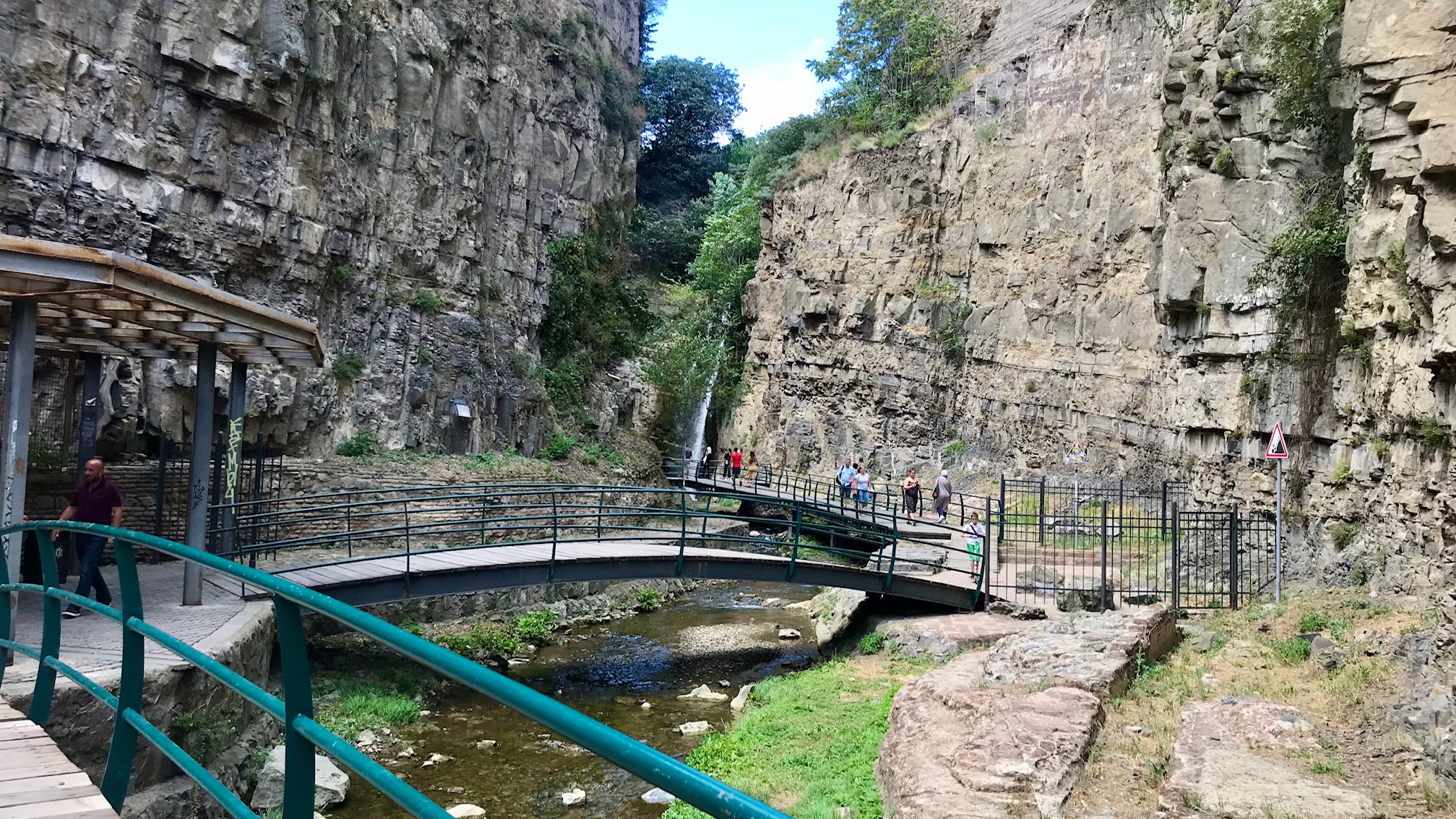
    Suddenly, the urban landscape vanishes, replaced by a stunning natural wonder—a 22-meter waterfall, cascading down rugged cliffs in the heart of the city. This was my absolute favorite spot in Tbilisi.

    First, you’ll cross the Lovers’ Bridge, its railings weighed down by tiny padlocks left by couples, a romantic tradition found worldwide.

    Apskates vieta Tbilisi - Leghvtakhevi kanjons

    As you venture deeper, Tbilisis pastel-colored houses teeter on the canyon’s edge, their delicate wooden balconies daring gravity. Would I step on one? Not so sure!

    Tbilisi nami kraujas malā

    And at the canyon’s end, the waterfall awaits—a serene yet powerful spectacle, a refreshing contrast to the bustling city just moments away.

    Leghvtakhevi ūdenskritums

    The Powerful Message of the Bridge of Peace in Tbilisi, Georgia

    The Bridge of peace location

    Tbilisi Miera tilts dienā

    A gleaming glass-and-steel structure, the Tbilisi Bridge of Peace tells the powerful story of unity between cultures and generations. But its real magic happens after sunset—when thousands of LED lights flicker across its surface, transmitting a hidden message in Morse code, listing the chemical elements that form the human body. A poetic tribute to our shared humanity.

    Tbilisi miera tilts naktī

    A Ride in Tbilisi Cable Car

    You have to purchase a ticket to ride.

    Aerial Tramway station

    Hike up the hill or glide above the city at ease? The cable car ride to Narikala Fortress is a no-brainer. It’s budget-friendly and offers breathtaking aerial views of Tbilisi’s rooftops and winding streets.

    But before boarding, take a moment to explore Rike Park and admire the futuristic Rike Concert Hall, its twin tubular structures resembling something from a sci-fi movie.

    Tbilisi trošu vilcieniņš

    A Must See on Your Tbilisi Itinerary: Narikala Fortress

    Narikala fortress location

    Stepping off the cable car, you’re instantly captivated by a breathtaking panorama of Tbilisi—a mesmerizing blend of ancient rooftops, winding streets, and distant mountains. Street musicians often fill the air with soulful melodies, and if you share where you’re from and leave a generous tip, you might just be treated to your national anthem played in your honor.

    Tbilisi no augšas

    To your right, the Mother of Georgia stands tall and resolute, a symbol of both hospitality and strength. In one hand, she extends a cup of wine to welcome friends, while in the other, she grips a sword, ever ready to defend her land. Up close, she’s awe-inspiring, but I do believe that this is one of the sights that are more impressive when viewed from the distance.

    Next, venture left to explore the Narikala Citadel, a fortress steeped in history. Follow the well-worn paths, check out the modest yet beautiful St. Nicholas Church, and wonder to the edge to look down—if you dare. But be warned: if heights make you queasy, this may not be the spot for you. Peering down from the fortress edge can send your stomach into a freefall! Some thrill-seekers even scramble up the crumbling ruins—though whether that’s officially allowed is anyone’s guess! I enjoy living so I wouldn’t try that.

    Ko apskatīt Tbilisi - Narikala cietoksnis

    Bonus Thing to Do in Tbilisi– Try Wine Ice Cream

    Of course, one has to try Georgia’s famous wine ice cream— I did it twice, just to be sure! The wine flavor is subtle but unmistakable. If you love wine, you’ll adore this unique treat, available at stalls near the Old Town, sulfur baths, and canyon area.

    Meitene ar vīna saldējumu rokā

    What Else To See in Tbilisi?

    If you have explored Tbilisi Old Town and have more time, here are the places I would recommend seeing next.

    National Botanical Garden

    Has an entrance fee.

    Location of Botanical garden waterfall

    Bamboo groves. Stone bridges. Waterfalls. Need I say more?

    I’m no botanist, but I can confidently declare that Tbilisi’s Botanical Garden is a breathtaking escape. Nestled in the heart of the city, it offers an exceptional view of Narikala Fortress. But my favorite part is what I call the “bridge district”, a hidden gem where multiple scenic bridges create a magical atmosphere.

    Tbilisi botāniskā dārza ūdenskritums

    First, you’ll encounter an enchanting arched stone bridge poised over a  waterfall—a scene straight out of a fairy tale.

    Next, a serene bamboo grove awaits, where another charming bridge crosses through. The bamboos steal the show here, though. Fun fact: Bamboo isn’t a tree; it’s actually a type of  a very tall grass?

    Finally, you’ll reach a picturesque suspension bridge, swaying gently over a babbling stream with a small waterfall in the background. It’s a perfect walk! 

    We explored this oasis right after visiting Narikala Fortress, as the garden’s entrance is conveniently nearby so I would suggest you do the same. 

    Tiltiņš Tbilisi botāniskajā dārzā

    Tbilisi Mtatsminda Amusement Park After Dark

    Mtatsminda park location

    Funicular station to get to the park

    Why go at night? Because from the summit, Tbilisi transforms into a sea of lights. The Holy Trinity Cathedral radiates a golden glow, while the TV tower flickers in an ever-changing dance of red, blue, and violet hues.

    Tbilisi televīzijas tornis naktī

    Reaching the top is an adventure in itself—starting with the iconic funicular ride, where the cityscape unfolds beneath you like a storybook coming to life. At the summit, a world of nostalgic charm and adrenaline-fueled excitement awaits. There are food stals, whimsical decorations and fun rides.  We set our sights on the Tbilisi Ferris wheel, eager for an even loftier view, but the night had other plans— the Ferris wheel isn’t operating, possibly due to the wind, so we have to settle for a roller coaster ride instead. But you could also try the free fall if you dare.

    Tbilisi no augšas naktī

    Impressive Chronicles of Georgia

    Chronicle of Georgia location

    Towering over the city, these massive dark pillars are impossible to miss. Their sheer scale and intricate carvings narrating the story of a nation are mesmerizing. Overlooking a pristine reservoir, this monument stands as a grand tribute to 3,000 years of Georgian history and 2,000 years of Christianity.

    Gruzijas hronikas - apskates vieta Tbilisi

    The air hums with an almost sacred stillness, amplifying the weight of centuries carved into stone. Standing beneath these colossal sculptures, you can’t help but feel minuscule, a mere flicker in the grand story.

    Skats uz baznīcu pie Gruzijas hronikām

    Tbilisi St. Trinity Cathedral

    Holy Trinity chatedral location

    Among Tbilisi’s countless churches, one stands out. The Holy Trinity Cathedral of Tbilisi, though relatively young—built in 1995—radiates a timeless majesty. Its golden dome glows against the skyline, a silent guardian watching over the city. Standing in the cathedral courtyard, one can’t help but marvel at its quiet grandeur—so imposing, yet so serene.

    Sv. Trīsvienības katedrāle Tbilisi
    Sv. Trīsvienības katedrāle Tbilisi tuvplānā

    Those are all the attractions on our Tbilisi itinerary. But somewhere in between the sights you’ll probably want to sample some local cuisine.

    Local Foods To Try on Your Tbilisi Itinerary

    Where to Try Best Khinkali in Tbilisi?

    The owner of our Airbnb described Zadiaqo (location) as the place to taste “the best khinkali in all of Tbilisi.” And I must say, they were indeed the most delicious khinkali we had during our trip to Georgia. It felt like a place where locals came to enjoy their Friday night dinner. 

    If you’re not familiar with khinkali, it’s a traditional Georgian dish that resembles large dumplings. The filling can be meat, mushrooms, or cheese. They are eaten in a specific way: you grab them by the twisted top (where the dough is pinched together), take a bite, drink the broth inside, and then eat the rest—except for the top. The top should never be eaten, as it is considered impolite.

    Gruzīņu Khinkali

    Where to Find Best Churchkhelas in Tbilisi?

    Churchkhela is a traditional Georgian sweet—nuts threaded on a string and dipped in thickened fruit juice. There are countless flavor combinations, including some unique ones like kiwi juice. My personal favorite, however, are walnuts dipped in raspberry juice.

    We spotted churchkhelas at many stalls in Tbilisi’s Old Town, but I believe the best ones were actually found at the market. I’d suggest visiting Dezertier Market (location) not a tourist spot—for a more authentic experience. 

    Churchkhelas

    Why visit Tbilisi?

    Because it offers a vibrant mix of sights (fortresses, modern architecture, waterfalls, and more) and flavors (khinkali, wine ice cream, traditional Georgian bread, and beyond). My two days in Tbilisi passed in the blink of an eye, but I do feel like I managed to visit Tbilisis most famous tourist attractions on this short and packed Tbilisi itinerary.

    Our Tbilisi Itinerary in Video Format

    Kravicas ūdenskritums Bosnijā un Hercegovinā

    Check out full Georgia road trip itinerary
  • Tips for Traveling in China & Planning a Trip to China From Personal Experience

    Tips for Traveling in China & Planning a Trip to China From Personal Experience

    When I started planning a trip to China, I quickly realized this would be the most planning I’ve ever done for any destination. My usual travel tools and go-to tips simply didn’t work the same way here. China plays by its own set of travel rules—and that’s part of what makes it so fascinating.

    But here’s the good news: once you’ve done the planning for your China trip, traveling in China is surprisingly smooth and easy.

    In this post, I’m sharing my essential tips for traveling in China—along with the real-life moments when those tips saved my skin (and a few times when they didn’t). Consider this your cheat sheet to planning a worry free trip to China.

    PS: Entry regulations to China change frequently and depend on your country of origin. Because of this, I won’t be covering immigration details in my Tips for Traveling in China. Please be sure to check the latest official sources for the most accurate and up-to-date information on the procedures you’ll need to follow before you go.

    Your Most Important Tool When Planning a Trip to China

    When planning a trip to China, your phone will be your ultimate sidekick: your wallet, your guide, and your voice. If it dies, so might your plans. So keep it well-charged and close… you’ll be relying on it more than you think.

    Skats pa logu Šanhajas tornī

    Tips for Traveling in China to Stay Connected

    How to Get Mobile Data When Traveling in China

    If there’s one thing you absolutely need when planning a trip to China, it’s mobile data. Without it, your mobile payment apps won’t work, you won’t be able to access maps for public transport, or use translation tools effectively. Staying connected is essential when visiting China.

    Here are three main options for getting mobile data when traveling in China:

    • eSIM – The most seamless option if your phone supports it. It’s easy to activate and works instantly—but usually doesn’t come with a Chinese phone number.
    • Roaming from your home operator – Often reliable and simple to use, but can get expensive and may have a cap on how much data you can get. Like eSIMs, it won’t give you a Chinese number.
    • Local SIM card – Offers data and a Chinese phone number, but can be tricky to set up.

    My personal experience

    If your phone supports eSIM, I highly recommend it. My travel partner used an eSIM and had zero issues the whole trip. Unfortunately, my phone doesn’t support eSIM, so I was planning to rely on roaming and a local SIM.

    I purchased a Chinese SIM card for travelers from a vending machine in the airport. Later I was desperately trying to set it up for nearly two hours, and even with the help of the Chinese-speaking hotel staff, it just refused to work. Total waste of time and money.

    Roaming worked great—for a while. My initial 300MB package lasted less than a week, so I bought another. That one worked too… until it ran out. When I tried to buy a third, I got an SMS from my provider saying I’d hit the limit for international data packages and couldn’t purchase any more. I didn’t even know that was a thing. With no data left, I was lucky the person I was traveling with had unlimited eSIM and could share their hotspot.

    Do I Need a Chinese Phone Number When Planning a Trip to China?

    Some popular attractions—like the Science and Technology Museum in Beijing—require booking through apps or platforms that require a Chinese phone number. You can only get one with a local SIM card. An alternative would be to find someone who has a Chinese number that would be willing to make the booking for you.

    My Personal Experience

    As mentioned above, I tried to use a local SIM for this exact reason, but couldn’t get it to work. I didn’t have Chinese friends who could help, but thankfully one kind hotel employee helped me book tickets to a museum I really wanted to see.

    Unfortunately, not all hotels are that helpful. At another one, the staff didn’t feel comfortable doing that so I missed out on another museum I was really excited to visit. If I had to plan a China trip again, I’d probably skip the vending machine SIM and go to a staffed shop where I would ask them to help set it up. Not sure if it really is an option, but I would try.

    Do I Need a Travel Adapter When Planning a Trip to China?

    China uses plug types A, C, and I. While newer hotels might have USB ports and in some metros I even saw wireless charging ports, many older ones don’t. So yes—bring a travel adapter. 

    My Personal Experience

    I packed a multi-purpose adapter with plugs for several countries, and it came in handy more than once—especially at the airport and in hotels without USB ports. 

    And as your phone is so important in China – if you see you’re running out of phone juice on the go – you can also rent portable power banks. But I did not use them, so i can’t comment if there are any issues for foreigners when trying to rent. I just saw them everywhere. 

    Nanjing iepirkšanās iela Ķīnā

    Tips for Traveling in China to Be Able to Pay for Things

    Do I Need Online Payments AND Cash When Planning a Trip to China?

    China is famous for being almost entirely cashless, with Alipay and WeChat Pay used pretty much everywhere. But here’s the thing: if you’re planning a trip to China, don’t leave your cash behind. Even in 2025, having some backup cash can really save you as it saved me—because sometimes, technology fails.

    My experience

    Every guide I read confidently declared, “China is cashless.” So I focused on setting up Alipay and WeChat Pay in advance. But being the paranoid traveler who likes to be prepared for anything, I still brought around €200 worth of RMB—just in case.

    Good thing I did.

    The first time I tried to pay with Alipay, it didn’t work—something about my foreign credit card not being valid. So I switched to WeChat Pay, which thankfully worked in most places… but not all. Some tourist attractions and grocery stores were Alipay-only, and even in a few restaurants that did accept WeChat Pay, something glitched and my transaction didn’t go through. Since I’d already enjoyed the meal, having cash saved me from a very awkward situation.

    Contrary to what I’ve heard when planning my trip to China, most vendors were happy to accept cash—as long as I had exact change. A lot of places don’t carry much (or any) spare change, so it’s worth preparing for that too.

    Steps to take before arriving in China

    • Set up Alipay before your trip and complete the document verification process. I followed a guide online to link my international card.
    • Set up WeChat Pay in advance and go through the ID verification as well. I followed an online set up guide.
    • Bring some cash in RMB. I exchanged mine at home. In total, I probably spent around €80–€100 in cash over the course of my 2 week China trip.

    Other Things to Prepare Before Traveling to China

    Do I Need a Translation App When Planning a Trip to China?

    While people in China are incredibly kind and often eager to help, English is not widely spoken. In many cases, you’ll get by with gestures, pointing, or using a calculator or scrap of paper to communicate prices—but having a reliable translator app will make your life so much easier.

    Most importantly, download the offline version of your translator app before your trip. While offline text translation is handy, keep in mind that image and voice translation features usually require an internet connection, which brings us back to the importance of staying connected.

    My experience

    The people I met in China were genuinely some of the friendliest and most helpful I’ve encountered while traveling. I still smile thinking about the person at the next table who out of good will jumped in to help us decode the hot pot menu.

    That said, the language barrier is real. I don’t speak Chinese, and only a few people we interacted with spoke fluent English. Staff in shops, restaurants, or tourist attractions would sometimes pull out their own translation apps right at the start of a conversation—but I still needed an app on my end to reply or clarify things.

    I found that Google Translate worked best when I had an internet connection via my travel buddies eSIM or roaming. However, since Google services are restricted in China, it didn’t work on public Wi-Fi, so I would highly recommend preparing a backup when planning your China trip. I tried Microsoft Translator, which was solid for written text but struggled with spoken language and image translation.  

    Make Sure You Have a Local Copy of Important Information

    China’s internet can be… unpredictable. One minute your app is working, the next it’s stuck loading forever. That’s why having offline backups isn’t just smart—it’s essential.

    When planning your China trip, it’s smart to save local copies or take screenshots of any crucial information—think QR codes for entrance tickets, insurance documents, booking confirmations, and train details. This way, even if your email or the app doesn’t work while you’re on the go, you won’t be left scrambling.

    My Experience

    I booked several tours and experiences through Viator, but the app’s reliability varied from city to city—it worked perfectly in some places but failed completely in others. On top of that, as you know I lost internet access halfway through my trip.

    Thankfully, my past planning self had already taken screenshots of all my QR codes, tour starting points, and pre-booked train seat details. Those saved screenshots turned out to be a lifesaver, allowing me to breeze through check-ins and get where I needed to go without stress.

    Ezers Ķīnā

    Tips for Finding Attractions and Planning a Trip to China

    Do I Need to Book Entry Tickets in Advance When Planning a Trip to China?

    Because of the daily visitors cap, even the free museums in China often require reservation to enter, and popular attractions can book out days in advance. There are a lot of people in China—and many of them want to visit the same famous attractions you’re planning to visit on your China trip. Think of it like trying to get a dinner reservation on Valentine’s Day—except every day is Valentine’s Day if you’re headed to the Forbidden City.

    Typically, bookings open 7–10 days ahead of time and sell out fast, so planning ahead is key if you don’t want to miss out. 

    My experience

    I visited during the off-season, and even then, places like the Science & Technology Museum, Shanghai Tower, and the Forbidden City required advance bookings to secure the dates I wanted. 

    Because I knew that Forbidden city tickets would disappear in a blink of an eye, and didn’t have a Chinese number to make the booking myself, I knew I wouldn’t stand a chance and decided to book a guided tour that included the tickets. Honestly, I’m glad I did, as this saved me a lot of hustle. I will talk more about that in another post!

    Other places, like the Temple of Heaven, Shanghai greenhouse or Lingyin Temple, during the off-season were more chill—you could grab tickets on the day. But I wouldn’t gamble on it for the big hitters.

    And of course there was the Shanghai planetarium which I couldn’t get the tickets to although it was free, because the WeChat app asked me for a phone number that I didn’t have. 

    How to book tickets to attractions in China

    1. Check the official website of the attraction. Most will redirect you to WeChat for booking e.g. this is what happened when I tried to book the Science & technology museum, so make sure you have that set up. Just note that it may require a Chinese phone number.
    2. If there’s no official website, try searching for the attraction on WeChat using its Chinese name. I had to do this for SoReal VR tickets and info on the Robot Exhibition center in Hangzhou. Again, some bookings through WeChat may require a local number.
    3. For attractions with paid entry, Trip.com can be a good option. The tickets might cost a bit more as it is a3rd party, but you usually don’t need a Chinese phone number. This is how I got the tickets to Shanghai tower.
    4. Check for guided tour options on Viator that includes the entrance tickets. I used the guided tour option for Forbidden city. Just choose an official tour company and be aware of the scammers trying to re-sell tickets for much higher price without any additional value. 
    5. If all else fails, try your luck with same-day tickets, but be aware that many spots might be sold out by then. mēģināt tās nopirkt uz vietas, bet rēķinies, ka var gadīties palikt ar garu degunu. 

    Tips How to Find Attractions and Activities When Planning a Trip to China

    In the beginning of your China trip planning, you may quickly realize that your usual go-to channels—like Google and TripAdvisor—just aren’t cutting it. Or at least that’s how I felt. A lot of the information is outdated or limited, especially if you’re trying to explore beyond the major tourist attractions. For example, I wasn’t able to find any information on SoReal Blast furnace there.

    So what tools did I use for planning my China trip?

    • Trip.com was by far the best English-language option for checking out attractions, buying tickets, and reading reviews.
    • Dianping is a Chinese alternative. It’s super helpful for finding local spots and up-to-date info on whether an attraction still exists or is open. But there are some limitations – you do need to download the app and would need to register to access some of the information, and the translations can be hit-or-miss. Still, I often used it to cross-check info.
    • Viator (by TripAdvisor) worked surprisingly well for booking guided tours.
    • For food and coffee spots, we used the built-in Food feature in Amap (China’s version of Google Maps). It was really handy for finding places nearby and checking reviews. 

    Should I Book a Guided Tour When Planning a Trip to China?

    While I usually prefer DIY travel, I’d highly recommend taking at least one guided tour—or even a food tour—at the start of your trip to China. It’s an amazing way to get a real feel for daily life here, plus you’ll discover insider tips on local foods to try and hidden gems to visit. After that, you’ll be much more confident exploring on your own.

    My experience
    I did three guided tours—two tip-based walks and one fixed-price tour of the Forbidden City—and honestly, these ended up being some of my favorite memories from the whole trip. Since reliable information on China can be hard to come by when planning your China trip, it’s tough to know the real stories behind the places you visit or whether the portrayals you’ve seen in the media are accurate.

    The guides shared fascinating details, like how Shanghai’s city planners actually consulted a feng shui expert when designing parts of the city. They also offered real insight into everyday life. For example, if you’re curious about how locals feel about traditional Chinese medicine versus modern pills or supplements, just ask—most guides are happy to share their perspective. A side note: there’s a whole philosophy around eating to heal your body, and it’s genuinely interesting. Worth looking into!

    Metro Ķīnā

    Transportation Tips for Visiting China: How to Get Around Efficiently

    Tips for Taking a High-Speed Train in China

    China’s high-speed trains are something else. Think smooth rides, futuristic stations, and speeds that make other countries’ trains look like they’re stuck in slow motion.But they’re also popular, which means you need to act fast—tickets go on sale 15 days in advance and can sell out quickly. So do yourself a favour and book trains in advance!

    Mana pieredze

    My experience
    If I understood things right, the official railway app requires a Chinese phone number—which quickly became my personal China trip planning kryptonite. So, I used Trip.com for all my train bookings. Yes, the tickets are a bit more expensive there, but honestly, it was worth the peace of mind knowing I had a confirmed seat on the train I wanted. During the rides I could see that all seats were really taken. 

    But you know what’s really cool? In China, your passport is your train ticket. No QR codes, no printouts. Just make sure you enter your passport details correctly when booking. And a heads-up: the self-service gates only work for Chinese ID holders, so as a foreigner, you’ll need to go straight to the staffed gate where they check passports.

    What Navigation App Should You Use When Planning a Trip to China?

    You’ve probably heard that Google Maps is pretty much useless in China—and yeah, that’s true. The locations are often inaccurate, so don’t count on it. Apparently, Apple Maps works well, but as an Android user… that wasn’t an option for me. So, what do you do? You have to go local and download a Chinese map app.

    My experience

    For planning my China trip and during my time in China Amap became my ride or die, and it was fantastic for both walking and public transport route planning. The app interface can be switched to English, which is a lifesaver. You can also find food, grocery stores, pharmacies etc. by using the in-built app features.

    That said, it doesn’t always recognize addresses when you type them in English. So I prepped like a nerd and saved all key names and addresses—hotels, airports, train stations, and major attractions—in Chinese in my phone’s notes app and in the favourites of the Amap itself. Then I just copied and pasted them into Amap when needed or retrieved my favourites. Super smooth.

    My Secret China Travel Tip: Save Addresses in Chinese

    Whether you’re using a Chinese map app or calling a Didi (China’s version of Uber), you’ll often need to input addresses in Chinese characters. Same goes if you’re asking locals for help—most won’t understand English names of places, but show them the Chinese version and you’re golden.

    How to find the Chinese place names & addresses when planning a trip to China?

    • For hotels, just message them after booking—they’ll usually send you their name and address in Chinese.
    • For attractions or train stations, a quick Google search with the English name + “Chinese name” prefix usually brings it up.

    Tips on Choosing a Transportation Option in China

    If there’s one thing I already miss from China, it’s how easy and well-planned their transportation system is. Cities like Beijing, Shanghai, and Hangzhou are incredibly connected—you’ve got:

    • Metro
    • Buses
    • Didi (China’s Uber)
    • Rental bikes

    I recommend taking the Metro when possible as that’s the most English friendly option..

    My experience

    China’s metro system is amazing. It’s clean, reliable, cheap (most rides we took cost just 2–8 RMB), and incredibly tourist-friendly. Signs, maps, and announcements are all in English, and transfer points are clearly marked. One detail I loved: some metro lines even show which train cars are cooler or warmer so you can choose your comfort level. How cool is that?

    If something’s tricky, they even announce clarifications in English—like if a transfer is on a different floor and people commonly miss it, they’ll call it out over the speakers every time a train pulls in.

    With Amap to plan routes, getting around was a total breeze.

    That said, metro hours can be limited—some lines stop around 10:30 PM, which caught us off guard once. For late nights or places off the subway grid, we used Didi, and that was super convenient too. I used the mini-program in WeChat to order and pay for rides—no extra apps needed.

    One heads-up: most Didi drivers don’t speak English, but since we had addresses ready in Chinese, it was never an issue.

    Bonus Tip For Traveling in China: Ask The Community

    When I was planning a trip to China and couldn’t find answers to a few questions—like whether I needed a train ticket as a foreigner or if my passport would work—I turned to a China travel Facebook group. Some kind people there helped me figure things out, and that community became a really valuable resource during my China trip planning. 

    Just be careful about what you share online to avoid any potential scammers.


    It was a lot of information wasn’t it? Well as I said planning a trip to China is a lot of work upfront. But hopefully this helps. 

    In summary, my 3 key tips for traveling to China would be to make sure you have a reliable internet connection, book at least one guided tour & download and set up all the required apps (WeChat, Amap, AliPay) in advance.  

    Good luck planning your trip to China!

    Kravicas ūdenskritums Bosnijā un Hercegovinā

    What to see in China?

  • What to See When Driving from Kutaisi to Tbilisi? Uplistsikhe and Jvari

    What to See When Driving from Kutaisi to Tbilisi? Uplistsikhe and Jvari

    The journey from Kutaisi to Tbilisi is long (~229 km) and, at times, nerve-wracking. The roads are unpredictable—cows and pigs may wander across your path, and local drivers follow their own set of unwritten rules. But despite the occasional chaos, the scenery outside your window is absolutely breathtaking. Along the way, there are several remarkable sights worth visiting, including the ancient rock-hewn city of Uplistsikhe and the UNESCO-listed Jvari Monastery. That’s where we are headed today.

    So sit back and enjoy a virtual road trip from Kutaisi to Tbilisi with us. 

    Tip: Both sites are located near Tbilisi, so if you’re not driving across the country from Kutaisi to Tbilisi they are also perfect for day trips from Tbilisi.


    Cost: Uplistsikhe has an entrance fee


    How to get there: Driving


    Stops along the way when driving from Kutaisi to Tbilisi:

    Changing Landscapes on Your Drive From Kutaisi to Tbilisi

    Different regions of Georgia feel like entirely different worlds, but there is one unifying element—the mountains.

    As you leave Kutaisi, the landscape is lush and green, with forest-covered hills stretching as far as the eye can see. But as you approach Tbilisi, the scenery shifts—trees give way to dry, rolling hills in warm, earthy tones. If you’ve never taken the route from Kutaisi to Tbilisi before, the ever-changing landscapes alone make the trip worthwhile.

    Skats pa logu pa ceļam no Kutaisi uz Tbilisi

    And before long, you’ll start spotting roadside vendors, sometimes in seemingly impossible locations. They sell everything from ceramics and textiles to fresh fruits, freshly grilled corn, and even woven chairs—a testament to Georgia’s rich craftsmanship and agricultural traditions.

    When the views are this beautiful the hours fly. But you do start to feel a bit stiffness in your legs, so we should definitely make couple of stops along our drive from Kutaisi to Tbilisi.

    Ceļmalas veikals braucot no Kutaisi uz Tbilisi

    A Quick Stop on The Way From Kutaisi to Tbilisi: Surami Fortress

    Location of Surami fortress

    If you are in a time crunch and only need a short break, consider stopping at Surami Fortress. Exploring the ruins won’t take more than 10 minutes, as only fragments of the original structure remain. However, the real highlight here is the panoramic view from the top.

    Surami cietoksnis

    Don’t miss the stunning vista through a small stone window—it perfectly frames the landscape beyond.

    Skats no Surami cietokšņa loga

    A Must-See Stop On Road Trip From Kutaisi to Tbilisi: Uplistsikhe Cave Town

    Location of Uplistsikhe

    Has an entrance fee.

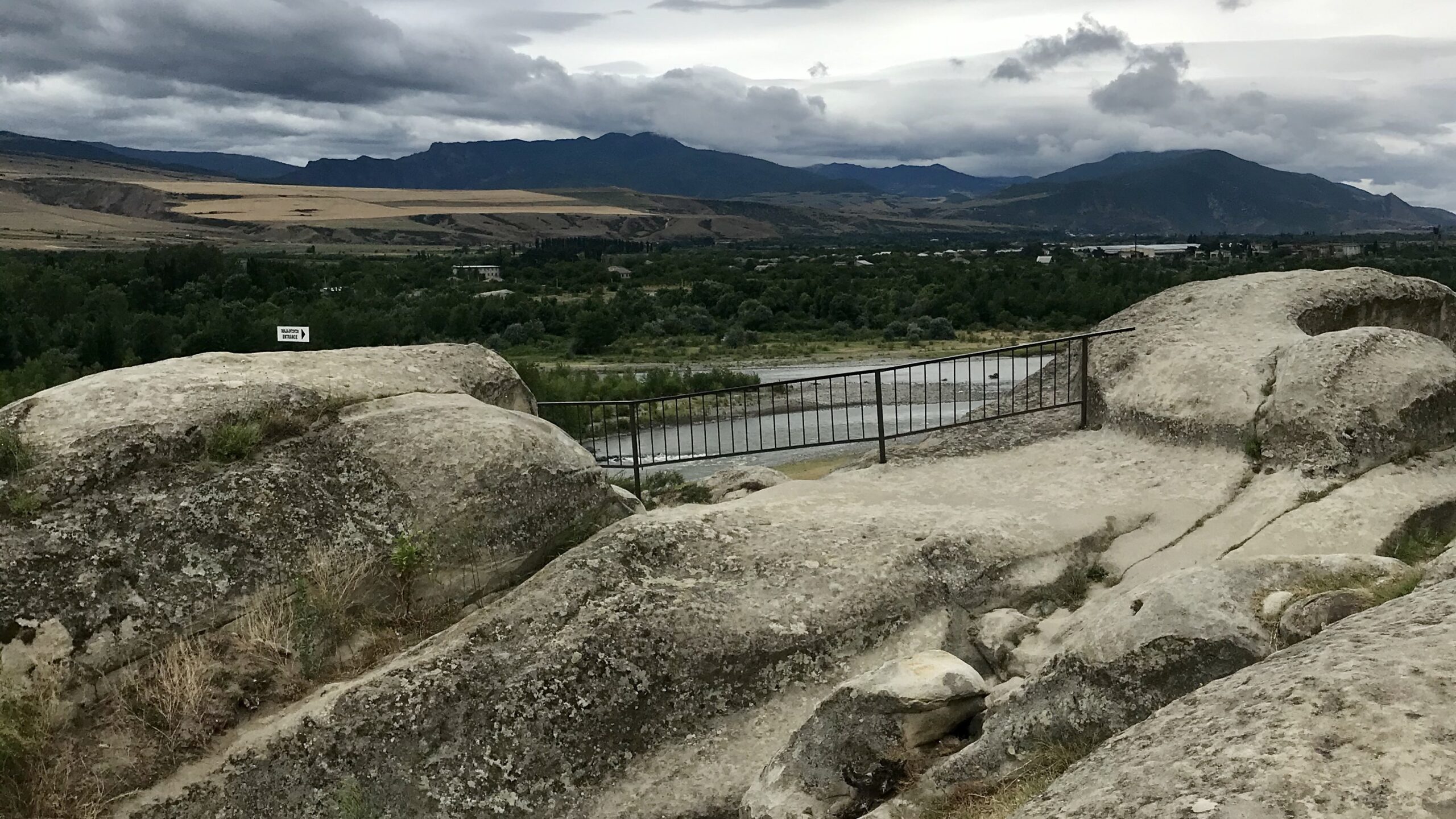
    Uplistsikhe is unlike anything you’ve ever seen. This ancient cave city is a labyrinth of chambers, tunnels, and rock-hewn temples, each one offering a new corner to explore. There are plenty of places to climb and peek into, transforming your visit into an exciting adventure and a bit of an obstacle course. So make sure you’re wearing comfortable shoes for the journey!

    Klintis Uplistsikhe alu pilsētā

    For those who take a moment to truly look, hidden treasures await in the seemingly empty rock-hewn chambers—like delicate fragments of ceiling decorations, preserved for centuries. And the panoramic views from the cliffs of Uplistsikhe? Absolutely spellbinding, offering a sweeping vista that will leave you in awe.

    Uplistsikhe alu pilsēta Gruzijā

    So, what exactly is Uplistsikhe? It’s a place that has worn many hats over the centuries. Once a pagan monastery, it later evolved into a Christian basilica. It also served as a fortress of strategic importance and was a thriving settlement. To truly understand the depth of its history, don’t miss the fascinating short film in the on-site museum. Trust me—it’s a must-watch before you set off to explore the rock-hewn temple-fortresses-city of Uplistsikhe . The film will offer you a whole new perspective on this site’s rich history and its cultural significance, transforming your visit into an even more immersive experience.

    Uplistsikhe alu pilsēta Gruzijā

    Looking at the  Uplistsikhe’s organic shapes with the dark caves peaking at us like the hundred eyes of a sleeping monster, it is crazy to think that people carved some of these structures as early as 1 millennium AD.

    And for the grand finale—if you’ve secured the full ticket and are not the one driving, your Uplistsikhe adventure culminates in a charming wine cellar, where you’ll be introduced to the centuries-old tradition of Georgian winemaking. The wine is crafted in special clay vessels buried underground, a method passed down through generations. And yes, of course—you’ll get to taste four exquisite local wines, each one a reflection of Georgia’s rich culture.

    Vina darīšanas trauki Uplistsikhe

    A Spectacular stop on Drive From Kutaisi to Tbilisi: Jvari Monastery

    Location of Jvari monastery

    Even from a distance, you’ll spot Jvari Monastery, standing majestically atop a hill.

    Many visitors come here to admire the 6th-century monastery (built between 586-605 AD), a UNESCO World Heritage Site with deep spiritual and historical significance. It’s a place that tells the story of the decline of paganism and the rise of Christianity in Georgia.

    Jvari klosteris

    Others visit for the breathtaking panoramic views. From the monastery walls, you can see the exact point where two rivers meet—a mesmerizing sight, beautifully complemented by the city rooftops below and the rugged mountain backdrop. I think mountains make everything more magical!

    Unfortunately, our timing wasn’t great. Google listed the closing time as 10 PM, but when we arrived, the doors were locked. A handwritten sign stated that the monastery closes at 5:30 PM. But the stunning, time worn, stone exterior and the views still made the journey worthwhile.

    Skats uz vietu, kur divas upes satiekas no Jvari klostera

    I was dreading the long drive from Kutaisi to Tbilisi, but the fun attractions we explored along the way not only made it tolerable – they made the road trip day into an adventure of its own. So I hope these ideas on what to see on drive from Kutaisi to Tbilisi will help you to plan your Georgia road trip as well.

    Kravicas ūdenskritums Bosnijā un Hercegovinā

    Check out full Georgia road trip itinerary

  • What to See Near Kutaisi, Georgia? Nokalakevi Hot Springs + More

    What to See Near Kutaisi, Georgia? Nokalakevi Hot Springs + More

    Georgia is a land of incredible diversity, and if you ask me what makes the area around Kutaisi truly stand out, I would say it’s nature. When we began our journey from Batumi to Kutaisi, we were beyond excited to immerse ourselves in the country’s breathtaking landscapes and explore all the incredible things to see near Kutaisi. 

    I had my mind set on some awe-inspiring canyons that seemed straight out of a dream… but then, as if on cue, the rain decided to make its entrance, forcing us to pivot and rethink our plans. Instead of letting the weather get in our way, we embraced the change and uncovered even more hidden gems on our way to Kutaisi. We focused on attractions that could still be enjoyed in the rain—like steaming sulfur springs, a magical hot waterfall, panoramic views from ancient fortress walls, and mesmerizing stalactite caves. These spontaneous detours ended up being a highlight of our trip—we were anything but disappointed! 

    So, join me on a virtual journey as we explore some of the must-see sights near Kutaisi, Georgia!


    Cost: Hot springs are free, the rest has an entrance fee


    Length: 1 day


    How to get there: By car


    What to see near Kutaisi, Georgia:

    Attractions Along the Route from Batumi to Kutaisi

    We rented a car and drove from Batumi to Kutaisi, where we spent one night. Along the way, we made stops listed in this itinerary. But since all the points of interest are located near Kutaisi, with the farthest being about an hour’s drive away, this route is ideal for those staying in Kutaisi as well. And if you’d rather not stress about driving, any taxi driver we met in Georgia was more than happy to take us on a tour to wherever we wanted to go. So, finding a driver to visit attractions near Kutaisi should be no problem at all.

    Where to See Hot Springs Near Kutaisi : Nokalakevi Sulfur Springs & The Hot Waterfall

    Nokalakevi hot sulfur spring location

    Attraction  ~54km from Kutaisi

    Have you ever seen a waterfall where the water is so hot that you can see steam rising from it from a distance? What? A hot waterfall? Is that even possible? Well, yes—it absolutely is! And Nokalakevi hot waterfall near Kutaisi is one of the most surreal and fascinating natural wonders I’ve encountered.

    Nokalakevi karstais ūdenskritums Kutaisi tuvumā

    As we drive toward the Nokalakevi sulfur springs, we can already see the steam rising above the treetops in the distance, like some mythical mountain trolls are boiling a giant pot of soup up there. The anticipation builds! After a wild, heart-pounding drive down the mountain (seriously, you need to be confident in your driving skills for this one), we park by the roadside near two smoking stone huts—as that’s where everyone else has parked.

    Ko apskatīt Kutaisi apkārtnē - Nokalakevi sēra avoti

    We walk over to touch the water flowing from the stone huts, and it’s boiling hot—like, “I’d better not dip my fingers in too long, or they’ll melt” kind of hot.

    Sērūdens

    From here, we continue our journey on foot toward the Nokalakevi hot waterfall. As we make our way down, we spot a reckless adventurer who somehow managed to drive all the way to the bottom of the river valley… and, predictably, got himself completely stuck.

    Naturally, we pause to watch as the fire brigade arrives to help dig him out. Everyone’s got their own adventure, I guess!

    When we finally reach the bottom, we are greeted by a breathtaking river valley that looks like something out of a dream. The water has this impossibly blue hue, the kind you’d never expect to see outside of a postcard. TAcross the river, small rock outcrops dot the landscape, and in the distance, misty mountains cloaked in green trees slowly fade into the rain-soaked fog. My heart leaps with joy—I think we’ve just stumbled upon one of the most stunning spots near Kutaisi.

    Skats ar upi

    Un aiz stūra dabas brīnums – karstais ūdenskritums, no kura gaisā paceļas tvaika mākoņi. Pieejot tuvāk, var just arī karstumu, ko tas izstaro. Minerāļu nosēdumi piešķir tam neparastu formu.

    And then, as if nature is saving the best for last, around the corner comes the true wonder—the Nokalakevi hot waterfall, sending steam into the air like something straight out of a fairytale. As we get closer, we can literally feel the heat radiating from the water. The mineral deposits around the waterfall give it this surreal, almost otherworldly shape. It’s hard to explain, it’s a bit like foam—except it’s solid foam. It’s almost like the waterfall is both bubbling and frozen in time. 

    Nokalakevi karstais ūdenskritums netālu no kutaisi - skats no priekšas

    From the waterfall, hot water cascades down through the rocks, blending with the cold river water below. Along the riverbank, small natural pools have formed where the two waters meet, creating the perfect, soothing temperature. These are the Nokalakevi natural thermal pools, known for their sulfur-rich waters that people come to soak in. Unfortunately, I’m not wearing a swimsuit, and there are no changing rooms nearby, so for now, we’ll have to settle for dipping just our feet into the healing waters.

    Pēdas ūdenī

    What an adventure! This place will be tough to top! But let’s see if the next attraction near Kutaisi can live up to the high standard set by this spectacular spot.

    Where to See Panoramic Views and Old Fortress Ruins Near Kutaisi: Nokalakevi Archaeological Site

    Nokalakevi archeological museum location

    Attraction ~51 km from Kutaisi

    Has an entrance fee

    It seems that Georgia doesn’t have many observation towers, but instead, you can enjoy panoramic views from the ruins of ancient fortresses.

    Nokalakevi cietokšņa drupas netālu no Kutaisi

    We first spotted the ruins on our way to the Nokalakevi Sulfur Springs, but we hesitated to stop, as Georgia is full of fortress ruins. However, something about this one drew us in, so we decided to take a detour before heading on to Kutaisi and see what this place had to offer.

    Reliģiska ēka Nokalakevi cietokšņa teritorijā

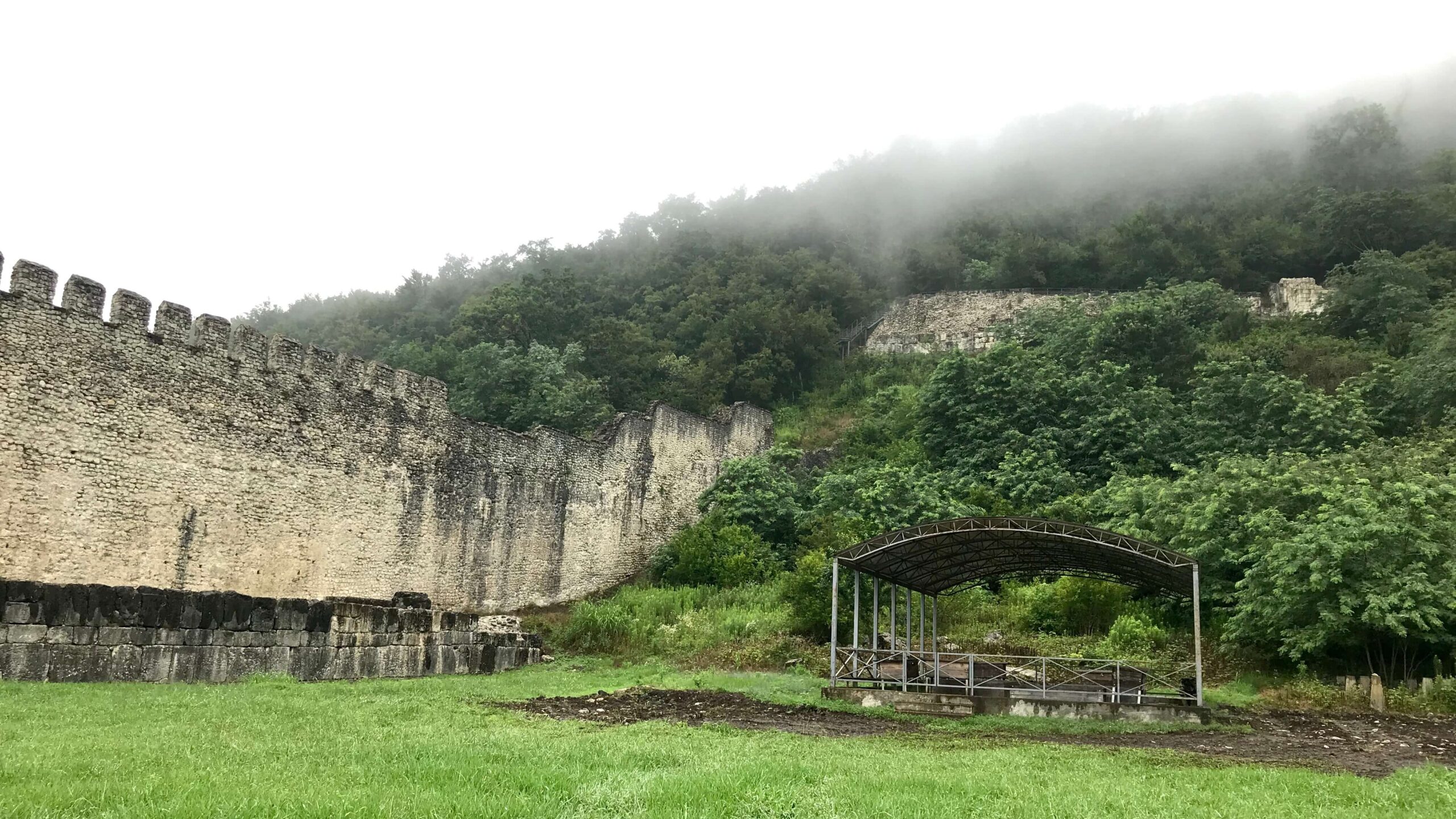
    It turns out this is the Nokalakevi Archaeological Site – the remains of an ancient fortress and city, once known as Archaeopolis (or Tsikhegoji or Nokalakevi), with roots tracing back centuries. The area is vast, featuring ruins, massive Byzantine walls, a small church, and a tunnel leading down to the river. I can’t help but wonder if this tunnel was a secret passage or perhaps a route used to transport goods from the river to the fortress. Unfortunately, we’ll never know for sure, as the Nokalakevi Archaeological Site lacks detailed descriptions. While there are stands where information should be, no actual details are provided.

    Skats uz upi

    It’s fun to roam around the site not knowing what you may stumble upon, but if you’re not an archaeology enthusiast, your main interest might lie in the towering walls, which double as an observation platform at various levels. So, let’s climb up and stroll along the ancient walls, soaking in the breathtaking views from above, all made even more magical by the misty rain.

    Skats no cietokšņa augšas
    Cilvēks skatu platformā

    I am unsure if anything could compete with a boiling hot sulfur waterfall, but this still was a fun stop with a completely different vibe. But let’s drive further to see what the third attraction near Kutaisi has in store for us.

    Where to See Stalactite Caves Near Kutaisi: Prometheus Caves

    Prometheus cave location

    Attraction ~21km from Kutaisi

    Has an entrance fee.

    Let’s venture underground to play with the shadows.

    Prometeja alas Kutaisi apkārtnē

    Before visiting the Prometheus Caves near Kutaisi, I was a bit nervous as I’ve heard comments like, “A friend of mine was disappointed with the caves near Kutaisi…” But maybe they were talking about a different set of caves, because as for me, the Prometheus Caves were far from disappointing. That being said, these were the first karst caves I have visited, so I have nothing to compare them with. 

    The walking route stretches nearly 2 kilometers, leading you through several stunning chambers that have formed 60-70 million years ago , each one decorated with stalactites (those that hang down from the ceiling) and stalagmites (those that rise up from the ground). It feels like a game – “What does this shape look like to you?” A king’s throne? Torn rags? These caves enhanced with colourful lights are a mystical, shadowy world where you can easily imagine hidden pirate treasure or mythical creatures like dragons and fairies lurking in the depths.

    Stalaktīti prometeja alās

    On a practical note, you can only explore the caves with a guide, but we were able to get in without making a booking in advance. When you buy your tickets at the entrance, they’ll let you know when the next tour starts, and you simply join in. There is also a boat ride add-on available, but we didn’t had a chance to try that one on our trip to Kutaisi, so I can’t comment on the fun levels there. 

    And just like that, stop by stop we have arrived in Kutaisi. And while you’re in Kutaisi, Georgia…

    Bonus : Don’t Forget to Stop By Colchis Fountain in the Heart of Kutaisi

    Colchis fountain location

    If you have time for only one stop in Kutaisi (like we did, as we had to rush further to Tbilisi), the Colchis Fountain is an absolute must. This fountain stands out from others due to its unique feature – its water jets are accompanied by statues that are large-scale replicas of various archaeological finds discovered around Georgia. For example, at the very top, you’ll find two golden horses that are modeled after gold earrings.

    Colchis strūklaka Kutaisi
    Colchis strūklaka tuvplānā

    Batumi stands out in my memory as the modern part of Georgia, Tbilisi as the historic one, and Kutaisi as the region where many fascinating and beautiful natural sights await. It’s been 2 years now when I am doing this translation and I still think about that hot waterfall at Nokalakevi Sulfur Springs. And if it hadn’t been for the rain, the possibilities would have been even greater.  

    Kravicas ūdenskritums Bosnijā un Hercegovinā

    Check out full Georgia road trip itinerary

  • Long Weekend in Stockholm Itinerary. 3 Days in Stockholm

    Long Weekend in Stockholm Itinerary. 3 Days in Stockholm

    Welcome to one of the lands of the Vikings — Sweden! This weekend, we’re diving headfirst into its vibrant capital: Stockholm, a city that’s literally risen from the ashes (more than once!) and still stands tall — full of life, charm, and character. It welcomes visitors with stunning architecture, fascinating museums you will want to tell your friends about, and some of the best freshly baked pastries I’ve ever tasted.

    Curious how to spend 3 days in Stockholm? Here’s my weekend in Stockholm itinerary.


    Location: Stockholm, Sweden


    When we went: September 2024.


    Overview of my long weekend in Stockholm itinerary (jump to):

    Weekend in Stockholm Itinerary Day 1: Vikings, Legends & Cobblestone Streets

    Let’s dedicate the first day of our Weekend in Stockholm itinerary to exploring ancient Viking tales, getting lost in a maze of storybook streets, spotting hidden surprises on centuries-old façades, and, of course, indulging in some of Sweden’s culinary icons.

    Tip: We arrived early in the morning, giving us a full day to explore. If you’re landing later in the day, feel free to swap  Day 1 of weekend in Stockholm itinerary with the Day 3 of weekend in Stockholm itinerary.

    If you didn’t guess from my hints – today we’re obviously headed toward Stockholm’s Old Town, but there are a couple of noteworthy stops along the way that are well worth including in your self-guided 3 days in Stockholm itinerary.

    The Homeless Fox Sculpture That Invites to Reflect

    Location

    Right at the end of Drottninggatan—a lively pedestrian street lined with cafés and restaurants—you’ll come across a quietly powerful sight: Rag and Bone, a sculpture of a beggar fox, bundled up in rags, silently asking passersby to spare a thought for those without a home. It’s a piece that lingers with you—thoughtful, moving, and just a little haunting. It will surely make you reflect on life.

    Rag and Bones statuja Stokholmā

    Be Amazed With the Grandeur of Stockholm Parliament – Riksdagshuset

    Location

    Just across a narrow stretch of water, perched on its own little island, a grand stone building rises into view—elegant and quietly commanding. Its arched entrance is adorned with sculpted reliefs, and at the very top, three crowns from Sweden’s coat of arms sit proudly. 

    You might find yourself wondering: What is this majestic structure?

    Stokholmas parlamenta ēka

    It’s Riksdagshuset—the seat of Sweden’s Parliament.

    Before stepping through the courtyard that connects the old and new wings of the Parliament, I encourage you to pause and take in your surroundings. The scene feels like a living postcard: grand façades mirrored in the water, bridges linking island to island, and the gentle murmur of the city providing the perfect soundtrack.

    Stokholmas ēkas atspoguļojas ūdenī

    For an even better view of the Swedish Parliament, head over to the wide staircase beside the Royal Palace, just across the water. From this angle, you’ll get the full effect of Riksdagshuset’s sculptural façade, which seems to tell stories carved in stone. At its crown stands Mother Svea, the personification of Sweden. 

    Stokholmas parlamenta ēka

    From here, the next logical stop for our Stockholm in 3 days itinerary is the Royal Palace itself.

    Check Out Stockholm Palace

    Location

    As one of the largest palaces in Europe, Stockholm Palace boasts around 600 rooms and serves not only as the official residence of the Swedish monarch, but also houses the royal court, offices for members of the royal family, various ceremonial halls, and several museums.

    Lielgabals pie Stokholmas pils

    Unfortunately, during our 3 days in Stockholm in 2024, much of the palace’s façade is under renovation. Bit of a shame, really—I’d read that each of the four façades has its own distinct theme and was curious to see if that’s something you can actually notice with the naked eye. For now, we’ll have to settle for the “King’s Side,” which features medallions of Swedish kings and war-themed decorations. See if you can spot them!

    Stokholmas pils fasāde

    I bet you’re hungry by now. And if you’re not vegetarian or vegan, there’s one iconic dish that just about everyone will insist you try during your 3 days in Stockholm. Can you guess?

    Try Swedish Meatballs

    Yes, the famous köttbullar! Traditionally made with a blend of ground beef and pork, these bite-sized meatballs are served with creamy mashed potatoes, a rich gravy, and that unmistakably Swedish touch—sweet-tart lingonberry sauce.

    Zviedrijas gaļas bumbiņas

    While IKEA may have introduced them to the world, I can tell you from experience: they hit differently when your enjoying them in Stockholm. The flavors seem deeper & richer. 

    During my 3 days in Stockholm I enjoyed meatballs in Moms kitchen. Just a heads-up—they were pre-made and reheated (in case that’s a dealbreaker for you), but honestly, it didn’t compromise the flavor one bit. They were hearty, flavorful, and totally satisfying, so I would recommend them. Plus, the owner was wonderfully friendly—one of those warm, casual chats that makes the whole meal feel even more special.

    Now that we are fueled up, let’s continue our Stockholm itinerary.

    Explore the Vibrant Streets & Secrets of Stockholm Old Town

    Location

    So we have finally got to Gamla stan, Stockholm’s oldest and possibly most charming quarter founded way back in the 13th century.  

    Stokholmas vecpilsēta

    For this part of our Stockholm itinerary I have 2 options:

    Self-guided Stockholm Old Town Itinerary

    Stockholm’s Old Town is a colorful maze of narrow, winding streets lined with bright, historic buildings. And if you know where to look, you’ll spot some fascinating little secrets—like rune stones tucked into walls or cannonballs hidden in plain sight. If you like treating a trip like a detective game and you’re up for a bit of solo exploration, stay tuned—my self-guided Stockholm Old Town route.

    Stokholmas vecpilsētas iela

    But if you prefer someone knowledgeable to take the lead and guide you around…

    Join the Viking Walking Tour of Stockholm

    Information about the walking tour

    Did Viking helmets have horns? Nope—total myth.

    Sweden, along with its Nordic neighbors, was once the land of Vikings, which makes it the perfect place to bust some myths and dive into their real stories. On this walking tour, your Viking guide—armed with a sword, a blowing horn, and a fantastic sense of humor—will lead you through Gamla Stan, revealing surprising connections between Viking lore and Stockholm’s past.

    It’s kind of like visiting a Viking museum… but in a more active way with getting your daily steps in. You might even get to unleash your inner warrior with a good ol’ Viking scream in public in a socially accepted way.

    Vikings pūš ragā

    Stockholm’s Viking tour is a unique and super fun way to explore the city, and I had an absolute blast. Highly recommend adding it to your Stockholm weekend itinerary. Just a heads-up: while it’s called a “free tour,” it’s actually donation-based—so you decide what it’s worth. You can read more about it on their website.

    After so much walking, it’s time to end our first day in Stockholm with something hearty—you’ve earned it. And if you were joining a Viking on a raid, it would be fitting to enjoy a proper viking feast, too.

    Immerse yourself in tale of Vikings in Stockholms Viking restaurant Aifur

    Location

    Aifur isn’t just a restaurant—it’s an experience. Dining here feels like stepping straight into a Viking feast, but without the risks associated with the actual time travel.

    As you step into the dimly lit room, decorated with weapons, shields, and old-style jugs, you’re immediately swept into the buzz of lively chatter and the clinking of cups and dishes. Your entrance is announced with the blow of a horn and a few ruthless Viking-style jokes, followed by cheers from the crowd. You’re then seated at one of the large communal tables, shoulder to shoulder with fellow travelers.

    Dekorācijas Stokholmas vikingu restorānā

    You can order mead to sip from quirky glass goblets without stems and choose from hearty, old-time-inspired dishes like Tore Hjort’s Venison or King Björn’s Birka-style Pike-Perch. Yes the restaurant is a bit pricey, but it’s immersive, it’s fun, and the food is tasty too.

    Kauss

    Tip: Make sure to book ahead as the Viking restaurant in Stockholm is very popular.

    Stockholm Long Weekend Itinerary Day 2: Superstars & Seriously Cool Museums

    I call the second day of our Stockholm itinerary the museum day, as we’re heading to the island of Djurgården – also known as the island of museums. If you’re into fascinating stories, interactive experiences, and a bit of time travel, this part of your weekend trip to Stockholm is going to be unforgettable.

    Tip on getting to the Djurgården from Stockholm city center: take the ferry line 82 from Slussen (part of the public transportation system in Stockholm). It’s super easy & convenient.

    There are way too many museums to fit into just 3 days in Stockholm, so we have to choose our favourites. Today, we are starting strong with the oldest open air museums in the world.

    This time I picked:

    Living Past in Stockholm Skansen Open Air Museum

    Location

    Ticket prices & working hours

    Skansen Open-Air Museum in Stockholm is like a time machine, but better – because you can actually buy cinnamon buns from the old-fashioned Swedish bakery, peek into historic workshops filled with vintage printing equipment and woodworkers’ tools, and hear the distant bleat of goats near rustic farm houses nestled deeper in the park.

    Koka ēka Skansen muzejā

    Around 150 buildings from different eras have been carefully taken apart and transported from all over Sweden to Skansen, where they’ve been thoughtfully reassembled and together with charming gardens, intriguing tools and impersonators dressed in period clothing they bring Sweden’s rich history to life. There is also a zoo with Nordic animals and an aquarium there if you’re into that kind of stuff.

    Konsum veikala replika

    Don’t be surprised if you end up spending the better part of your second day here – it’s one of those Stockholm attractions that pulls you in and doesn’t let go.

    It’ll be tough to top that, but I think I’ve got enough energy for one more world-famous museum in Stockholm, adding a bit of musical magic to our Stockholm itinerary. Here’s a clue – think Waterloo

    The Fun & Interactive ABBA Museum in Stockholm

    Location

    Ticket prices & working hours

    Welcome to the ABBA Museum in Stockholm, where glitter, nostalgia, and pop music reign supreme.

    Autore spēlē spēli ABBA muzejā

    Whether you’re a lifelong superfan or just someone who never skips “Dancing Queen” at karaoke (I’m the 2nd one), this place is an absolute blast. Explore the band’s journey, hear behind-the-scenes stories in their own words and marvel at the iconic stage costumes. And if you’ve ever dreamed of being a superstar yourself – this is your moment. Step onto the virtual stage and perform with ABBA’s digital avatars. For a few unforgettable minutes, you’re not just visiting a museum… you are the fifth member of ABBA.

    Autore uz skatuves

    Tip: If you’re planning your own weekend in Stockholm itinerary make sure you book tickets to Abba museum in advance, as they may be sold out. 

    If you’re not completely worn out after all this, there are plenty of other museums you could add to your 3 days in Stockholm itinerary on Djurgården Island. Or, if you’re craving some excitement, there’s even a huge amusement park here. I’m wiped out, though, so I’m calling it a day!

    Tip: If you’re heading to Gröna Lund, it’s cheaper to buy tickets online. At least when I visited Stockholm in 2024, there was a special online deal package that wasn’t available in person.

    Long Weekend in Stockholm Itinerary Day 3: Sweeping Views & a Soft Goodbye

    Did you know you can turn everyday things—like a metro ride or a visit to a food market—into a fun little adventure? In Stockholm, you definitely can. Since our last day in the city isn’t a full one, we’re spending it exploring a random (but fun!) mix of bits and bobs, all with a unique Stockholm twist.

    Unless you’re staying in the very heart of Stockholm, you most likely will need to purchase a metro ticket. Since metro tickets in Stockholm are time-based, why not make the most of them by adding an extra stop (or a few) to your Stockholm itinerary?

    Metro stacija Stokholmā

    Stockholm Metro Art Gallery

    What is this place? Ruins of old Roman-style columns and creepy stone heads staring back at you?

    Drupas

    Surprise—it’s the Kungsträdgården metro station!

    Inspired by the King’s Garden above it, this station feels like an underground archaeological site, with dripping cliff walls and all sorts of quirky surprises. Then, just as you’re taking it all in—whoosh! A metro train rushes through. The mix of art history and modern transportation makes this place a bit of a mind-blowing paradox.

    Galva uz sienas Stokholmas metro stacijā

    In fact, many of Stockholm’s metro stations double as art galleries, filled with colorful murals, sculptures, and  installations. I wouldn’t necessarily go out of my way to visit them all—but if you’ve already got a metro ticket and a bit of extra time, why not include a few stops in your weekend in Stockholm itinerary?

    What’s next? Well, we haven’t seen Stockholm from above yet on this itinerary—and that simply won’t do. Let’s fix that!

    Panoramic Views at Monteliusvägen

    Location

    There are many places to see Stockholm from above, but today for our quick travel dopamine fix that comes from taking pictures at beautiful sites, we are headed to Monteliusvägen where you’ll find a 500m wooden walking path by the edge of the cliff. 

    Skatu platforma Stokholmā

    From here, you can spot the Swedish Parliament building, the spiky church towers, colorful old houses, and some sleek modern buildings that are probably apartments or hotels. This feels like a perfect way to say goodbye to this fascinating city at the end of your weekend itinerary in Stockholm.

    Panorāmas skats uz Stokholmu

    But before we wrap up our Stockholm adventures we have to fuel up!

    Gardākās smalkmaizītes Stokholmā

    Threat Your Eyes or Your Taste Buds at Östermalm Market

    Location

    When you step into the building that has served as a market for over 130 years, you realize—markets can be elaborate too.

    Östermalm tirgus Stokholmā

    If you look from top to bottom, the interior of this Stockholm market is full of unexpected contrasts. The building features a high, industrial-style ceiling supported by large pillars—but those are contrasted with detailed paintings on soft pastel yellow walls that add an elegant touch. The market stalls, filled with all sorts of goods, are framed in wood with beautiful craftsmanship and charming old-time signs. Combined with the everyday market buzz, it all creates a unique, lively atmosphere that feels both historic and refreshingly modern.

    Östermalm tirgus interjērs

    Stalls offer a variety of fresh produce, seafood, meat, cakes, and Swedish shrimp toasts (I think they’re called Toast Skagen).

    And with that our 3 days in Stockholm comes to the end and it’s time to return to the airport. Till the next time!


    What are your thoughts?

    Stockholm is perfect for a weekend trip! It is very easy to get around and if you want to you can pack so many fun and iconic Stockholm’s attractions into just 3 days. I would definitely recommend this weekend in Stockholm itinerary if you’re looking for a city break. 

    Kravicas ūdenskritums Bosnijā un Hercegovinā

    Looking for A Different adventure?

  • What to See in Batumi, Georgia?

    What to See in Batumi, Georgia?

    Looking for ideas on what to see in Batumi? Georgia is a land of contrasts, where every city has its own unique energy. Batumi feels like a glimpse into the future. Picture palm trees swaying along a sleek, seaside promenade, towering hotels rising skyward, and an electrifying skyline that comes alive in a symphony of neon lights at night. We spent two unforgettable days in Batumi—the first and last of our trip through Georgia. So if you find yourself in Georgia here are my recommendations what to see in Batumi.


    Location: Batumi, Georgia


    Cost: Mix of paid & free attractions


    Length: 2 days


    How to get there: By driving or taxi to Batumi center, from there you can reach all attractions on foot


    What to see in Batumi, Georgia:

    What to See in Batumi’s Miracle Park?

    Miracle park location

    Welcome to a place where tales of tragic love, Georgia’s vibrant culture, and the magic of summer nights all come together in perfect harmony.

    Batumi’s Miracle Park isn’t just a park—it’s an experience that’s just as mesmerizing by day as it is by night, so I would recommend you to come here to check some of Batumi’s most famous tourist attractions at least twice.

    Ko apskatīt Batumi miracle park - skats ar panorāmas ratu, Alfabēta torni un mīlestības skulptūru

    What to see in Batumi Miracle Park by Day: Stunning Views and Timeless Stories

    Batumi Ferris Wheel

    Have to purchase a ticket to enjoy this attraction in Batumi.

    We’ll start our adventure by hopping on the Batumi Ferris Wheel, where you can enjoy panoramic views that stretch across the mysteriously blue sea and the bustling city below. The ride may be brief, but the thrill of rising high above the world will give you a flutter in your stomach.

    Batumi panorāmas rats un bāka naktī

    Batumi’s  Statue of Love

    Next, prepare to be swept away by the Ali and Nino sculpture—one of Georgia’s most heartbreaking love stories. The figures of a man and woman glide toward each other, filled with longing, only to briefly merge in a tender embrace before slowly drifting apart again. It’s a deeply emotional tribute to Ali and Nino, star-crossed lovers from two completely different worlds. Their love defied everything, only to be tragically cut short by fate.

    Ali un Nino skulptūra

    Batumi’s Unique Architectural Gems

    Batumi is home for some very creative architecture. Picture a smaller-scale upside-down white house (location) or a hotel that channels the grandeur of the Coliseum—just a taste of the quirky buildings that make this city unique. As you explore the streets of Batumi, prepare to be surprised by every wild and imaginative structure that pops up around you.

    Māja ar panorāmas ratu sienā

    From Batumi Miracle Park, you can catch sight of a striking skyrise with a Ferris wheel (location)embedded right into its wall. Though still unfinished, it’s the kind of bizarre, jaw-dropping sight that will stop you in your tracks!

    And then there’s the infamous Chacha Tower (location)—originally designed with the grand idea of Georgia’s beloved Chacha (the local alcoholic spirit) flowing freely through its fountains. No kidding! Before you get too excited – these days, the tower is said to be abandoned, and no free alcohol flows there. But even without the booze, it remains one of Batumi’s most quirkiest attractions well worth a look.

    Čačas tornis

    What to see in Batumi Miracle park by Night: A Dazzling Display of Light 

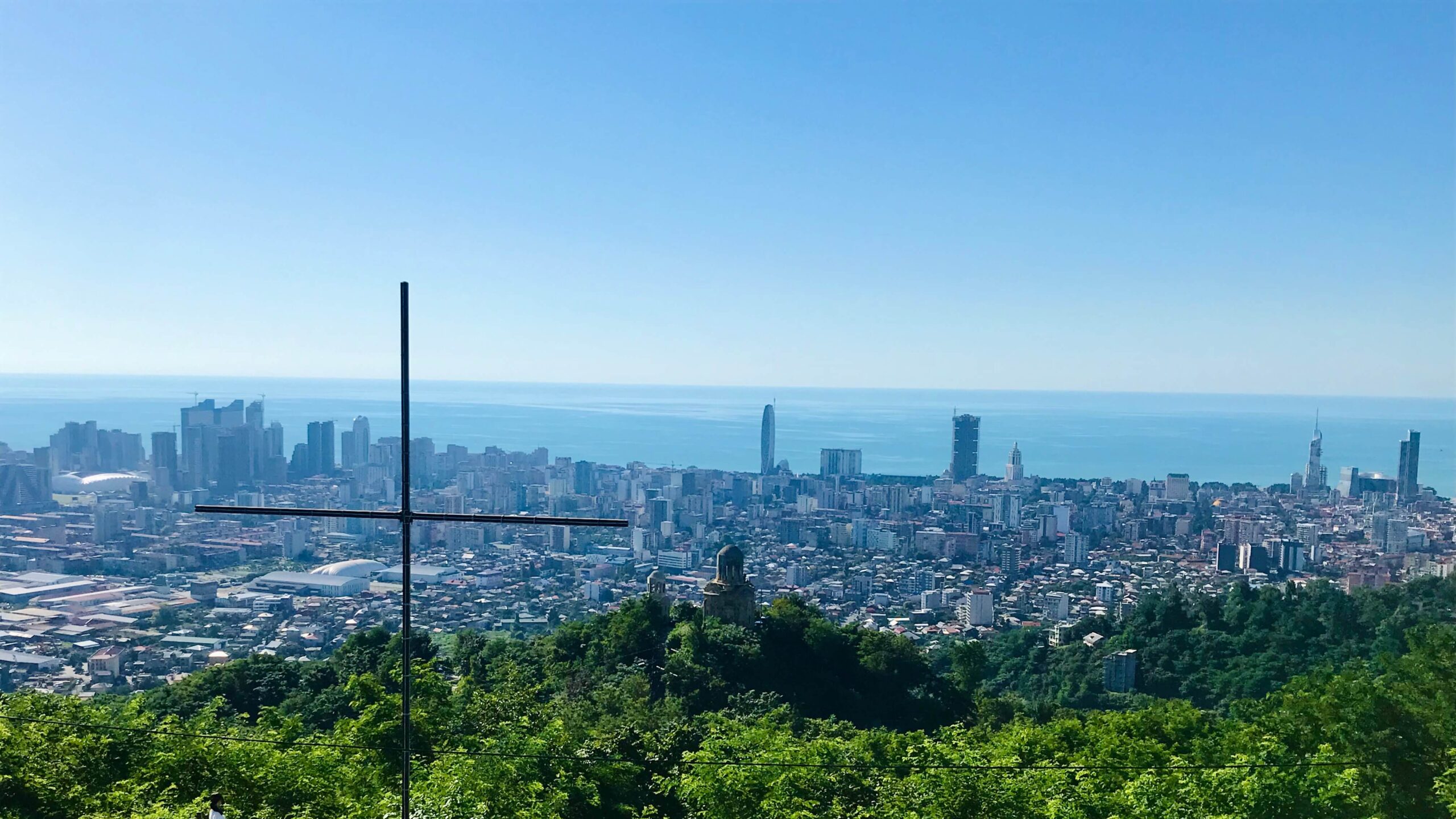
    As the sun sets, Batumi Miracle Park transforms into a stunning display of light . The Batumi Alphabet Tower rises over the landscape, shimmering in the dark sky. Its unique design, shaped like intertwining strands of DNA, tells a powerful story of the Georgian alphabet and the rich cultural identity of this ancient land. The ferris wheel and the lighthouse glows up too and everyone seems to be out and about having fun and enjoying the warm summer nights in Batumi.

    Batumi alfabēta tornis naktī

    Batumi Boulevard – More Than Just a Seaside Walk

    Batumi Boulevard Fountains location

    Batumi Boulevard isn’t just a 7km seaside promenade perfect for long, leisurely walks and watching fire-dancing shows at night—it also boasts a beautiful green park filled with trees, columns, and fountains.

    Batumi beach

    Our stroll begins at Miracle Park, where the promenade is alive with happy tourists and food stalls. On one side, the stunning sea stretches out before you, while on the other, tall palms rise toward the sky, with the vibrant city unfolding in the distance.

    Batumi bulvāra palmas un velosipēdistu celiņš

    After a short while, we stumble upon a side path leading to a beautiful square—one of my favorite places to see in Batumi. Maybe it’s the bamboo grove that has always fascinated me, or perhaps it’s the fountains. By day, they seem like ordinary water features, but come nightfall, they spring to life with light and movement, dancing in time with the music played by the musician sculptures perched atop columns at either end.

    Bambusu audze

    If, like me, you’ve searched for Batumi’s dancing fountains on the map and got confused because you found two, don’t worry! Batumi actually has two sets of dancing fountains: these (created in 1977) and another set by the lake, opposite the rotating sculpture. I’ll tell you more about those later!

    Batumi dejojošās strūklakas naktī

    Then we can continue our walk through the park, where you’ll discover perfectly trimmed trees, columns, and blooming flowers. But if you leave the park area and continue strolling along the Batumi promenade, you’ll find a collection of sculptures, including the Instagram famous human figures with hearts, which you’ve probably seen in photos.

    Batumi bulvāra parks

    Check the Moon’s Position with the Astronomical Clock in Europe Square

    Batumi Europe square location

    Surrounded by elegant buildings, Europe Square in Batumi is home to the statue of Medea, holding the Golden Fleece in her hand, a symbol of fame and prosperity. But that’s not all this square has to offer!

    Ēka eiropas laukumā

    Here, you’ll also find the astronomical clock, a fascinating piece of craftsmanship that does much more than simply tell the time. It displays the position of the Sun and Moon, zodiac signs, and other celestial details, making this landmark in Batumi a perfect spot for those who love a touch of astronomy with their sightseeing.

    Batumi astronomiskais pulkstenis

    But if your rather interested in getting closer to the sky than learning about astronomy the next stop on our Batumi itinerary might just be your cup of tea!

    Argo Cable Car – A Thrilling Ascent to 256 Meters over Batumi, Georgia

    Argo cable car location

    You have to purchase a ticket to enjoy this attraction in Batumi.

    Get ready to soar above rooftops and treetops on the Argo Cable Car, an exhilarating ride that lifts you to a breathtaking height of 256 meters. As the gondola sets off, there’s a slight jolt of acceleration at both ends—just enough to make your heart skip a beat—but don’t worry, it’s all part of the thrill (or maybe I was just a little nervous myself!).

    Argo trošu vilcieniņš un panorāmisks skats

    Unlike Tbilisi’s shorter cable car ride, this journey is much longer—designed not just for transport, but for taking in spectacular panoramic views over Batumi. Once you reach the top, you’ll need to step out for a while, as the gondola returns with the next group of passengers. So hold onto your ticket for the return trip!

    At the summit, you’ll find a café, a wine shop, and a viewing platform, where you can enjoy sweeping vistas of the city and watch the Batumi cable car gondolas gracefully glide back and forth.

    Batumi panorāma

    Batumi’s Dancing Fountains at Ardagani Lake – A Spectacle of Light and Sound

    Ardagani lake dancing fountains location

    This is the ultimate evening hotspot in Batumi! As night falls, prepare to be mesmerized by a stunning light, color, and music show reflecting off the waters of Ardagani Lake. The fountains dance in perfect harmony with the rhythm, creating a magical atmosphere.

    Dejojošās strūklakas

    But the spectacle doesn’t stop there—on one side of the lake, a lively amusement park lights up the night, while on the other, towering skyscrapers glow in vibrant neon colors. Though Batumi isn’t a massive city, summer nights here buzz with a big-city energy.

    With this our guide on what to see in Batumi comes to an end. But with all this walking and sightseeing you must be quite hungry…

    Where to Eat in Batumi? Taste the Flavors of Georgia

    We made the classic mistake of assuming that Georgian cuisine would be on every corner—surely, there’d be no need to plan ahead, right? Wrong! While Batumi has plenty of places to eat, its restaurant scene is surprisingly international, which meant we had to wander around a bit before finding a spot that served a proper Adjarian khachapuri.

    In the end, our favorite meals were at Heart of Batumi and Sazandari. Both delivered on flavor, but fair warning—Sazandari packs a spicy punch! From what I’ve gathered, Georgian food is meant to have some heat, so if you enjoy bold flavors, this is the place to try.

    A Must-try Food in Batumi: Adjarian Khachapuri

    Georgia is a land of many breads, and khachapuri—cheesy bread in its many forms—is a national treasure. But it was the hearty, indulgent Adjarian khachapuri that completely won us over from our very first meal in Batumi. After that, we made it our mission to order it everywhere we ate—for the sake of comparison, of course!

    Imagine this: a freshly baked, piping hot boat-shaped bread, its center filled with melted cheese—rich, slightly salty, with a creamy, curd-like texture. Nestled inside, a golden pool of butter melts into the cheese, while a fresh egg yolk sits temptingly on top..

    Hačapuri maize Gruzijā

    You tear off the crisp, toasty edge of the bread and slowly stir the egg and butter into the molten cheese, watching as it all blends into a velvety, indulgent mixture. Then, you dip each piece of bread into this cheesy goodness, soaking up every last bite of warm, gooey perfection.

    This isn’t just food—it’s an experience. 

    One thing we discovered is that khachapuri bread varies from place to place. Sometimes, it had a texture similar to pizza dough, other times, it was softer, almost like lavash. But no matter the variation, one thing remained constant—it was always delicious. 


    My travel companions admitted that Batumi, Georgia was nothing like he had imagined—except for the stray dogs wandering the streets. And I have to agree—Batumi feels very different from the rest of Georgia. The city has a unique blend of different cultures and influences, giving it a character all its own. But the variety is what makes a trip fun, so I would I’d say Batumi is definitely worth a day or two. Whether it’s for the eclectic architecture, lively entertainment, or simply unwinding on the beach, the city adds an exciting contrast to your Georgia travel itinerary.

    And where to next? After ticking all the boxes on your what to see in Batumi bucket list, why not rent a car and headed toward Kutaisi, to dive into Georgia’s breathtaking nature. That’s what we did!

    Kravicas ūdenskritums Bosnijā un Hercegovinā

    Check out full Georgia road trip itinerary

  • Georgia Road Trip Itinerary: Drive From Tbilisi to Batumi (7 days)

    Georgia Road Trip Itinerary: Drive From Tbilisi to Batumi (7 days)

    Dreaming of an unforgettable road trip through Georgia (country)? Picture breathtaking mountain landscapes, hidden hot waterfalls, and the irresistible aroma of freshly baked Georgian bread. In this guide, I’ll take you through our Georgia itinerary, based on my personal 7-day road trip from Batumi to Tbilisi and back. But you could also use the same itinerary for a drive from Tbilisi to Batumi.

    This journey across the whole country covered everything from Georgia’s modern cities to ancient cave towns, allowing us to experience both historic Georgia and new Georgia. We drove ~853 kilometers, walked until our sneakers wore out and indulged in 7 Adjarian khachapuri. It was amazing.

    Ready to embark on a Georgia road trip from Batumi to Tbilisi yourself? Let’s roll! 

    Skats uz Miera tiltu Tbilisi, Gruzijā, kad sāk krēslot
    Tbilisi, Georgia

    On this Batumi to Tbilisi to Batumi road trip:

    Georgia Road Trip Itinerary

    We landed in Batumi at 5 AM and were greeted by a culture shock. The airport is glowing with countless “FREE SIM”, “FREE SIM”, “FREE SIM” signs, and nearly every vendor offers their own version of an “almost free” SIM card. One stand even has two signs—one is the official one, the other hastily handwritten on cardboard—advertising a better deal than the first. This is the moment we realized our Georgia road trip will be an adventure, in the best way possible.

    Day 1 of our Georgia Itinerary: Batumi

    I was surprised by how modern and “touristy” Batumi is—a stark contrast to the rest of Georgia, where the emphasis is on history and culture.

    After a short afternoon nap, it is time for a stroll between the palm trees and the sea to explore some of Batumi’s most famous attractions.

    Ko apskatīt Batumi miracle park - skats ar panorāmas ratu, Alfabēta torni un mīlestības skulptūru
    First stop of our Georgia itinerary – Miracle park, Batumi

    Today’s itinerary includes:

    • Miracle Park – This area is home to several striking landmarks competing for attention, including the Ali and Nino statue, the Alphabet Tower, and the Chacha Tower. Nearby, vendors sell fresh fruits and pomegranate juice pressed right before your eyes, along with a variety of souvenirs.
    • Batumi Boulevard – More than just a seaside promenade, this beautifully landscaped park offers a serene escape. And there is bamboo growing here as well. How fun is that!
    Batumi bulvāra parks
    Batumi boulevard in Georgia
    • Europe Square and its architecture – A showcase of elegant buildings and an impressive astronomical clock.

    To learn more about these places read my full travel story about Batumi, Georgia.

    On a cold day, don’t be surprised if a kind-hearted coffee vendor offers you a shot of chacha to warm you up. 

    Day 2 of our Georgia Road trip Itinerary: From Batumi to Kutaisi

    In the morning, it’s time to rent a car and pick up some fresh Georgian bread for the Batumi to Tbilisi road trip. If you come across a small bakery, you might even get to see how traditional Georgian bread is made—stuck to the walls of the oven as it bakes. Fascinating! Unfortunately, I was too shy to take out my phone and snap a photo, but you have to believe me that it tastes incredible. 

    Nokalakevi karstais ūdenskritums netālu no Kutaisi sānskatā
    Hot waterfall in Georgia

    Today on the itinerary are the following Georgia attraction:

    • Nokalakevi Hot Springs and the hot waterfall (yes, such a wonder actually exists!).
    • Nokalakevi Archaeological Park, which, beyond its ancient ruins, offers breathtaking views.
    • Prometheus Stalactite Caves—a must-see stop in Georgia just outside Kutaisi.

    This day was my favourite out of our whole Georgia road trip, so I have a full travel story for it. Check it out to learn more about each attraction.

    Stalaktīti Prometeja alās
    Prometheus caves

    Day 3 of our Georgia Itinerary: Kutaisi to Tbilisi

    The day starts with a quick mission: snapping a photo of the Colchis Fountain, a dazzling landmark adorned with golden replicas of ancient artifacts.

    Here you can also catch a fleeting glimpse of Bagrati Cathedral in the distance. I do believe it is worth a stop, but turns out, we may have enjoyed breakfast for a bit too long, and now we’re racing against the clock to reach the day’s main attraction: Uplistsikhe, an ancient cave city with limited visiting hours.

    Uplistsikhe is like something out of an Indiana Jones movie—an entire city carved into the cliffs, with tunnels, hidden chambers, and rock-hewn staircases leading to panoramic viewpoints. Every twist and turn reveals something new. While it’s an awe-inspiring place, we hear that Vardzia—a similar but even larger cave monastery—is the ultimate cave-city experience. Sadly, it’s far off our route, so we’ll have to save it for the next trip to Georgia.

    Klintis Uplistsikhe alu pilsētā
    Uplistsikhe

    Before wrapping up the day, we can squeeze in one final stop: Jvari Monastery, perched high on a hill. Some come here for the monastery’s deep historical significance, others for the jaw-dropping view over the valley and the city below. Either way, it’s a place that leaves an impression.

    Skats uz vietu, kur divas upes satiekas no Jvari klostera
    View from Jvari monastery

    If you want to learn more about any of the places on the third day of our Georgia road trip itinerary check out the full travel story.

    Day 4 of our Georgia Road Trip Itinerary: Tbilisi

    After spending so much time in the car, we’re ready to stretch our legs—and what better way than a deep dive into Tbilisi’s Old Town?

    My favorite part of Tbilisi has to be Leghvtakhevi Canyon. Hidden right in the heart of the city, its towering cliffs make it feel like you’ve been teleported far away from the urban buzz.

    Apskates vieta Tbilisi - Leghvtakhevi kanjons
    Tbilisi old town

    Other must-see stops include the Narikala Fortress, where the panoramic view over the city is nothing short of breathtaking, and the Botanical Garden, home to bamboo groves and even a waterfall. A little slice of nature in the middle of a busy the city!

    Read more about these attractions and other things to see in Tbilisi, Georgia in my full travel story about Georgia’s capital.

    Skats uz ēkām Tbilisi, Gruzijā
    Tbilisi old town

    Day 5 in Georgia: Tbilisi

    Today’s Itinerary:

    The Chronicles of Georgia – Towering 35-meter-tall stone columns covered in intricate carvings make this monument an absolute spectacle. Standing beneath them, one can’t help but feel as small as an ant in the presence of giants. The sheer scale alone is enough to leave you in awe.

    Gruzijas hronikas - apskates vieta Tbilisi
    Chronicles of Georgia

    Holy Trinity Cathedral of Tbilisi (Sameba) – Sticking with the theme of Georgia’s grand architecture, our next stop is this monumental cathedral. Once again, I feel tiny—this time, more like a speck of dust caught in the wind. Its golden dome and towering presence make it one of the most striking landmarks in the city.

    Mtatsminda Park – For the evening, I’d recommend heading to this amusement park, perched high on a hill with stunning panoramic views of Tbilisi. We actually visited on our first day in the city, but in hindsight, it fits better here—there’s only so much sightseeing you can cram into one day! When we went, the views were magical, the atmosphere lively, but exhaustion got the better of us sooner than we’d hoped. 

    Tbilisi no augšas naktī
    View from Mtatsminda park at night

    Day 6 of Our Georgia Itinerary: Long Drive from Tbilisi to Batumi

    No matter how we spin it, with just 7 days in Georgia, one day has to be dedicated to a long drive from Tbilisi to Batumi (~6 hours). But to stretch our legs and break up the journey, one can still make a couple of fun stops.

    On the route from Tbilisi to Batumi, you’ll find the Surami Fortress, which offers the perfect spot for some stunning panoramic views. Then, there’s the black sand beach—or, in our case, the black mud beach since it was pouring rain when we passed through. I have to admit, the rainy weather didn’t do the beach any justice. Instead of a tropical paradise, it looked more like a potato field! But I’ve heard it’s much better when the sun’s out.

    Melno smilšu pludmale Gruzijā
    Ureki beach

    Since we were completely exhausted from the long drive from Tbilisi to Batumi, we didn’t learn much this day.

    Day 7 in Georgia: Back in Batumi

    Finally, the sun comes out, and the beach stones are so hot that the air above them seems to shimmer. Let’s spend the most of the last day of our Georgia itinerary lounging on the beach loungers. A quick tip: on a stone-covered beach, both loungers and water shoes are an absolute must!

    Later in the evening, it is time to take a cable car ride to get a stunning view of Batumi from above and, of course, buy a few souvenirs. Now, I proudly own a pair of pink socks with khinkhali on them. But if you’re more of a khachapuri fan, don’t worry—there are socks and keychains with those on them, too!

    Batumi, Georgia from the above

    Since our flight is at 5 a.m., we decided to soak in the nighttime beauty of Batumi. After the sun goes down Miracle Park is beautifully lit up, and many of the towering buildings in the center of the city shimmer in neon. And, of course, the Dancing fountains wake up for their performance— did you know there are 2 of them in Batumi?

    Dejojošās strūklakas
    Dancing fountains in Batumi

    If you haven’t yet read the full travel story about Batumi and all you can see there, you still have the chance.

    Driving from Batumi to Tbilisi on Your Georgia Road trip

    Before we went on our trip to Georgia, we were told all sorts of scary things about why we shouldn’t drive there by ourselves. The road signs outside the cities would only be in Georgian, the navigation would show a blank spot, and the locals would drive in such a way that you would need spare pants.

    As you can see, we have returned safe and sound. We had no problems with navigation or orientation (at least on the main roads). We bought a local SIM card and used it with Google Maps to figure out where to go. But when it comes to driving style – I would be lying if I said it wasn’t scary. Even sitting in the passenger seat (my boyfriend was driving).

    Gruzijas ceļš ar auto
    On the road trip from Batumi to Kutaisi, Georgia

    How Does a Foreigner Feel When Driving in Georgia

    “One must constantly focus fully on the road, attention cannot be lost for even a moment. But otherwise, it’s okay”

    Quoted from Miks, who was driving.

    Outside the cities, you need to watch out for cows and pigs. These animals walk freely on the street and tend to be immune to honking. Also, be cautious of sharp turns in mountainous areas. We drove on the main highways, but there were still places where the road on the other side had a steep cliff, and you had to be especially careful.

    In cities, you need to watch out for other drivers.

    “After a while, you realize that everyone drives not by the rules, but by feelings and mutual communication”

    Miks, reflecting on the Georgia road trip.

    This driving style is quite unusual for us. For example, it seems that pedestrians already know it’s not worth risking crossing the street when a car is approaching. They most likely won’t let you cross. Even at crosswalks. But we made an interesting observation – if someone does want to let a pedestrian go, they turn on their hazard lights before stopping, so others can see they’re slowing down. Otherwise, this kind of situation might not be expected. We also noticed flashing lights and other gestures, but we never figured out what they meant.

    Govis uz ceļa
    Sorry about the dirty glass but I had to show the cows

    Car Rental in Georgia for Your Tbilisi to Batumi to Tbilisi Road Trip

    Our deciding factor was the price.

    Since we were four people, and the route from Batumi to Tbilisi and back was planned along the main highways, not off-road, we chose a Toyota Prius 1.8. Miks who was driving said that a hybrid is a very good choice in Georgia, as it’s much easier to start driving uphill. I’ll take his word for it.

    We rented from localrent.com, and for a small fee, they delivered the car to our guesthouse in Batumi, so we didn’t have to go pick it up or drop it off, which was very convenient. When signing the contract, though, you can never be too sure, so we photographed the car to have proof of its condition at the time of pick-up. We’ve heard all sorts of stories about car rentals abroad, but we had no problems ourselves.

    What else you should know about car rentals in Georgia if your planning a road trip from Batumi to Tbilisi (or Tbilisi to Batumi):

    • To rent a car in Georgia, the driver must be at least 21 years old.
    • When booking accommodation, make sure the place is easy to reach by car. One of the places we stayed at during our Batumi to Tbilisi road trip was so high up on a mountain that even the taxi drivers had a hard time getting there.
    Skats pa logu pa ceļam no Kutaisi uz Tbilisi
    A views from the car on the Georgia road trip

    Alternative to Car Rental in Georgia – Taxi / Personal Driver

    If you don’t feel safe on the road, or, for example, don’t want to limit the amount of wine you drink on your Batumi to Tbilisi road trip, you can get a private driver to take you on a tour almost everywhere you want. Both taxi drivers, accommodation owners, and various transfer services offer this. You can find one driver to take you to all the sightseeing spots, or if your budget doesn’t cover the taxi driver’s accommodation, you can take a taxi from one city to another, and in the second city, hire a local driver to take you to nearby attractions.

    Tip: If you agree beforehand or use Bolt (the same app available in Latvia), taxi prices are very reasonable. But if you don’t agree on the price, you might get some surprises. On our last evening of our Batumi to Tbilisi to Batumi road trip, when we were heading to the airport, they applied a much higher rate than expected with the explanation that “they had to carry the luggage too.


    As I mentioned – Georgia is amazing, our road trip from Batumi to Tbilisi to Batumi was very exciting. Is there anything I would do differently next time? Yes, I would choose a less ambitious route (stay in one or two regions) or have a longer travel time, so there isn’t such a rush from one place to another. But other than that, I definitely recommend going on a road trip in Georgia and I hope my Georgia road trip  itinerary helps you to plan one.

  • What to See in Portugal? 4 Days in Lisbon and Nearby (Sintra, Óbidos)

    What to See in Portugal? 4 Days in Lisbon and Nearby (Sintra, Óbidos)

    During one of my previous trips, I met someone from Portugal who shared a story about the “Hill of Kings,” a place filled with the most magnificent palaces. You step off the train and spend the day climbing the mountain, stopping at several fairytale-like castles until you reach the most vibrant one at the very top. Later, I found out that this magical place was Sintra, Portugal.

    He also told me about the deep sorrow of Portugal, embedded in their soulful Fado singing—songs performed by women traditionally performed in taverns, filled with pain, longing, and stories of lost loved ones and wars that can easily leave you in tears. These tales struck a chord within me, and that was when I decided—I had to travel to Portugal.

    If you only have a day or two in Portugal, Lisbon is the perfect destination, offering a mix of cultural sights and culinary delights. And you can easily combine it with a visit to the nearby fairy-tale town of Sintra. My trip to Lisbon lasted four days, and I have to say—four days in Portugal were not enough, but sometimes you have to take what you can get. So join me on a little virtual journey and let’s find out what to see in Portugal together. 


    Location: Lisabon ; Sintra; Obidos


    Cost: Mix of free and paid attractions


    Length: 4 days


    How to get there: We got around the cities by public transport and walking and took a guided tour to reach Obidos


    What to see in Portugal in 4 days:

    What to See in Lisbon, Portugal

    If no one had told me, I would never have guessed that Lisbon had once been devastated by a catastrophic earthquake. The city feels so light, bright, and full of life that its tragic past seems almost impossible to imagine. Only in Lisbon’s historic sights like the roofless Carmo Convent does history whisper it’s reminders, but as you wander the hilly streets, past cheerful, sunlit facades adorned with vibrant tiles, it’s the city’s pulse of energy and resilience that truly defines it.

    São Jorge Castle & the Panorama of Lisbon from the Castle Walls

    Has an entrance fee

    Location

    Fairytale castles may belong to Sintra, but this Moorish fortress atop a hill, with its imposing walls and straight lines, resembles a mighty stronghold. And that’s what makes it fascinating. You can walk along the castle walls, gaze over Lisbon from above, and imagine life back in the 11th century.

    Ko apskatīt Lisabonā - Sv Georga pils

    Oh, and don’t be surprised—peacocks roam freely in the castle courtyard!If you decide to hike up to the Lisbon’s São Jorge Castle, you might pass by Lisbon Cathedral on the way. Since the entrance required a fee and I was visiting Lisbon on a bit of a budget, I didn’t go inside, so I can’t describe it firsthand. But if you love historic architecture, it might be worth a visit.

    Sv. Georga pils mūris no augšas

    Santa Justa Lift – a Stand Alone Lift in the Middle of Lisbon?

    Taking the lift requires a ticket, but you can admire it from the outside for free.

    Location

    Santa Justa Lift is one of the most famous landmarks in Lisbon. Though I didn’t take the lift up to the viewpoint, just seeing it in person (and snapping a photo) was a must do in Lisbon. After all, how could I say I had been to Lisbon without proof? It’s an intriguing structure—an outdoor elevator right in the middle of the city. How? Why?

    Sainta Justa lifts ko apskatīt Lisabonā

    Turns out that originally, this lift was built to connect the lower and upper parts of hilly Lisbon, so that people could get to upper levels at ease. After walking up and down the slopes of Lisbon for a while it all makes sense.

    Strolling the Sunlit Streets of Lisbon & Stopping by Arco da Rua Augusta

    In Lisbon, Portugal many buildings are painted in vibrant colors—pink, blue, bright yellow—while others are decorated with the signature Portuguese tiles. Speaking of which, turns out Lisbon even has a tile museum.

    Lisabonas nami

    The city also has several famous squares that serve as perfect waypoints when you’re unsure which direction to head in. Rossio Square, known for its distinctive wave-patterned pavement, and Praça do Comércio, once home to a palace before the earthquake destroyed it, are both lively and full of history. And at the heart of Praça do Comércio stands the grand Arco da Rua Augusta the iconic arch often seen in Lisbon’s photos.

    Bonus challenge: While exploring, try to snap a picture of one of Lisbon’s famous trams!

    Arco da Rua Augusta apskates vieta Lisabonā

    Lisbon Food Tour: Foods to Try in Portugal

    Has a fee

    Is it strange that my most vivid memories from the trip to Lisbon are the flavors of Portugal? If you get the chance , I highly recommend taking a food tour with a local guide. They’ll not only teach you the right way to eat each delicacy but also share fascinating insights about history and culture. These tours can be found on Tripadvisor. But if a food tour is out of your budget here are some foods I learned about and would recommend you to try in Lisbon:

    Pastel de Nata – Portugal’s Famous Custard Tart

    Before my trip to Lisbon, I kept seeing these praised everywhere online, and now I know why they’re so beloved. Our guide told us they’re best enjoyed sprinkled with cinnamon (and sometimes powdered sugar). Perfect with your morning coffee!

    Ko nogaršot Portugālē - Pastel de nata un kafija

    Ginja – Cherry Liqueur

    Alkohola lietošanai ir negatīva ietekme.

    You’ve probably heard of Portuguese wines, so I won’t go into that, but I do have to mention this little boozy treat. Ginja is a tart cherry liqueur often served with whole cherries in the glass. In Lisbon, you can sample it in small glasses, but in Óbidos, they serve it in edible chocolate cups!

    Ginja - Portugāles skābo ķiršu liķieris

    Arroz de Marisco – Portugal’s Seafood Rice

    Portugal is known for its fresh seafood, and the options are endless. But my favorite dish was Arroz de Marisco—somewhere between a risotto, a stew, and a soup, packed with shrimp and other seafood goodness.

    Portugāles rīsi ar jūrasveltēm

    A Quick Heads-Up for Dining in Portugal: In Portuguese restaurants, it’s common for them to bring bread and appetizers to your table, even if you didn’t order them. These are not free! Some places may try to charge you even if you don’t touch them, claiming they’ve been on the table too long. If you don’t want them, politely let them know right away.

    What to See in Sintra, Portugal (Day trip from Lisbon)

    I can’t deny it—Sintra was the most magical part of my trip. Getting there from Lisbon is easy—just hop on a train, and in about an hour, you’ll arrive. The real challenge? Choosing which stunning palaces of Sintra to visit in just one day. If I could give you one piece of advice, it would be this: Plan for more than one day in Sintra. And be prepared for long queues at the entrances.

    Quinta da Regaleira and it’s  Mysterious Park

    Has an entrance fee

    Location

    Quinta da Regaleira palace in Sintra itself is a true sight to behold – a striking, photogenic structure with jagged turrets and delicate patterns, but it’s the sprawling gardens that truly captivate the soul. These gardens, steeped in mystery, seem to whisper secrets with every twist and turn.

    Ko apskatīt Sintrā, Portugālē, Quinta da regaleira

    Winding paths meander along ancient walls, leading to tiny turrets where you can climb and feel the rush of history beneath your feet. The stones beneath you create intricate, almost magical patterns, while the lush plants breathe life into the place, evoking the ambiance of a fairy-tale forest.

    Apskates vieta Portugālē - Quinta da regaleira parka tornītis

    The most photographed spot of Quinta da Regaleira park may be the little bridge by the waterfall, where tourists pause to capture the perfect moment. But the most fascinating features are definitely the Templar initiation wells – eerie, waterless shafts that draw you in with their mystique. You descend into the darkness via a spiral staircase that leads from the light above, and as you journey through shadowy caves, you emerge once again into the light, beside a small, overgrown pond that you cross with stone steps.

    Ko apskatīt Sintrā, noslēpumainais dīķis Quinta da regaleira parkā

    Were these wells crafted for ancient ritual ceremonies, or were they simply the fascination of the palace’s owner with the esoteric? Who knows? But it’s impossible not to imagine how the garden must have felt when it was still a private sanctuary, filled with its original owners’ secrets, rather than being one of the most famous tourist spots in Portugal today.

    Ko apskatīt Portugālē Quinta da regaleira templiešu iniciācijas aka

    Pena Palace at the Summit Overlooking Sintra

    Has an entrance fee

    Location

    The Pena Palace is perched high atop a mountain, and as far as I know, it’s never been conquered, which isn’t surprising when you consider its location. I think this is THE palace my Portuguese acquaintance mentioned. During our Lisbon trip we had decided to save a few euros and, instead of taking the bus, we embarked on the hike up the steep mountain. We made it to the top, but by the time we reached the summit, I had nothing left in me, so I wouldn’t personally do it again. On the way back, I gladly hopped onto the bus.

    Ko apskatīt Portugālē Pena Palace Sintrā

    It’s clear that Pena Palace of Sintra attracts a lot of visitors, as we had to wait in line to get in. But oh, those colors! Brilliant yellow. Bold red. The palace seems to have been pieced together from vibrant, colorful Lego blocks. As you get closer, though, you start to see the signs of age – some areas of paint are chipped, and the surfaces are dusted with time’s residue. But, as with all ancient buildings, that’s perfectly normal. Despite this, the impression left is unforgettable – a colorful dream rising from the mountaintop.

    Pena Palace Sintrā

    The Pena palace grounds also boast a magnificent park, perfect for a leisurely stroll. And from the Pena palace terraces, you’re treated to a breathtaking panoramic view over the treetops, with the distant ruins of Sintra’s Moorish Castle visible on the horizon. If we hadn’t used up all our straight trying to hike the mountain we could have gone exploring that too!

    Moru Pilsdrupas ko apskatīt Sintrā

    What to See in Óbidos, Portugal (Day Trip From Lisbon)

    One of the things I would definitely recommend if you have the time is to venture outside of Lisbon. Because once you leave the city, a whole new world unfolds – one that is just as beautiful and vibrant but offers a different story.

    During our Lisbon trip we decided to do a day trip to Óbidos. Since I don’t have a driver’s license, we opted for one of the many day tours available online, which not only took us to Óbidos but also offered a glimpse of other stunning spots, like the breathtaking coastline of Nazare,  famous for its colossal waves. Only we happened to be there on one of the few days of the year where there were no waves. So I wouldn’t be able to give this place justice if I’d tried to describe it. 

    Enchanting Streets of Óbidos, Portugal

    Location

    Óbidos is a small, walled town in Portugal, where the streets are lined with white houses, their lower edges adorned with striking blue and yellow accents. As you wander through the town, it feels as though the cute, picturesque houses and the ancient rough, rock walls surrounding the city belonged to two completely different worlds. The narrow, winding streets and alleyways are packed with souvenir shops, snack stalls, plants, and, of course, the occasional crowd of tourists.

    Ceļojums uz Portugāli Obidošas ieliņas

    Óbidos is home to a quaint little Moorish castle, along with some fascinating religious structures that add to its charm. Since we didn’t linger in any one spot for too long, we had just enough time – about 1.5 hours – to stroll through the tiny town , sample some of the local chery liquor served in tiny chocolate cups and stop by a souvenir shop.

    Obidošas ieliņa Portugālē

    In the souvenir shops, you’ll find a wide array of cork products, as Portugal is one of the world’s largest producers of cork. One of the most iconic symbols of Portugal is the rooster – it turns out, Riga isn’t the only place to choose a rooster as one of its symbols! In Portugal, the rooster is believed to bring prosperity and good fortune to its owner. And, of course, you can’t visit Portugal without seeing sardines – they’re painted on plates, displayed on magnets, and are an undeniable part of the country’s charm.

    I Would Highly Recommend Traveling to Portugal in January

    While January might not be the warmest month (don’t be fooled by photos of women in summer dresses, they don’t actually walk around like that), the days are sunny, and Portugal seems to glow in the sunlight. The streets are bright, the houses are painted in cheerful colors, and the food is extraordinarily delicious all year round. If you love to walk, the cooler temperatures can actually be a blessing. Plus, there are fewer tourists around… Spring travel to Portugal offers so many benefits, so I am very happy that I visited in January.


    I’ve only scratched the surface of all that Portugal has to offer. I already can’t wait to indulge in another Pastel de Nata and take a leisurely stroll through the sunlit streets again. If you ever have the chance, I wholeheartedly recommend visiting Portugal. And if possible, consider going in the spring – and I hope my guide on what to see in Portugal has helped to inspire your future trip. 

  • Daugavgrīva Fortress and Daugavgrīva Nature Trail

    Daugavgrīva Fortress and Daugavgrīva Nature Trail

    It’s always a pleasure to discover a sightseeing spot right here in the capital that can be visited without much effort or long drives. This time, our journey takes us to Daugavgrīva, home to possibly the most impressive and eeriest fortress ruins in Latvia – the Daugavgrīva Fortress. And it turns out that just a stone’s throw from the fortress lies a lesser-known destination – the Daugavgrīva Nature Trail, offering a chance to explore floodplain lagoon meadows.


    Cost: Free


    How to get there: Public transport or by car


    Jump to:

    The Secrets of Daugavgrīva Fortress

    Location of Daugavgrīvas fortress

    Daugavgrīva Fortress is considered one of Latvia’s most valuable military heritage sites, with origins dating back to the 17th century. Over time, it has been seized, shelled, bombed, conquered, and rebuilt. It has changed rulers multiple times and has even been visited by multiple monarchs. During World War I, some of the first Latvian riflemen units were formed here (source). In short, this fortress has a long and complicated life story.

    Daugavgrīvas cietoksnis

    In the late 20th century, the Daugavgrīva fortress lost its military importance and now seems to be slowly crumbling. However, there are rumors about plans for its restoration and maintenance. As of April 2025, the Daugavgrīva fortress is still open to visitors on Saturdays and Sundays during specific hours. The limited opening times only add to the intrigue – but before heading to Daugavgrīva, it’s definitely worth checking the latest updates to see if it’s still accessible to tourists.

    When we arrive at the starting point of our adventure, we find the Daugavgrīva fortress hidden behind a moat and an earthen rampart, adding a sense of adventure even before stepping inside. So let’s gather our courage and walk through the gates guarding Daugavgrīva Fortress to find out what secrets lie within.

    What Can You See Inside the Daugavgrīva Fortress?

    It turns out the “belly” of Daugavgrīva Fortress is empty – inside is an overgrown outdoor area that looks rather abandoned and gloomy during the spring season. All the real adventure and spooky chambers are found in the fortress walls.

    Daugavgrīvas cietokšņa iekšpagalms

    A tall tower also rises here with a crumbling top. My first thought was that it’s a watchtower. But after reading some information online, I lean toward it actually being an Orthodox church that once stood within the Daugavgrīva fortress grounds.

    Baznīcas tornis Daugavgrīvas cietoksnī

    So let’s not waste time – off we go to explore the most interesting part of the fortress: the defensive walls. Their empty windows stare back at you like dark eyes.

    Each Spooky Chamber of  Daugavgrīva Fortress Has Its Own Style

    Behind doors and window openings lies a labyrinth of dark, half-collapsed rooms. Interestingly, each chamber has its own unique vibe.

    In the first one, the crumbling walls are covered with something green, and as you get closer, you can feel the cold and dampness radiating from them. Some floors are completely bare, while others are covered with old, broken planks. It’s creepy and fascinating at the same time – just watch your step! Some rooms even have informational stands about the Daugavgrīva fortress’s history, giving it a bit of a museum feel.

    Daugavgrīvas cietoksnis

    The next chamber greets you with a photogenic series of arches. The walls here were once painted, but now the paint is peeling off in large flakes.

    Daugavgrīvas cietoksnis

    Then there’s a room full of tree branches sticking out of the ground, adding to the ghostly atmosphere – as if the room has lost a battle with nature.

    As you continue moving from room to room, you also come across a dark tunnel. Where it leads – who knows? Stepping inside makes your heart beat faster. You know how in video games, there’s always a monster hiding in places like this, right?

    Daugavgrīvas cietoksnis

    Finally, we reach a room where train tracks disappear into the darkness – time to pull out the phone flashlight. Pretty unsettling!

    Daugavgrīvas cietoksnis

    So, after playing hide-and-seek with the unknown, we’ve made a full circle. Daugavgrīva Fortress turned out to be far more interesting and diverse than I expected!

    But if the Daugavgrīva fortress visit felt a bit too short, you can extend the adventure with a trip to the Daugavgrīva Nature Trail, just a few minutes’ drive away.

    Early Spring on the Daugavgrīva Nature Trail

    Location of Daugavgrīva Nature trail

    At the start of the Daugavgrīva nature trail, the first thing that catches the eye is a long, straight cobblestone path stretching endlessly into the distance. A gut feel tells me the sea might be at the end, but from here, you can neither see nor hear it.

    Daugavgrīvas dabas taka

    In early April, nature is still asleep – the meadows on both sides of the path are golden-brown, and some of the dry grasses are soaking in large puddles.

    Applūdušas pļ škšu Daugavgrīvas dabas takā

    Daugavgrīva Birdwatching Tower

    Just a few dozen steps in, the Daugavgrīva birdwatching tower comes into view. This area happens to lie along one of Europe’s most important bird migration routes. If you’re into ornithology, you probably knew that already. If not, you’re likely more curious about the view from the top.

    Putnu vērošanas tornis Daugavgrīvas dabas takā

    The tower’s high foundation suggests that water levels here are quite variable – meaning the landscape you see today might be completely different in just a few weeks.

    Today, the wide meadows seen from the tower are completely dry and resemble a golden field swaying gently in the wind. Instead of grain, there are thousands of reeds – so tall they’d tower over me if I stood next to them.

    Skats no Putnu vērošanas torņa Daugavgrīvas dabas takā

    Daugavgrīva The Nature Trail’s Boardwalk

    In the middle of this vast reed field a boardwalk winds like a snake. Let’s go stretch our legs!

    The Daugavgrīva boardwalk seems to be one-way with only a single passing spot, but since there aren’t many people on the trail today – just one man out walking his cat – it’s not a problem.

    Laipa Daugavgrīvas dabas takā

    Seems like we’re here off-season, because today the meadows on either side are completely dry. That means that at the moment the Daugavgrīva trail lacks the charm seen in photos with flooded fields. All around is just a sea of dried grass, that makes you wonder if the boardwalk is even necessary.

    Even though we’re still in Riga, apartment blocks are visible only in the distance, beyond the bare branches of the trees, giving the trail a peaceful and unhurried aura.

    Around a bend, the Daugavgrīva nature trail leads into a small grove. Here, in the shade of the trees, the trail looks much more intriguing – the grass surrounding the boardwalk sinks into pools of water, reflecting the bare branches above.

    Laipa Daugavgrīvas dabas takā

    We take a moment to enjoy the early spring landscape, until the Daugavgrīva Nature Trail leads us to a sand dune behind which the roaring sea awaits. From here, the choice is yours – continue along the coast or turn back.

    Jūra

    So, what do you think?

    Daugavgrīva Fortress turned out to be even more mysterious than I had expected. It’s one of those places where you feel like you’re in a video game. As for the nature trail – maybe we just didn’t come on the right day. It would’ve been much cooler if the meadows had been flooded.

  • 1 Day Lyon Itinerary: Discover Secret Traboules and More

    1 Day Lyon Itinerary: Discover Secret Traboules and More

    Picture this: You’re in France, wandering through the enchanting streets of Lyon’s Old Town, where every corner is alive with history and hidden stories. Sure, Lyon’s cuisine is world-renowned, but what if I told you there’s a whole other treasure to uncover? Welcome to Lyon’s secret world of traboules—a network of ancient  passageways that transform your stroll through the city into a thrilling, self-guided scavenger hunt! As you wander from square to square, past grand fountains and stunning centuries-old buildings, you’ll feel like an explorer on a quest, uncovering elusive clues and hidden gems. And towering above it all, the majestic white basilica watches over the city and you from its perch on the mountain.

    Let’s go, find out what to see in Lyon together. 


    Location: Lyon, France


    Cost: Listed attractions in Lyon are free, except the lunch


    Length: 1 day


    How to get there: By car or public transport to Lyon center, from there you can walk to all attractions


    Jump to:

    A Treasure Hunt: Find Lyons Secret Traboules

    Let’s turn our day trip to Lyon into a scavenger hunt! Here are the rules:

    Lyon has a network of around 400 hidden passages and stairways that wind through the Old Town, known as traboules. For centuries, these have been used as shortcuts to navigate the city, but today, fewer than 100 are open to the public.

    Your quest is to Uncover as many of Lyon’s secret traboules as you can! Keep your eyes peeled for hidden signs along the way, but no peeking at the secret Traboule map—yes, it exists, but where’s the fun in that?

    Ready? I’ll give you a hint: the traboules are located in the Vieux Lyon and Croix Rousse areas of the city.

    Lionas ieliņa

    The Excitement of Finding Your First Traboule

    We begin our quest on a random street, eyes darting across the buildings, searching for clues. But in Lyon, it’s not so simple—many facades feel like wannabe art galleries, adorned with tiny, quirky masterpieces. A Pac-Man mosaic grins from a corner, a miniature Mona Lisa smirks from a nearby wall. Could one of these be the key to unlocking a hidden passage?

    Ielu māksla uz Lionas nama sienas

    We wander for quite a while, hopelessly scanning the doors of Lyon’s houses, wondering if a traboule is hiding behind any of them. It’s hard to tell.

    These secret passages were once used by 19th-century silk workers to transport their precious goods. But they became even more crucial during World War II, when the city’s resistance used them to outmaneuver German forces, slipping through the city undetected. If these passageways once fooled soldiers, what chance do we have of finding them?

    But then—you spot it. A sign with a blue lion and an arrow showing the way. That’s our clue!

    Norāde uz Lionas slepeno eju

    We step through the doorway and into the mystery, finding ourselves in a hidden inner courtyard. Tall walls enclose the small open-air space, as if guarding its secret. A few plants sit in large pots, transforming the courtyard into a secret garden.

    Lionas  traboule kas ved uz slepenu iekšpagalmu

    Different Types of Traboules in Lyon

    As you’ll soon discover, there are all kinds of traboules in Lyon, and no two are alike. Some boast striking architectural features, like a pink tower with dark, hollow windows that seem to stare at you like empty eyes. Others are simple but undeniably photogenic.

    Lionas slepenais iekšpagalms

    And then there are the grittier ones—bare floors, graffiti-covered walls—those ones make me a bit uneasy, but they each add a unique layer to the city’s labyrinth. It’s like every traboule is a little puzzle piece, contributing to the intricate story of Lyon.

    Lionas slepenāeja - traboule

    We walk along the streets, scanning the houses for another blue Lyon. The thrill of spotting one never gets old. And once you’ve found your first, you start noticing them everywhere. Sometimes, there are even signs pointing in different directions, forcing you to make a choice.

    But just to make sure this scavenger hunt doesn’t get too easy, you also start spotting other symbols—like a little eye. What could that mean? It’s a mystery. Maybe it’s marking a traboule that’s visible but not accessible? Just a guess.

    You might think all traboules are tunnels and secret passages, but Lyon’s traboules also take the shape of stairs. After wandering from one hidden passage to the next, we find ourselves at the famous Cour des Voraces—a breathtaking six-story staircase that feels more like a piece of modern art than something built in 1840. No wonder it attracts photographers like a siren.

     Cour des Voraces trepes Lionā, Francijā

    I could easily spend the entire day wandering these hidden streets, exploring every corner and discovering new passageways. But we only have one day in Lyon, and this city has so much more to offer. So, let’s say our goodbyes to the traboules—at least for now—and set our sights on the next adventure waiting for us in our Lyon itinerary.

    Just a short walk away from the maze of traboules we find ourselves in one of Lyons most impressive squares.

    Bartholdi Fountain on Place des Terreaux, Lyon

    Location

    At the heart of Place des Terreaux, nestled among grand buildings that look like they have cost a fortune to build, stands a fountain that radiates power and grace. Four wild horses, each straining in a different direction, tug relentlessly, their hooves kicking up water below them. Yet, in the chariot at the center, a woman sits unflinching, her calm presence controlling the wild spirits with ease.

    Bartholdi strūklaka Lionā

    What makes this fountain even more fascinating is its history: it was designed by Frédéric Auguste Bartholdi, the same sculptor who created the Statue of Liberty. Originally intended for Bordeaux, the fountain proved too costly for them, so Lyon stepped in and claimed it instead.

    Don’t miss Lyons Large Scale Murals

    As you explore Lyon, keep your eyes peeled—not just for the quirky, tiny artwork that decorates the corners of houses, but also for the impressive large-scale murals that cover some of the facades. 

    Look up now, and you might spot a black panther gracefully walking along the edge of a building, framed by fake windows. But that’s not all—more murals are scattered throughout the city, and from a distance, some are so lifelike they’ll have you second-guessing whether you’re staring at a real person.

    Murālis ar pantēru Lionā

    But now my tummy is grumbling so I believe it is time to grab some lunch.

    Lunchtime in Lyon: Indulge in Crepes

    Although Lyon isn’t the birthplace of crepes (that would be Brittany), crepes have a long and beloved history in France. In fact, there’s even a holiday, La Chandeleur, dedicated to eating them! With such a strong tradition, I couldn’t leave France without trying some.

    But since it’s lunchtime, a Nutella or lemon-and-sugar covered desert might not be enough. Thankfully, there’s also a savory variety: Crêpes de sarrasin (also called galettes), made with buckwheat flour. These hearty crepes are typically served with savory toppings like baked egg and bacon, and they’re just as scrumptious as the sweet kind.

    Griku krepe ar olu un salātiem

    Lyon’s Notre-Dame de Fourvière – The Basilica Overlooking It All

    Location

    Climbing the Mountain to Reach the Basilica

    It’s been watching us the whole time!

    As you walk through Lyon, it feels like Notre-Dame de Fourvière is always there, perched high on the hill, silently keeping an eye on the city below. Now, it’s finally time to climb that hill and visit the stunning white basilica that’s been overseeing us all along.

    So, we begin our ascent.

    Trepes augšup kalnā

    And oh my God, this climb! I run twice a week and consider myself to be in decent shape, but as we keep climbing—and climbing—and climbing, even I start to regret my life choices.

    But hey, there’s a reward at the end, right? So encouraged by friendly locals “you’re almost there” we push on!

    Along the way, we pass the “Eiffel Tower of Lyon.” Now, I don’t want to upset anyone, but my honest opinion? The metallic Fourvière Tower is nothing like the Eiffel Tower.

    It’s tucked behind a large wall covered in barbed wire and serves as a television tower, so I wouldn’t exactly call it a must-see attraction. Sorry!

    Lionas Eifeļa tornis

    But from here, Notre-Dame de Fourvière is almost within reach, so we just have to hang on for a little longer.

    The Unbelievable Detail Work of Notre-Dame de Fourvière Basilica

    When we finally reach the basilica, I can’t help but let out a sigh—not from exhaustion after the climb, but in sheer awe of the breathtaking detail that adorns Notre-Dame de Fourvière.

    Fourviere Dievmātes bazilikas logs

    Its light facade is a masterpiece of intricate craftsmanship, layered with ornate sculptures and delicate reliefs, as if draped in stone lace. Every inch of it seems to tell a story, rich with symbolism waiting to be uncovered. Winged lions, angels, stars, crosses, and other Biblical motifs peek out from the elaborate carvings, each with its own hidden meaning. Even the four towers of the Notre-Dame de Fourvière basilica hold significance, representing the cardinal virtues of fortitude, justice, prudence, and temperance. How fascinating!

    Fourviere Dievmātes bazilika

    And as if the basilica itself weren’t mesmerizing enough, the view from up here is just as striking. Lyon stretches out below like an endless sea of terracotta rooftops and colorful façades. Amidst it all, a couple of skyscrapers rise unexpectedly, almost as if they took a wrong turn and wandered into the wrong city—a quirky contrast that makes me smile. 

    But now, let’s head inside for some more exploration.

    Lionas panorāma

    What’s Inside Notre-Dame de Fourvière Basilica?

    It turns out that this basilica is actually made up of two churches: the main church above and a crypt below, dedicated to St. Joseph, the husband of the Virgin Mary.

    If the intricate details on the exterior took your breath away, the interior might just surpass them. Inside the main church, every inch is lavishly decorated—from the mesmerizing mosaic patterns on the floor to the sculpted columns and the gilded designs woven into the ceiling. It’s an overwhelming display of artistry and devotion. What grandeur!

    Fourviere Dievmātes bazilikas iekšpuse

    The crypt, in contrast, is more muted. Its decorations are simpler, the atmosphere heavier, and the space dimly lit. But as I later learned, this contrast is intentional. Pilgrims were meant to move from the darkness of the crypt into the radiant light of the main church—symbolizing their spiritual journey through Joseph toward the Virgin Mary (source).

    Grīdas mozaīka

    As we have climbed all this way up, after visiting the basilica it also makes sense to stop by another Lyons attraction next door. 

    Did You Know Lyon Has an Amphiteatre?

    When I think of Roman theaters, my mind immediately goes to… well, Rome. So, I was genuinely surprised to learn that Lyon is home to not one but two well-preserved amphitheaters. Turns out, that’s on me for not knowing my history—Lyon was once one of the most important cities of the Roman Empire, known as Lugdunum.

    Lionas amfiteātris

    The larger of the two of Lugdunum Roman Theatres of Lyon  is the Grand Théâtre, where tragedies and comedies were performed, while the smaller one, the Odéon, was used for musical and literary performances. At its peak in 120 AD, the theater could hold up to 10,700 spectators. Today, you can wander through the rows of ancient stone seats and step on the half circle stage to imagine the grandeur of this place in its prime.

    Lionas amfiteātris

    With this short stop our day trip to Lyon comes to an end. I hope you had fun exploring with me!


    Thoughts?

    Looking for Lyon’s traboules was a lot of fun – I would recommend it and would actually do it again myself. And the architecture of the basilica was outstanding – such an intricate detail work! So overall my one day in Lyon, France turned out to be a lot of fun, and I think yours would too if you made a stop there.

    Lake with mountains in background in Annecy, France

    View full French Alps trip itinerary