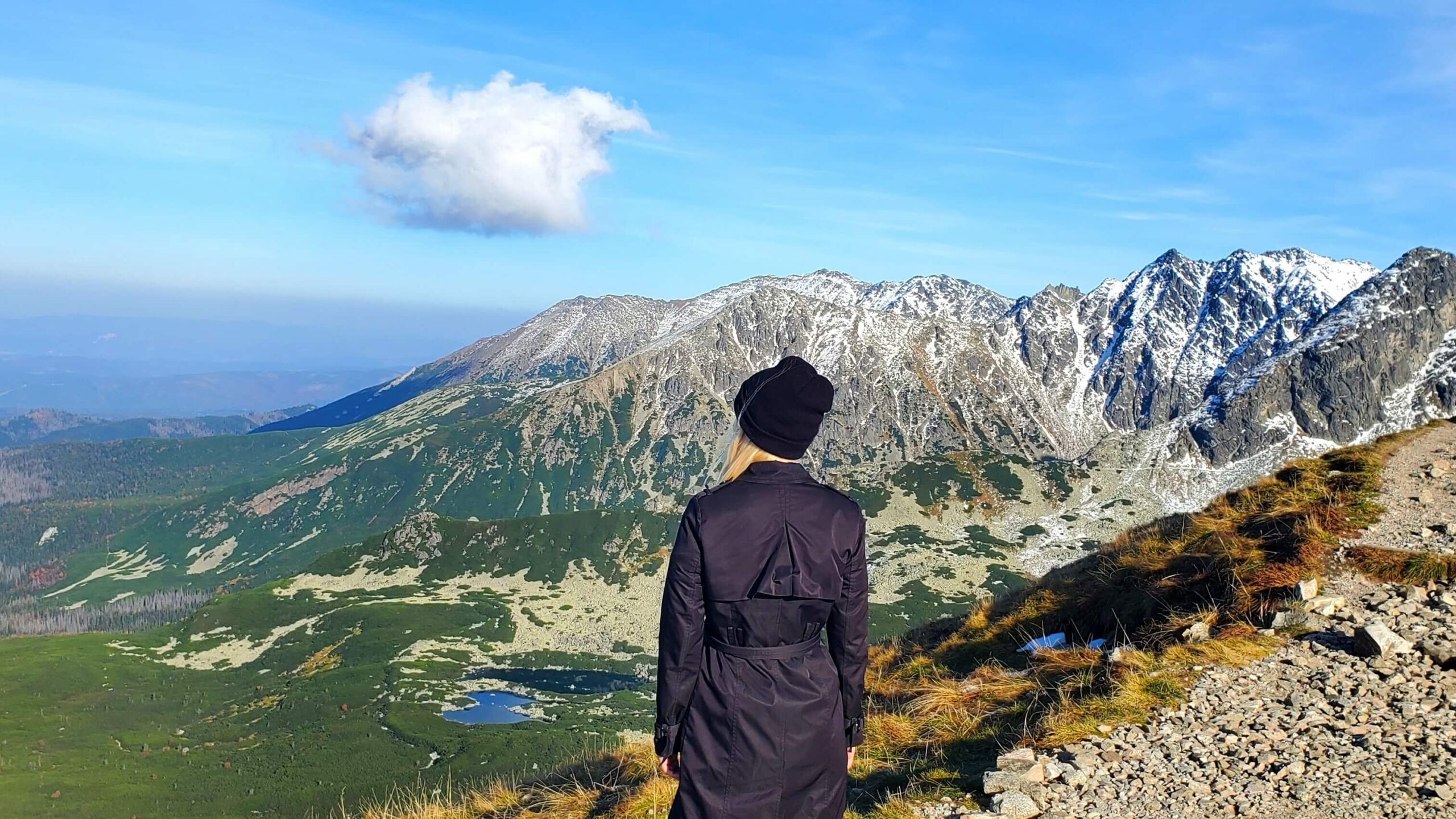
The Tatra Mountains sit in front of you, wrapped in slow-moving mist. Somewhere nearby, goat cheese sizzles over an open fire. You blink twice, and somehow you’re already standing on a mountain peak. You pull your coat tighter as the cold mountain wind cuts through the air, but it doesn’t really matter — the view makes it worth it. And you know a hot thermal bath is waiting for you afterward.
Intrigued?If that sounds like your kind of escape, Zakopane is exactly where you want to be.
In this travel story, I’ll share my personal experience and the best things to do in Zakopane if you want to spend a few days surrounded by breathtaking nature — without committing to an eight-hour mountain hike. Pack your sense of adventure and some warm socks — we’re heading to find out what to see in Zakopane together!
In this Zakapone itinerary:
Day 1 in Zakopane: Waterfalls, Tatra Mountains, and Thermal Baths
Arriving in Zakopane: Driving From Krakow to the Mountains
There are no direct flights to Zakopane, so we landed in Kraków, spent a day wandering its streets, and then rented a car. I’d recommend doing the same — or, depending on where your journey begins, you might choose to drive the entire way. Poland is made for road trips.
The drive from Krakow to Zakopane takes around 1.5 hours — and along the way, the landscape becomes quite picturesque.
After you arrive, you’ll probably want a bit of time to grab a bite and settle in — but don’t take too long. I am always eager to explore, so let’s head straight to our first Zakopane attraction.
Hiking the Siklawica Waterfall Trail in Tatra National Park
Check the ticket prices to enter Tatra national park here.
We’ll start in the place that, for me, was one of the original reasons to come to Zakopane at all — the mountains themselves.
So lace up your hiking boots.
To enter Tatra National Park, you need a ticket. In the first half of the day there was a noticeable queue at the entrance, but by the time we returned it had completely disappeared. You can also buy tickets online, which might save you a bit of waiting.
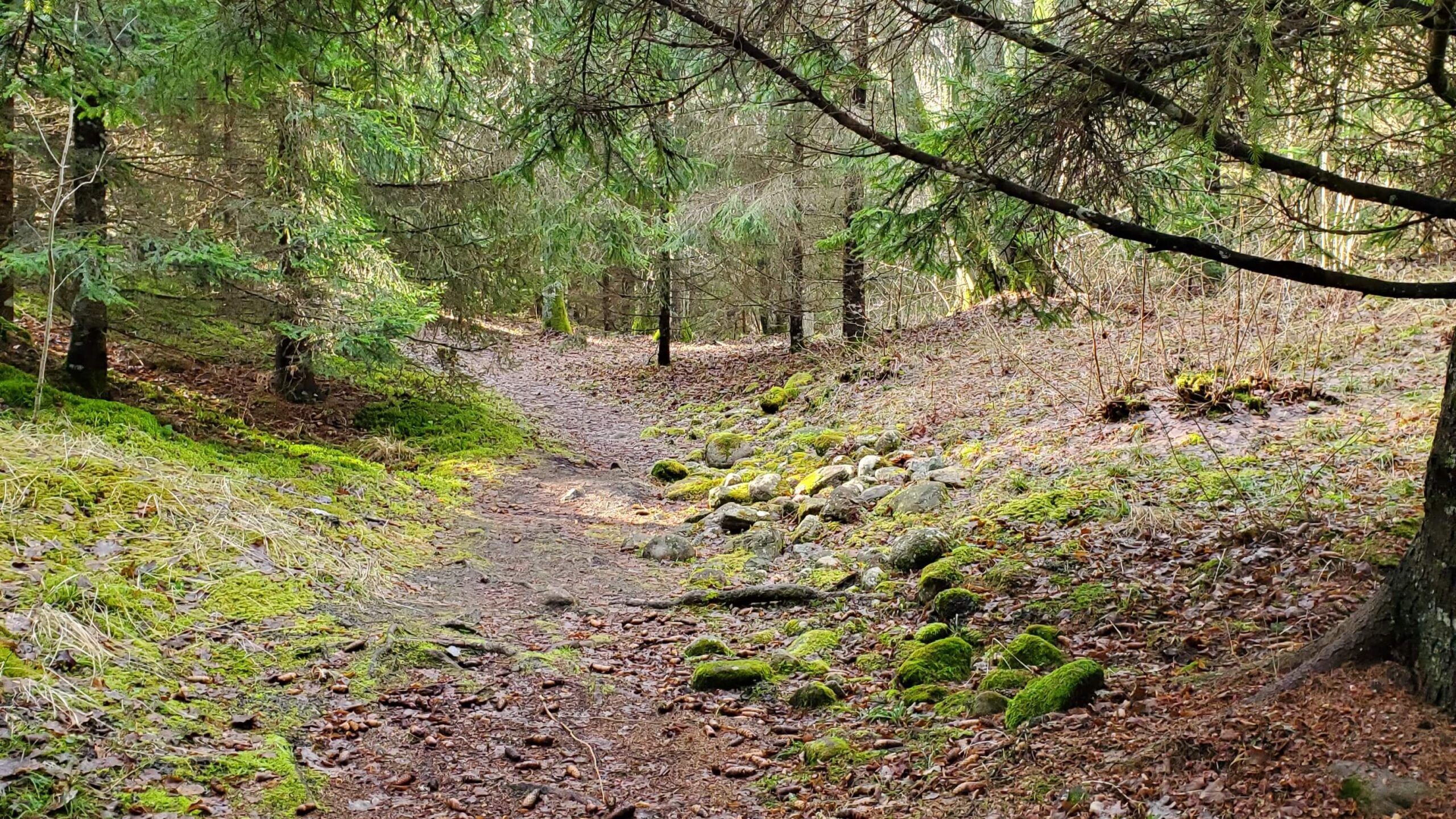
The Siklawica Waterfall trail in Tatra National Park begins gently. You step into a forest that feels calm and familiar, almost welcoming — but it doesn’t stay simple for long.
Soon, a rocky stream appears beside you. The water is so clear you can see every stone at the bottom, and so ice-cold it almost burns your fingertips just from the air around it. On the other side, stone walls rise behind the trees — sharp, layered, and constantly shifting in shape as you move deeper into the forest.
Overall, the trail is relatively easy… until it isn’t.
It climbs steadily uphill, and near the end — just after passing the wooden houses and a large boulder — the path changes character completely. It becomes rocky, uneven, and slippery. This final stretch demands attention and, unfortunately, won’t be accessible to everyone.
But those who push through this natural obstacle course are rewarded.
A 23-meter waterfall, dropping in two powerful tiers over moss-covered stone walls.
The power of the water crashing down gives you a new wave of energy.
If you want to put that energy to use, the path continues further into the mountains. We didn’t go beyond this point, as the 2.5 km walk there and back felt like enough to kickstart our Zakopane adventure.
Zakopane Trip Lesson
Autumn belongs to the mountains.
Or maybe it’s the other way around — the mountains simply reveal what autumn is supposed to feel like.
If you have the chance, plan your Zakopane trip for the golden autumn season. It’s the most magical time of year around here.
A few practical notes on this Zakopane attraction:
There is only paid parking near the trail, no free parking
Drinking water refill point is available
Toilets (free) are only at the start of the trail
After a proper hike, you need to recover. So let’s continue with the most relaxing thing to do in Zakopane. You can take off your hiking boots for now.
Thermal Baths in Zakopane: The Perfect Post-Hike Recovery
What could be better after a long day of travel and exploration than “boiling” yourself in thermal pools?
The best time to visit Zakopane’s thermal baths is when it’s cold and dark outside. Imagine being submerged up to your neck in an open-air pool while steam drifts up around you. The contrast between the hot water and crisp mountain air is instantly refreshing — the warmth slowly loosens every tired muscle, one by one, until your whole body feels like it’s finally exhaling.
During our trip, the most famous thermal baths in Zakopane — Chochołowskie Termy — were closed for maintenance. So we asked our guesthouse for an alternative, and they pointed us toward Terma Bania. It’s a bit of a drive, but absolutely worth it once you’re there.
Terma Bania is impressively clean — noticeably cleaner than the thermal baths I visited in Budapest. Beyond the pools, you’ll find jacuzzis (though you may need a bit of patience to grab a spot), a lazy river, three slides, and a swim-up bar. There’s also a sauna area, though it requires a separate ticket, which we didn’t try this time.
Travel tip
Not everyone makes it to the far end of the complex near the spa entrance. That section seemed much quieter, and you’ll have a far easier time finding bubbling jets all to yourself.
Staying in a Zakopane Mountain Cabin With Tatra Views
I don’t usually write about accommodation, since everyone chooses based on budget. But I’ll make an exception here — because staying in a mountain-view cabin in Zakopane is something you should absolutely experience.
Can you imagine waking up in the morning, stepping onto a balcony with a hot cup of coffee, and looking out at mountains still wrapped in mist? Everything is quiet. The grass is covered in dew, and the windows are slightly fogged. The atmosphere feels almost unreal. Zakopane attractions are cool. But this was hands down my favourite experience.
There are many cabin options in Zakopane. We stayed at Biała Owca. I can recommend it for its beautifully designed interior — modern, tasteful, and charmingly themed around sheep. Just make sure to have a room with a balcony facing the mountains.
Day 2 in Zakopane: Kasprowy Wierch & Food
After morning coffee on the balcony, it’s time to head out in search of another adventure. The Zakopane views you’ll see today are the kind that stay with you for a lifetime. But dress warmly!
The Kasprowy Wierch cable car ride in Zakopane is one of the easiest ways to experience the Tatra Mountains without a demanding climb.
During the ride, it’s fascinating to watch the landscape transform — the endless sea of forest slowly fades away until, at a certain altitude, trees simply stop growing and only raw rock remains.
On the way up, an audio guide shares insights about the route, including why you need to switch cable cars halfway, along with other interesting details. Unfortunately, if other passengers are talking too loudly, it can be difficult to hear everything — but in the end, we’re really here for the views anyway.
Part 2: Exploring the Kasprowy Wierch summit
I’m not surprised that people searching for something often end up on solitary mountain hikes. Standing on a rugged rock in the cold mountain wind, looking out over the vast, untamed landscape below, feels almost otherworldly. It’s as if the world stretches endlessly beneath you — and at the same time, you become painfully aware of just how small you are within it.
One thing that surprised me was finding snow at the very beginning of October. Someone had even built two palm-sized snowmen. For those who arrived in T-shirts, it must have been quite a shock. At least there’s a place to warm up — a cafeteria on site serving hot drinks.
And if you’re craving more adventure, there are hiking trails leading to nearby peaks. The views of rolling, wavy mountain ridges dusted with a light layer of snow stay with you the entire way. A steady stream of hikers moves along the snaking paths, appearing like tiny moving dots across the landscape. And if you look closely, you might even spot two small mountain lakes in the distance. Absolutely breathtaking.
Zakopane Trip Lesson #2
You might want to learn a bit of Polish — because in Poland, some websites (including the one for cable car tickets) are only available in Polish. I used Google Translate, but even that only managed to translate parts of it. Let’s just say I bought my tickets half-blind — but it worked out in the end.
A few practical tips:
Book tickets in advance. I bought mine just one day before in October and couldn’t get my preferred time slot. In summer, it’s likely much busier.
A round-trip ticket gives you 1 hour 45 minutes at the top. If you miss your return, you may be able to take a later ride, but seats are limited and priority goes to timed-ticket holders.
Dress warmer than you would at the base of the mountains. If there’s a chance of snow, wear proper non-slip shoes — otherwise you’ll be walking like a penguin.
You can’t drive directly to the cable car station. You’ll need to park in a paid lot and either walk, take a shuttle, or grab a taxi for part of the way — though some walking is unavoidable regardless.
Smoked cheese ice cream?
After you’re back on the ground, don’t rush off — there’s one more truly unique thing you have to look for. I was genuinely shocked it exists: smoked cheese ice cream.
Yes, really. And no, it’s not cheesecake ice cream — it’s salty, smoky, cheese-flavoured ice cream.
I can’t promise you’ll like it, but I can promise your taste buds will have an experience.
You can find it in one of the small ice cream shops in the area. Unfortunately, I didn’t note the name, so you’ll have to rely on a bit of luck — to track it down.
Krupówki Street is full of life. As you walk down the street, your ears catch fragments of music drifting from somewhere nearby, while your eyes move over souvenir stalls. The smell of fried food floats through the air.
Zakopane Lesson #3
It turns out you can also buy tiny wooden axes and wooden knives as souvenirs. The real question is: would they even let you bring those on a plane?
If you don’t like crowds, this might feel overwhelming — the street is packed. But despite that, the atmosphere is cheerful, lively, and full of energy.
Along the sides, you’ll find beautiful wooden buildings, most of them restaurants or shops. The only real challenge is deciding where to stop for lunch.
We had lunch at Karczma Góralska (Góralska Inn), which we discovered while walking along the main street.
Portions are generous, there’s plenty of space, and the food is tasty. But what really stands out is the interior — almost everything is made of wood. The space is filled with all kinds of objects: kettles, pots, blankets, barrels, even a cradle… and I swear I spotted a bucket hanging from the ceiling. Why? Why not.
If you need a recommendation of a food to try in Poland try Pierogi dumplings. They also have a vegetarian option filled with cheese. But any meat-potatoe dish will be very hearty and tasty.
And we had to skip the dessert in favour of a salty local snack.
Cheese lovers, this is your moment
Your first encounter with Zakopane’s famous cheese will most likely be on Krupówki Street. Stalls line the street selling this local specialty in many variations — smoked or unsmoked, saltier or milder, sometimes even with extras like tomatoes.
In taste, it somewhat resembles the braided cheese you can find in Latvia.
But when it’s grilled and served with cranberry jam, it reaches a whole new level. The texture, however, is quite unusual — slightly rubbery, and definitely an experience.
And just like that — with our bellies full and our hearts even fuller — it’s time to wrap up our Zakopane adventure and head back to Kraków.
Is it worth traveling to Zakopane?
Absolutely.
Once again, I have to say this was only a small glimpse of what Zakopane has to offer — the list of things to do in Zakapone is far longer than what we managed to experience in just two days.
And yet, even in such a short time, I already fell in love with it. There’s something undeniably magical about the mountains — something that lingers long after you’ve left.
Shanghai is a city that grabs you by the senses and refuses to let go. It’s chaotic, exciting, and at times almost surreal—so much so that you’ll catch yourself wondering if what you’re seeing is actually real. From a golden-roof temple to a waterfall inside a greenhouse that feels like another planet, to dazzling 3D billboards, Shanghai attractions are unlike anything you’ve ever experienced. This Shanghai trip itinerary—part guide, part personal recap—is based on my own journey through the city during my China trip in 2025.
Ready to discover what to see in Shanghai? Let’s go.
5 days
Spring
Packed itinerary
Shanghai trip itinerary:
Shanghai Itinerary Day 1: Iconic First Impressions
Our Shanghai itinerary begins the moment our high-speed train from Beijing glides into one of Shanghai’s four massive train stations. We’re buzzing with excitement, eager to dive into everything on our list of what to see in Shanghai.
As we step outside the station to find our way to the hotel, the first surprise of our Shanghai itinerary awaits. Not too far from the train station, I catch sight of a building so unbelievable that I stop in my tracks. It’s covered in tall pillars topped with enormous “vases,” and from each one, actual trees are growing. Whaaaat?
You’ll never guess what this architectural wonder is—it’s not a museum or an art installation. It’s a shopping mall. Welcome to Shanghai!
After checking into our hotel, it is already dark outside. But there’s no way we’re staying in. Too excited (and a bit hungry), we decided to officially kick off our Shanghai travel itinerary with one of the most iconic things to see in Shanghai after dark: Nanjing Road.
Nanjing Road at Night – A Must-See Shanghai Attraction That Defines the City’s Energy
What makes East Nanjing Road one of Shanghai’s most unforgettable streets?
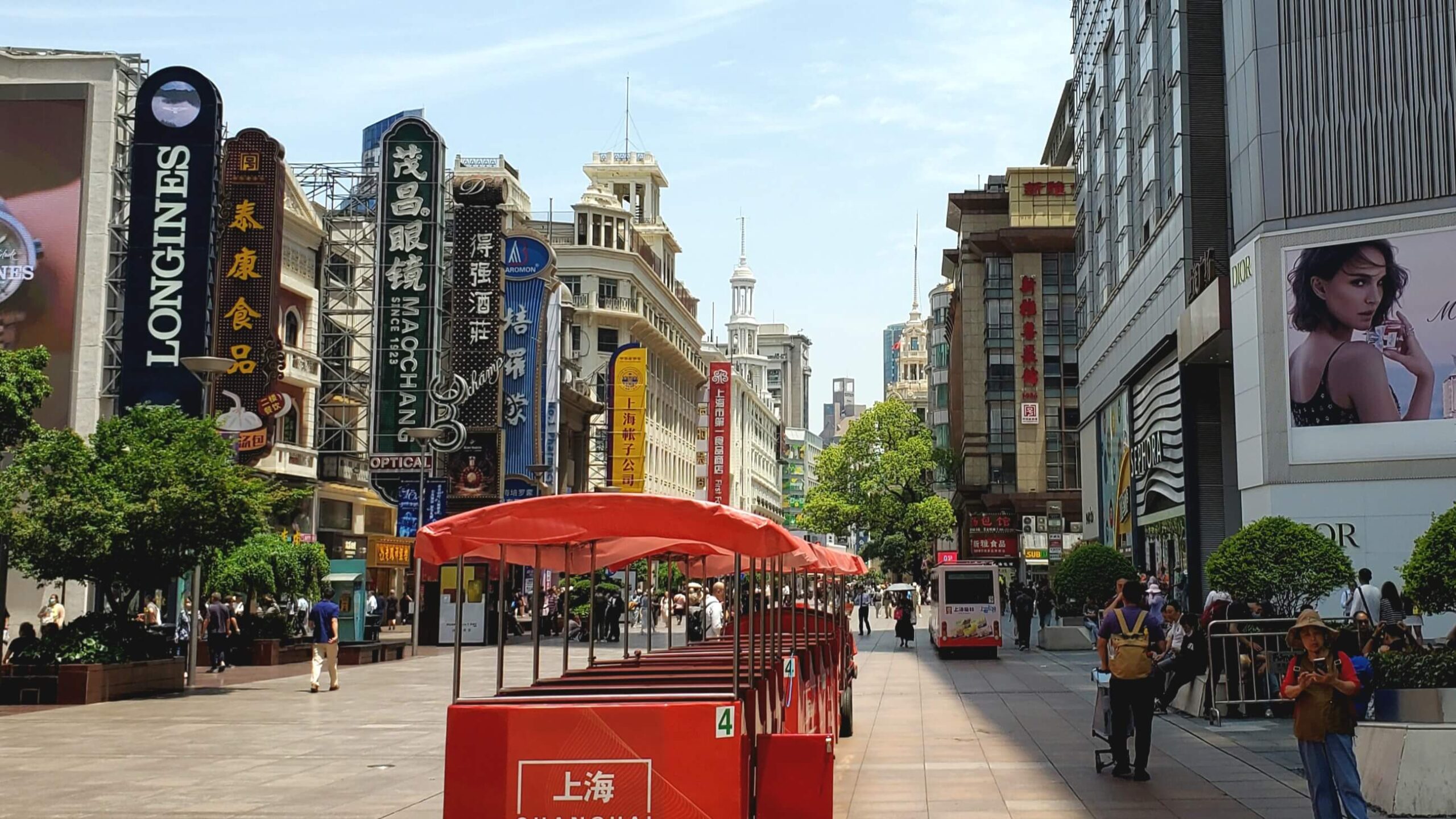
Is it the neon glow of signs and 3D billboards, the ever-moving, ever-buzzing crowd of shoppers, or the lure of secrets tucked away in the shops? East Nanjing Road is a modern promenade of screens, shops, and snacks — a place where the city’s energy never really slows.
When we reach East Nanjing Road, a street of light and motion stretches before us — glowing, humming, alive. Hundreds of neon signs flash and shimmer, and in the distance, a futuristic building floats like a UFO above the crowd. It’s overwhelming, yes, but also thrilling — a glimpse of Shanghai’s restless spirit, glowing through the night.
We pause to snap a photo, and immediately a man approaches us with a card in his hand, promoting, “Guchi, real Guchi!” You’ll meet plenty of these friendly hustlers in the more touristy parts of Shanghai — Nanjing Road included. Luckily a polite “no, thank you” does the trick, and they move along, looking for their next curious traveler and we are free to explore Nanjing Road further.
So, let’s follow the tide of people and dive right into the beautiful chaos — lights flickering, aromas swirling, voices blending. The plan? Wander aimlessly and maybe snag a snack or two from a nearby stall.
And while we are at it, keep your eyes open to historic nods – there are many historic department stores here, including Shanghai No. 1 Department Store, known as the first state owned department store and largest department store in Shanghai. And the retro tram-buses that carry tourists down the street are actually a reference to the historic tram system that once ran through this street.
Find the 3D Billboards of East Nanjing Road
One thing I couldn’t wait to see on this trip to China was the famous 3D billboards — those giant animated screens where images seem to leap into real space. Lucky for us, East Nanjing Road is one of the best places to spot them in Shanghai.
And sure enough, a few steps in, there they are — two massive screens side by side, and a third one perched across the street. The synchronized videos are mesmerizing: a dolphin swims out of one screen and dives straight into the next, as if the street itself were an ocean. How fun is that?
We hang around for a bit, watching the display morph — fluffy, playful Chinese characters seem to dance across the screen, an ancient map unrolls like a magic scroll, and in it, you can see mountain scenery… There are other fun animations too, but from what I understand, the scenes change over time, so by the time you visit Nanjing Road yourself, you’ll probably catch a completely different set of surprises.
The only thing I can’t quite figure out is why they’re called “billboards” — they don’t seem to sell anything. They’re simply here for everyone to enjoy.
We spend a couple of hours here popping into the various shops, taking pictures and grabbing a late dinner on one of the side streets. But after that it’s time to head back to the hotel for some rest.
Crane game arena in one of the Nanjing road shop basements
Shanghai Itinerary Day 2: Futuristic Shanghai Attractions & Skyline Experiences
On the second day of our Shanghai trip, on our way to the metro, we catch a glimpse of the city’s everyday rhythm. Walking through narrow streets lined with block apartment buildings, we notice laundry hanging from poles outside nearly every window — and, as we later learn from our guide on the fourth day of our Shanghai travel itinerary, many people in China simply don’t believe in dryers (shrugs shoulders).
Shanghai feels different from other Chinese cities we’ve visited — busier, less polished, and more chaotic. Hundreds of electric scooters seem to buzz past at every street crossing. But it’s exactly this kind of difference that we seek when we travel.
China 3D Printing Museum – Adding a Technological Twist to Our Shanghai Itinerary
This one’s definitely a niche stop—you really need to be into 3D printing to make this detour part of your Shanghai itinerary. But if 3D printing is your thing and you’re looking for some inspiration, you’ll find plenty to marvel at: from a huge, glowing robot greeting visitors in the entrance hall to 3D models of famous buildings in China, as well as printed bones and furniture. My personal favourites, though, have to be the 3D-printed garments—they sit somewhere between delicate lacework and armour.
After exploring for a bit, we quickly realized the Shanghai 3D printing museum is smaller than expected. But tucked away in the seating area is a fun surprise: a vending machine where you can pay to 3D print a tiny souvenir on the spot. I went with the baby dragon (aka the snake). It’s adorable.
After exploring the museum, we decided to wander around the area a bit—it has a kind of hipster vibe. The buildings are made of colorful shipping containers, there’s a large Transformer statue on one corner, and a bright red telephone booth on another. Yet this part of Shanghai feels a bit in-between—either up-and-coming or fading out—as many of the buildings between the coffee shops appear empty.
Eventually, we head back to the metro because we’ve booked tickets for a very exciting Shanghai attraction. Can you guess what it is? Here’s a hint: the next stop on our itinerary is home to the world’s fastest elevator.
Shanghai’s Glass SkyScraper Jungle – Pudong New Area
This is the Shanghai I imagined.
As soon as we reach Pudong New Area, I have to tilt my head all the way back to take it all in. Glass skyscrapers rise in every direction, reflecting the light and each other. Front and center is the twisted giant itself: Shanghai Tower, the third-tallest building in the world at the time of our Shanghai trip.
Standing nearby are its equally iconic neighbors — the one that looks like a bottle opener (Shanghai World Financial Center) and the one that resembles a syringe (Jin Mao Tower). Together, they’re often jokingly called the three kitchen tools of Shanghai, and seeing them clustered together really drives home just how futuristic this part of the city feels.
It is a vibe rather than an attraction, but it’s the busy metropolitan vibe I’ve been searching for.
Reaching New Heights at Shanghai Tower – Fastest Elevator and Lights Show
Of all the places you can see Shanghai from above, we choose the one that breaks records instead of just offering views — the 3rd tallest building, the fastest elevator and the highest art and culture space.
The experience begins with a rapid ascent — 118 floors in seconds. Then the doors open, and Shanghai unfolds endlessly beneath your feet: a mix of perfect geometric apartment grids and the chaotic older neighborhoods.
The place is perfect for pictures but the real highlight waits even higher.
Beyond the observation deck hides a 1,000-ton tuned mass damper — an engineering marvel designed to steady the tower — transformed into an immersive light and sound experience that fills the space with color, movement, and atmosphere.
At this point, we hit pause on our Shanghai travel itinerary for a bit to take a couple of side quests — a one-day trip to Suzhou and a three-day getaway to Hangzhou. Both cities are incredible and make perfect day or weekend trips from Shanghai. You can read about those adventures first, or jump ahead with us as we return to the city, ready to pick up where we left off and explore more of Shanghai’s must-see attractions.
Shanghai Itinerary Day 3: Nature, Culture & Unique Shanghai Attractions
This day of our Shanghai trip itinerary is definitely the dreamiest. Who would have thought that in a huge, busy city like Shanghai you could feel like you’re in a dreamy fairytale? Well, Shanghai is full of surprises! The Shanghai attractions we are going to visit today will make you feel like the main character in a story about another dimension.
Shanghai Greenhouse – is this reality… or a dream?
How much is there really to see in a greenhouse? Well… if it happens to be the largest in Asia, the answer is: a lot more than you’d expect.
The Shanghai Greenhouse isn’t just a greenhouse — it’s a fully immersive, slightly surreal world divided into three distinct environments: desert, tropical rainforest, and flower garden. Real plants blend with futuristic design and art to create something that feels less like a botanical space… and more like stepping into a dream.
The journey begins in the desert zone. Beneath the spaceship-like ceilings, you walk into a valley filled with cacti in every imaginable shape and size — some of them oddly charming, others just plain strange. You kinda know all of this is staged – but at the same time everything in the Shanghai greenhouse fits in organically as if it was nature’s own masterpiece.
From there, the path leads into a canyon. And here’s where things shift.
You can actually hear the wind howling as you move through the space — until suddenly, you step into something entirely unexpected. A digital landscape comes to life on the walls: animated desert animals dart and play around you, while at the center stands a towering digital “tree” cycling through endless regrowth —and each time it re-grows it’s a bit different.
At this point, I’m already thinking: okay, the ticket to Shanghai greenhouse felt a bit pricey at first but it definitely is worth it. And we’re nowhere near done.
Leaving the sand behind, we step straight into humidity and green.
The tropical zone is dense, layered, and almost overwhelming in the best way possible — plants stacked upon plants, stretching upward and outward, creating a full rainforest atmosphere. But then you look up…
…and realize this isn’t just nature.
Metal walkways crisscross above, and the ceiling curves in a way that feels more sci-fi than jungle. It’s like someone took a rainforest and dropped it inside a spaceship.
And yes — there’s a waterfall. Inside a greenhouse. Not something you see every day.
Hidden beneath a gigantic central tree of this pavilion of Shanghai greenhouse is another surprise: the “underwater forest.” A series of aquariums where fish weave through submerged roots and plants, adding yet another layer to this already surreal story.
And just when you think it can’t get more dreamlike… There’s one more building.
The flower zone.
You’re greeted immediately by a soft, sweet scent as you walk in. Pathways and elevated walkways wind through vibrant blooms, playful installations, shallow pools and sculptural, futuristic shapes that feel almost otherworldly. And there is another waterfall in this part of Shanghai greenhouse too!
It’s less of a garden… and more of a fantasy. I think this might be my favourite modern attraction in Shanghai!
Although every dream eventually comes to an end, this day of our Shanghai itinerary isn’t quite over yet.
Since the Shanghai Greenhouse sits right in the middle of the World Expo Park, it almost feels wrong to rush off. So… why not slow things down for a moment and take a stroll through this vast green space as well?
Shanghai Expo Culture Park – A Relaxing Escape Among Shanghai Attractions
I feel like this is one of those Shanghai attractions many tourists might overlook. But this huge green space hides quite a few surprises — from beautifully landscaped flower beds to fun sculptures, to interesting-looking buildings I’m not entirely sure about the purpose of.
As you stroll around, you’ll notice people simply enjoying the weather — relaxing, playing, or just hanging out on the seemingly endless green lawns.
The overall vibe is very chill and refreshingly real. So if you’re looking to take a break from the always-busy streets of Shanghai, this is definitely the place to be.
After the little break we are ending this day of our Shanghai travel itinerary with a visit to another wonderland.
Yuyuan Bazaar (Yu Garden Market) – What to See in Shanghai for Traditional Charm
When the sun goes down in Shanghai, Yuyuan is the place to be. It’s the historic old part of the city—once the Chinese-run core of Shanghai, while the surrounding areas were taken over as foreign concessions.
Here, you’re surrounded by beautiful old Chinese buildings and old Chinese architecture–inspired buildings—and it’s honestly hard to tell which ones are original and which are newly built. They all share the same elaborate details: multiple levels, wooden lattice balconies, gold accents, and those iconic upward-sloping roofs. Once it gets dark, everything lights up in red, and the whole area feels completely different. At one point, we even caught a little light show, with colors shifting and lights playfully blinking across the buildings.
Travel tip: The transition from day to night completely transforms Yuyuan. Arrive just before sunset and stay until dark—you’ll witness the area shift from calm and historic to vibrant and almost dreamlike. Fair warning – it does get crowded though.
At street level, the first floors are packed with shops and cafés. You could call it a shopping theme park—but that’s part of the charm. I grab a milk tea on the way in, but the options go far beyond that: matcha ice cream, sizzling meat skewers, dumplings… and, surprisingly, some of the freshest, most flavorful mango of our whole China trip.
As we wander deeper into the maze of narrow streets that are packed with people, an enthusiastic vendor pulls us in, and we end up buying “lucky pearls” with our Chinese zodiac animals hidden inside—you peek through a tiny opening to reveal them. A quirky, memorable souvenir from our Shanghai trip. And that’s just one of many: from Chinese green tea to unexpected finds like chocolate beer, Yuyuan Bazaar is full of surprises.
But even if shopping isn’t your thing, there’s plenty to take in in this Shanghai attraction. Turtle statues sit quietly among the crowds, and nearby, the famous pond with its zigzagging nine-turn bridge that is said to grant you long and happy life. During the day, you can spot colorful fish gliding beneath the surface. At night, the water glows an electric blue, creating a striking contrast against the deep red lit buildings surrounding it—one of those scenes that stays with you long after you’ve left.
9 turns bridge in daytime
This is also where the renowned Yu Garden is located, though by the time we arrived, its gates were already closed for the evening—so this experience will have to wait for another visit.
With full bellies and a camera roll full of amazing pictures we finally made our way back to the hotel, ready to rest and take on Shanghai again tomorrow.
Shanghai Itinerary Day 4: Local Life & Iconic Shanghai Attractions at Night
On this day of our Shanghai itinerary, we’ll go beyond what Google can teach and learn about the lives of locals through a walking tour. And after that we’ll do some shopping. Excited? I am.
Shanghai Guided Walking Tour – Your Insight in Locals Daily Lives
Want to understand what everyday life in Shanghai really looks like? This tour dives into stories you won’t find online — from the famous marriage market to the city initiatives shaping locals’ lives. You’ll even hear what a feng shui master advised when planners were deciding what to build on the site of the former race course.
Although I love planning my own travel itineraries, I’ve realized there’s a thread of local culture that’s nearly impossible to catch on your own. That’s why I’ve also grown to love walking tours with a local guide.
This “free” Shanghai walking tour (not actually free — you pay what you feel is appropriate) takes you through some places we already explored earlier on this Shanghai itinerary like the Nanjing road, but also reveals areas and interesting buildings I hadn’t heard of before. And along the way, the guide shares history, local traditions, and even superstitions, giving every corner its own personality.
We wander through wide boulevards and narrow residential alleys, from the former English racecourse all the way to the Bund, where the Pudong skyline rises dramatically across the river. And here’s a fun fact: the oldest skyscraper in this forest of glass and steel — the iconic Oriental Pearl TV Tower — was completed only in 1994. A perfect illustration of Shanghai’s breathtakingly rapid growth.
And while you’re on the Bund, you might notice the giant bull sculpture — Shanghai’s answer to Wall Street’s famous bronze bull. If you’re feeling brave (or hopeful), you can rub its balls for good fortune. You don’t have to… but it’s said to bring financial luck in the future. Just saying.
All in all, the Shanghai free walking tour is a fun, insightful experience that I’d highly recommend.
What’s next on our Shanghai itinerary?
For us, this was the one misstep in planning our Shanghai trip. We headed to the Electronics Mall hoping for a store packed with cool gadgets — but it wasn’t that. Instead, it was a half-empty shop filled mostly with electronic components and spare parts. Not exactly the thrill we had in mind.
Lesson learned: if shopping is on your list, head straight to Shanghai’s most famous “fake shop”.
Shanghai Science Museum Market – A Unique Shopping Experience in Shanghai
I’ll be the one to say it – shopping in the “almost real brands” shop in Shanghai is a lot of fun.
It’s a crazy labyrinth of small stores, one after another, where after a while you can’t tell whether you’ve already walked down the same aisle. The stores kinda look the same but kinda are different.
Most stores sell items “inspired” by popular brands: bags, shoes, glasses, toys, and even some electronics. Mostly wearable items, as it seems.
As you wander through this maze, shop owners enthusiastically promote their wares, and prices depend entirely on your haggling skills. It’s ok if you don’t speak Chinese. Turns out you can haggle by using a calculator.
Tip: Only haggle if you actually plan to buy the item. Trying to negotiate the price down and then walk away will seriously offend the shop owner — and honestly, I can understand why.
Day 4 of our Shanghai itinerary has been quite exhausting. Most people would probably be done at this point. But if you’re a little crazy like us, there’s always one more Shanghai attraction to squeeze in.
Bund at Night – One of the Most Memorable Shanghai Attractions
Yes, we already visited The Bund earlier on our Shanghai itinerary. But that was in broad daylight — and if you ask me, you haven’t truly seen the Bund until you’ve stood here after dark.
Because this is when the difference between the old and the new truly shines — quite literally.
Travel tip: If you’re planning your own Shanghai itinerary and have limited time, I would absolutely prioritize exploring The Bund at night over the daytime visit.
Across the dark river, Pudong explodes into light. Skyscrapers glow in electric blues, and neon pinks. Entire facades pulse and transform in looping animations. Some buildings blink. Others stream advertisements (the Shanghai hustle is very real). A few proudly flash “I ❤️ SHANGHAI” across their surfaces.
Unlike the perfectly timed spectacle we saw in Hangzhou, Shanghai doesn’t seem interested in moving in sync. Here, every skyscraper performs independently — blinking, scrolling, pulsing, advertising. It’s busy. It’s bold. It’s chaotic. And somehow, this layered energy mirrors the city’s personality perfectly.
Now turn around.
On this side of the river, the historic buildings lining The Bund glow in warm golden light. Their neoclassical facades are illuminated softly, highlighting every architectural detail. They feel calm and collected. Almost as if standing in quiet protest to the neon spectacle across the water.
Ok, after snapping the obligatory (and very cool) photos I am exhausted too, so let’s end the 4th day of our Shanghai itinerary here.
Shanghai Itinerary Day 5: Spiritual Landmarks & Unbelievable Tricks
I could call the last day of our Shanghai trip itinerary the catch-all day — the one where we squeeze in all the Shanghai attractions we didn’t have time (or energy) to visit earlier. But somehow that label doesn’t quite do this day justice.
After all, what could be more fitting for a city as financially minded as Shanghai than a golden temple tucked between skyscrapers?
Jing’an Temple : A Golden Temple in the Heart of Shanghai
Jing’an Temple is worth a stop on your Shanghai itinerary for many reasons, but the first thing that will likely catch your attention is its setting. There’s something fascinating about the contrast—a Buddhist temple standing quietly among glass skyscrapers, the old and the new meeting in a way that feels very Shanghai.
Then your eyes are drawn to the roof.
The golden roof seems to shimmer, even on a rainy day, catching what little light there is. Not far from it, a pillar guarded by four golden lions stands firmly in place, and the longer you look, the more details appear: countless golden animals and mythical creatures, from elephants to water drains shaped like dragons—which, as it turns out in Chinese mythology, are believed to control water and weather. Layered roofs, intricate carvings, moon gates… every element seems designed to reward careful observation.
Inside the temple, you’ll find many halls, each housing its own statue of Buddha or a deity, with an altar covered in offerings in front—similar to other temples around China. And because China is digital-first, you can even make an offering using a cashless payment on your phone.Who would have thought?
But what I love most is a small interactive moment. In the middle of the courtyard of Jing’an Temple sits a large metal vessel. I’m still not entirely sure what it is, but that’s okay. What matters is what people are doing around it. One by one, visitors step forward and toss coins toward it, hoping to land one inside and bring themselves a bit of luck.
It looks easy.
It isn’t.
We give it a try—and quickly realize it takes more than just a casual throw, which makes the moment when you finally succeed all the sweeter.
But what’ s next?
During our Shanghai trip, we used part of this day to visit another attraction that unfortunately I can’t wholeheartedly recommend — so I’ll spare you the details.
Instead, I’d treat this part of the day as a bit of breathing room. It’s a good opportunity to fit in any Shanghai attractions from my itinerary you didn’t have the time or energy to visit earlier (I know my schedule may feel quite packed for some).
Or if the Shanghai Science and Technology Museum has reopened (it was under renovation during our visit), that could easily fill a few fascinating hours. We visited the science museum in Beijing and that was really fun.
But even if you decide just to sit back and chill for a couple of hours, we’re not done yet — the real highlight of the day, and the perfect way to wrap up this Shanghai itinerary, comes in the evening.
Shanghai Circus World – A Spectacular Finale to Your Shanghai Itinerary
Welcome to a place where visual projections meet fearless acrobats performing gravity-defying tricks. Shanghai Circus World is guaranteed to make you hold your breath.
The show starts slowly, with a dance number and a touch of a love story — but it doesn’t stay calm for long.
Soon, ethereal performers take to the air, twisting and rolling on ribbons, pulling off splits high above the stage as if they were made of feathers… and nerves of steel.
That energy quickly shifts into high-speed chaos — trampolines, flips, mid-air twists, and performers jumping through circles thrown in the air and onto each other’s shoulders to form human towers, each act more complex than the last.
The air turns heavy with tension. You sit there, holding your breath… you can see the focus and a hint of nervousness in their faces and when they land a particularly complex trick, you can hear the audience around you aww in unison. Some things just seem impossible to do until you see someone do it.
And then — it somehow goes even further.
A giant metal sphere appears. One motorcycle rider enters, circling inside, defying gravity.
TThen another.
And another…
And another. And another… I think in the end there are around 6 or 7 but I’ve lost the count and at this point all you can can see are streaks of light from the headlights racing around the ball in every direction
The show in Shanghai Circus is a spectacular performance that leaves your nerves tingling, but the ending is a happy one.
On this high note, our Shanghai trip itinerary comes to an end.
On our Shanghai trip we did have a couple of hours the next day before our flight, which we used for some last-minute souvenir shopping, but other than that it’s time to head home to tell all your adventure stories.
…
Thoughts?
Shanghai could be a bit of a culture shock for some. But for me – that’s what I was going for. So I enjoyed the fast paced, chaotic rhythm of the city that is different not only from Europe, but also from other cities I visited in China. From record breaking high-rises to beautiful places that feels like they could be a backdrop for a fairytale and all the scooters on the crossroads – visiting Shanghai was truly an adventure.
PS: if you’re actively planning a trip to China you may also be interested to take a peek into my China travel planning tips as well.
In the Baltics, Tartu, Estonia is best known as a university town—so it feels only right to approach our winter trip to Tartu like a small experiment. The goal? To find a simple formula for what to see in Tartu during a short winter day.
Since Tartu is rather quiet in winter, our equation isn’t complicated. It includes exploring some of the Tartu Old town attractions, having lunch in an old gunpowder cellar, getting fooled multiple times by optical illusions at a science center, and ending the day by winding down in a spa. Sounds good? Then let’s find out what to see in Tartu in winter.
When we arrive in Tartu on a December day, the weather is rather sad: gloomy skies and pouring rain. To escape the miserable conditions, we head straight to Tartu’s most famous indoor attraction—and a classic destination for school trips from Latvia—the AHHAA Science Centre.
You can already guess what awaits inside AHHAA by the very first exhibit standing outside the building: a lever that lets you lift a small car into the air. It’s an immediate promise of what’s to come.
The AHHAA Science Center in Tartu explains natural phenomena through hands-on experiences, inviting visitors to touch, test, and question everything. It’s clearly designed for children, but with an open mind—and a bit of curiosity—adults can enjoy it too.
Inside the two main rooms, there’s a box where you can experience an earthquake, the floor vibrating under your feet. Right next to it, a small tornado spins endlessly, so close that you could touch it. There’s also a tunnel that makes you feel like the floor you’re walking on is slanted—when it actually isn’t. That one made me dizzy. And many more smaller experiments.
In addition to the main halls there’s also a temporary exhibition hall, which, to my mild horror during our winter trip to Tartu, was filled with gigantic bug sculptures.
We get lost in a small mirror maze (I walked straight into a wall twice—oops), laugh at crooked mirrors that stretch and shrink our reflections, and watch the braver visitors ride a bicycle along a rope suspended high above the ground. Elsewhere, people test how far they can jump or how loud they can scream, filling the space with bursts of laughter.
If I were a kid, I would have absolutely loved this place—and judging by the many excited children running from exhibit to exhibit, it clearly delivers. For us grown-ups, exploring the AHHAA Science Center in Tartu took about an hour, though I can easily imagine it taking much longer when explored together with curious kids.
When we step outside the rain is still pouring down, so it is time to explore another indoor attraction in Tartu and cross our fingers that the weather improves.
Today’s lunch takes place under brick arches that are more than 300 years old, in Tartu’s historic Gunpowder Cellar.
Following the map we locate a building that does look like a piece of an old brick fortification wall. And as we step inside the Tartu’s former fortification, we’re greeted by a tall, curved brick ceiling and sturdy wooden furniture. The walls are decorated with old barrels, carriage wheels, and countless mugs with people’s names written on them. The space feels cozy, atmospheric, and slightly like stepping back in time.
Luckily, Gunpowder cellar in Tartu is not just pleasing to the eye. The food is hearty and local, perfect for a cold winter day. The most fun dishes, in my opinion, are the soups or mashed potatoes with smoked meat served in bread bowls. Add a wide selection of beers, and it’s an excellent lunch stop while exploring what to see in Tartu in winter.
After lunch the rain has finally stopped so we get a chance to explore some of Tartu outdoor attractions as well.
Tartu Town Hall Square and Kissing Student Sculpture
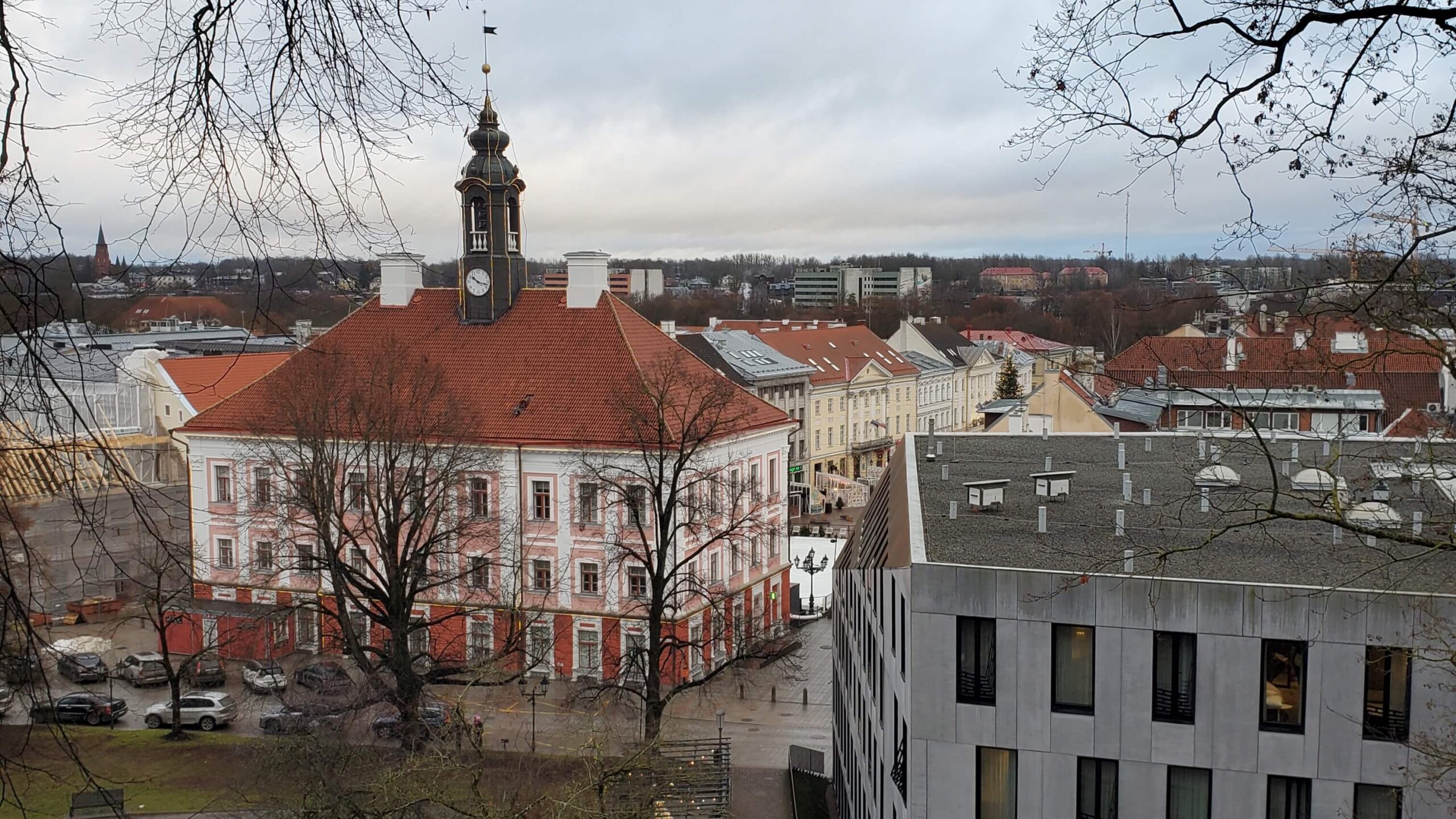
Town Hall Square is picturesque any time of year, but during the Christmas season in Tartu, it takes on an extra layer of charm. The entire square is strung with lights, and the edges of the Tartu iconic pink Town Hall—already the third to stand on this spot—are outlined with fairy lights, giving it a whimsical, almost magical Christmas touch. It’s a perfect picture spot!
In front of the Tartu town hall building, surrounding Tartu’s famous Kissing Students sculpture, a seasonal (Dec-End of Feb) ice-skating rink is set up. With lights reflecting off the ice, the square transforms into a charming, picturesque spot to practice your skating and soak up the festive atmosphere. If it wasn’t raining during my winter trip to Tartu I would have tried it.
But if you are not visiting Tartu during winter, I also find the Kissing Students sculpture very romantic in the summertime, when the water is running. Here’s an older photo from my first visit to Tartu in 2019, showing how different the scene looks in warmer months.
Memory from Summer of 2019.
Fun detail: As I later discovered, all the Christmas magic had distracted me from another, slightly quirky attraction in Town Hall Square—the Crooked House. Apparently, one side of its façade is lower than the other. Keep an eye out for it on your trip to Tartu and see if you can spot the tilt—it sounds like a fun little detail that’s easy to miss!
Tartu Christmas Tree (December Only)
Another beautiful addition to Tartu Town Hall Square that you can see during the Christmas season in Tartu is the city’s Christmas tree. It stands tall, brightening the gloomy winter days with strings of lights and sparkling ornaments that remind me of puzuri.
The most charming detail is the red mailbox for Santa placed next to the tree. Letters hang from the branches, many decorated with children’s drawings. It brings back sweet memories of my great-grandmother once suggesting that I leave my letter to Santa in a tree so the birds could carry it to him.
But now let’s address the elephant in the room: the Tartu Christmas Village doesn’t make it onto my list of places to see in Tartu. Why? I want to be honest and I’m sorry to say it didn’t meet my expectations.
The small glass domes under the strings of lights look cute and picturesque, but I had expected each of them to house a little market stall. Unfortunately, during the 2025 Christmas season when we visited, only two or three of the booths were actually selling anything; the rest were installations featuring books or sports equipment. So this year, at least, it wasn’t a Christmas market in the way most people might expect. Hence why I didn’t spend much time here.
The next couple of attractions to see in Tartu old town will be more subtle and suited for those enjoying historic architecture (or the ones like me who just like to wander through older towns). If you’re traveling with children they might not be too interested in these, so feel free to jump ahead.
Rüüti Street: One of the Oldest Streets in Tartu
While wandering through Town Hall Square in Tartu, we spot a side street lined with pastel coloured houses, and I make an executive decision to walk down it.
A plaque on the wall explains that Rüüti Street is one of the oldest streets in Tartu and gives a brief history. According to the sign, the buildings represent the Classical style and later periods—but to be honest, I’m not entirely sure what that means.
Many of the ground-floor windows are shop fronts advertising dresses and baked goods, but in winter, this street—like much of Tartu—is unusually quiet. Overall, this is just a street, so I simply enjoy the chance to stretch my legs and take in the pastel-colored architecture at a leisurely pace.
Then I decided we should climb the little hill we noticed on our way to Tartu’s Gunpowder Cellar. I think it’s where the Tartu Observatory is located, though unfortunately, according to my research, no excursions are available on weekends. Still, I suspect there might be a nice view from the top, and the climb up the stairs isn’t too strenuous.
From the top, you can see the rooftops of Tartu, with the pink Town Hall building standing out in the skyline. I can’t help but think that places always look better from a higher vantage point. Would you agree?
We continue our walk through Tartu Old Town and soon reach something that, at first, looks like a yellow gate. As we get closer, it becomes clear that it’s actually a pedestrian bridge connecting two parts of the hill.
Tartu’s Angel Bridge is decorated with a relief of the first rector of the University of Tartu and an inscription that translates to “Rest restores strength.” It’s a pleasant detail rather than something you’d plan a visit around—but since it lies directly on the walking route, it’s an easy and enjoyable photo stop while exploring Tartu Old Town.
And some people say you can make a wish while crossing it. We keep walking as we’re on our way to another interesting architectural structure to see in Tartu.
Just a short walk from the bridge, we reach the Tartu Dome Cathedral, one of the most important historical attractions in Tartu. Built in the 13th century, it was once among the largest religious buildings in Eastern Europe, before falling into decline during the Reformation.
Approaching the cathedral from the side of Angel Bridge, you wouldn’t immediately suspect that much of it lies in ruins. Part of the building has been restored and now houses the University of Tartu Museum, giving a more complete impression from this angle.
Closer up, the ruins reveal themselves. Several sections are missing their roof and windows, leaving tall brick arches exposed to the sky. The bare walls and open structure give the space a raw, slightly dramatic atmosphere and in my opinion this haunted look makes it more interesting.
And even in its ruined state, the cathedral feels majestic. The sheer height of the remaining walls hints at how grand it must have been in its prime. It’s hard not to pause here and imagine what the cathedral once looked like in its full glory. And it’s a great place for photos!
That was a lovely walk through Tartu Old Town, but now it’s time to escape the city’s gloomy winter weather and unwind in some steamy saunas and hot water baths.
What I like about VSpa Tartu is the variety of saunas they offer. Alongside the usual steam bath and Russian sauna, there’s an aroma sauna with a large window overlooking the street below—and, amusingly, a TV playing cartoons. My personal favorite is the honey sauna, which isn’t too hot but fills the air with the sweet scent of honey.
The spa also has pools for adults and children with fun bubblers and a “river” effect where the stream carries you in circles, hot tubs, a deeply warm and soothing Japanese bath (my favourite), and plenty of spots to relax in loungers or swinging chairs. Overall, there’s a wide variety to enjoy, and in my opinion, it’s a genuinely fun place to unwind.
This is also where we spent the night, rounding off our list of what to see in Tartu.
Thoughts?
I can easily imagine travelers with kids loving Tartu, thanks to attractions like the Science Centre and the spa. I remember visiting back in 2019, when my brother was still a teenager—he absolutely enjoyed it. For adults, however, it takes a bit more effort to fill a full day, as many of the highlights in Old Town are subtler and less obvious. For me, one full day was more than enough to discover what to see in Tartu.
Practical information on visiting Tartu
How to get to Tartu, Estonia?
You can Travel to Tartu by car or by buss from the largest cities in Baltics (E.g. Riga, Tallinn…). I traveled with Luxexpress buss from Riga and it was a pleasant trip as they have an entertainment system where you can watch movies.
If you’re curious about Buddhism in China, just outside Hangzhou you’ll find Lingyin Temple—a historic and still active place of worship. Here, you can take your time admiring the intricate temple architecture and respectfully observe the rituals of those who have come to pray. But the experience doesn’t end there.The surrounding Lingyin–Feilai Peak Scenic Area is home to the remarkable Feilai Feng Grottoes—a collection of around 300 Buddhist stone carvings hidden among moss-covered cliffs, many dating back over 1,000 years.
During my two-week adventure through China, I was fortunate to explore the breathtaking Feilai Feng Grottoes and the fascinating Lingyin Temple. This journey wasn’t without its logistical hiccups, but the sheer beauty of the sites more than made up for it. Let me take you on a virtual walk through this ancient spiritual landscape — and share tips for your own trip to Feilai Feng Grottoes.
The Roller Coaster of Getting To Lingyin Temple and Feilai Feng Grottoes
I’m calling this part of the story “Learn from My Mistakes.” Because for me, getting to the Lingyin – Feilai Feng Scenic Area was a bit of a rollercoaster. But don’t be discouraged — it was absolutely worth it in the end.
Since the Feilai Feng Scenic Area sits outside of Hangzhou’s city center, there are no metro lines that go directly there. The two main options I found were to take a bus or use a taxi/Didi. I wasn’t sure how to buy a bus ticket at the time, and since Didi is super affordable, I figured it would be easiest to take the metro as far as I could and then catch a Didi from the last station.
Spoiler alert: it wasn’t.
My Attempt to Use Didi to Get To Feilan Feng
I entered the Feilai Feng Scenic Area ticket office as my drop-off point in the app. It seemed straightforward. But I should’ve known something was up when multiple drivers canceled on me. Eventually, one did accept, and for a moment, things were looking up.
But soon after we got going, the driver started pointing at the map and trying to explain something. The problem? He spoke no English, and I speak no Mandarin. Still, through some miracle of pointing and shrugging, we reached a shared understanding: he couldn’t drop me off where I’d requested.
I wasn’t sure why… until we got further along and I saw it for myself — there was a restricted zone where cars weren’t allowed to pass.
This is where I start to panic. I’m outside the city, alone, with limited mobile data and a very real language barrier. But people in China are incredibly kind — the taxi driver actually gets out of the car with me and flags down someone nearby, who turns out to be a police officer. And luckily, he speaks English.
The officer explains that from this point on, no cars are allowed, and I’ll need to continue the rest of the way on foot. It’s about a 15-minute walk, he says, and points me in the right direction.
Views along the way were beautiful though
So, I take a breath, thank both of them as best I can, and start walking. I fall into step with the gentle stream of people making their way along the path. The greenery on either side feels calm and quiet — a soft contrast to the chaos just moments before. Eventually, the first signs of the Feilai Feng Scenic Area appear: a few small shops, then the first clusters of people, and finally the ticket booths. Just like that, I’m back on track.
Looking back, I honestly think I should have just taken the bus from the beginning. And because I now knew that didi wasn’t a viable option, that’s exactly what I did to get back to Hangzhou. I did see a sign for some kind of a taxi in the scenic area, so I suppose there are some exceptions, but knowing I speak no Mandarin I thought I wouldn’t be able to explain where I needed to go or align on the price. So let’s skip forward to the point I was ready to return to the city.
Going Back from Feilai Feng Scenic Area to Hangzhou by Buss
When I’m ready to head back to Hangzhou, I open Amap to figure out which bus can take me back to the city where I can connect to the metro. I follow the signs to the bus stop — and to my surprise, the signage is actually really clear and easy to follow.
There’s just one last challenge: figuring out how to buy a bus ticket. Everyone else is scanning a QR code on an app that isn’t working for me.
Long story short: it’s best to buy your public transport ticket through the app. But if that fails, the station at the Lingyin–Feilai Feng Scenic Area also accepts cash — but you have to have exact bills. Because there’s just a simple fare box where you drop in the money and they have no chance to give. Luckily, even though China is mostly cashless, I always carry a bit of RMB, and this time, it really came in handy.
Fortunately this bus even announced the stops in English, which helped a lot. But in case if it doesn’t…
Travel tip: Once on the bus you can use Amap to track your live location vs the bus route to your destination to make sure you don’t miss your stop.
So after all the stress and a few hiccups, I make it back to Hangzhou safely.
Please note: I’m not trying to scare anyone — just sharing my experience to help you plan ahead and avoid unnecessary stress.
So in summary my tip on how to get to Lingyin – Feilai Feng scenic area would be:
The easiest and most stress-free way to reach the Lingyin–Feilai Feng scenic area is by bus. I took Route 7 on my way back, but I recommend using Amap (the local navigation app) to find the route that works best from your location. It’s reliable and keeps you informed with real-time updates.
If you do need to take a taxi, I strongly suggest asking your hotel to help you arrange it. They can confirm the drop-off point with the driver and give you any essential information — especially helpful if there’s a language barrier.
But now, let’s jump into the actual adventure of Lingyin temple and Feilan Feng Grottoes.
Sneak peak
How to Purchase Tickets to Lingyin Temple and Feilai Feng Grottoes
I believe there’s an option to buy tickets online, but since I’ve had some challenges booking through Chinese websites in the past, I decided to buy my ticket at the entrance instead.
There are a LOT of people here — but luckily, it seems many have pre-booked online, so the queue for on-site tickets is surprisingly manageable.
Travel tip: during my trip in 2025 this ticket booth only accepted Alipay — not WeChat Pay. I never managed to get Alipay to work properly, but I come prepared with some cash, and they’re happy to accept that. So even though China is largely cashless, I still recommend carrying some RMB — it can be a lifesaver.
Another important heads-up:
There are two separate entrance tickets — one for the Feilai Feng Scenic Area, and another for Lingyin Temple itself. The ticket you buy at this first booth only gives you access to the scenic area. If you want to visit the temple as well (which I recommend!), you’ll need to buy an additional ticket later, near the temple entrance.
To clarify:
✅ You can visit just the Feilai Feng Scenic Area without entering the temple.
❌ You cannot visit Lingyin Temple without first entering the scenic area.
Hope that makes sense!
Ticket in hand, we set off again — continuing our quest to find the actual entrance.
Exploring the Mesmerising Feilai Feng Grottoes: What to Expect as a Foreigner
I think everyone arrives eager to explore the famous Feilai Feng Grottoes. But just after the ticket check, there’s a small park area that feels like a quiet pause before the main experience. Hidden among blooming hydrangea bushes are large Chinese drums. It’s much less crowded here than near the ticket booths or snack stands, and the calm is welcome.
Every so often, a visitor strikes one of the drums, sending a deep, echoing sound across the park. The steady beat lingers in the air as we continue our walk toward the limestone cliffs.
Find the Buddhist Rock Carvings Hidden in the Feilai Feng Cliffs
There are countless small caves and grottoes hidden within the moss-covered, mysterious cliffs of the Feilai Feng Grottoes. Narrow paths wind organically between the limestone hills, and I’m not quite sure where to begin this exploration. But when I spot a few other visitors slipping into a shadowy archway — carved by nature itself into the rock — I decide we should follow.
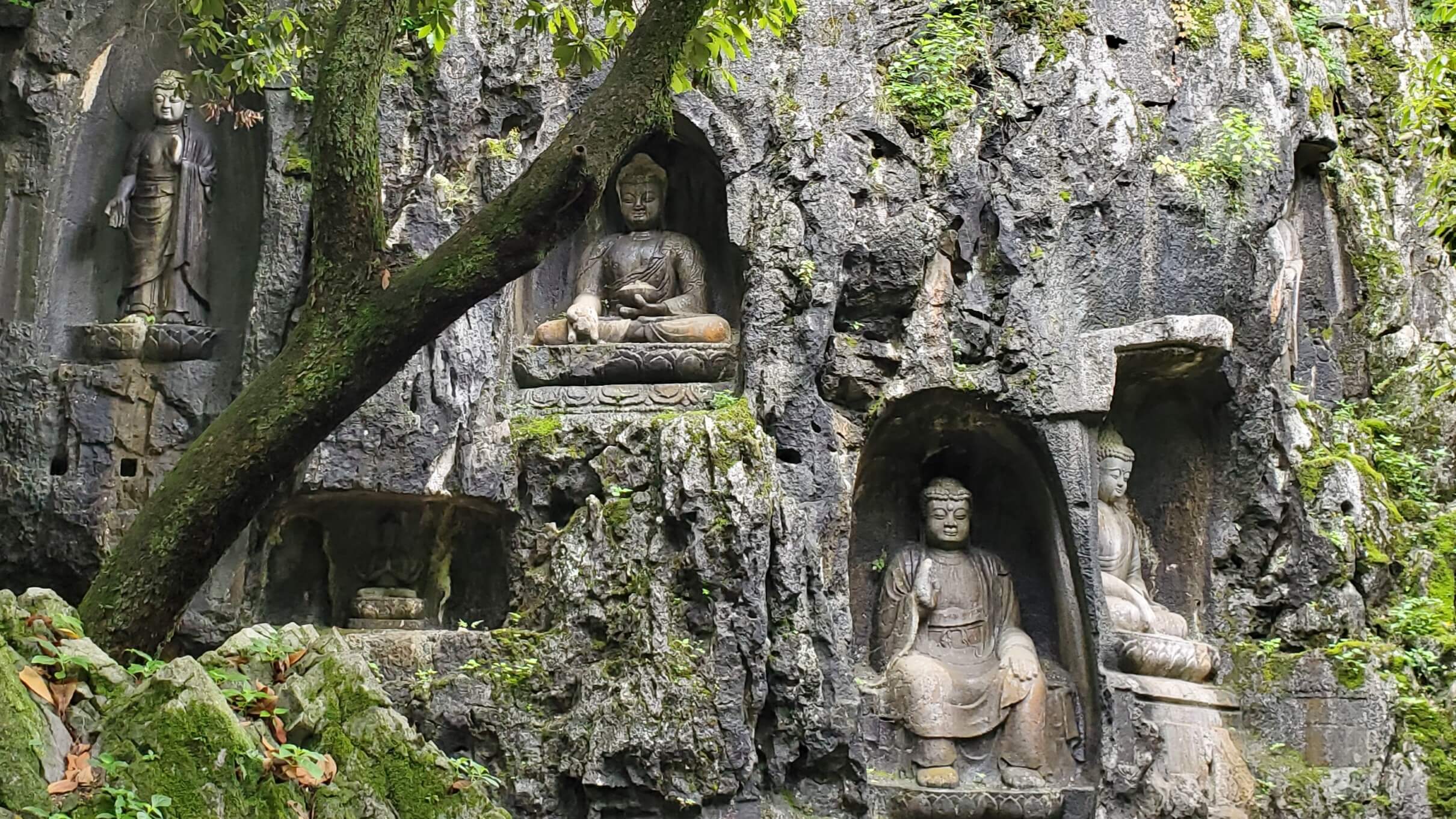
Inside, the air is cold and the walls glisten with moisture. The rock ceiling curves and dips like frozen ocean waves — low in places, soaring in others. Soft beams of light filter through natural skylight above, casting a gentle glow on the raw, sculpted surfaces. But the darkest corners are lit up with artificial light, revealing what lies hidden within: ancient Buddhist statues, carved into the stone of Feilai Feng cliffs.
There really are all kinds of figures here in the Feilai Feng Grottoes — Buddhas, Bodhisattvas (enlightened beings who delay their own enlightenment to guide others), and powerful deities. Many sit cross-legged in deep meditation. While their features are often similar, each one wears a distinct expression — wise, peaceful, joyful. Between them, inscriptions are etched into the rock, clearly filled with meaning. I can’t read them, but I wish I could.
Stepping out of the cave and into bright daylight, we’re greeted by even more stone statues. Just ahead stands a weathered rock pagoda, its surface decorated with rows of tiny Buddha sculptures. Behind it, inside a stone niche, sits a large figure — a man with a crown on his head and a floral sash draped across his body.
The level of detail is astonishing. Can you imagine the patience it must have taken to carve every wrinkle in the folds of the robes the stone figures in Feilai Feng Grottoes are wearing?
And where the cliff stretches beyond, it’s full of all kinds of sculptures tucked between the moss — including the famous Laughing Buddha, a symbol of good cheer and contentment. Exploring the Feilai Feng scenic area is like one of those detective games where you have to spot objects hidden in a scene.
At the base of the cliff is a still pool of milky blue water. Turtles lounge on the rocks or drift slowly through the water, undisturbed by the endless flow of people taking the photos of the statues and exploring the paths that lead up the cliff.
I don’t have the knowledge to decode what each statue represents, but I can tell that every one is telling its own unique story. The figure that fascinates me most in the Feilai Feng Grottoes is tucked away in a dark cave. I say “figure” loosely—because all I see are two glowing red eyes staring back at me from the shadows.
Climbing up the Path Above the Feilai Feng Carvings
I’m curious to see where those winding little paths above the cliffside carvings of Feilan Feng actually lead to. Aren’t you?
We pick one at random and begin our climb. Be careful as after the train the steps are very slippery! Around us, the forest feels quiet and a little mysterious — full of trees and massive, smooth boulders that look like they’ve been polished by centuries of mist and time.
The path twists and rises for quite a while. Eventually, we reach a small clearing — a sort of plateau with large rocks in the center — where most other visitors seem to be stopping. It’s not exactly a dramatic summit. The dense trees block any sweeping views, so if you’re hoping for a panoramic photo op, this probably isn’t it. But there is a vending machine where you can purchase ice cream and water for some refreshment!
I look around for a few minutes, wondering if I’ve missed another path leading deeper into the forest. If you discover something I didn’t, do let me know. For now, we make our way back down — legs a bit wobbly from the descent and minds already shifting to what’s next: the Lingyin Temple.
Discover Lingyin temples Living Legacy
There are actually several temples scattered throughout the Feilai Feng scenic area, but today we’re focusing on the most famous one: Lingyin Temple. Founded in 326 AD by an Indian monk, Lingyin Temple is considered one of the ten most important Buddhist temples in China.
After purchasing the separate entrance ticket (as mentioned earlier, Lingyin Temple requires its own admission in addition to the ticket for the Feilai Feng scenic area), we follow the steady stream of visitors into the temple’s vast courtyard. The scent of incense immediately fills the air, grounding you in the moment. At the center stands a towering incense burner, smoke curling upward in thick, fragrant spirals.
Because Lingyin Temple is still an active place of worship, you’ll see pilgrims bowing with incense sticks in hand. I don’t know the specific rituals of Buddhism well enough to explain what I’m seeing — and I wouldn’t want to get it wrong — so I simply watch quietly from a respectful distance, letting the atmosphere speak for itself.
Exploring the Lingyin Temple Halls
There’s not just one hall inside Lingyin Temple — there are many, each with its own distinct energy. The architecture is striking: upturned eaves with dragons perched on the corners, and large doors that seem to always be open, welcoming a steady stream of visitors. Though the temple has been destroyed and rebuilt multiple times throughout history, its structures still offer a deep glimpse into traditional Buddhist temple design. For example look at these windows – each seems to have a different scene carved in it.
Since I can’t read Mandarin, the golden signs above each doorway remain a mystery to me. So, I let intuition guide me. One particular hall catches my eye: a striking yellow building flanked by twin stone pagodas. At its entrance, large wooden racks hold thousands of red ribbons, each tied carefully and left to flutter in the breeze. From the outside, I can’t quite tell what’s inside — only a soft golden glow beckoning from within.
We step closer and there it is: a towering 24.8-meter-tall statue of Sakyamuni Buddha, the founder of Buddhism. An altar in front of him holds neatly arranged flowers and fruit offerings.
Sorry, to be respectful to those in prayer – I didn’t take any pictures here, so you’ ll have to imagine how grand this hall is.
Unique Highlights of Lingyin Temple
Some of the most remarkable sights at Lingyin Temple include the Hall of 500 Arhats — individuals who have followed Buddha’s teachings, overcome defilements like greed, hatred, and ignorance, and attained nirvana. Each statue has a distinct expression and character. Another standout is the golden statue of Guānyīn, who stands atop a mythical creature that some sources describe as a dragon-turtle. What makes this statue so captivating is the relief background behind it, featuring about 150 arhats carved into the wall in a way that makes it seem almost alive and moving.
In addition to the prayer halls in Lingyin temple you’ll also find exhibitions of buddhist artefacts and art, for example paintings of buddha sitting on a lotus throne.
The hall that I found the most memorable is the one that I don’t know the name of – it’ s a room where both walls surrounding the large golden statue in the center are covered with thousands of small golden Buddhas, each housed in its own tiny capsule or shrine. Overall you could easily spend a long time walking around Lingyin temple, exploring, and observing every detail.
With this our trip to Feilan Feng scenic area comes to an end. It sure was a great day trip from Hangzhou! Hope you enjoyed it too!
More Travel Tips for Visiting Feilai Feng Grottoes and Lingyin Temple
The area gets very crowded on weekends, so if possible, try to visit on a weekday for a more peaceful experience. That said, I managed to explore it on a weekend myself.
Since Lingyin Temple is an active religious site, please dress respectfully — make sure your knees and shoulders are covered.
Most signs directing visitors to buses and toilets are in English, but many other signs are only in Mandarin. A translation app that can read text from pictures can be a huge help, though keep in mind you’ll need internet access for it to work properly.
PS: if you’re actively planning a trip to China you may also be interested to take a peek into my China travel planning tips as well.
Ever wondered what life was like in the era of kings and queens? When the city’s beating heart was its bustling market square, and grand celebrations took place behind towering castle walls? Good news — you don’t need a time machine, just a ticket to Krakow.
This historic Polish city is full of beautifully preserved architecture, cobblestone streets, and centuries of stories waiting to be discovered. If you’re visiting Krakow for the first time and wondering what to see in Krakow, I’m here to help — and I highly recommend starting with the Krakow Royal Route.
So here it is: a Krakow itinerary for first-time visitors based on my first trip to Krakow, Poland.
Wondering where to start your first-time Krakow itinerary? The city was once surrounded by tall defensive walls, with visitors entering only through its fortified gates. While most of those walls are gone, you can still follow in the footsteps of kings, diplomats, and honored guests by walking the Krakow Royal Route, which begins at St. Florian’s Gate and leads through the heart of the Old Town to Wawel Castle — the perfect way to experience Krakow’s historic charm.
Begin Your Krakow Itinerary at St. Florian’s Gate and the Barbican
If you’re starting your first time Krakow itinerary from the main train station, the first landmark you’ll spot — even before entering St. Florian’s Gate — is the striking Krakow Barbican. In a world full of ordinary buildings, this one stands out. At first glance, it might resemble a barrel crowned with turret-like towers, but it was actually a heavily fortified outpost that once defended the entrance to the city.
Just beyond it stands St. Florian’s Gate, a beautiful and historically significant entry point to Krakow’s Old Town. While the gate is modest in structure, its charm lies in the contrast between the rugged stonework and the elegant figure of St. Florian that adorns the tower. If you, like me, are wondering who St. Florian is – turns out he is the patron saint of firefighters, chimney sweeps, and steelworkers (source).
As I mentioned earlier – this is part of the Krakow Royal Route, so take a moment to imagine all the kings, foreign envoys, and travelers who once passed through this very gate — just as you’re doing now on your own quest to figure out what to see in Krakow.
Take your time soaking in the charm of Krakow’s Old Town — its cobblestone streets, historic facades, and timeless atmosphere are truly worth lingering over. But eventually, you’ll want to pick up a few treasures to bring back from your adventure in this faraway land. So check your coin pouch (aka wallet!) and let the Krakow Royal route take you to the bustling Main Market Square — the vibrant heart of the city and a true must-see in Krakow.
The Beating Heart of Krakow Old Town – Main Market Square (Rynek Główny)
Step into Krakow’s Main Market Square and you’ll find it brimming with life — just as it has been for centuries.
St. Mary’s Basilica: A Legendary Stop on Every Krakow Itinerary
One of the first landmarks to catch the eye of most first-time visitors is the towering St. Mary’s Basilica — so tall, it’s a challenge to fit into a single photo.
Did you notice that each tower has a different roof? That’s no architectural quirk — there’s a chilling legend behind it. As the story goes, the towers were built by two rival brothers, each determined to build the taller one. Fueled by jealousy over his brother’s progress, the younger brother murdered the elder, completed his own (shorter) tower, and then, stricken with remorse, jumped to his death from the taller one — leaving the towers forever uneven as a silent monument to his guilt.
The Lonely Krakow Town Hall Tower
As you take in the Krakow Market square, you’ll also notice a solitary tower standing proudly on its own — the last remaining part of Krakow’s old Town Hall, which was demolished in 1820 as part of efforts to modernise and open up the Main Square. The Krakow Town Hall Tower is an interesting landmark in its own right, but here’s something I completely missed on my first visit: there’s a viewing terrace at the top (for a small fee). So if you’re looking for some panoramic views and are not visiting the basilica tower consider adding it to your Krakow itinerary!
Take a moment to soak in the atmosphere and capture the beauty of the Krakow Market square — whether in your memory or on your phone — before we move on. Up next on our first time in Krakow itinerary is an architectural masterpiece that sits right in the heart of the Main Market Square.
Cloth Hall – Krakow’s Historic Trading Hub
When else would you have the chance to shop in a place that has served as a trading center for centuries—if not in Krakow?
Although Krakow’s Town Hall building was reconstructed in the 19th century, it’s still easy to imagine the hustle and bustle that once filled this iconic Krakow attraction, where Renaissance era merchants sold precious imports like silk and spices alongside local salt and fabrics.
That vivid history still comes alive today—step inside the main arcade, and you’ll find shops bustling with vendors. The only difference is that today, Krakow’s Cloth Hall sells souvenirs instead of silks.
Whether you add this stop to your Krakow itinerary to pick up a soft dragon plush or simply to browse, don’t forget to look up. The ceilings of this iconic Krakow attraction are adorned with intricate coats of arms and large chandeliers that add to its timeless charm.
Lesson of our Krakow itinerary
A popular souvenir to bring back from your Krakow trip is unique socks — I picked up a pair with dragons, but others feature the city’s abundant pigeons or the famous Obwarzanek bagels (more on those later).
But now, dress in your best and remember how to curtsy — the next stop on our Krakow itinerary brings us to the grand finale of the Krakow Royal Route: the magnificent Wawel Castle!
What to See in the Magnificent Wawel castle in Krakow
Even before you step inside, standing beneath the towering walls of Wawel Castle gives you a sense that something truly special lies ahead. If you only have time on your Krakow itinerary to visit one attraction in Krakow, make it this one.
Visiting Krakow on a Budget? You Can Explore Some Parts of Wawel Castle For Free
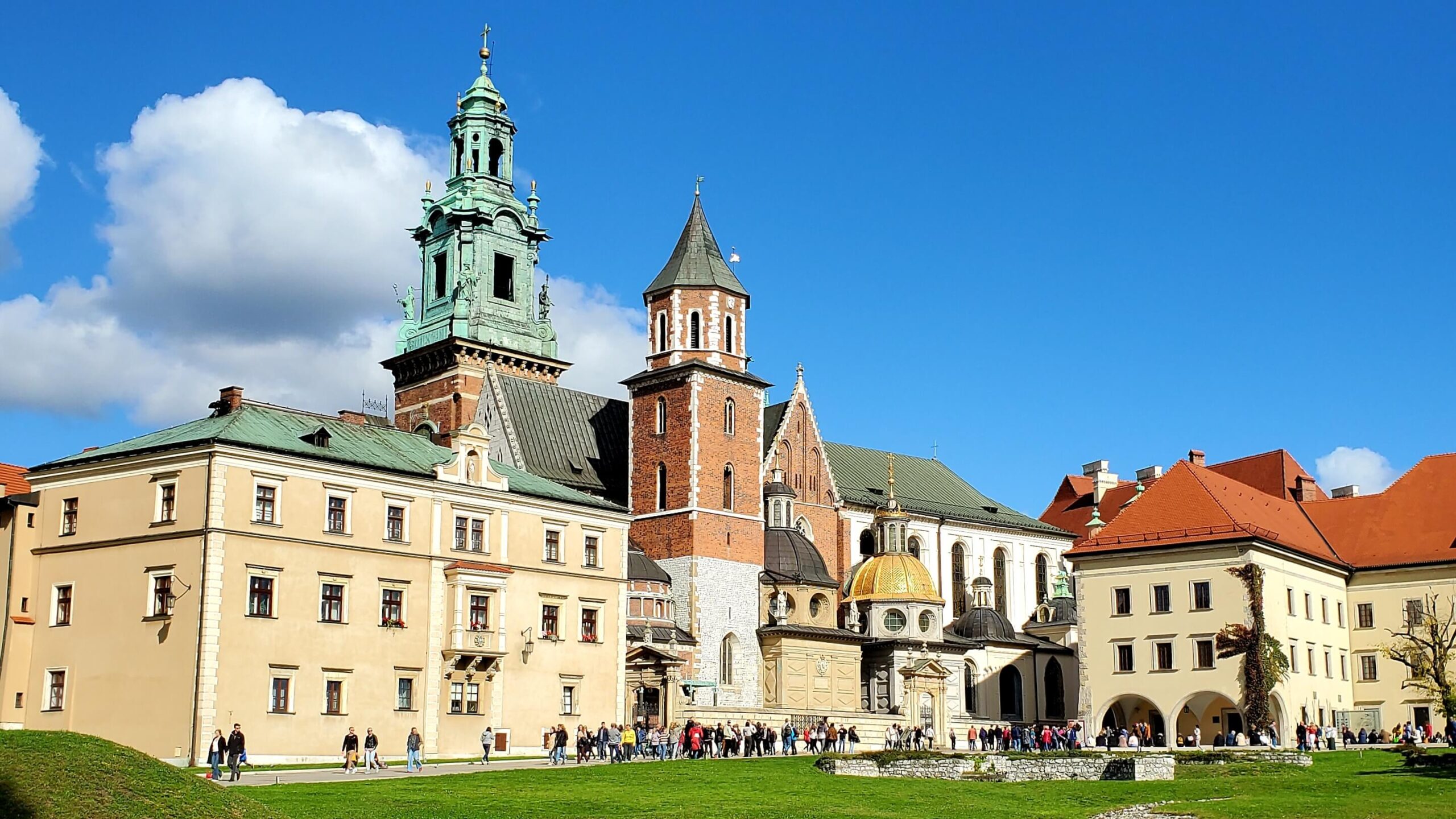
With its eclectic mix of styles, shapes, and colors, this iconic Krakow landmark almost feels like it was assembled from different LEGO sets, each element revealing a unique chapter of history. Look one way and you’ll see a building corner elegantly draped in ivy. Look the other, and you might spot a sun and moon cleverly tucked into the cathedral’s clock face.
As you explore the courtyards of Wawel Castle, there’s always something curious to catch your eye — perhaps a visitor capturing the soaring spires on camera, or someone laughing at a robotic lawnmower comically zigzagging through the the ruins in the middle of flowerbeds, clearly unsure how to escape this maze. It’s these unexpected details that make Wawel Castle one of the most memorable stops on any Krakow itinerary — blending grandeur with a touch of whimsy.
Don’t Miss the Wawel Castle Inner Courtyard
Hashtag: aesthetics. As you walk through a small archway, it’s like stepping into a world washed in beige and white. Everything around you is soft in tone, yet incredibly detailed — arches, vaults, columns, and a decorative frieze below the roofline. This is the perfect photo spot… if you can catch a moment without the crowds. Consider it a challenge!
What’s Worth Paying for Inside Krakow Wawel Castle?
While you can roam the Krakow castle grounds for free, you’ll need a ticket to visit the exhibitions inside. Note: there’s no single ticket for all exhibitions — you’ll have to choose which ones you want to include in your Krakow itinerary.
There’s actually quite a lot hidden behind those castle walls. We ended up visiting Wawel Castle on three separate occasions — and still didn’t manage to see it all! So here’s a quick overview of what we did see, and what I’d personally recommend if you’re wondering what to see inside Wawel Castle:
Welcome to the very heart of Polish royal tradition — the place where kings were crowned and history was made. Step inside, and you’ll be greeted by a dazzling interior filled with gold accents, intricate details, and centuries of royal history — though sadly, photography isn’t allowed.
But beneath the cathedral lies the resting place of former Polish royals — the crypts carry a quietly eerie atmosphere that lingers as you walk among the coffins.
My personal highlight of this part of my first Krakow itinerary was climbing the bell tower. The narrow, dimly lit staircase makes you grateful you’re not wearing full medieval armor. As you ascend, massive bronze bells come into view one after another, each larger than the last. Take a moment to look closely — one bell has a face subtly carved into its surface. It’s a little spooky and totally unforgettable.
On the very top there is also a window you can take a peak of the city from above.
Sandomierska Tower – A Quick but Worthwhile Stop
Though the Sandomierska Tower isn’t always open to visitors, when it is, it offers a fantastic vantage point over Wawel Castle. Inside, the space is nearly empty, allowing you to appreciate the exposed beams and ancient masonry. Historically, the tower served as one of the castle’s three artillery towers during times of conflict, and in peaceful eras, it was repurposed as a prison.
Pro tip: To skip the lines at the ticket booth, purchase your ticket from the vending machine tucked under the stairs near the tower entrance. This ticket is also valid for the Dragon’s Den, making your Krakow itinerary smoother and more efficient.
Wawel Castle State Rooms – A Matter of Taste
This one’s a bit like “mother, daughter, and dress” —you may like it or you may not. If you decide to add this to your Krakow itinerary you’ll walk through several grand halls filled with thrones, paintings, and ornate stoves. The ceilings, in particular, are spectacular.
Lesson from Krakow’s Wawel Castle
At Wawel Castle, it’s not just ghosts you might want to watch out for. In one of the State Rooms, if you glance up at the ceiling, you’ll notice carved heads staring back at you — and they definitely don’t look very friendly.
To give a fair review, I should also mention a few parts that weren’t exactly to my taste. I was a bit disappointed by the Dragon’s Den. While it was fascinating to explore what lies beneath the castle’s foundations and imagine sneaking through secret passages, I didn’t really feel much connection to the dragon legend itself and the visit was very short.
And here’s an important tip to make sure you fully enjoy your visit: I heard from another travel content creator on Instagram that the staff are very strict about the closing time, so take this into the consideration when planning your visit to Wawel castle.
Right by Wawel Castle stands a statue of a dragon that ACTUALLY breathes fire at regular intervals — the perfect spot for a memorable photo! Plus, you’ll get to brag to your friends that on your Krakow trip you saw a real dragon (and luckily didn’t become its dinner).
The Wawel Hill Marks the end of the Krakow Royal route. But jumping straight from ancient history to the present day can be dizzying. So, before returning to everyday life, let’s take a moment to acclimate with one last fascinating stop on our first timers Krakow itinerary — one that feels a little closer to modern times on the grand timeline and is a bit of a hidden gem.
End Your Krakow Itinerary With a Surprising Twist: Krakow Arcade Game Museum
Step into a dimly lit room where the glow of vintage arcade machines bursts with color. Brighter than the screens, though, will likely be your eyes — lighting up with memories or dreams of Friday nights spent with friends, feeding handfuls of coins into arcade machines to take turns playing classics like Pac-Man or Super Mario.
You might have thought those days were long gone, but Krakow’s Arcade Game Museum brings that nostalgia back to life. Here, you can relive those moments — playing beloved games and even practicing your zombie shooting skills to prepare for the apocalypse. Feel the thrill as you take a spin on a virtual motorcycle or drive a tank!
The best part? In Krakow Arcade game museum you never run out of coins. Instead of paying per game, you pay for your time inside, so you can play as much as you want without worrying about running out of credits. It’s a perfect, fun way to wrap up your Krakow itinerary.
Foods to Try When Visiting Krakow For the First Time
Our Krakow itinerary was full of fun and adventure — but all that exploring can definitely work up an appetite. So, here are some of my favorite local foods I highly recommend trying while you’re in Krakow.
Start with Obwarzanek— a delicious, traditional Polish bread ring sprinkled with salt and sesame or poppy seeds. These tasty treats are sold from mobile stands all around the city, especially in the lively Krakow Market Square.
If you’re craving something sweeter, try Pączki— Poland’s traditional filled doughnuts. These soft treats are coated with a sugar glaze, and you can choose from a variety of fillings. I tried the one filled with rose jam, and it was delicious. You’ll find Pączki sold at several shops around the city, usually behind glass counters rather than from street stalls.
But if you’re looking for something more filling, I can’t recommend Pierogi enough. Imagine a steaming hot plate of these special Polish dumplings served right in front of you. For vegetarians, a popular choice is the potato and cheese filling — simple, hearty, and utterly satisfying.
So enjoy your snack and we’ll meet on our next adventure!
At last, we’ve returned to the present day. I hope history buffs won’t mind if I mixed something up — with this Krakow itinerary my goal was to take you on a journey full of wonder and awe. Did I succeed?
And this is just one side of Krakow’s story. This time, our time machine brought us to the royal era, but if you wish, you can set it to explore other chapters of history too. Krakow has many stories waiting to be told.
Once home to a towering Soviet-era monument, Victory Park in Riga underwent a major transformation after the concrete memorial commemorating the Soviet Union’s victory in World War II was dismantled in 2022.
So today, the park tells a very different story—one of renewal, life and energy. Rumor has it, it’s now one of the most beautiful spots for a walk in Riga. But is that really true? We have to find out! And adding to its new charm, 2025 brought a bold feature: the Riga Ferris Wheel. Nestled on the edge of Uzvaras Parks, it offers sweeping panoramic views over the city’s rooftops. So join me for a stroll through this reimagined green space and see how this iconic part of Riga has evolved since its bold makeover..
How Uzvaras Parks (Victory park) in Rīga Looks After It’s Makeover
Stroll in Victory park in Riga
After its renovation, Victory Park in Riga has taken on a romantic new character. It’s now full of flowerbeds brimming with freedom-loving plants that seem to have wild, wind-tossed hair—grasses, bright orange rudbeckia, mysterious purple-budded blooms, and small, leafy bushes.
The wide green lawns are sprinkled with blooming meadow plants that evoke the feeling of Latvian Midsummer—when everything is lush, alive, and at its vibrant peak. At the heart of the renewed Victory Park in Riga lies a peaceful duck pond, its edges gently overgrown with tall reeds. And just beside this body of water—where the concrete monument once stood—the Latvian flag now proudly flutters in the wind.
Because Victory Park in Riga is a shared space for both walkers and those enjoying more active leisure, its paths are cleverly built on two levels. One is for people like us, who want to enjoy a peaceful stroll, and the other is dedicated to rollerbladers and cyclists.
But what happens when the two paths meet? Well, sometimes one crosses over the other via a small bridge, or slips under a grassy mound through a tunnel that looks a bit like the entrance to a hobbit house. I think those little tunnels in Victory park in Riga are quite iconic and fun!
Active Leisure in Riga’s Victory Park
As we continue our leisurely walk, we pass by several playgrounds with swings and trampolines. On sunny days, the sound of children’s laughter drifts through the air, echoing across the park.
At the far end of Victory Park in Riga, there’s a skateboarding area and a rental station where you can pick up roller skates—perfect for enjoying the park’s dedicated skating trails. In winter, this same spot offers ski rentals for snowy adventures.
And if you visit on a summer evening, don’t be surprised to spot a group or two doing outdoor aerobics, adding even more energy to this lively, shared green space.
There’s no denying it—after the renovations, Victory Park in Riga has become a lively garden, perfect for families, casual strolls with loved ones, or simply enjoying a peaceful walk on your own.
Looking for a perfect place to quiet the noise in your mind and soothe your soul? Some lakes in this world don’t just reflect the sky — they reflect something deeper, something poetic. West Lake in Hangzhou is one of those places. Calm and graceful, it has a quiet charm that makes time feel slower and the world feel softer. And in the evenings, the lakeside fills with soft energy: people strolling, boats drifting, someone singing karaoke under the trees. It’s peaceful, but alive.
But what should you actually see by West Lake? Good question — it’s vast. So vast, in fact, that people have been curating lists of its most scenic spots for centuries. The most famous is the Ten Scenes of West Lake — a collection of picturesque spots that capture the lake’s changing moods through the seasons. This list dates back to the Song dynasty, in the 12th or 13th century, which says a lot about how deeply people have valued this place.
Of course, we won’t have time to explore all of them today. But I’ll take you to a couple of spots by West Lake that stayed with me. Let’s go.
Wandering Along the West Lake Promenade by the Former Dancing Fountains
For navigation:杭州西湖音樂噴泉
When we reach Hangzhou West Lake, it’s clear that this peaceful spot still sits right in the heart of a busy city. Crowds move steadily along the street, and between the street and the lakeside—lined with tall, ancient trees—stretches a row of shop stalls offering all kinds of goods. Yet, despite the city’s hum, the calming presence of West Lake in Hangzhou quietly overpowers it all.
Right by the water, tempting snack stalls beckon with refreshing drinks, creamy ice cream, and mouthwatering baked potatoes. I can’t resist grabbing a fancy slushy served in a bamboo cup, topped with velvety matcha ice cream—a sugary indulgence perfectly suited for sipping as we wander along the Hangzhou West Lake promenade.
In the distance, the mountains wear a delicate rainy mist like a soft veil, their outlines dreamy and blurred, while the gently rippling surface of Hangzhou West Lake stretches endlessly before us.
Soon, we arrive at a fenced-off patch where vibrant green leaves ripple on the water’s surface. At first, I thought they were water lilies—but no, they’re lotus leaves, their round pads floating serenely near a picture-perfect gazebo perched on the lake. I think I’ve heard that West Lake in Hangzhou was designed to unveil like an art scroll and I can definitely see that.
Pleasure boats dot the Hangzhou West Lake—some are resting while they wait until they have collected a full group of tourists, others are slicing peacefully through the water in the distance. You can buy tickets right here by the West Lake promenade in Hangzhou. Despite the gloomy weather, the atmosphere buzzes softly. People snap photos, meander along the promenade, or sit quietly soaking in the views. Nearby, a group is engaged in open-air dancing—some kind of couples’ dance—while someone else sings karaoke under the spreading trees.
And here’s something unique: people are feeding nuts and seeds to squirrels darting among the tall, ancient trees lining the shore. I’ve seen birds fed in parks before, but squirrels? That was a first. It’s small everyday life moments like these that make this part of Hangzhou West Lake so captivating.
I’ve never been much of a people-watcher, but observing locals and visitors here is truly fascinating. This corner of Hangzhou West Lake has no grand monuments, but it’s the perfect place to soak up the vibe—the gentle pulse of daily life by the water.
We sit and observe for a while. But soon, it’s time to head back. Don’t worry—there’s plenty more to discover, and we’ll be back tomorrow to explore another must-see attraction by Hangzhou West Lake!
Another Side of West Lake in Hangzhou: The Broken Bridge
For navigation:杭州西湖風景名勝區-斷橋
First, let’s clear something up: the Broken Bridge isn’t actually broken. It’s a historic structure that blends effortlessly into Hangzhou West Lake’s tranquil scenery. In winter, when snow begins to melt, an optical illusion makes the bridge appear “broken”—hence the name. But since we’re visiting in summer, we don’t get to witness that effect. Still, the bridge’s real fame comes from something far more enchanting: the legendary love story of the White Snake and her mortal lover—a tale so beloved, it’s woven into the very fabric of Hangzhou’s culture.
Hangzhou West lake White snake legend
The Legend of the White Snake tells of Bai Suzhen, a white snake spirit who transforms into a beautiful woman. She meets the kind human scholar Xu Xian on a rainy day at the Broken Bridge on West Lake in Hangzhou, where their love story begins with a shared umbrella. They fall deeply in love and marry.
But their happiness is short-lived. Fa Hai, a strict Buddhist monk, sees their union as unnatural. He tricks Xu Xian into forcing Bai Suzhen to reveal her true snake form, which causes Xu Xian to die of shock. Bai Suzhen bravely sets off to find a magical herb and succeeds in reviving him. However, Fa Hai continues his relentless pursuit and ultimately imprisons her beneath the Leifeng Pagoda on the shores of Hangzhou West Lake.
The area along Hangzhou West Lake leading up to the bridge is filled with people, yet it doesn’t feel overly busy. The calm, blue water and tall trees with peeling bark create a soothing, almost dreamlike backdrop. The best spot to take in the Broken Bridge at West Lake in Hangzhou is actually from a distance, where you can see its full shape. The stone bridge arches upwards gently in the middle, and there’s a circular opening just above the water—probably to let boats pass underneath. Due to its popularity it is dotted with people.
And this iconic bridge also leads us seamlessly into the next attraction to see by Hangzhou West Lake…
Hangzhou West Lake Bai Causeway
Do you want to walk across West Lake? Wait—what?
Yes, in Hangzhou West Lake, there are actually two scenic causeways—elevated paths that stretch right across the water. Today, we’re taking a leisurely stroll along the shorter one, Bai Causeway, which is about one kilometer long. Don’t let its size fool you—it’s still one of the most beautiful Hangzhou West Lake attractions. It feels like a peaceful park floating on the water.
A path stretches ahead, set on a narrow strip of land lined with tall weeping willow trees. Their delicate branches sway in the breeze and dangle gracefully on both sides. Along the water’s edge, benches offer quiet spots to sit and gaze at the boats gliding in the distance. In the soft, moody light of evening, the boats look like dark silhouettes drifting through a painting.
We wander right up to the edge, where the water is thick with lotus leaves—lush and wild, like a floating jungle. Beneath the surface, tiny fish dart between the leaves. We pause for a while, then keep walking.
Compared to the promenade we visited yesterday, this part of West Lake in Hangzhou doesn’t have many food stalls, but partway through I spot a line of locals queuing up for some flatbread-like snacks sprinkled with seasoning. Let’s give it a try! I have no idea what it’s called, but it’s delicious—crispy on the edges with a savory flavor. I nibble on it happily as we continue walking all the way to the end of Hangzhou West Lake Bai Causeway, and then slowly make our way back
It was a fun outing and after this, we headed to the nearby night market.
But if the legend of the White Snake intrigued you, there’s still one more West Lake attraction worth checking out—the Leifeng Pagoda. Now, full disclosure—I didn’t have the energy to visit it myself (the walking definitely adds up!), but my travel buddy went and came back absolutely hyped.
Hangzhou West Lake Leifeng Pagoda
For navigation: 雷峰塔
Pagodas are ancient religious structures, often built centuries ago—and typically admired from the outside. But the Leifeng Pagoda by Hangzhou West Lake offers something different: you can actually go inside and climb to the top for sweeping panoramic views over West Lake in Hangzhou and the city skyline beyond.
This unique access may have something to do with the fact that the original structure, first built in 975 AD, collapsed in the early 20th century. What stands today is a faithful reconstruction completed in 2002. Still, the five-story tower is a stunning sight—blending traditional design, modern engineering, and a touch of folklore. According to legend, this is where the White Snake was imprisoned beneath the pagoda.
Thoughts?
Hangzhou West Lake was just as calm and poetic as I imagined—a place that lives up to all the verses and praise. If you’re wondering what to see by West Lake in Hangzhou, I would say just get to the lake and start walking. The scenery, stories, and soft rhythm of life will meet you along the way.
PS: if you’re actively planning a trip to China you may also be interested to take a peek into my China travel planning tips as well.
There are corners of the earth that hold such heavenly beauty that just being there—and exploring at a peaceful rhythm—soothes the soul. I believe Hangzhou, in China, is one of those places. This Hangzhou itinerary, based in my experience, will help you explore the city’s timeless charm, ensuring you experience the best Hangzhou attractions beyond the famous West lake.
Hangzhou feels like a breath of calm in a fast-moving world. It’s the kind of place that invites you to slow down, look closer, and simply be present. Yet it also has a distinctly modern edge you might haven’t heard about. So join me on this 3-day Hangzhou itinerary, where we’ll wander through peaceful, picture-perfect corners, marvel at dazzling city lights, meet robots , and explore sacred Buddhist sights that offer space to reflect.
We arrive in Hangzhou by high-speed train just after noon, with plenty of time to explore. So, what to see in Hangzhou first? With a light drizzle hanging in the air, it seems wise to start with an indoor attraction—and cross our fingers that the sky clears so we can visit the famous West Lake later.
First Stop on Our Hangzhou Itinerary: The Former Residence of Hu Xueyan
Logistics: Have to pay for entrance ticket that you can buy it on the spot, but they only accept Alipay or cash
For navigation:胡雪岩故居
If after seeing traditional Chinese houses from outside earlier on our trip you are wondering what’s inside – Hangzhou offers a rare glimpse. Tucked in the heart of the city is the Former Residence of Hu Xueyan—a villa built by one of the wealthiest businessmen of 19th-century China. My curiosity got the best of me, and I knew I had to add this stop to my Hangzhou itinerary.
The moment we step inside this Hangzhou attraction, it’s clear: this place oozes wealth. Everywhere you look, there’s evidence of quiet opulence. Intricate wood carvings twist along the roofline trim, trail down the wooden columns, and trace every railing with elegant, geometric patterns. The stained glass windows—dominated by vibrant blues—are covered in delicate, symmetrical designs that catch the eye, even in the subdued light. Overhead hang rows of Chinese lanterns with red silk tassels. It’s striking how much elegance can be created from such simple materials—just wood, stone, glass, and extraordinary craftsmanship.
As we wander deeper into this Hangzhou attraction, the layout reveals itself as a kind of architectural labyrinth. Dimly lit hallways and quiet rooms intertwine with pockets of open-air courtyards. One moment, we’re under a roof; the next, stepping into a courtyard garden arranged with organically shaped rocks and thoughtfully planted greenery—only to be pulled back inside a moment later.
Most of the rooms in the residence of Hu Xueyan are empty, but if you wander around, you’ll come across a few with furniture on display—mostly chairs and tables as elaborate as the house itself. Interestingly, the room that really catches my attention in this elaborate Hangzhou attraction is the servants’ quarters. It has a telephone. Well, sort of. Back then, “telephone” meant a system of metal tubes sticking out of the wall, allowing servants to speak with their mistress from across the house.
We wander through the rooms for a while, and just when we think we’ve seen it all, you stumble upon a whole other side of the house that holds an enchanting surprise—a Chinese-style garden that feels like something out of my gardening dreams. The centerpiece is a porous rock wall with a building towering on top of it. In front of it lies a small pond, where colorful fish glide just beneath the surface. The scene is framed by trees and shrubs in rich shades of green, orange, and red, and anchored by a quaint little gazebo with a spiky roof perched atop a beautiful stone bridge.
It’s peaceful, yet buzzing with visitors and photo-takers who, like us, have added this spot to their Hangzhou itinerary—each trying to capture a piece of this poetic corner of the past.
When we exit the house, the sky is still moody, but according to the weather forecast, we have about an hour and a half without rain. So, let’s take what we can get and rush to the next attraction on our Hangzhou itinerary—the one and only West Lake.
Hangzhou travel tip When using metro during your Hangzhou itinerary, check for the signs on metro doors: they indicate which coaches are cooler and which are warmer so you can choose the temperature that is more comfortable for you. Isn’t that cool?
Hangzhou’s Best-Known Attraction: West Lake (By the Former Dancing Fountains)
For navigation:杭州西湖音樂噴泉
Looking for a perfect place to quiet the noise in your mind and soothe your soul? Some lakes in this world don’t just reflect the sky — they reflect something deeper, something poetic. West Lake in Hangzhou is one of those places. Calm and graceful, it has a quiet charm that makes time feel slower and the world feel softer. And in the evenings, the lakeside fills with soft energy: people strolling, boats drifting, someone singing karaoke under the trees. It’s peaceful, but alive.
The promenade along the coast at the place where the West lake fountains used to operate is a perfect place to enjoy the views, people watch and grab an evening snack.
We enjoy the vibes for a while, but then the rain is back, so it’s time for a meal and some rest. But the evening is not over yet – there is one more attraction left on our Hangzhou itinerary today. We just need to wait for the sun to go down to enjoy it.
Light Up Your Night with the Qianjiang New Town Light Show
Name for navigation: 杭州城市陽台
Light shows are cool — but what if the entire city skyline became the canvas? That’s exactly what happens in Hangzhou, China, every Thursday to Saturday evening, when the Qianjiang New Town Light Show transforms the business district into a living, glowing masterpiece.
The best place to experience this spectacular phenomenon is from Hangzhou City Balcony — a wide, open-air terrace offering panoramic views of the skyline on both sides of the river. That’s where we’re heading now to wrap up the first day of our Hangzhou itinerary. As we make our way there, we pass other illuminated high-rises, some already glowing with vibrant colors — and even one with playful, animated fish swimming across its facade.
Travel tip:There are multiple shopping malls in this area, so if you’re interested in checking out some high tech cars or latest phones (we saw one that was a double fold, with 3 screens in 2025, haven’t seen anything like that in Europe) as part of your Hangzhou itinerary, you can plan a stop in a shopping center.
This day of our Hangzhou itinerary has been rainy and misty, but the lights are so bright and joyful that the weather hardly matters. In fact, the light drizzle adds to the mood, blurring the silhouettes of distant buildings and softening the neon glow into a dreamy haze.
Catching the Qianjiang New Town Light Show in Hangzhou can take a bit of planning, since the start times vary with the seasons. But luckily, there are two shows each evening, so even if we miss the first one, another begins within the hour.
Then, the round silhouette of the Intercontinental Hangzhou hotel comes into view — a striking building shaped like a golden sun. Even if you’re visiting Hangzhou when the light show isn’t running, this iconic Hangzhou attraction is still worth a stop during the day.
Right beside it, fountains put on their own dazzling spectacle, illuminated in soft pink and blue hues, “dancing” in sync while videos of astronauts and science-themed symbols are projected onto them. And just as the fountain show ends… the main light show begins!
Suddenly, ALL the buildings around you bursts to life in a dazzling explosion of color. Coordinated videos dance across the facades, featuring birds, flowers, and an array of mesmerizing visuals. The Qianjiang New Town Light Show is almost overwhelming in its scale and beauty. With reportedly 700,000 LED lights illuminating the cityscape, it’s easily one of the most spectacular light shows I’ve ever witnessed — truly unforgettable.
With this dazzling outing, the first day of our Hangzhou itinerary comes to a close — well, almost. We couldn’t resist a quick stop at the huge outlet store right by Hangzhou City Balcony. But if shopping’s not your thing, it’s time to say good night and get ready to explore even more amazing Hangzhou attractions tomorrow.
Day 2 of My Hangzhou Itinerary
On Day 2 of our Hangzhou itinerary, we’ll continue to enjoy the city’s peaceful, picture-perfect spots—then mix in a dash of technology for a glimpse of its modern edge.
Explore the Picturesque Xiaohe Historic District
For navigation:小河直街
Xiao He in Hangzhou is a charming and wonderfully Instagrammable neighborhood, lined with tiny shops, cozy cafés, and costume rentals. The streets are adorned with hanging lanterns, potted plants, and whimsical bird-shaped ornaments. I can’t help but wonder if these decorations are seasonal — but either way, they add a festive, playful atmosphere. It’s the perfect place to wander, window-shop, and soak in the laid-back charm.
This day of our Hangzhou itinerary turns out to be another rainy one, but we’ve come prepared with raincoats. Honestly, I don’t mind it. The rain gives the pavement a soft glow, the greenery looks lusher than ever, and the streets of Xiao He are pleasantly quiet. It feels like we have the place almost to ourselves.
The neighborhood is dotted with old stone bridges crossing serene canals filled with greenish-blue water. Occasionally, a boat drifts by, and tree branches lean gently over the banks. You can walk along one side, cross a bridge, and continue on the other — it’s an easy, peaceful rhythm.
Further down the canal, we spot a group of local women performing graceful, almost ethereal movements under one of the bridges. I think it’s Tai Chi? They don’t seem to mind me stopping to watch for a while.
Eventually, we wander off the main shopping street and stumble into a quiet park by the canal, shaded by tall, leafy trees. Who says China is just a concrete jungle? Sure, Hangzhou has its fair share of sleek skyscrapers, but it also offers tranquil corners like this where you can feel completely at peace.
But as the rain starts to fall harder, it’s clear our next stop on the Hangzhou itinerary needs to be indoors. And honestly… I haven’t seen any robots in a while. Time to change that.
Add a High-Tech Twist to Your Hangzhou Itinerary: Xiaoshan Robot Experience Center
Logistics: Entrance if free, but check the working hours on their WeChat page.
For navigation:萧山机器人博展中心
It’s time to say hi to some promo robots in Hangzhou.
The most exciting one is definitely the talkative robot with a flair for performance. He may look like the kind of machine that wants to take over the world, but he’s actually quite friendly. You can program a sequence for him to act out, or ask him to perform a trick like singing or delivering a monologue. And yes, English is available — which is a big plus.
Around the 2 floors of Xiaoshan Robot Experience Center , industrial robots are on display, too. One lifts boxes. Another weld. Others show off their finesse by navigating their mechanical arms between obstacles without a scratch. And behind them there are videos that explain how these robots are used in real-life applications, from factories to warehouses.
There are also some interactive robots at this Hangzhou attraction — including a sketching robot that draws your face and a competitive air hockey robot. Sounds impossible, but I actually managed to score a goal. Just one, but I’ll take the win.
Not every robot is active, though. Some, like the giant drone centerpiece and the dancing bots, seem to be on break during our visit. Still, they are fun to look at.
It doesn’t take us too long to explore the robot exhibition center in Hangzhou, but as we step outside, the rain had cleared. That means our Hangzhou itinerary is taking us back to the city’s most iconic attraction.
On our walk from the metro to the West lake, we spot market stalls being set up along the street — early signs of one of Hangzhou night markets. We’ll definitely be returning here later.
Back at West Lake: Walk the Bai Causeway
For navigation: 杭州西湖風景名勝區-斷橋
There are so many beautiful spots around West Lake, and it’s easy to see why it’s Hangzhou’s most famous attraction. On our second visit, we head to one of the two iconic causeways—an elevated path that lets you cross the water under the shade of tall, weeping willows. Misty mountains rise in the background, green leaves float gently on the surface, and little fish swim below.
It’s perfectly calm here.
We walk the Bai Causeway and then head back the same way. I don’t know about you, but as serene as that stroll is, I’ve definitely worked up an appetite. Luckily, the final stop on Day 2 of our Hangzhou itinerary offers the perfect chance to indulge in some tasty treats.
A Sensory Overload at Wulin Night Market
For navigation: 武林夜市
For a Westerner, night markets can be pretty mind-blowing—and a visit to Wulin Night Market might just be the most memorable experience of Day 2 on my Hangzhou itinerary.
After 5 p.m., the street comes alive with rows of shoulder to shoulder market stalls and crowds weaving between them. It’s chaotic, colorful, and completely captivating.
At one stall, someone is mixing raw chicken legs with vegetables; three stools over, a woman is giving manicures. And in between? Everything. You pass by endless stalls offering snacks and drinks—giant pots filled with what looks like tea, or maybe magic potions, floating with lemons and flowers. There’s matcha ice cream, grilled meats, fresh fruit, and all kinds of quirky trinkets: jewelry, figurines, potted plants, some (live?) see creatures and even bobblehead sculptures that move their heads in eerie unison.
It can feel overwhelming—but it’s also a lot of fun to browse, pick up a souvenir, and sample a few local bites.
Let’s follow the golden rule of street food: go where the line is longest. That leads us to spicy duck skewers, bursting with flavor from a generous sprinkle of seasoning. Njam!
And that’s where we wrap up Day 2 in Hangzhou. Sleep tight—more wonders await tomorrow.
Day 3 of My Hangzhou Itinerary
On the third day of our Hangzhou itinerary, we’re heading outside the city to visit one of the most important Buddhist sights in China.
Not gonna lie—getting to Lingyin Temple was a bit of a rollercoaster. But trust me, it’s worth it.
Final Stop on My Hangzhou Itinerary: Feilai Feng Grottoes & Lingyin Temple
Logistics: You have to purchase 2 separate entrance tickets one for the Scenic area and other one for the temple. You can pay in Alipay or in cash.
For navigation: 飞来峰
If you’re curious about Buddhism in China, just outside Hangzhou you’ll find Lingyin Temple—a historic and still active place of worship. Here, you can take your time admiring the intricate temple architecture and respectfully observe the rituals of those who have come to pray.
But the experience doesn’t end there. The surrounding Lingyin–Feilai Peak Scenic Area is home to the remarkable Feilai Feng Grottoes—a collection of around 300 Buddhist stone carvings hidden among moss-covered cliffs, many dating back over 1,000 years.
After the trip to the temple, I’m wiped—so I’m calling it a day here. But if you’ve still got some stamina left in you, another great Hangzhou attraction to check out is Leifeng Pagoda.
Bonus Stop for Your Hangzhou Itinerary: Leifeng Pagoda
For full disclosure – I didn’t visit it myself, but my travel buddy visited it while I was at the temple and had nothing but good things to say—especially about its beautiful 5 story architecture and the rare chance to actually go inside to enjoy some panoramic views of West lake from the top, which isn’t something you can do with many pagodas. So if you’re looking for a high vintage point to admire the Hangzhou panorama this is the place to go!
Thanks for joining me on this little virtual Hangzhou travel itinerary!
Thoughts?
I truly enjoyed my peaceful days in Hangzhou. It offers the perfect escape from the nonstop pace of nearby Shanghai—a place to slow down, soak in serene beauty, and discover a fascinating blend of ancient history and modern surprises. So if you’re looking for a travel experience that balances tranquility with excitement, Hangzhou should definitely be on your list.
PS: if you’re actively planning a trip to China you may also be interested to take a peek into my China travel planning tips as well.
There are high speed trains that can take you to Hangzhou from nearby cities like Shanghai and Suzhou in just a couple of hours. I would highly recommend to book the train tickets in advance as they may get sold out.
How to get around Hangzhou?
We mostly used the metro—it was super convenient and easy to navigate. Almost every Hangzhou attraction on our list was accessible by metro, with just two exceptions where there were no stations nearby.
The first was the Robot Experience Center. We took a Didi instead, which was still very affordable and hassle-free. The second was Lingyin Temple. Getting there is a bit more complicated, so I cover that in a separate post.
How many days should you spend in Hangzhou?
We spent two days exploring the city itself, and used the third day for a trip to the temple just outside Hangzhou. If you’re short on time or prefer a faster pace, you could probably combine the first two days of this Hangzhou itinerary into one. But I really appreciated the slower rhythm for once—it gave the city room to breathe.
Which part of the West lake should I visit when in Hangzhou?
You can find a vivid story about 3 different places by the West lake on my other post about Hangzhou West lake.
Where to see robots in Hangzhou?
This is something I really wanted to see and something that was surprisingly hard to track down. As mentioned earlier the Xioshan Robot Experience center is a great (Free) place to see some robots in action. They do have limited working hours though, so check their WeChat account for the info before visiting.
Do I need to book tickets to Hangzhou attractions in advance?
I was traveling outside of the tourist season (in may, after the bank holiday) and I was able to buy tickets on the spot.
Anything else I should know about visiting Hangzhou?
One thing I noticed was that in some places—especially a few tourist attractions—only Alipay was accepted (not even WeChat Pay). Since the Alipay app didn’t work for me, having some cash on hand was a lifesaver. I definitely recommend keeping a bit of cash with you, just in case.
Zemgale (also known as Semigallia) lures travelers in with its historic castles, fascinating museums, and mythical forest trails. If you’re looking for a memorable day trip from Riga to Zemgale, I’ve gathered a handful of Southern Latvia travel itineraries that I’m excited to share with you.
But let’s face it—picking the perfect day trip in Zemgale isn’t always easy. That’s why we’re turning this list into a fun little “dating” game. I’ll ask you a few questions, and together we’ll find your ideal match—a place in Southern Latvia that clicks with your vibe.
First question: Are you looking for a day trip in Zemgale that takes you into nature—or one that explores city life?
City Day Trips in Southern Latvia
If you’re leaning toward a Zemgale day trip that takes you to one of Southern Latvia’s charming cities—complete with beautiful architecture, fascinating museums, and stroll-worthy streets—then I think you’ll click with one of these Southern Latvia travel itineraries:
Meet Bauska: Day Trip in Zemgale for History Lovers
There’s a place in Latvia where roses never wilt, and a fairytale castle stands tall on the riverbank. Rumor has it that this castle has recently undergone a facelift and is now more stunning than ever. Intrigued? But there’s more to this Southern Latvia gem than just the castle. The city of Bauska is also home to an impressive vintage car museum, and it’s a delight to explore in every season. And the best part? You can easily visit Bauska as a day trip from Riga using public transport. Sounds like the perfect package, doesn’t it?
Learn more about the castle and other places to see in Bauska in my full Bauska travel story.
But if you don’t feel like Bauska is the one, I have another Zemgale day trip that I think you’ll love…
Jelgava: The Active and Romantic Heart of Southern Latvia
In this Zemgale city, art, history, and nature come together in the most intriguing ways. Jelgava invites you to wander a scenic boardwalk through lush floodplain meadows, explore a modern take on local history through interactive museum exhibits, and admire three distinct styles of sculpture displayed within a walkable area. And as evening falls, Pasta Island lights up with a romantic glow, making your stroll even more magical.
The best part? You can easily visit Jelgava as a day trip from Riga by public transport.
Curious about what to see in Jelgava? Check out the full article!
If you’re looking for a day trip idea in Zemgale that lets you soak in the beautiful nature of Southern Latvia—whether it’s a nature trail, a peaceful lake, or stunning forest scenery—you’re in luck. Zemgale is filled with places just like this.
But since there are so many options, I need to ask a few questions to help narrow things down:
Question 2: How far from Riga are you willing to travel? Would you be up for a destination in Zemgale that’s up to 100 km from the capital, or do you prefer to keep it closer—say, within 50 km?
What to see in Zemgale Max 50km from Riga
If you answered that you’re looking for a “quick date” with a Southern Latvia attraction no more than 50 km from Riga, you’re in luck—we’ve got some great options. But before we make any matches, I have one more question: Would you prefer to combine your time in nature with an activity, or are you just here to take in the sights?
If your interested in activities:
Where to Enjoy Outdoor Active Leisure in Zemgale? By Ozolnieki Lake
I’d describe Ozolnieki as a leisure-friendly town—perfect for soaking up sunny summer afternoons in Southern Latvia.
Here, you’ll find a clean, well-maintained lake that offers plenty of active leisure options. You can take a refreshing swim, purchase a ticket to the inflatable water park (complete with trampolines, slides, and obstacles), or—if you’re feeling bold—try your hand at wakeboarding.
Not a fan of getting wet? No problem. Take a relaxing walk along the lakeshore or challenge yourself on the outdoor rock climbing tower.
And the best part? All this fun is less than 40 minutes from Riga—and yes, it’s easily doable as a day trip by train.
But if you answered that activities aren’t a priority and you’re simply looking to stretch your legs on a scenic hiking trail in Zemgale, I think you’ll really enjoy this next option:
Hiking in Zemgale: Baldone Story Trails
What stories do the Baldone Story Trails have to tell? Well, they proudly speak of Baldone’s famous swamps and sulfur springs, whisper about forests that conceal hidden artwork and an observatory. And, of course, they call out from the top of the Riekstu Hill observation tower.
On this Zemgale nature trail, you can choose between five different routes, making it easy to find one that suits your fitness level. And if I’m not mistaken, it’s possible to do this day trip from Riga by public transport (bus), making it an accessible escape into nature.
If you answered that you’re committed and happy to travel a bit further—up to 100 km from Riga—then I think you’ll vibe with one of these beautiful nature spots in Zemgale:
The Most Mythical Place in Southern Latvia: Pokaiņi
Pokaiņi Forest has a slightly mysterious vibe—some even say spooky. Many visitors report sensing a supernatural presence here. Scattered throughout are unusual stones and rock formations, believed to be remnants of ancient cult sites. Even in early spring, the rocks are covered in bright green moss, giving the whole place the look of a fantasy movie set.
So even if you don’t believe in spirits, Pokaiņi is still a magical and memorable spot for hiking in Zemgale.
But if you do believe that rocks can hold supernatural powers, Pokaiņi has a stone for just about every occasion. Want to get married? Head to the Bride Stone. In need of some healing? Try the Healer Stone. There’s even a Snake Stone—though I’m not quite sure what that one’s for. I definitely wasn’t tempted to touch it!
What I can say for sure is that wandering through Pokaiņi Forest, searching for its legendary stones, is a surprisingly fun and quirky way to spend a day in Zemgale.
And if you’re heading to Pokaiņi (you’ll need a car for this one, as it’s a bit off the beaten path), I’ve got a bonus stop to add to your Southern Latvia day trip.
Dobele Castle Ruins
If you’ve chosen to visit Pokaiņi, make sure to stop by the Dobele Castle ruins along the way. While the stop might be a bit brief to make it the sole destination of your Zemgale day trip, if you’re already heading in that direction, why not take a leisurely photo walk around the skeleton of this historic fortress?
However, if Pokaiņi feels a bit too spooky for you, don’t worry—I have some great alternatives. How about…
Most Popular Attraction in Zemgale: Tērvete Nature Park
This place definitely brings back fond childhood memories for many Latvians, but I was surprised by how much Tērvete Nature Park has changed since I was a kid. Don’t worry—all your favorite Latvian story characters are still here. The witch’s hut and Sīkstulis’s home remain right where they belong, but now the park has expanded to include a labyrinth, a playground, and a charming, brightly colored Dwarf Town with tiny houses you can actually step inside. It looks like it’s been lifted straight out of a fairytale book!
This Southern Latvia attraction is a joy for both kids and grown-ups alike. That said, I can’t deny feeling bittersweet when I realized I can no longer squeeze into the tiny houses of the old wooden dwarf village. Time really flies! But to shake off that nostalgic feeling, let’s head up the 39-meter-high Tērvete Observation Tower for stunning views.
To reach this Zemgale attraction you will also need to have a car, but it offers fun adventures for the whole day.
But if you read those last two day trip options in Southern Latvia and realized you’re not quite ready for a full-day commitment, why not try something lighter instead?
Lighthearted Summer Days in Jaunpils
If you’re planning a visit to Jaunpils, the enchanting Jaunpils Castle is an absolute must-see. The castle greets you with a breathtaking view of Jaunpils Mill Lake, its tranquil waters providing a postcard-perfect backdrop to the castle’s timeless charm. Pause for a moment to bask in the serenity as you gently sway on the park’s delightful swings, overlooking the peaceful surroundings. Or if you wish to stretch out your legs you can wander along the nearby Kartavkalns Nature Trail, a short and leisurely path perfect for immersing yourself in the beauty of nature.
That’s all I have for now, but I hope one of these Zemgale day trip ideas has sparked your interest. If not, don’t worry—I’m committed to adding new spots to this list as I continue exploring Southern Latvia. So be sure to come back soon for more travel inspiration!
Every city I visited during my trip to China felt completely different, but Beijing has stuck in my memory as a calm and collected epicenter of culture. This is where you find the Forbidden City, the Great Wall, and the historic hutongs — places that carry centuries of history in every stone and alleyway. And it was during my Beijing trip that I learned how every detail in China carries fascinating symbolism — something you often need to learn to decode. For example, did you know that in ancient China, every color had a specific meaning?
So join me as I look back on the amazing time I had during my Beijing trip — and let’s find out what to see in Beijing together!
PS: As you can see on my full China trip itinerary, I arrived mid day a day before the adventures start, so theoretically I had 0.5 more days on my Beijing trip, but I didn’t explore any of Beijing’s attractions then, so for simplicity here I am counting only full days on this Beijing travel itinerary.
It’s bright and early, and we’ve just wrapped up breakfast at the hotel buffet. Honestly, I’m still not sure what half of it was—I think I had fried rice and some kind of mystery veggies. Either way, we’ve filled our tummies and are ready to explore Beijing.
Beijing has been China’s capital—with a few interruptions—for around eight centuries. It served as the center of power for many dynasties in Imperial China and remains the capital of the People’s Republic of China today, making it one of the most layered and fascinating cities to visit. With so many stories and landmarks woven through its streets, it’s hard to know where to begin.
But here is my tip – if you’re wondering what to see in Beijing first, start with the hutongs.
First Stop of Our Beijing Travel: A Fascinating Tour Through Historic Hutongs
Logistics: if you explore on your own it is free, but if you wish to do a guided tour – it is tip based. And you need to book in advance.
Chinese name for navigation毛儿胡同
How did people live in Beijing in the past, and how do they live today?
For me, the best way to begin a Beijing travel itinerary is with a guided tour that reveals both the city’s rich history and the daily rhythms of its people. That’s why, for the first thing to do in Beijing, I chose a guided walk through the city’s historic alleyways—known as hutongs—where past and present blend in fascinating ways.
Beijing is home to countless hutongs, but our local guide leads us to Nanluoguxiang and Mao’er Hutong—a brilliant choice for any Beijing travel itinerary. These narrow alleyways are snugly lined with single-story gray houses in varying conditions—some freshly restored, others bearing the marks of age. They have gently curved tiled roofs and small windows—some of which have ornate railings.
From the tangled electricity boxes to the scooters, bikes, and rickshaws parked along the sides, and the endless flow of people weaving through the alleys, it’s clear—this is where real life happens. And watching it all unfold is absolutely fascinating.
Who Lives (and lived) in Beijing Hutongs?
Amid the almost grayscale palette of Beijing’s hutongs, vibrant architectural details stand out, quietly telling colorful stories of their past inhabitants. Take a closer look at the entrance doors—many are adorned with faded yet elaborate paintings of nature, decorative knobs, and stone sculptures flanking either side.
The first hutongs appeared during the Yuan Dynasty (1271–1368) and expanded significantly during the Ming and Qing Dynasties (1368–1911). The grand, ornately decorated courtyard homes near the Forbidden City—within the area once called the Imperial City—belonged to those closest to the emperor: military officers, government officials, and scholars. Merchants, artisans, and commoners lived further out, in the Inner and Outer Cities.
Fun fact of the first day of our Beijing travel
Did you know you can tell who once lived in these homes just by the statues at the door? If a house had rounded statues resembling shields, it meant a military official once lived there. Square statues, shaped like books, indicated the home of a scholar.
There are many more hidden meanings woven into the architectural details of Beijing’s hutongs—but I won’t steal our guide’s thunder. He was brilliant, and if you’re planning a Beijing trip itinerary, you should take a guided tour to learn more.
What is Life Like in Beijing’s Hutongs Today?
Turns out that, nowadays, there are two very different kinds of homes tucked into these alleyways. Some are high-value residences owned by a single family. You can recognize them by their beautifully restored facades.
And then there’s the other side: modest communal housing, where each room is rented by a different family. Because they were constructed so long ago, these spaces often lack running water and central heating.
That said, it’s important to remember that this is just one small part of the city and this lifestyle should not be generalised to the rest of the city. The majority of Beijing is a vast, modern metropolis filled with high-rises and newly built apartment complexes.
You could walk through Beijing’s hutongs for hours and never get bored! Conveniently, our guided tour ends right by the next stop on our what to see in Beijing list. I’ll give you a hint: it’s the beating heart that once set the pace for all of ancient Beijing.
Beijing Drum Tower: Unveiling Ancient Chinese Timekeeping Secrets
Logistics: You have to purchase an entrance ticket to this Beijing attraction.
Chinease name for navigation:北京鼓樓
Have you ever heard of the 108 beats? In ancient China, time was measured using their own intricate system—one deeply rooted in numerology and traditional Chinese worldviews. Just as church bells once marked the hours in European cities, ancient Chinese cities like Beijing relied on Drum Towers and Bell Towers to keep the rhythm of society in sync. The deep, resonating sounds of the drums in were traditionally used to mark time during the night, while the Bell Tower took over during the day. But the system was more complex than it might seem—ancient China didn’t follow the 24-hour format we use today.
If this topic piques your interest and you’d like to explore it further, a visit to Beijing’s Drum Tower is a must. And even if you’re just here for the views, it’s well worth a stop—both towers are stunning architectural landmarks in their own right.
After that it is time for some Chinese street food. Sounds like the famous Wangfujing food street isn’t operating at the moment, but luckily for us there is another food district right by where we are.
Fuel Up in Shichahai Food Street in Beijing
Chinese name for navigation:什刹海小吃街
Ready to indulge in some matcha ice cream or grilled meat skewers generously dusted with spicy seasoning? Let’s head to Shichahai food street! I used to wonder why so many travel blogs and vlogs focus so much on trying local food — until I traveled to Beijing. That’s when I truly understood just how diverse and flavorful Chinese cuisine is. Let me tell you, it was tough going back to my own bland cooking after that.
One of the best ways to experience food in China is through its street food. We got our first taste of juicy, meat-filled buns in one of the Beijing’s famous tourist attractions Shichahai — a lively food district that not only offers an incredible variety of local delicacies, but also picturesque views of three of Beijing’s famous “seas”: Lake Xihai, Lake Houhai, and Lake Qianhai.
I think we will return here for dinner as well! But now, let’s head to today’s last stop on our Beijing travel itinerary. Something a bit more futuristic.
Add Space Travel to Your Beijing Travel Itinerary: SoReal Blast Furnace VR Park
Logistics: You have to purchase an entrance ticket to this Beijing attraction.
Chinease name for navigation:首钢一高炉·SoReal科幻乐园
The next stop on our Beijing itinerary might feel a bit puzzling at first. We’ve ventured farther from the city center, into an area where towering, industrial structures dominate the skyline — massive rusted pipes, skybridges, and enormous cylindrical tanks rise around us, stained with time and weather. It’s like stepping into a world built for giants.
What is this place? A factory?
Not anymore. It used to be a blast furnace — part of a massive steel factory — but today, it’s been reimagined as an immersive theme park called SoReal Blast Furnace. If, during your Beijing trip, you’re interested in trying virtual reality that goes beyond just 3D glasses, this is the place to go. This experience combines animated visuals with full-body motion: 360-degree flip chairs, mechanical horses, and harnesses that simulate parachuting.
As you purchase your ticket and step into this futuristic Beijing attraction, you realize the entire space has been designed to feel like a spaceship. Purple lighting glows across the walls, pipes twist through the corridors, and control panels blink with coded displays. Ambient sounds hum all around you, deepening the illusion. Through the massive window of the “ship,” Earth appears far in the distance — just one more detail pulling you into this surreal world.
Unfortunately I wasn’t sure if photography was allowed inside, so I didn’t take any. But you can check out some cool renders to get a feel for the place on their website.
Scattered throughout the rooms are eerily lifelike humanoid robots. Their synthetic skin looks so real, you almost expect it to feel warm to the touch — but their unfocused gaze gives them away. Even if you don’t play 3D games, this is still a fun place to walk around.
But if you do, this stop on our Beijing travel itinerary offers plenty to explore. Across multiple floors of the spaceship-like complex, you’ll find a wide range of seamlessly integrated interactive 3D experiences — from shooting games and racing simulations to virtual roller coasters and much more. There is a person at each project to help you. Although they don’t speak English fluently, they are very attentive and use translation apps to explain the rules of each game.
One thing to keep in mind, though: during this virtual reality experience in Beijing, I discovered that I’m prone to motion sickness when using 3D glasses. That has nothing to do with the venue — it’s just how my body reacts — but I thought it was worth mentioning in case you’re sensitive too. Luckily, I managed to shake off the dizziness with a little help from a robot-made ice cream. Yes, that’s a thing — you can pay a robot to make you a soft serve.
That concludes our first Beijing travel day.
I have to say I am hooked and can’t wait to continue to explore Beijing tomorrow. Now rest and recharge!
Day 2 of My Beijing Travel
We woke up on the second day of our Beijing trip to the sound of rain — the kind of weather that could easily dampen your mood while traveling. But not this time. For this part of our Beijing travel itinerary, we had pre-booked tickets to a museum that promises something truly exciting, so the rainy start doesn’t matter one bit.
Want a hint? While Beijing’s history is endlessly fascinating, I also think it’s just as important to look ahead. So today, let’s explore what to see in Beijing if you’re drawn to futuristic design and cutting-edge technology.
Robots and Future Tech in Beijing Science Museum (China Science and Technology Museum)
Logistics: You have to purchase an entrance ticket in advance.
Chinese name for navigation:中国科学技术馆
Ready to meet some robots? Spanning multiple floors and covering topics like robotics, 5G, space exploration, natural resources, the human body, and more — all presented through interactive exhibits — China Science and Technology Museum is a must-visit for anyone looking to add a dose of innovation to their Beijing travel itinerary.
We somehow completely miss the fact that the first level holds an exhibit on ancient Chinese technical achievements, and instead head straight to the F1 floor — where we’re greeted by a giant dinosaur skeleton. Its head stretches all the way up to the 3rd floor. Not a bad way to kick things off!
But as we walk in the first exhibition I get a bit discouraged. It seems clearly designed for young children, featuring colorful displays that explain basic natural science concepts like sound. But don’t worry — the real fun is just one floor higher. Unless you’re visiting with little ones, I’d recommend heading straight up to the robotics exhibit.
There are many robots, including robot fish gliding through a tank, a robot playing the harp and a robotic doll head that recognizes and mimics your facial expressions. Try flexing your face into the weirdest expression you can think of and see if it can keep up — it’s both hilarious and slightly creepy.
Not every robot runs at the same time (they follow set activation schedules), so you might have to wait a bit between demonstrations. But trust me — they’re worth it. And the museum has filled these in-between moments with mini-games and interactive fun. One of my favorites? A facial recognition game that matches you to your historic look-alike.
Beyond the robotics section, there are other exhibits that truly stand out. In one room, you can draw your own animal, scan it, and watch as it comes to life on a massive digital jungle wall alongside creatures created by other visitors.
And then there’s the sleek, futuristic 5G exhibit, which explores how 5G technology could shape everyday life. One highlight is an AR-enhanced experience where you use a “magic mirror” to scan a historical artifact. The image transforms into a 3D model that you can rotate and examine from every angle. How cool is that? We spent around 5 hours here and I would definitely recommend you to add this museum to your Beijing travel itinerary!
Why You Should Include Beijing Olympic Park in Your Beijing Travel Itinerary
Chinese name for navigation:奥林匹克公园
We had already spotted the towering, futuristic Beijing Olympic Tower — topped with the five iconic Olympic rings — rising above the Olympic Green as we made our way to the China Science and Technology Museum earlier that day. With its stacked, circular platforms, it reminded me a bit of a cluster of space mushrooms… in the best possible way.
But if there’s a time to truly appreciate Beijing’s Olympic Park, it’s after dark — when the whole area lights up in dazzling color. So of course, we had to come back.
The buildings in Beijing Olympic Park were constructed for the 2008 Olympic Games, and many have since become staples of the city’s skyline. Some are instantly recognizable thanks to their bold, futuristic designs — others blend more quietly into the landscape, only catching your eye if you know what you’re looking at.
We begin our exploration at the shopping mall by the metro station, where we stopped for dinner. The first cool thing about this place? It actually runs under the water — you can enter the shop on one side of the river and emerge on the other. The second? Even though it’s not directly connected to the Olympic Games, it fully embraces the atmosphere, with vibrant lights and playful decorations.
The next building we spot after the Olympic Tower is the Linglong Tower, which once served as part of the International Broadcast Center during the Games. It has multiple pods that are held together by metallic structures. Unfortunately, it’s not illuminated tonight, leaving the nearby National Stadium to steal the spotlight. Fortunately, we had the chance to admire Linglong’s intricate architectural details earlier in the day, when they’re far easier to appreciate.
Then we continue walking towards (possibly) the best known buildings of Beijing Olympic Park.
Beijing Birds Nest Stadium and Aquatic Center at Night
To one side, there’s the National Stadium — better known as the Bird’s Nest due to it’s unique shape. It’s glowing from within with a fiery red light. It truly does resemble a metallic bird’s nest, alive with energy.
Facing it across the plaza is the National Aquatics Center, also known as the Water Cube. At night, it looks like it’s wrapped in glowing soap bubbles, lit up in electric blue.
It’s a surreal contrast — fire on one side, water on the other. Or heaven on one side and the earth on the other as the circular shape of the Birds nest is said to symbolise heaven and the square shape of the Water cube is said to symbolise the earth. Anyways – it’s one of those places where you could just stand still, observing, and feel like you’re in another world.
And with that, the second day of our Beijing travel itinerary comes to an end — a day completely different from the first, perfectly showcasing just how diverse China as a travel destination can be.
Day 3 of My Beijing Itinerary
The first two days of our Beijing adventure felt like a warm-up — and now we’re ready to dive into some of Beijing’s most iconic attractions. Today, we’ll be walking in the footsteps of ancient Chinese emperors. Ready to step back in time?
Decoding The Hidden Symbols in Forbidden City
Logistics: You have to purchase an entrance ticket or book aguided tour to this Beijing attraction in advance.
Chinese name for navigation:紫禁城
The former imperial palace complex at the heart of Beijing — known today as the Forbidden City (or Palace Museum) — is a fascinating maze of grand gates, intricately decorated buildings, and winding corridors filled with echoes of history. Every step holds a story, and symbols seem to hide in plain sight, so it is a must see in Beijing.
Why We Chose a Guided Tour of Forbidden City for our Beijing Travel Itinerary
Since tickets to the Forbidden City are notoriously hard to get, we decided to join a guided tour — and I’m so glad we did, for two big reasons. First, official tour guides have access to special entrance lines, which are often much shorter than those for individual visitors. Second, this place is massive. I would’ve been completely lost trying to navigate it on my own.
To even reach the main entrance, you have to cross Tiananmen Square — the largest public square in the world — and then weave your way into the Forbidden City itself. They say it spans the area of more than 100 football fields and contains exactly 9,999.5 rooms. Why not 10,000? Because only the ruler of heaven could claim that number. Technically, the room count is more legend than fact (official numbers vary), but it’s exactly the kind of detail that adds depth and wonder to your Beijing trip.
Highlights of the Forbidden City: A Key Part of Your Beijing Travel Itinerary
Our guide leads us to the Gate of Supreme Harmony, and I can’t help but be struck by the sheer scale and splendor of it all. Towering red columns support golden-glazed roofs, their corners curving skyward, lined with rows of little golden statues. Below them, the walls are painted in rich patterns of green, blue, and red, accented with shimmering gold. Two lions stand guard at the base of the terrace.
But the beauty goes deeper — as our guide points out, much of what we see in Forbidden city is layered with meaning.
Fun fact of the 3rd day of our Beijing trip
The drainpipes of the Forbidden palace are shaped like dragons, the symbol of the emperor. And all the rooftops are covered in yellow tiles, because yellow was the imperial color. Even the layout of the complex reflects cosmic and philosophical order. Every detail, no matter how small, was placed with purpose.
Since the main gate was reserved exclusively for the emperor, we entered through the side gates. Just when you think the grandeur couldn’t get any greater, you arrive at the Hall of Supreme Harmony — the largest and most important hall in the entire palace complex, where the grandest imperial ceremonies took place. I was completely humbled by the sheer scale of the place. A vast stone courtyard stretched out before us, leading to an elaborately decorated hall perched atop a magnificent, multi-tiered terrace.
As the tour continues, we wind our way forward and sideways through a maze of corridors and courtyards. Most buildings are closed to visitors, but if you look closely, you’ll spot a few that are open — offering a rare glimpse into the once-private world of China’s emperors. Some structures have been fully restored, glowing with vibrant colors and intricate details, while others still wait their turn for preservation. After a while, everything starts to feel somewhat similar… yet each turn reveals something slightly different. You could easily spend hours of your Beijing travel itinerary exploring the Palace Museum — and still not manage to see it all. So after ~3h of walking our tour comes to the close in the beautiful Imperial gardens.
Can you still stand on your feet? I think I need to sit down for a moment — but knowing our Beijing trip is coming to an end, I’m going to rally for one last stop today. If you’d also like to linger a little longer in the echoes of imperial China, join me at the place where emperors once prayed for a good harvest.
Temple of Heaven in Beijing: Where Emperors Used to Pray
Logistics: You have to purchase an entrance ticket to this Beijing attraction.
Chinese name for navigation:天坛
The next stop on our Beijing travel itinerary is equally iconic and historic. In ancient China, one of the emperor’s sacred duties was to pray to Heaven for a good harvest, favorable weather, and the overall prosperity of the nation. That ritual took place at the Temple of Heaven — an intriguing and colorful complex that hides centuries of imperial ceremony and ancient cosmological philosophy.
I found the temple buildings, especially the Hall of Prayer for Good Harvests with its striking triple-tiered roof, to be visually captivating. It’s no wonder the temple has been the muse for countless photographers. But what many visitors don’t realize is that the Temple of Heaven is also surrounded by an expansive, peaceful park — a pocket of calm where you can enjoy the presence of nature right in the heart of a bustling city.
And the chance to recharge in the shade of ancient trees, watching locals practice tai chi and take part in lively outdoor dance classes, was exactly what I needed after a packed day three of our Beijing trip.
Day 4: of My Beijing Travel Itinerary
Before I even started planning my trip to China, there was one place I knew I had to see. Today, we’re heading just outside Beijing to explore the Great Wall of China. I’m so excited! How about you?
Highlight of My Beijing Travel Itinerary: A Day Trip to The Great Wall of China
Logistics: You have to purchase an entrance ticket to this Beijing attraction.
Chinese name for navigation:慕田峪
The Great Wall of China needs no introduction, right? But let me try to blow your mind anyway.
Picture this: you’re surrounded by layers of misty mountains stretching into the distance. And winding between them, like the spine of a sleeping dragon, is a long, ancient wall. It’s dotted with people who, from far away, look like tiny specks drifting along its ridges.
What you may not realize is that the Great Wall wasn’t built as one continuous structure. It was first made by connecting multiple defence structures already built and then rebuilt, and extended over centuries by various dynasties — eventually becoming the longest military structure in the world, spanning more than 20,000 kilometers.
Today, we’re exploring the Mutianyu section of the Great Wall of China to take on the Hero’s Slope — and I can’t wait to show you why it’s worth the trip… and the sweat.
Check out my full blogpost on traveling to Great Wall for details on how we got there and what we saw.
What a truly unforgettable way to wrap up our Beijing trip!
Thoughts?
Exploring Beijing’s attractions has been nothing short of fascinating. From ancient wonders to futuristic tech, every stop added a new layer to the adventure. And the journey doesn’t end here — next up: the dynamic, fast paced Shanghai!PS: I hope that my experiences and my list of things to see in Beijing will help you plan your own Beijing travel itinerary. If you’re actively planning a trip to Beijing you may also be interested to take a peek into my China travel planning tips as well.
We were in Beijing for 4 full days (+ a bit less than a half day when we arrived) and to me it felt like it wasn’t enough. I didn’t get to cross off all the items I had listed in my wat to see in Beijing list. If I just had one more day to go to Summer palace and Lama temple… So I would suggest planning 5 days for exploring Beijing & traveling to the great wall.
How to get around Beijing?
I feel like the metro is the most foreigner friendly way to get around Beijing. It is very convenient and the metro system is very extensive, so I was able to reach all the attractions I wanted to visit in Beijing by using the metro.
Do I have to book tickets to Beijing attractions in advance?
Yes, tickets to places like Forbidden palace & museums in Beijing get fully booked quickly, so you do need to purchase tickets / reserve your entry ahead of time. For large open spaces like Temple of Heaven and Drum tower we were able to buy tickets on the site the day off (but we were not traveling in peak season)
Any other tips for planning your Beijing travel itinerary?
Beijing is huge, so when booking the hotel I would suggest you prioritize location, so that you don’t have to spend hours in the metro just to get to the city center and I would highly recommend booking a hotel that is close to the metro station. That will save you a lot of time.
We use cookies to ensure that we give you the best experience on our website. If you continue to use this site we will assume that you are happy with it.