You’ve probably heard tales of mountain lakes so breathtaking they seem almost unreal—where crystal-clear waters reflect towering peaks, and the landscape is so pure and untouched that it almost feels mythical. Hidden deep within the wild beauty of Écrins National Park in France, Lac du Lauvitel is one such marvel. Nestled at 1,530 meters above sea level, this pristine alpine lake attracts hikers like a siren. But the magic of Lac du Lauvitel hike isn’t just in the destination—it’s in the journey. So, lace up your boots and join me on a virtual hike to one of the most breathtaking gems of the French Alps.
In my mind, no hike is complete without securing a baguette to savor at the top of the mountain. Since we’re starting our hike after lunch, this is the perfect opportunity to fuel up on some hearty mountain food. So, before we head to Lac du Lauvitel, let’s stop in the charming nearby town of Le Bourg d’Oisans for a quick taste of life by the French mountains.
Because it’s off-season, there’s a lot of construction going on in the streets, but the town still exudes its charm with stone houses, simple facades, and heavy wooden shutters. At the end of each street, you can catch a glimpse of a mountain peak in the distance. It’s a joy to just wander around, peeking into a souvenir shop or a bakery.
For lunch, we’re stopping at Café du Centre. The hearty meat with gravy, accompanied by a small Gratin Dauphinois (sliced potatoes baked in cream with spices), is so tasty and filling that I’m now ready to conquer any mountain after savoring this.
Let’s start our Lac du Lauvitel hike
We park the car in the free parking lot, and as soon as you open the door, you can feel the soft dance of raindrops on your skin and the smell of the rain in the air.
The weather is far from ideal for hiking, but there is nothing we can do about it. Unless, of course, we want to turn back—which would be a perfectly reasonable decision for those who aren’t experienced hikers.
But today, we are accompanied by some seasoned hikers, so we press on, following the winding road towards a charming cluster of stone houses. They appear to be either a tiny village with a peaceful rhythm of life or a retreat, as we spot some people practicing yoga.
Looking up towards the mountain peak we are planning to conquer, all you can see is a gray wall of rain. I burst into laughter. It looks like we’re in for an adventure! And trust me—we are. While I wouldn’t recommend hiking in the rain (the rocks become extra, extra, extra slippery), not even the weather can diminish the beauty of the Lac du Lauvitel hike.
Hopefully, when you come here, the weather will be much nicer than it was in our virtual adventure.
The Terrain of Lac du Lauvitel Hike
Most of the trail leads through lush green forest, with trees and shrubs surrounding you. You can spot birches and ferns and various other vegetation I don’t know the name of.
The path itself is well-maintained, and most of it is laid with rocks, which can be both a blessing and a curse. It’s good that it doesn’t get muddy, but in the rain, the rocks—polished by thousands of feet each year—become very slippery, so you have to be mindful of every step.
They say that the Lac du Lauvitel hike tends to get very crowded in the summer, but it looks like during the mid-week in September, you can enjoy relative solitude. Or it could be because of the weather – who knows?
Higher up the mountain the track turns into more of a rock staircase, and the vegetation grows scarser, so time after time the forest opens up to reveal a peak of other mountains. In this weather they are almost completely hidden in the mist, with one exception that randomly seems to be enjoying some sunlight.
The Restless Mountain River
A playful companion to your walk up is a restless mountain river that hides for a large portion of the Lac du Lauvitel hiking route, just to peek out again when you start to feel that the climb gets too monotonous.
Our first meeting with the river is at the start of the trail, where the stream runs over a pathway of rocks in various shapes and sizes. But the grandest spectacle awaits higher up the mountain. As you climb, you can see white streams of water moving in the distance. As you come closer, a series of cascades, split by rocks and trees, reveals itself in all its glory. The water here runs with tremendous force, oozing the energy you need to finish your hike.
The Breathtaking Lac du Lauvitel
We need to stop and catch our breath from time to time, but on a trail so beautiful, time flies. Before we know it, we’ve reached the top.
And the scene that unfolds is like a dream.
On your right, a maze of rocks in various shapes and sizes sprawls out before you. It looks as though a giant, weary from carrying them, tossed these rocks carelessly across the landscape. Now they lie wherever they fell, forming a natural obstacle course that only a few determined shrubs and patches of moss have dared to conquer. But deeper within this sea of rocks, sit picturesque, rustic stone houses.
This place can’t be real, can it? Well, it is. And it gets even better.
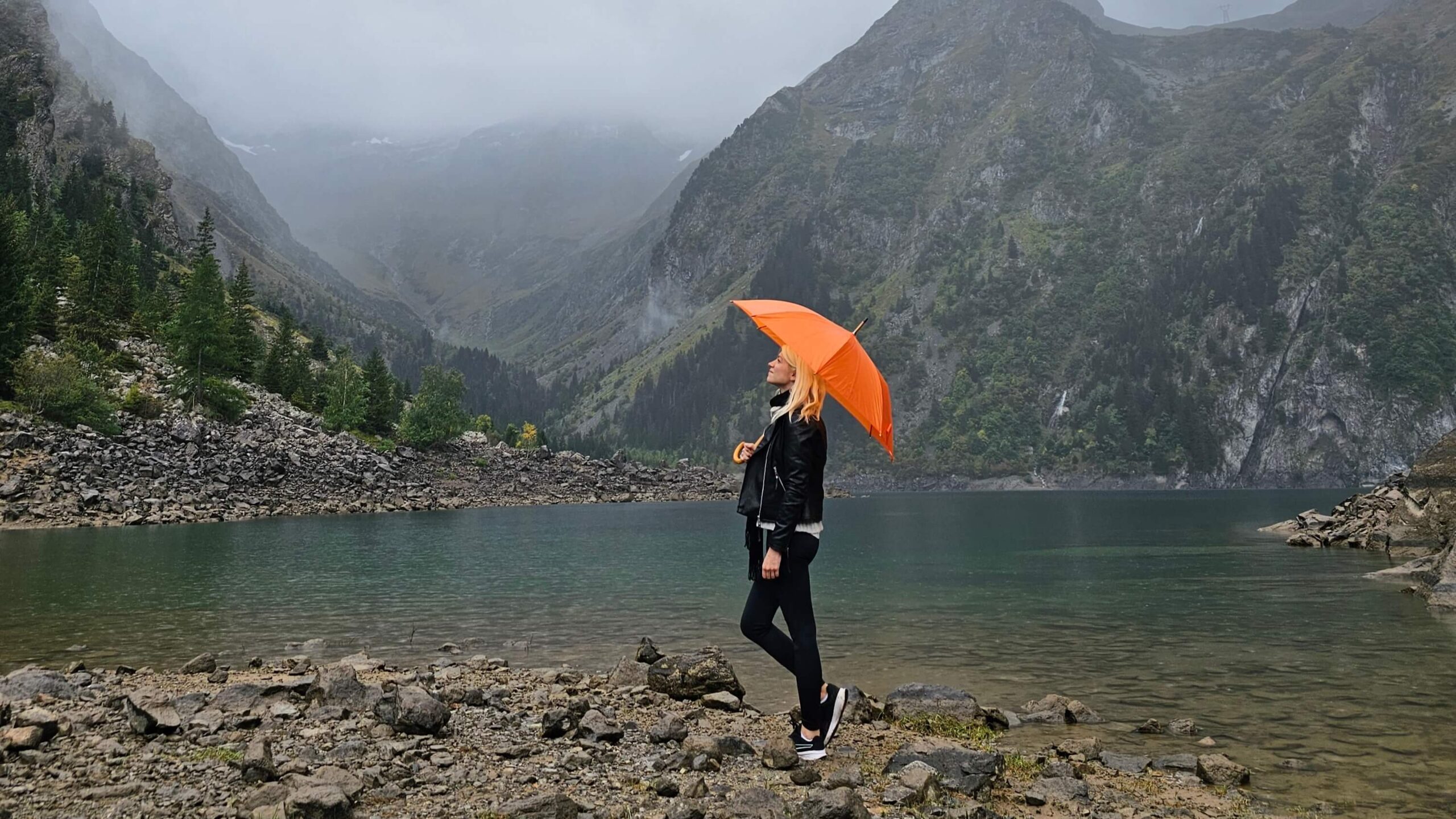
In front of you lies Lac du Lauvitel—the stunning blue waters of the lake, surrounded by towering mountains. Their peaks are veiled in a soft mist of rain, and clouds rise from the water’s surface, ascending into the sky. In the distance, nestled between the lush forests that blanket the mountains, streams cascade down the rock walls, possibly feeding the lake with fresh, clean mountain water. You step closer to the rock-covered shores and peer into the water, which from this distance is as transparent as glass. As you look further out, it transforms into a mesmerizing play of blues.
But remember: swimming or engaging in any water sports in this pristine lake is strictly forbidden to protect its delicate ecosystem. So please keep a respectful distance.
They say that one can spend hours watching water flow or fire burn. But you can also spend hours simply gazing at Lac du Lauvitel, peacefully existing in the moment. From here, the journey down follows the same path, so you’ll get a chance to say hi to the river a few more times. But the descent is always easier—probably due to the dopamine rush we just received from this magical sight.
Thoughts?
I am in love. Lac du Lauvitel hike definitely is one of my all time favourites. And it is not a particularly long or challenging hike (unless you’re hiking in bad weather), so if you ever wanted to see a mountain lake – this is an amazing option.
Grenoble, France, is known as a city of mountain sports and innovation. But what if I told you it’s also a city of secret tunnels winding through an ancient fortress and captivating stories echoing within the walls of a former cloister? If you’re planning a Grenoble itinerary and wondering what to see in Grenoble in 1 day, join me on a virtual journey through my favorite attractions in this charming city, nestled at the foot of the majestic French Alps.
Cost: Most attractions listed in this what to see in Grenoble itinerary are free, the exception is lunch and cable car where you have to purchase ticket
Length: 1 day
How to get there: By a car / public transport to Grenoble city center and from there all the attractions can be reached by foot
This stop is part of our French Alps travel itinerary
It is bright and early and I know your eager to explore what to see in Grenoble, but first we need to fuel up with some tasty breakfast…
Fueling Up the French Way: Start Your Grenoble Itinerary in a Boulangerie
Can you truly say you’ve experienced France if you haven’t indulged in a freshly baked treat from a boulangerie?
These charming bakeries—often with just a couple of small tables—are scattered throughout Grenoble, each offering a mouthwatering array of pastries, tarts, éclairs, baguettes, and buttery croissants, all made fresh daily. The air inside is always filled with the irresistible aroma of dough, butter, and sugar.
The hardest part is choosing which pastry to go for. They all look so tempting! After much deliberation, I’ve settled on the Paris-Brest—a delicate, flaky dough ring filled with rich praline cream made from caramelized nuts and silky pastry cream. This indulgent treat was created in honor of the famous bike race from Paris to Brest, and it’s absolutely decadent.
Which pastry will you choose?
After fueling up with sugar and coffee, it’s time to step out and actually find out what to see in Grenoble.
To me, Grenoble feels more livable than touristy. But if you’re on the lookout for a few architectural gems to include in your Grenoble itinerary, let’s head over to Place Saint-André, the heart of Dauphin power.
What do I mean by that? Well, this square is home to some incredibly important buildings that reflect Grenoble’s rich history. In the center of the square stands a dark statue of the French knight and military leader, Chevalier de Bayard—renowned for his bravery and known as the “knight without fear and beyond reproach.”
The knight gazes toward the impressive Palace of the Parliament of Dauphiné. Before the Revolution, French parliaments were second only to the king in power. The parliaments held the authority to scrutinize—and even reject—any new laws the king wanted to pass, especially if they didn’t benefit the regions the parliaments oversaw, making them a significant force in French politics.
After the Revolution, the parliament building in Grenoble was repurposed as a courthouse, but its grandeur remains. Built in three distinct stages, the facade is a stunning display of multi-colored stonework. The oldest section dates back to the 15th century, while the grey-blue right wing was added in the 16th century. And the blonde left wing was completed in the late 19th century. As you admire the building, don’t miss the intricate details on the facade, including the coats of arms.
Opposite the Parliament building stands the 13th-century Saint-André Church. Built to house the tombs of the Dauphin family, this brick church in Grenoble is a striking example of Gothic architecture. Its towering spire seems to reach for the heavens, flanked by smaller turrets and pointed windows that enhance the church’s dramatic silhouette.
If you’re looking for more squares to explore in Grenoble’s old town, head over to Place Grenette, Grenoble’s former market square. This historic square is home to a beautiful fountain, which takes center stage, surrounded by colorful buildings that bring the space to life. The fountain features four cherubs—angelic, childlike figures perched on dolphins, which symbolize the Dauphiné region.
I’ve mentioned Dauphiné quite a bit in this Grenoble itinerary, haven’t I? It seems like the perfect time to head over to the Dauphiné Museum to dive deeper into the rich history and heritage of this fascinating region.
Grenoble’s Riverfront Beauty: Colorful Houses and Charming Views
To get to the museum, we’ll need to cross the Isère River, and this is where you’ll find one of my favorite spots in Grenoble. The icy blue waters of the river shimmer beneath the sunlight, gently flowing over a bed of light pebbles. As far as the eye can see, pastel-colored houses of Grenoble line the riverbanks, their soft hues a defining characteristic of the French Alps region.
If you’re patient enough, you might catch a glimpse of the Grenoble Bubbles—those iconic cable cars making their way up and down the mountainside in the distance. But if you’re not one for waiting, just glance up across the river. There, you’ll spot Bastille Mountain, its fortress perched high above, keeping watch over the city of Grenoble below. It’s a view that feels almost cinematic, the kind of moment that makes you want to pull out your camera and capture the essence of Grenoble forever.
But now let’s continue our Grenoble itinerary and head up the mountain to find the museum.
Enrich Your Grenoble Itinerary by Uncovering Regional History in the Dauphiné Museum
So, what’s Dauphiné? In short—Dauphiné was a historic province nestled in the French Alps, covering the southeastern French départements of Isère, Hautes-Alpes, and Drôme, with Grenoble as its capital. In long—well, you’ll just have to travel to Grenoble and visit the Dauphinois Museum, housed in a beautifully restored 17th-century women’s convent, to uncover the rich history and vibrant culture of this fascinating region.
The Religious Layer of the Dauphinois Museum in Grenoble
The Dauphinois Museum in Grenoble is like an onion—layer upon layer of history waiting to be discovered. Our journey begins in the old hallways of this historic building, where the walls whisper stories of the cloistered nuns who once walked these very corridors. But if you need more straightforward information – there is an exhibition of posters that will explain all about this place and its journey from religious building to one of the best museums to see in Grenoble.
As we move forward, we step into the breathtaking chapel, where every inch of the ceiling is adorned with intricate paintings. At first glance, it appears to be covered in delicate lace, but upon closer inspection, angels reveal themselves, woven into the mesmerizing patterns around golden medallions.
The Tranquil Layer: A Garden of Peace in the Heart of Grenoble
Next, we step outside into the museum’s lush terrace gardens, where the 17th-century architecture blends seamlessly with nature. This serene oasis is bursting with trees, vibrant flower beds filled with fragrant herbs, and inviting benches that tempt you to sit down and soak in the tranquility. Though we are still very much in the center of Grenoble, as evidenced by the sea of rooftops stretching out just beyond our reach, it feels like we’ve stumbled upon a secret paradise.
A Mythical Encounter in the Courtyard of Dauphinois Museum of Grenoble
Venturing back inside, we uncover yet another garden—this time hidden within a charming courtyard, enclosed by ancient passageways that are lined with simple stone arches. This is where the dragon lives! Well, sort of. A massive, twisting installation resembling the scales of a mythical beast winds its way through the heart of the building, adding an unexpected touch of fantasy to our journey through Dauphinois Museum of Grenoble.
History Layer of Dauphinois Museum of Grenoble
The architecture of the building alone is a good enough reason to add this museum to your Grenoble itinerary. But there is more. Now, we will delve into the historical layer of the Dauphinois Museum of Grenoble. Here, maps and videos unravel the story of the region’s past, while installations reveal scenes from daily life in the French Alps.
Did you know that bread was so scarce in some alpine villages that they only baked it once a year? When the big day arrived, the entire village would gather to bake together, marking their loaves with unique stamps to ensure each family could recognize which one was theirs. This exhibit definitely broke some preconceived notions I had about mountain life.
What to See in Grenoble for Mountain Sports Enthusiasts
For those who love the thrill of the slopes, the top floor offers a treat—a dedicated exhibition on mountain sports in Grenoble. Here, you’ll find an intriguing collection of vintage skiing and snowboarding equipment that, quite honestly, looks far more intimidating than the gear we use today. The walls are adorned with vibrant posters and nostalgic photographs promoting Grenoble’s legendary ski slopes. The only downside? This section doesn’t have much English signage, so be prepared to piece together what you can.
The Dauphinois Museum in Grenoble is a true gem, so if you’re looking for places to see in Grenoble, I definitely recommend this one.
Enjoy a Lunch Offer in One of Grenobles Restaurants
Now, my stomach is grumbling, and since we’re in France, it’s time to indulge in some classic French cuisine.
If during your Grenoble trip you’re looking to enjoy a meal at a French restaurant in a bit more cost effective way, be on the lookout for the daily lunch specials. Many of Grenoble’s restaurants offer a pre-set menu with a starter, main, and dessert, all bundled together for a price that’s often cheaper than ordering the dishes separately.
After using Google Translate to decipher the menu nailed to the exterior (don’t expect much English here!), we find ourselves in a cozy little spot with a mouthwatering daily offer and light French music playing in the background. Today, we’re served a delicious duck salad to start, followed by a hearty main of sausage, sweet potato purée, and mushroom sauce. I’ve already had my sugar fix this morning, so I’m skipping dessert this time.
But do keep in mind that places like this fill up quickly, so if you’re hoping to snag a seat without a reservation, it’s best to arrive as soon as the restaurant opens—or right when the lunch offer begins.
What’s next on our what to see in Grenoble list? The Bastille has been teasing us all day, always in the corner of our eye. Now, it’s time to conquer it!
While we could hike up to the Bastille, why not save our strength for the way down and take the thrilling route? The Grenoble Bubbles (Les Bulles) are the iconic, round cable cars that can take you up or down the mountain in around 6 minutes. Built in 1934, they were one of the world’s first urban cable cars, but don’t worry, they’ve been modernized since then so the ride up should be quick and safe.
As we float up in our little bubble, the view of Grenoble below grows smaller and smaller, until it becomes a sea of light-colored houses, with occasional pops of pink, red, or yellow facades breaking the pastel harmony.
Stepping out of our soap bubble, we head straight for the Bastille viewing platform. It’s a jaw-dropping sight. Below us, Grenoble sprawls out in every direction, like a living map, framed by soft, misty blue mountains that melt seamlessly into the sky.
I’ve seen plenty of panoramic views in my travels, so I always look for that special something that sets each one apart. In Grenoble, it’s the long, perfectly straight line cutting through the city below. That’s Cours Jean Jaurès, one of Europe’s longest straight avenues, stretching as far as the eye can see.
Conclude Your Grenoble Itinerary by Exploring The Mysterious Passages of La Bastille
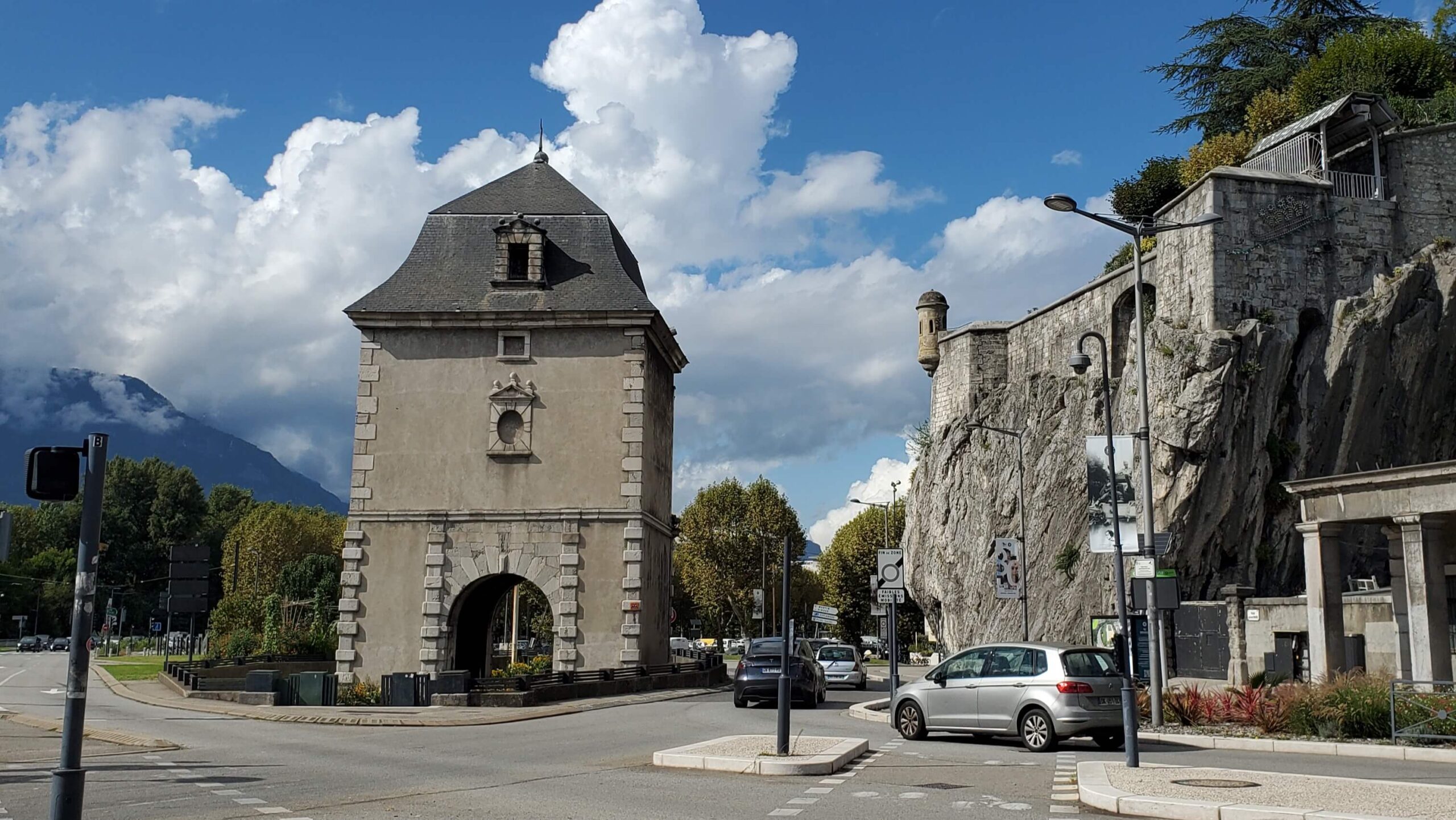
Now, let’s get to know La Bastille! This hill has been a strategic point for centuries, but the military constructions visible today were built between 1823 and 1848 to protect Grenoble from potential attacks.
Luckily, according to the information I could find, La Bastille of Grenoble was never stormed. So, we don’t need to worry about ghosts.
As you can see, the summit of the mountain is an ideal observation point, and as it is the hardest place to reach, this is where the final stronghold—the keep—was placed. Up here, the fortifications feel imposing: large arches of cold stone with no hint of color or cheer. I’ll admit, they make me a little uneasy.
But it’s on the way down that the real fun begins. As we descend, the adventure shifts into something that feels like a spy video game. We slip through winding paths, uncovering hidden corners of this ancient fortress. Then the narrow stairs give way to a wide balcony, offering another breathtaking view of the city.
But wait—what’s that on the left? A narrow opening in the rock wall, guarded by a metal door leading to a tunnel. The tunnel seems to descend into darkness, its end disappearing into the unknown. A runner dashes past us, vanishing into the shadows.
I suppose we can do the same—just slower, of course.
For a while, we’re swallowed by pitch-black darkness, every step uncertain, the air thick with anticipation. But then, just when it feels like the darkness might swallow us whole, a faint light flickers at the far end. We breathe a collective sigh of relief as we emerge into another lower-level balcony. Turns out, La Bastille is a labyrinth of levels, tunnels, and balconies—designed to harness the full defensive potential of the mountain. Some passages lead us further down, while others seem to derail us, pulling us into mysterious chambers with huge arched windows, their silence echoing around us. One passage leads to a small tower. I guess this is where they’d place their best snipers.
Anyways, the walk down is the best part of the Bastille, and you should definitely not miss it if you’re traveling to Grenoble and it is also the perfect end to our Grenoble day travel itinerary.
What to See Near Grenoble? Extend Your Grenoble Itinerary
Day Trip From Grenoble to Lac du Lauvitel
Around an hour drive away from Grenoble hides one of the most beautiful mountain hiking trails of this region – Lac du Lauvitel trail. Although the trail through the lush green forests is a treat on its own, the desert is undeniably the pure and untouched mountain lake that awaits on the top. It’s guarded by the nature park and the towering peaks that surround it. On calm days you can see those peaks reflected in the water like a mirror, but when it rains, the scene is surrounded by a soft fog that rises from the water and blends out the harsh mountain lines.
Grenoble has a bastille, but I don’t believe it has a castle, so to fill up our French castle picture quota we can drive to a nearby Vizille, where, since the 14th century, one of the most important castles of Dauphine region stands.
I wish I could tell you about the revolution museum that’s inside the castle or the grand garden, but I accidentally wandered there the day when both were closed, so all I was able to see is the palaces’ massive, time-worn walls and the old garden next to the castle. It’s a bit overgrown, with some ruins and a panorama viewpoint over the town’s houses.
Thoughts?
Grenoble’s attractions surprised me. I have to admit that the old town didn’t live up to my expectations, but the food and the museum exceed them. And who would have thought I’d have so much fun exploring a military fortress? I am usually hooked on different types of attractions, but yet, here I am telling you that out of all the places to see in Grenoble, these fascinated me the most. I guess it’s your reminder to keep an open mind and try different experiences during your Grenoble itinerary.
How many days should I plan for my Grenoble Itinerary?
For me 1 full day in Grenoble was enough to see all the attractions on my Grenoble must-see list. Although I technically stayed in Grenoble for more than 1 day I used other days for day trips outside Grenoble.
What to see in Grenoble in winter?
I visited Grenoble in early autumn, but I can imagine some of you may be traveling to Grenoble in winter to hit the slopes. I believe all of the attractions listed in my what to see in Grenoble list should be accessible in winter time as well. But if the weather is cold and you prefer to stay indoors – definitely head to Dauphine museum.
In France, there’s a medieval town painted in bright pastels, drenched in flowers, nestled next to a crystal-clear lake, and surrounded by picture-perfect mountains shrouded in soft mist. It sounds like a dream, doesn’t it? But it’s not. Welcome to Annecy, France—a town where, after just one stroll, you’ll feel like your storybook dreams have come true. If you’re wondering what to see in Annecy, I’ll be your guide today, taking you on a virtual tour of a few of the town’s unforgettable attractions that are etched in my memory to this day.
Cost: All attractions listed in my what to see in Annecy guide (except dinner) are free to admire from outside, but if you wished to explore castles from inside you’d have to purchase a ticket
Length: 1 day
How to get there: By a car or public transport
This stop is part of our French Alps travel itinerary
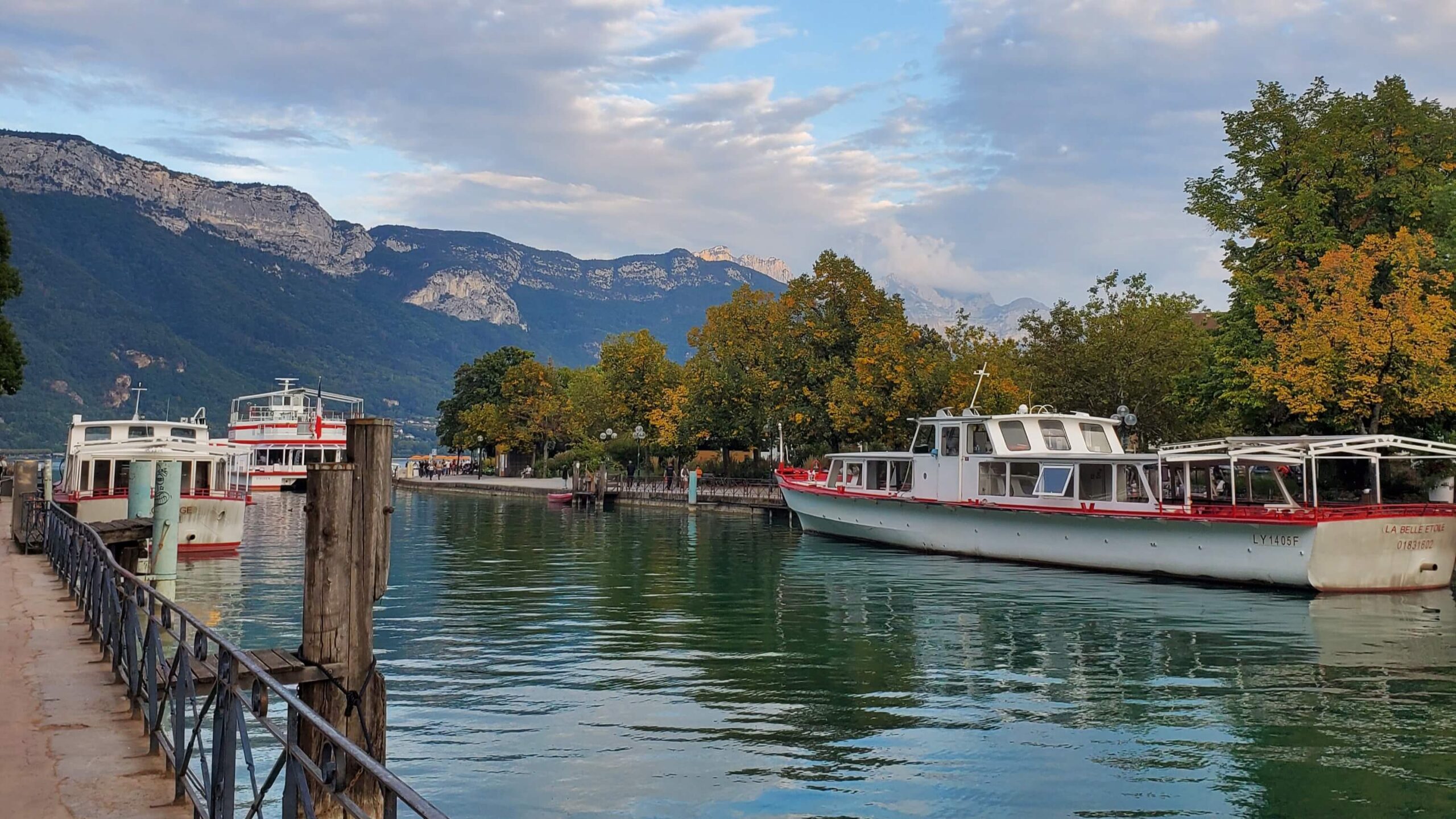
In front of you lies a lake with the clearest water you’ve ever seen. This is Lake Annecy, born from Alpine glaciers and fed by mountain rivers.
The evening sun has transformed the surface of Lake Annecy into a mesmerizing kaleidoscope of blues, each shade shifting with the gentle ripples stirred by the breeze. Along the promenade, the wind softly rocks the boats docked in neat row.
Beyond the lake, the mountains rise like guardians of this tranquil haven. The nearer peaks are draped in lush green forests, with occasional patches of bare rock breaking through the canopy. In the distance, the far-off mountains blur into the sky, their misty silhouettes merging with soft clouds.
Everything around you—the sky, the mountains, the water, even the pathway along the promenade—seems painted in delicate pastels, with a subtle smokiness softening the edges. The scene of Lake Annecy feels like a watercolor painting, and you catch yourself wondering, Is this real? Perhaps you need someone to pinch you, just to be sure.
As we stroll along the promenade, we join others basking in the calm of the evening. From time to time, you pause at the edge of the water, gazing into the crystal-clear depths of Lake Annecy. The sandy bottom is visible, undisturbed and pure, but there are no fish swimming below. Thankfully, there’s also no sign of the ghostly lady said to haunt these waters. According to legend, her restless spirit searches for her lost husband, luring unsuspecting men into the lake’s depths.
For now, though, the lake offers nothing but peace. The tranquility of Lake Annecy seeps into your soul, leaving you content and unburdened. The serenity lingers as we leave the lakeside and head toward Annecy’s old town. Gradually, the soft whispers of the lake give way to the lively hum of the streets. The air fills with laughter and the sound of footsteps on cobblestones.
Dive in The Crowded Streets of Annecy to Take a Picture of Palais de I’lle
Looks like everyone has decided to find out what to see in Annecy this evening as the narrow streets are buzzing with people. But who can blame them? Just look around.
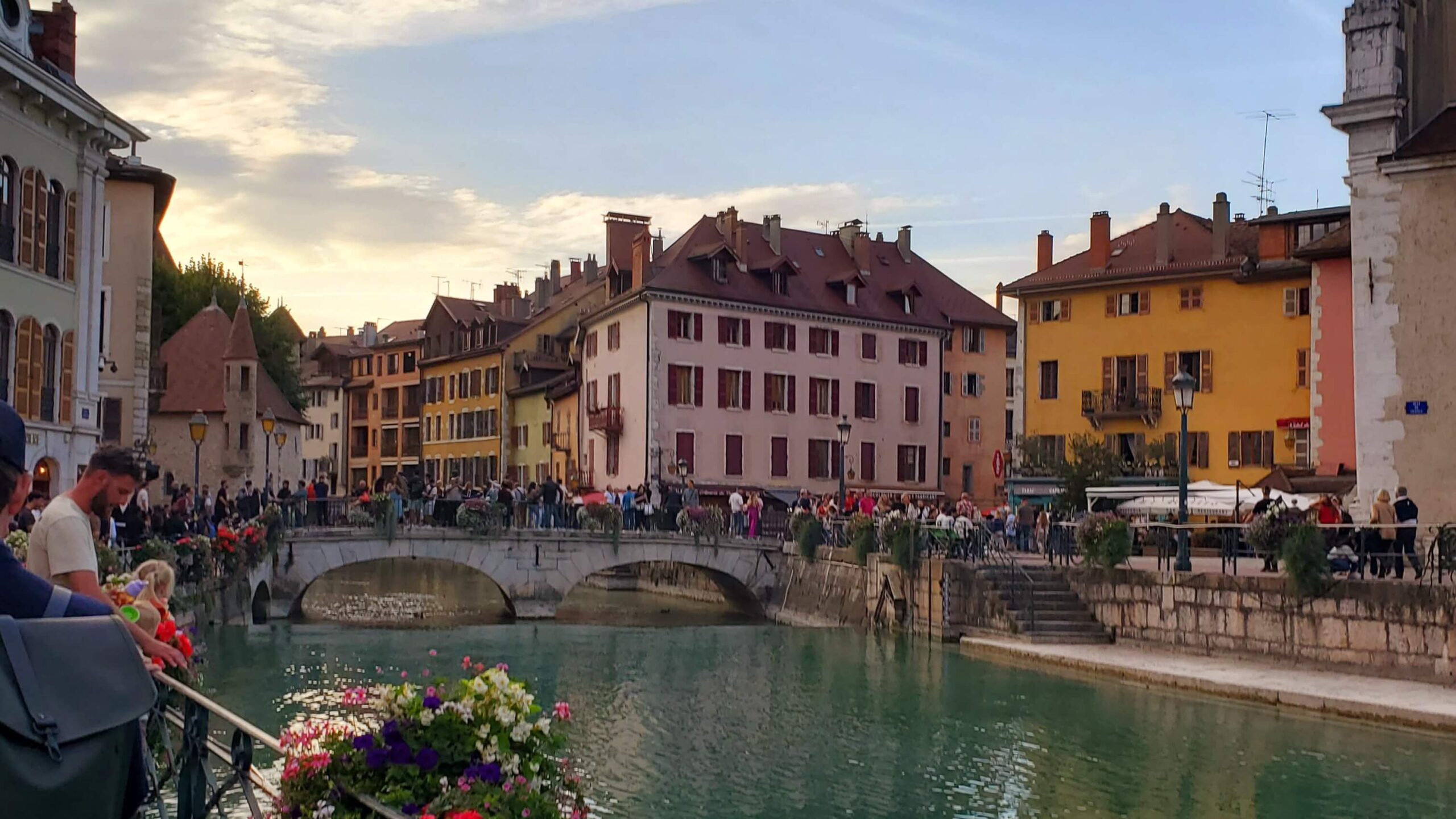
You’re standing on one of the many bridges arching over the turquoise waters of Annecy. To your left, a street stretches out, lined with houses painted in bright, cheerful pastels. In Annecy pink and orange seem to reign supreme, their vivid hues catching the evening light, while softer shades of green and beige add a touch of elegance to the view. On your right, the church of Saint François de Sales stands tall, showing off it’s light to-level facade.
Then your gaze falls over the canal, and there it is—arguably the most iconic landmark of Annecy: the Palais de l’Île. This small castle perches on a rock island in the middle of the water, its weathered stone walls rising proudly above the shimmering surface. With its pointed rooftops and sturdy structure, it looks as though it has been plucked from the pages of a medieval tale.
Take a guess—what’s the story behind this Annecy attraction?
As it turns out, the Palais de l’Île has taken on many roles over the centuries. With parts of its history dating back to the 12th century, it has had more than enough time to evolve. This Annecy must-see has served as a courthouse, a prison, a minting workshop, and even a home for the elderly. Today, it seems to have settled into its true calling as a museum.
The Palais de l’Île is also often referred to as a “building in the shape of a ship,”. Do you see the resemblance? I am struggling to, but perhaps this is not the right angle. Regardless, it remains a must-see attraction in Annecy, drawing visitors from all over the world to take it’s picture. Don’t forget to take yours too!
What do you want to see in Annecy next? From here, we have two options: we can either wander deeper into the enchanting streets of Annecy’s old town or use the last light of the day to return to the lake.
I think we should head back to the lake. The colorful streets of Annecy old town will still be just as magical in the soft hues of dusk, but the lake—bathed in the warm embrace of a setting sun—will be a sight to remember.
We return to the lakeside, ready to greet the mountains once more. This time, our path takes us past larger boats swaying gently in the breeze. To our left lies Jardin de l’Europe, a spacious park with lush green lawns shaded by towering trees. The garden is said to host a fascinating variety of trees from across Europe, America, and Asia, including the majestic giant sequoia.
Turning around, your gaze is drawn to Annecy Castle, perched proudly on a hill with the sunset painting the sky behind it. Its stone walls and roof seem to echo the material of the Palais de l’Île, giving it the feel of an older sibling. And like the Palais de l’Île, Château d’Annecy has its share of fascinating stories. In its early days, it served as a residence for counts and dukes. But by the 17th century, its role shifted dramatically—it was abandoned as a residence and repurposed as barracks. Today, it stands as an art museum and symbol of Annecy.
What to See in Annecy if You’re a Hopeless Romantic: Pont des Amours of Annecy
Continuing our stroll, we arrive at one of Annecy’s most iconic tourist attractions—the Pont des Amours, or Lovers’ Bridge. While Annecy boasts countless bridges, this one, at first glance, seems similar to the rest—slightly arched, with graceful metal railings, and set against a stunning backdrop of turquoise waters and towering mountains.
But what truly sets it apart is the legend that surrounds it. According to local superstition, if two lovers meet in the middle of the bridge and share a kiss, their love will last forever. After all, France is the land of romance. Who wouldn’t want a love that endures a lifetime? It’s no wonder that this bridge is always full of couples and hopeful romantics.
From there, we continue along the canal, shaded by an avenue of tall trees. The calm waters below mirror the docked boats and the silhouette of Annecy’s skyline that peeks through the foliage. The world feels perfectly still, as if nature and architecture have conspired to create this flawless harmony.
It doesn’t get more perfect than this, does it?
What to See in Annecy Old Town? Romantic Stroll Through the Streets
From here, we cross the street and step into the charming streets of Annecy’s old town. Once again, we are surrounded by quaint, colorful houses that exude the romantic, storybook charm of a little French town—the kind your soul has been longing for.
Quint and Colourful Houses of Annecy Old Town
I don’t have a particular route in mind, so let’s wander wherever our hearts—or perhaps the crowd—leads us.
The buildings around us rise several stories high, their facades painted in cheerful hues of olive, mint, coral, mustard, baby pink, and more. Together, they remind me of a box of colorful candies. On the ground floor of the buildings in Annecy old town, it’s easy to spot a pattern: rounded archways framing the windows and doorways of boulangeries, lively restaurants, and charming shops. Meanwhile, the upper floors of Annecy Old town houses are lined with neat rows of small windows, each concealed behind shutters—a timeless method of climate control that Annecy’s residents still embrace.
Annecy’s Old Town is often referred to as a medieval town, and while the buildings vary in age, each tells a story of the passage of time. You can see it in the chipped paint and dusted shutters, evidence of years gone by. Yet they carry their age gracefully and remain as beautiful as ever.
If you’re looking for a bit of guidance on what to see in Annecy old town, some popular spots include the Palace de Notre-Dame and the charming Rue Sainte-Claire. And be sure to check out the historic old city gates. These gates once marked the entrance to the walled city, and in the past, visitors had to pay an entrance tax to pass through them.
Countless Bridges and Canals of Annecy
What goes around comes around. We’ve wandered back to the canals that weave through the heart of Annecy, earning the city its nickname: the Venice of the Alps. These waterways have shaped the town’s charm and contributed to the sheer number of bridges that span across Annecy’s picturesque streets.
I’m not sure anyone has ever counted exactly how many bridges you can see in Annecy, but one thing is certain—there are plenty. Bridge after bridge stretches before us, lined parallel to each other as far as the eye can see. At this time of year, they’re all draped in cascades of flowers spilling from boxes perched on the railings. The combination of the sparkling blue water, pastel-colored houses lining both sides of the canal, and the soft, wavy blooms creates a scene that feels almost otherworldly—a romantic, dreamlike atmosphere, like seeing the world through rose-tinted glasses when you’ve just fallen in love.
Now, I don’t know about you, but I’m starting to get a little hungry. How about we seek out a cozy French restaurant to indulge in one of France’s most beloved culinary treasures—cheese? This rich, savory delight comes in countless varieties, but tonight, we’ll be enjoying it in its most indulgent form: molten and bubbling. Intrigued?
End Your Annecy Itinerary With a Ritch Cheese Fondue in Annecy Old Town
I haven’t checked any reviews, but Le Freti in Annecy’s Old Town looks quite charming, and the wait time is only about 20 minutes today. So, I say, let’s go for it!
We’re seated, and now we face the age-old dilemma: cheese fondue or raclette?
In short: Both are irresistible cheesy delights that originated in Switzerland but have become beloved in neighboring countries like France. Raclette involves melting a wheel of cheese and scraping the gooey goodness directly onto your plate. Fondue, on the other hand, involves melting a blend of cheeses with flavorings like wine, garlic, and nutmeg in a pot, and then dipping bread or other treats into the molten mixture.
I’ve made up my mind: let’s go with the fondue. Now, we just need to decide on the sides. The fondue comes with pieces of white bread, it is delicious on its own, but for a little extra variety, you can add meat or vegetables for an additional charge. As a tourist, I’d recommend adding a plate of fresh veggies to balance out the richness of the cheese, but hey, I’m no expert!
The wait time isn’t long, and soon enough, a large pot of bubbling, melted cheese is placed before us. It’s kept on the burner throughout the meal, so it stays warm and gooey. The smell is strong (as with many French cheeses), but it looks so inviting!
Having done this before, let me give you a little demonstration. You take your special fondue fork, spear a piece of bread, and dip it into the bubbling cheese. Swirl it around for a bit, and then pull it out to reveal a glorious string of cheese stretching from the pot to the bread. Just look at that pull!
The cheese is rich, savory, and wonderfully warming. I love cheese. But let’s be real—there’s no way I can finish all of this on my own, so I’d recommend not overdoing it with the portion sizes.
With this indulgent dinner, our evening of exploring what to see in Annecy comes to a close, and it’s time to head back to the hotel. But don’t worry, tomorrow awaits, bringing with it a whole new day of unforgettable attractions around Annecy.
What to See Near Annecy, France: Day Trips for Nature Lovers
Enjoyed my ideas of what to see in Annecy and looking to explore beyond the city? Here are some amazing attractions near Annecy you could add to your Annecy trip itinerary.
We arrived in Annecy in the evening, and explored places in my what to see in Annecy list mentioned above, then explored these the next day. But if you have only 1 day you could also start with one of the 2 ideas listed below and then explore Annecy after.
Take a look at Lake Annecy from Mont Baron & Veyrier Hiking Loop
If you enjoy hiking, there’s a mountain trail near Annecy that rewards persistent adventurers with breathtaking views of the crystal-clear waters of Lake Annecy, high up in the clouds. From this height, you gain a true sense of just how vast the second-largest lake in France really is. And if you’re in the mood for a little detective work, you can try spotting the places you’ve just visited in Annecy, nestled within the sea of rooftops far below.
According to my sports watch we walked ~5.11km on a round trip from the parking lot to Mont Baron peak.
Decode the Rock Formations in the Fairytale land of Gorges du Fier
If you’re mesmerized by the wonders of nature, you can leave Annecy to step into an otherworldly place that seems like the magical kingdom of elves. As you walk along pathways clinging to moss-covered cliffs high above a roaring river, you’ll find yourself searching for faces and mythical creatures hidden in the rock formations around you.
Annecy is a place that can inspire stories. If you’re looking for that charming little French town to stroll through to fulfil your romantic dreams, you have found it. Yes, it is very crowded, but can you blame anyone for wanting to get lost in a place like this? And hopefully my list of things what to see in Annecy will help you plan your own Annecy travel itinerary.
It takes thousands of years for a relentless river to carve its path through softer rocks, slowly shaping mountain valleys with steep, dramatic cliff walls that we call gorges. Water, however, is a master sculptor, and the Gorges du Fier feels like a breathtaking natural art gallery—an enchanting kingdom where dragons and mountain spirits seem to watch over every step you take along the footbridges clinging to the cliffs.
Join me on a virtual journey through these awe-inspiring gorges.
Brace Yourself and Step Onto the Footbridge of Gorges du Fier in France
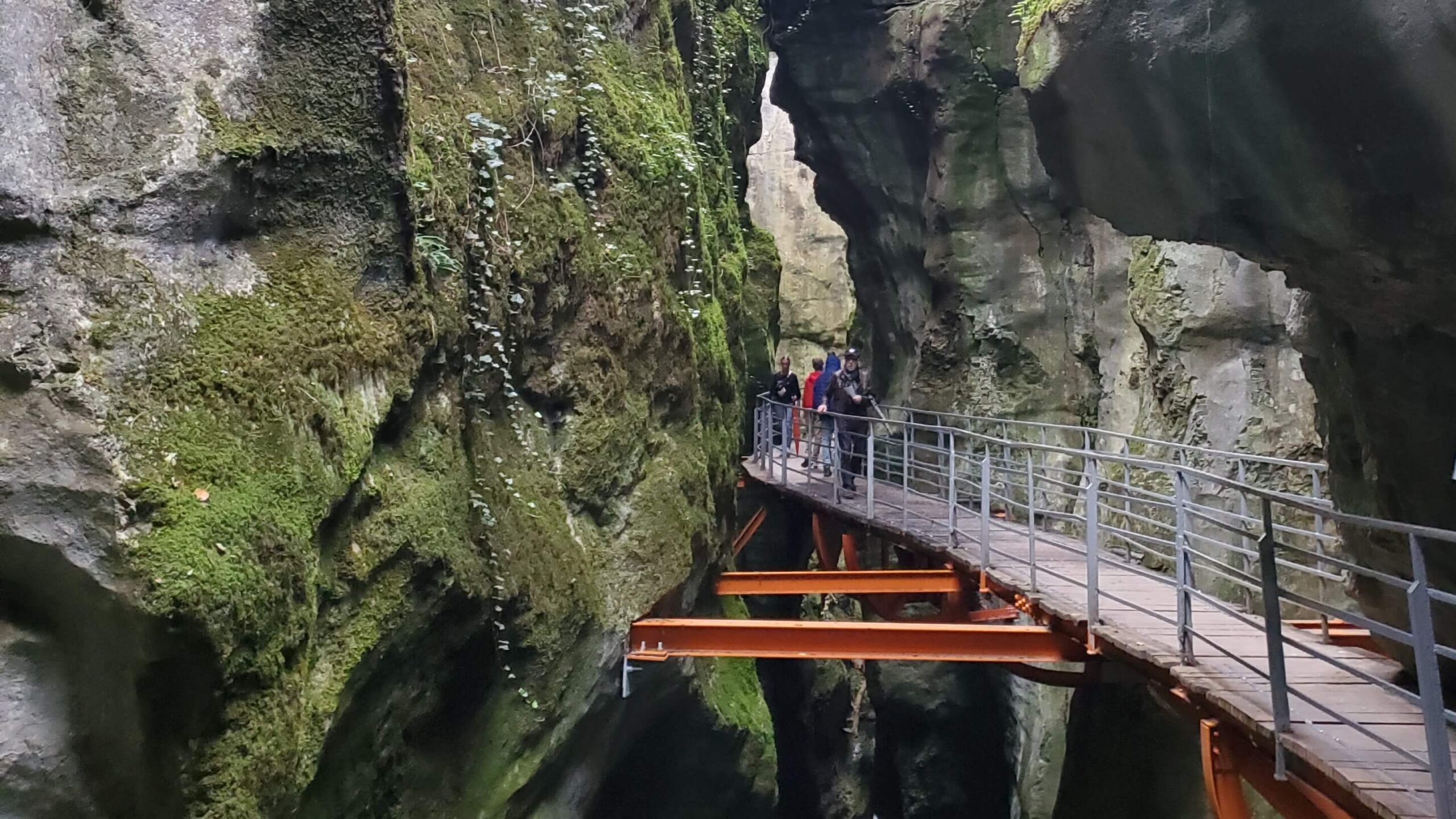
To discover true magic, you often need a touch of bravery. The Gorges du Fier is no exception. To unveil its secrets, you’ll need to step onto footbridges that cling to the cliffs, suspended 25 meters above the river—an experience adventurers have been enjoying since 1896. Are you ready?
Beyond a sturdy metal gate, a narrow wooden walkway stretches ahead, attached to the rough cliff wall. It’s so slim that passing someone coming the opposite way requires careful maneuvering and an awkward smile.
You take a deep breath, steady your nerves, and step forward. As you inch along, your gaze drifts down to the lush green valley where the Fier River dances over rugged rocks. Looks like we’re somewhere in-between the earth and the sky, at the height of the tree branches. But luckily it is more exciting than frightening —a true thrill offered by nature.
And just like that, the Georges du Fierwalkway leads you into the cliff’s embrace, a portal to another world.
The Magic of Gorges du Fier
Now, you’re in the heart of the valley, a breathtaking masterpiece sculpted by the Fier River over millennia. You look up, and the walls of the Gorges du Fier tower high above your head, their rugged surfaces cloaked in lush moss, evoking the enchanting aura of an elven kingdom. Long, trailing vines hang like green curtains, perfectly still, adding an air of mystery to this magical landscape.
The shapes etched into the cliffs are fluid and organic, as if nature herself had sculpted them with the precision of an artist’s hand. Not a single straight line can be found. Even the suspension bridge you’re walking on follows a gentle curve, disappearing behind a rocky bend. What lies beyond remains a tantalizing mystery.
The sound of rushing water grows louder, an ever-present reminder of the Fier River’s relentless power. You pause, steady yourself, and summon the courage to look down. Far below, the river roars, its crystal-clear waters crashing and churning against ancient rocks, carving the gorge with timeless force.
The sight is mesmerizing—a vivid reminder of nature’s unyielding strength and your own smallness in its vast embrace. It’s humbling, thrilling, and an experience you’ll never forget.
The Power of the River Fier
Further along the trail, you spot a giant ruler affixed to the cliff wall, proudly displaying the water level records. The highest marking soars far above your head, a testament to the river’s incredible power. During heavy rains, the river can surge over 26 meters in just a few hours. This dramatic rise likely explains why the Gorges du Fier remain closed to visitors from late autumn to spring.
Faces of Gorges du Fier
The gorges are a realm of illusions and hidden wonders. As you walk through the valley, keep your eyes open—you might just spot a face or the outline of a mythical creature in the shadows or among the boulders. In fact, I can see one right now. Can you?
It’s as if the enchanting spirits of the cliffs are quietly watching over us, their presence adding an air of magic to the experience. And who knows? Maybe they really are.
The Labyrinth of Rocks
As the trail nears its end, you emerge from the narrow valley into a more open area, where several information stands share insights into the geology, history, and legends of the Gorges du Fier. Beyond these, you’ll find a remarkable section known as the Labyrinth of Rocks.
This area is a chaotic yet captivating scene where boulders and cliffs of organic shapes seem to have collapsed and intertwined with one another. The roaring sound of the river echoes through the maze, though you can not see it from here. Perhaps this is how the gorges appeared in their infancy?
At this point, the trail comes to an end. It’s not a long hike, and now it’s time to turn around and retrace your steps. Consider this your opportunity to spot any rock faces you may have missed on the way in.
Thoughts?
I think the experience was truly magical. The only downside for me was the amount of people who were here, as the paths are narrow and you have to make an effort to let someone pass by if they are coming the opposite direction or are walking faster than you. But other than that – Gorges du Fier is a fascinating example of nature’s artistry that is worth seeing.
Rising majestically above Lake Annecy, the peaks of Mont Baron (1,299m) and Mont Veyrier (1,291m) set the stage for a hike that strikes the perfect balance between challenge and reward. Though the Mont Veyrier – Mont Baron loop is relatively short, it packs in plenty of adventure. As you climb through lush forests, traverse rocky paths—including a thrilling ridge walk—and pause at breathtaking lookout points, you’ll experience the true essence of hiking in the French Alps.
Mont Baron & Mont Veyrier Hike Leads Through the Forest
The incline of the Mont Baron & Mont Veyrier hike begins with a gentle challenge, drawing us into the heart of the forest. The dirt path snakes ahead, shaded by a canopy of towering trees. The lower branches of evergreens stretch out like skeletal arms, their bare and pointy limbs adding an eerie charm to the surroundings. Yet, the scene is far from gloomy because the bright green leaves of deciduous trees brighten up the space.
Beneath Your feet, the trail is dotted with exposed roots and occasional rocks jutting out of the earth. It keeps you mindful of each step, but it doesn’t diminish the scenery. Locals, however, seem unfazed by the challenge—not just climbing Mont Baron, but running up it! As I huff and puff my way along, many of them breeze past us at what feels like the speed of light. I can’t help but admire their endurance and determination!
Other hikers descending to complete their Mont Baron & Mont Veyrier hike greet you with a warm bonjour. It’s a simple yet heartwarming gesture that adds to the friendly atmosphere on the trail. By the way, exchanging greetings when you pass someone coming from the opposite direction is the polite thing to do on a mountain path—so don’t be shy, join in with your own cheerful bonjour!
Here and there, clusters of moss-covered troll rocks punctuate the path, their shapes cloaked in vibrant green moss, like ancient guardians watching over the forest. Mountains have long been the backdrop of myths and legends, and these whimsical formations only enhance the trail’s enchanted atmosphere.
We continue our upward journey toward the peaks of Mont Baron & Mont Veyrier, guided by the trail markers painted on the trees. Orientation is straightforward for the most part, as the path rarely branches off. However, there are a few spots where the trail markers play a game of hide-and-seek.
As we press on, the trail begins to reveal its more challenging side, morphing into a labyrinth of tangled roots and uneven rocks. This section requires both effort and focus—you’ll break a sweat and need to pay close attention to your footing to avoid slipping. But rest assured, it’s all part of the adventure and entirely manageable!
The Breathtaking Views of Lake Annecy from Mont Baron – Mont Veyrier Loop
At last, the forest parts to reveal the first glimpse of what lies beyond: a sliver of Lake Annecy. Through a natural window in the trees, you catch sight of a corner of shimmering blue water, framed by a tapestry of light-colored houses and rooftops. These scatter into the distance, softening into smoky blues where the sky melts into the horizon.
Though this initial view doesn’t yet reveal the full splendor of the Mont Baron & Mont Veyrier hike, it’s a tantalizing promise of the breathtaking vistas ahead. Energized by this glimpse of what’s to come, we press onward.
Deeper into the forest, the trail leads us to an open clearing, thoughtfully equipped with benches—perfectly placed for taking in the magnificent panorama. Here, Lake Annecy stretches before us in all its glory, a vast expanse of sapphire blue punctuated by tiny white yachts drifting leisurely on its surface. Beyond the lake, misty mountains rise, their soft, blurred outlines blending seamlessly with the clouds. Below, between the clusters of houses in the village, streets weave like veins, tying the scene together in intricate patterns.
As you take it all in, one word of caution: stay mindful of the edge. The only thing separating you from a steep drop are some modest bushes.
After this, there are plenty more lookout spots, each offering a unique perspective of the surrounding landscape. My favorite, however, is the one where a towering cliff wall rises on our left, adding a dramatic touch to the scene.
When we reach the Veyrier peak, we discover that it doesn’t offer much open space for our well-deserved lunch, so we press on to Mont Baron instead. Thankfully, it’s not far.
Walking By The Edge (Literally)
And just when you think this hike couldn’t get any more thrilling, we come across the Ridge Trail. Ahead of us, a narrow rock path stretches right along the mountain’s edge. Oh, it’s both breathtaking and exhilarating, with a sheer drop on one side and sweeping views that stretch endlessly below.
We’ve Conquered the Mont Baron Peak
At the Mont Baron peak, a perfect spot for our picnic awaits. Here, nature has created a series of natural rock stairs, which have become ideal makeshift benches. Already, many hikers who’ve conquered Mont Baron before us are seated, enjoying their lunch at the edge of the cliff.
Naturally, we join in. As I’ve said before—and will say again—there’s nothing quite like savoring a French baguette on top of a French mountain. Bon appétit !
From here, the trail begins its descent, winding down through the forest back to our starting point. What an adventure the climb of Mont Baron & Mont Veyrier has been!
When I went on my first hike, I was surprised to find that most trails seem to take you through dense forests until you finally reach the peak. These days, I’ve come to expect that. So when a trail comes with so many beautiful lookout spots, especially ones that offer views of the lake, it feels like a jackpot. What makes it even better is that the hike doesn’t take up the whole day—leaving you plenty of time to explore more of France once you’re down. And although the trail was challenging at points, I was able to do it without the hiking poles that I don’t own. Just be mindful of all the roots and rocks below your feet!
What You Need to Know About Mont Baron & Mont Veyrier Hike
The route we followed when Hiking Mont Baron – Mont Veyrier
~5.11 km with the total ascent of 707m according to my sports watch
Are there any amenities on the Mont Baron and Mont Veyrier trail?
The hiking trail is market, however there are no cafes or shops along the hiking route, we did not saw any toilets either. So come prepared.
Welcome to the French Alps (Auvergne-Rhône-Alpes region) – a land where the majestic peaks of towering mountains meet charming old towns and crystal-clear lakes. Picture this: one day you’re venturing through breathtaking hiking trails, the crisp mountain air filling your lungs, and later, you’re fueling up on heartwarming local cuisine. The next day, you’re strolling through cobblestone streets lined with colorful houses, camera in hand, capturing the fairytale beauty of a centuries-old château.
This 5-day France road trip itinerary will guide you through the region’s best beginner-friendly hikes, hidden gems, and unforgettable experiences. Ready to explore? Let’s go!
Let’s Talk Logistics For This France Road Trip Itinerary
For this itinerary, a car is essential to reach the hiking trails and explore the region at your own pace. If you’re traveling with your own car, like we did, you’re all set—just head straight to the first stop of our France travel itinerary, Annecy, and let the adventure begin!
If you’re flying in, you’ll need to rent a car. While I don’t have personal experience with car rental in France or Switzerland, I recommend doing your own research to find the best options for your needs. The two closest airports to Annecy are Geneva (Switzerland) and Lyon (France). Both airports are well-connected to the region, so you can fly into either and drive to Annecy in just a couple of hours. Alternatively, if you choose Geneva, you can take a train to Annecy and then figure out your car rental options in France for the rest of the trip.
Our first stop on our France Alps road trip is the medieval city of Annecy, which lives by the crystal-clear lake waters and wears bright pastels. This perfect, romantic French town, with its historic château and mountain views, feels like it could inspire storybooks.
I can’t imagine hiking in the French mountains without a baguette to savor at the peak—it’s like a well-earned reward for your endurance. That’s why the first stop on our itinerary is a boulangerie in Annecy, where the air is thick with the scent of freshly baked pastries. There, you can pick up a freshly baked pain au chocolat for breakfast, enjoy a warm coffee, and, of course, take a baguette to go.
Since the hike lasts several hours and there are no lunch spots at the peaks, I strongly recommend preparing a picnic beforehand. Otherwise you’ll get grumpy.
First Hike in French Alps: Mont Baron & Mont Veyrier Hike
Each French mountain hiking trail has its own unique charm, and the signature feature of the Mont Baron & Mont Veyrier hike is the spectacular views of Lake Annecy. The trail weaves through dense woods, and at various points, glimpses of the lake peek through, adding a magical touch to the journey. These moments of wonder make this hike truly special, and the final view from the summit is worth every step.
You have to be brave to witness the magic. Gorges du Fier is a land of enchantment, fit for a storybook about elves and fairies. To explore the canyon that the restless river has carved over centuries, you must be brave enough to step onto the suspension bridges attached to the cliffs. The view is both exhilarating and breathtaking. Do you dare to walk across?
Drive to Grenoble, France to spend the night there.
Day 3 of Our France Road Trip Itinerary
Explore the “Capital of French Alps” Grenoble
After a day of physical adventure yesterday, it’s time to stimulate our minds at the Musée Dauphinois, nestled in a historic cloister. Here, you’ll explore everything from the region’s rich history and skiing culture to its captivating architecture—plus, a panoramic view of the city that will truly take your breath away.
Then, stop by one of Grenoble’s many French restaurants to take advantage of the daily specials. These typically offer a delicious three-course lunch at a great price during a set time in the workday.
Just when you think the day couldn’t get any better, we’re heading up—way up. A cable car will whisk you to the top of Fort de la Bastille, where jaw-dropping views await. But don’t just take the ride down—trust me, the descent is an adventure of its own, with secret tunnels and hidden pathways that feel like something straight out of a spy thriller.
Have you really been to France if you haven’t seen a Château? With around 45,000 castles across the country, visiting one is an absolute must.
Unfortunately, the castle and its gardens were closed on the day of our visit, but you can still make the most of it by exploring the old park right next door, which felt like stepping into a forgotten memory. And hey, you can always plan better than I did and for your next trip choose a day when it’s open!
A Hearty Lunch in A Cute French Mountain Village
To survive the harsh environment of the French Alps, people relied on hearty, filling meals. After burning all those calories hiking, there’s no better reason to indulge in a traditional dish like Tartiflette, made with layers of potatoes, crispy bacon, onions, and rich, flavorful cheese or the Dauphinoise Gratin (another local potato dish) . It’s a perfect comfort food on a chilly day.
Second Hike in French Alps: Lac du Lauvitel
This mountain trail is accompanied by a beautiful mountain river and scenic viewpoints of the surrounding peaks, turning the entire hike into a breathtaking sightseeing adventure. But the moment you reach the top, you’ll never forget: a crystal-clear blue lake lies nestled among towering mountains. Clouds rise from its surface, and in the distance, you can see streams of water cascading down the peaks, feeding the lake below. It’s an idyllic scene that feels untouched by time.
Day 5: The Last Day of Our France Road Trip Itinerary
Travel to Lyon, France to Explore The Hidden Passages
Lyon’s Old Town is brimming with beautiful architecture and delightful art scattered throughout the streets. But the real charm of this French city lies in its hidden traboules—secret passageways tucked away around the town. Some lead to charming inner courtyards, while others might just send a chill down your spine. You never know what you’ll discover until you embark on a traboule hunt.
Spend the night in Lyon, France and travel home the next day. That’s the end of our France road trip itinerary.
From the charming canals of Annecy to the breathtaking peaks of the French Alps, this France road trip itinerary offers the perfect blend of adventure, culture, and unforgettable moments. Whether you’re savoring a freshly baked baguette at sunrise, conquering mountain trails, or exploring hidden passages in Lyon, the French Alps never fail to leave you in awe.
Has visiting the market turned from a necessity to a trend these days? I would say yes, to some extent, at least for some people. You can find a gastro market in almost every big city. And a visit to the market on a Sunday, like enjoying a coffee and a freshly baked pastry in a Parisian bakery, is somewhat romanticized. Therefore, if you are not afraid of hustle and bustle and are attracted to unusual interiors, let’s go on a little adventure to Agenskalns market.
At the Agenskalns market, there will be neither shouting nor the smell of fish nor the saleswoman who catches you as you pass by and tries to convince you that you would look great in those knockoff boots. At least I didn’t meet her. So it is nothing like the markets I remember from my childhood. The shopping experience is deliberately romanticized to attract those people who go to the market on weekends not to look for the best deals but for entertainment.
But is it bad? For things to live, they must adapt to the times. That’s why many activities that used to be a daily necessity for people today get a second life and turn from a need into an experience. Therefore, perceive a visit to the Agenskalns market as a treasure hunt from which you will return either with new impressions, a full stomach, or local delicacies in a bag.
Interior of Agenskalns Market
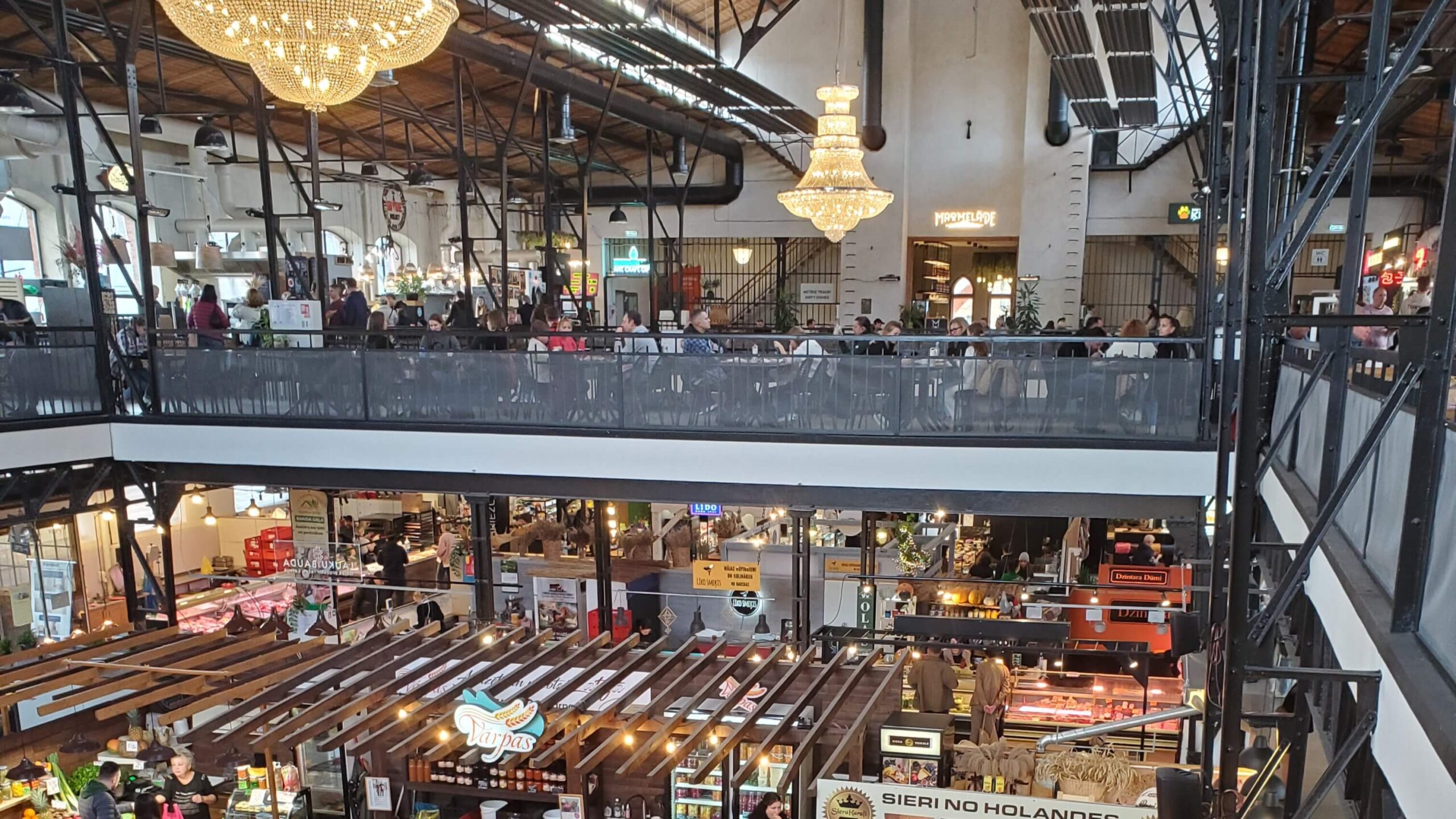
As soon as you enter the market, look up and appreciate the most intriguing feature of the place – the ceiling. They are designed in an industrial style with panels, pipes, and fans. It should not be a surprise that they most often appear in the pictures posted on social media. It is a market after all. But to create a surprising effect, someone has hung grand crystal chandeliers, which I think is a fun idea! Contrast like this always sticks in your memory.
Āgenskalns Market First Floor – Colourful Shopping Area
Is your reusable bag ready?
Let’s do some delicacy treasure hunting at the market stalls!
On the first floor of Agenskalns Market, you’ll find a variety of product stalls—colorful fresh fruits, tempting cheeses, fresh bread, Molberts ice cream, local craft beer, some more exotic things like olives and other goodies.
Every stall you pass by is a little different. In the bakery section, cakes sit proudly on the shelves. Your mouth starts watering as you imagine how sweet the glaze must be. I bet it literally melts on your tongue! But if you’re craving something savory, the large cheese wheels sit just as majestically as the cakes. And it’s not hard to imagine the smoky aroma you’d get from one of the smoked sausages.
However, in the autumn season, the real kings of the Agenskalns market are definitely the vegetables. Onions, cauliflower, and carrots are practically spilling over the edges of their crates.
Seeing the abundance of fresh produce gets the gears turning in your head, sifting through all the recipe ideas you could try.
Antique Hunting at Agenskalns Market
I’ll be honest, I’m a little bummed that we didn’t come to Agenskalns Market on a day when the Flea Market is operating. Hunting for delicacies is fun, but if we’re talking about romanticizing a market visit, then the stalls filled with the most eclectic mix of items sound like the ultimate adventure. Oh well… The experience will have to sit on my wishlist for a bit longer.
But before we head to the food area, if you don’t mind, I need to make a quick stop at the restrooms.
But what’s this? Guess what’s hidden in the basement on the way to the toilets? An antique shop! We definitely have to check it out.
The store’s shelves and tables are packed with all sorts of intriguing items. Here, you’ll find all kinds of pots, mugs, and small dishes. Let’s have a contest—who can find the most unusual item? I’m voting for that swan-shaped dish, but the game isn’t over yet!
Next, your attention is drawn to several record players and an impressive vinyl collection. I spotted a typewriter.
Deeper into “Skandinavs,”, you’ll find furniture and all kinds of trinkets—old matchboxes, coins, and jewelry. There’s even a shelf with used electronics, in case you happen to need, say, an iron. And at the very back, you’ll find clothes.
You could probably spend half the day carefully inspecting every treasure hidden on these shelves.
But my stomach is growling. So I vote to head to the Agenskalns Market food area. A little bird told me you can even find Georgian khachapuri there!
Agenskalns Market Food Area
The Āgenskalns Market food area is perfect for people who can never agree on what cuisine to choose. No arguments this time—there’s a little bit of everything here. In Āgenskalns Market you’ll find stalls offering Asian cuisine, Georgian dishes, pancakes, pizza, and other delights. For those interested, there are also liquid calories—wine, beer, and cocktails. Ironically, the only thing you probably won’t find here is Latvian cuisine.
All the food stalls share common tables, meaning you can enjoy a completely different meal from your friends, yet still sit together. Great! However, just like in other markets, you might have to fight for a table. It looks like it’s all based on a “first come, first served” principle. Not so great.
But if you do manage to claim a table, while you wait for your buzzer to signal that your food is ready, you can watch the hustle and bustle of the lower floor of Agenskalns Market, where people are busy shopping at the market stalls. It’s fascinating to observe all the movement and excitement.
And if people-watching isn’t your thing, we can check out what books are currently available at the book exchange station. Which one intrigues you the most? Stories about Spain? Or perhaps differentiated math exercises? Or… we could go play a game of table football.
Finally, the buzzer lets out a sharp beep—it’s time to pick up our meal.
Since I’ve been craving khachapuri ever since my trip to Georgia, I went for this hearty treat. It’s delicious. The bread feels a little different than in Georgia, but the cheese is just as rich, salty, and stretchy.
Bon appétit!
And what are your thoughts?
I know opinions differ, and some people might disagree with me, saying that a trip to the market isn’t an adventure. But I believe that visiting Agenskalns Market is an interesting way to spend a leisurely Sunday in Riga. You’ll likely return home with vibrant impressions, a full stomach, and something extra in your bag to snack on later.
Here’s a fun trivia! Which city has the world’s oldest still-operating Ferris wheel? Vienna, Austria! What has an old anti-aircraft defense tower been turned into in Vienna? A giant aquarium! And where can you learn to tell the difference between schnitzel and strudel using just your taste buds? Of course, in Vienna, Austria! Intrigued? Then let’s embark on a short (1.5-day) Vienna itinerary to find out what to see in Vienna—a city where magnificent architecture awaits at every corner.
Decisions, decisions. With more than one iconic palace in the city, choosing just one can be tough.
Schönbrunn Palace seems to be the most popular choice in Vienna. And yes, 1,441 rooms do sound truly impressive. But since the imperial family’s summer residence is farther from the Vienna city center and doesn’t quite fit within our time constraints, we’ll have to leave it for our next trip to Vienna—unfortunately.
That leaves us with the palace that seems to be a close runner-up in many reviews of Vienna’s palaces: Belvedere. It’s said to have a royal garden, a stunning exterior, and a fantastic location. Sounds like a plan—let’s go, check out what to see in Belvedere palace!
When we arrive, we quickly realize that back in the day, building just one palace to impress Vienna simply wasn’t enough. There are actually two Belvederes—the Upper and the Lower.
I’d say both of these buildings are majestic, but they are more like cousins than sisters. The Upper Belvedere, with its green roof, countless windows, columns, and statues, exudes grandeur. Meanwhile, the Lower Belvedere, with its red roof, slightly more angular shapes, and a breathtaking city view in the background, has its own distinct charm. The two are connected by a sprawling garden, where neatly trimmed hedges and colorful flower beds create intricate patterns.
The fountains, however, are… peculiar. As in “a goat-legged creature spewing water while a knife is held to its throat” peculiar.I suppose back in the day people had a different sense of entertainment?
Nowadays, the main attraction here is the art displayed inside the Belvedere buildings. Fun fact: this palace was originally built as a summer residence for a prominent figure but was later transformed into one of the first museums open to the public.
And this is where we learned a hard lesson…
Lesson of our Vienna Itinerary
During peak season in Vienna, you have to book tickets in advance—otherwise, you’ll miss out. We learned this the hard way when we couldn’t get tickets to the Belvedere Museum on the same day we tried to buy them.
What Architecture Marvels to Add to Your Vienna Itinerary?
I bet you haven’t taken as many pictures of buildings anywhere else as you will in Vienna!
You could spend hours wandering through the city, moving from one grand building to the next.
That said, I’ll be honest—most of this beauty is concentrated in the city center. Venture into the outskirts, and you’ll find unkempt streets and graffiti, which somewhat break the magic of Vienna’s old-world charm.
But as tourists, let’s focus on the highlights! We’ll take a long stroll through the heart of Vienna—the area where, if you zoom in on Google Maps, you’ll see the most iconic landmarks.
Our first stop in Vienna city center? A stunning church with a large, green dome.
St. Charles Church in Vienna and Its Iconic Columns
The church’s dome is visible from afar, its striking green hue reminiscent of Belvedere Palace’s roof. Before long, you’ll start noticing that green rooftops are a signature feature of Vienna’s historic buildings. Soon enough, every time you spot that familiar shade, you’ll instinctively reach for your map, eager to uncover which famous landmark of Vienna stands before you.
But as you draw closer, it’s the towering columns that truly command your attention. Adorned with intricate reliefs depicting various scenes and crowned with majestic golden eagles, they are nothing short of breathtaking.
For a small fee, you can step inside and admire the church’s magnificent interior. But today, we’ll skip this opportunity—there’s so much to see in Vienna, and time is short!
As you continue your walk, another famous building of Vienna comes into view—once again, with a distinctive green roof. But what truly catches your eye are the two towering statues of riders on winged horses on top of the roof. These figures, as it turns out, represent Harmony and the Muse of Poetry.
Take a moment to admire the building’s grand columns and intricate sculptures. In fact, why not turn it into a little game—how many sculpted heads can you spot?
Here’s an interesting fact: did you know that part of the Vienna State Opera was destroyed during World War II bombings? Looking at its beautifully restored façade today, you’d never guess. Quite remarkable, isn’t it?
As much as I appreciate the Opera’s history, classical music isn’t exactly my cup of tea, so I won’t be leading you inside this time. But for those who are interested, the Vienna State Opera offers not only breathtaking performances but also guided tours, giving you a glimpse behind the scenes. You can find more details on their official website.
And now, speaking of historic buildings in Vienna that were nearly lost during the war—let’s continue our journey to Austria’s tallest church.
Engrave Vienna’s Skyline and the Vibrant Tiles of St. Stephen’s Cathedral in Your Memory
Some sights are beautiful, but others are truly unforgettable—St. Stephen’s Cathedral is one of them. Its most striking feature? A breathtaking, multicolored tile roof where vivid shades of green, gold, and black form intricate patterns. Look closely, and you’ll even spot the imperial eagle woven into the design. Once you see it, you’ll never forget it.
But the beauty of the cathedral isn’t just above you—it’s all around. Every inch of the façade is adorned with intricate stonework and delicate carvings. As you ascend, you’ll discover that even the most distant details, far from the public eye, have been crafted with meticulous precision and care.
Step inside, and you’ll be enveloped by a quiet grandeur. Unlike other churches that dazzle with gold, St. Stephen’s captivates through its soaring vaulted ceilings, intricate stained glass, and finely carved details, all creating an overwhelming sense of majesty.
For those looking to take their adventure to the next level, the cathedral’s towers offer panoramic views of Vienna. I’d suggest visiting the North Tower, as it has an open-air viewing platform for unobstructed views. I’ve heard that from the South Tower (though I haven’t climbed it myself), you can only view the panorama through windows.
We step into the small elevator, and the operator whisks us up above Vienna’s rooftops. From here, the entire city unfurls before you— you can spot the Belvedere Palace we just visited, the distant television tower, and even the imposing wartime defense towers.
It’s a view that stays with you long after you’ve left.
The Dark Pages of History – Vienna’s Anti-Aircraft Defense Towers
Vienna’s history, like any city, has its darker chapters. You probably sensed this when we discussed buildings that were damaged during the bombings. But another stark reminder of the horrors of war lies in Vienna’s anti-aircraft defense towers.
This is definitely a niche attraction—not quite my cup of tea. But I think it’s important to mention them so you can fully appreciate the next stop on our journey. These towers are notoriously hard to demolish. In fact, when they tried to bring one down in Berlin 25 tons of dynamite weren’t enough.
So, what do you do when you can’t destroy the tower? You transform it into a gigant aquarium!
Vienna’s Aquarium
From the outside, Haus des Meeres still retains its iconic anti aircraft tower shape, but one wall has been transformed into a vertical garden with flower boxes full of lush greenery, while another features a rock climbing wall. And through a small window, you can catch a glimpse of the water gently swaying inside. Truly impressive!
I would have loved to go inside, but unfortunately, due to our lack of foresight, all the tickets are sold out, and we are left empty-handed. Don’t be like me—if you’re interested in something, book your tickets in advance!
But no worries, there’s still plenty to explore—let’s move to the next stop in our Vienna itinerary.
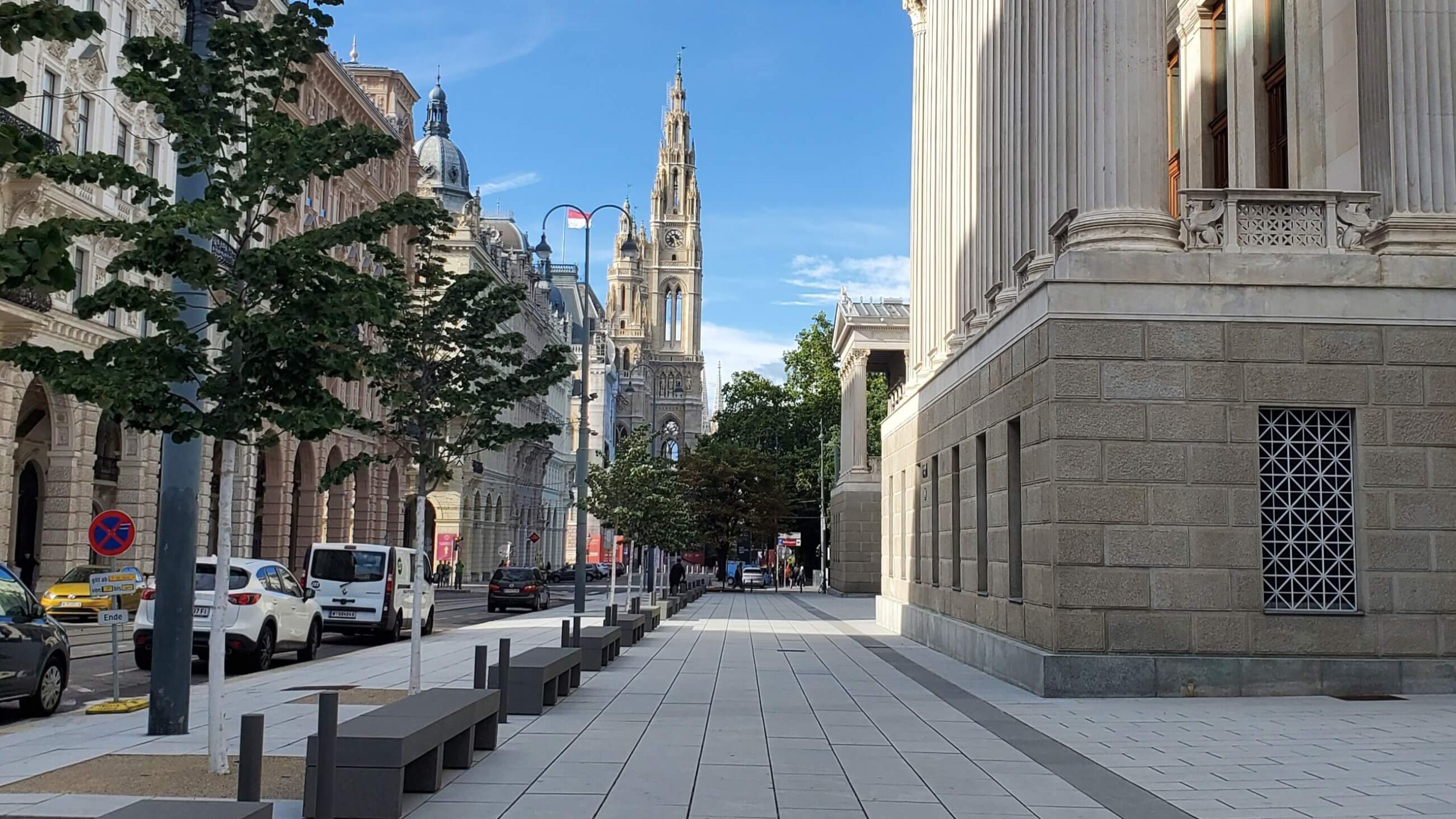
The Vienna City Hall stands out with its intricately decorated tower and soft, ivory-colored lacework. In the summer, the romantic window arches are further enhanced by vibrant flower boxes, creating a truly picturesque scene. This is definitely a spot where you’ll want to snap a photo!
Not far from here, two pale towers beckon. Naturally, we have to check out what they are. Perhaps they are part of a church?
If you also guessed that the two striking, light towers belong to a church, you’re right. Up close, these towers have a sharp, almost imposing presence. I feel like I’ve been repeating myself on this trip, but I have to say it again—the building itself is truly stunning, adorned with intricate details.
And of course, here’s an interesting fact: Did you know this church was built on the very site where an assassination attempt was made on Emperor Franz Joseph? The church was constructed as a thank-you to God for sparing his life.
But now, it’s time to take a break to relax—perhaps over a cup of coffee?
The Taste of Austria on Your Vienna Itinerary: Coffee, Schnitzel, and Strudel
Am I the only one who constantly mixes up the names for schnitzel and strudel?
Apple strudel is a delicious pastry, often drenched in vanilla sauce—at least, that’s how they served it to me. And it’s best enjoyed alongside a cup of Vienna’s signature coffee. I tried the Wiener Melange—a smooth coffee with creamy milk and frothy foam, similar to a cappuccino, but not quite the same.
As for the famous Wiener Schnitzel, it’s a delicate slice of veal, coated in breadcrumbs and fried in either butter or bacon fat until the outside is perfectly crispy. It’s like a cross between a breaded cutlet and a giant chicken nugget. And I mean giant—the one I got was about the size of both of my palms!
You look out the window and realise it is getting dark. Is there something to do in Vienna when the sun goes down?
Let’s End Our Vienna Itinerary With Enjoying Neon Lights in Vienna’s Prater Amusement Park
Entrance is free but you need to pay for the rides.
How about a thrilling carousel ride or a trip on the world’s oldest still-functioning Ferris wheel to end our Vienna itinerary?
Prater Amusement Park has an atmosphere that feels like a scene from a vintage movie. As night falls, neon lights flicker to life, casting a nostalgic glow. The sweet, sugary crunch of candied apples tempts you, while the irresistible aroma of sizzling Vienna sausages fills the air. There are carnival games where you can win prizes by tossing balls, and of course, an exciting mix of exhilarating rides waiting to get your heart racing.
You’ll find a freefall ride, haunted houses with skeletons, a moving gorilla, and a variety of other spooky surprises. Then, there are roller coasters with loops that will give you goosebumps just by looking at them! One of the oddest sights is a carousel featuring a group of teddy bears (?). Did you notice the bear reaching for a drink while his wife chases him with a rolling pin?
Of course, the true icon of Prater is the legendary Vienna Ferris Wheel. Look closely – you’ll notice it’s missing half of its original carriages. After sustaining serious damage during wartime, the wheel was lovingly restored, now with every other carriage absent as a poignant reminder of the past.
Even if you’re not quite ready to face your fear of gravity (I’ll admit, I skipped every single spin while my friends went wild!), Prater is still an absolute must-see as the sun sets. It’s the perfect place to immerse yourself in the electric energy of the park, watching the bright lights, feeling the excitement in the air, and watching your friends getting tossed around in a giant swing.
And that’s the end of our Vienna itinerary! Hope you enjoyed this little, virtual Vienna trip.
Thoughts? I think one and a half day in Vienna isn’t enough. Vienna has so much more to offer in terms of rich history and culture that I wish I could add at least one or 2 days to my Vienna itinerary. I wish I would have had the chance to visit the famous coffee houses and some more palaces. How about you? Which places would you include in your own Vienna itinerary?
This time, we’ll be passing through the Czech Republic road trip style, making our way from Vienna to Poland. But that doesn’t mean we’ll miss out on adventures—quite the opposite! We’re about to discover stunning Punkva stalactite caves with underground waters, tunnels, and even an angel. Plus, a charming little mountain town with storybook-worthy streets awaits us—the only place in the world where the famous Štramberk Ears are made. Curious to find out more? Then join us on our virtual Czech Republic road trip.
This Czech Republic road trip stop is so popular that in summer, tickets need to be booked a month in advance—so it must be something special! And that’s not the only requirement. To reach the Punkva caves in the Moravian Karst Nature Park, you must arrive at least 40 minutes early. Why? Because you can’t drive right up to the Punkva caves—you’ll need to leave your car in the parking lot and either walk a bit or take a tourist train.
We park our car in a paid parking lot—don’t forget to have some Czech koruna for this—and embark on the paved path through the forest. The walk to Punkva Caves turns out to be a feast for the eyes, as time after time, a smaller rock outcrop or a tiny cave pops into view.
When we arrive at the Punkva cave entrance, we have to wait a little—entry is only allowed at the designated start time since the tour is guided. Which makes sense. You wouldn’t want to get lost in a cave, would you? That sounds like the perfect setup for a horror movie.
However, there’s a small catch you should be aware of—the tours in Punkva caves are only available in Czech. For English speakers, a booklet is provided. But that’s no problem; our imagination is working just fine—we’ll enjoy the views and create our own story.
Punkva Caves Underground Lake and the Stalactites That Almost Met
Entering Punkva Cave feels like stepping into a hidden kingdom that wastes no time revealing its aces. After just a short walk through a dimly lit corridor, a small underground lake emerges before you—its still waters as reflective as a mirror.
Can you tell where the stalactites end and their reflection begins?
Every now and then, a single droplet falls from the ceiling, breaking the silence and creating tiny ripples on the water’s surface.
The stalactites in Punkva caves come in all shapes and sizes—some resemble icicles, others totem poles or multi-layered cakes. I don’t know if you’d agree, but to me, most of them look a bit slimy. My fingers itch to touch them, to feel their texture. But I must resist.
Then, we come across a true melodrama of the stalactite world—a stalactite and stalagmite that nearly touch. Only a few centimeters apart, yet they will forever remain distant. Fate has played a cruel trick on them. These formations have dried out, and they will never grow to meet. A little heartbreaking, don’t you think? A symbol of longing, frozen in time.
We wipe away an imaginary tear and continue through the many passageways and chambers.
Something catches your attention. What do you see?
I don’t know about you, but I see hands and the folds of a cloak. I see an angel.
Nature never ceases to amaze!
A Surprise in the End of the Tunnel
We make our way through a dark, damp tunnel, feeling the chill of the stone walls. But at the end of the tunnel there is a light.
Here Punkva caves will really surprise you. Exiting the tunnel feels like stepping into another dimension, like stumbling into Narnia through a wardrobe.
We emerge from the tunnel into a vast, green grotto formed by a sinkhole. ‘Just like in Iceland!’ someone exclaims. I’d say – it feels more like an elf’s kingdom. Above us, the blue sky shines, the stone walls are covered in lush green moss, and at the center lies an unusually vibrant greenish-blue pool. This is said to be the place where the Punkva River disappears underground. Simply breathtaking!
This extraordinary natural formation is known as the Macocha Abyss. The term ‘Abyss’ here refers to a bottomless chasm. At first, I thought the Punkva Caves lacked the colorful lights found in some other stalactite caves I’ve visited, but this otherworldly abyss more than makes up for it.
And our Punkva cave adventure isn’t over yet.
A Slightly Extreme Underground Boat Ride in Punkva Caves
A boat ride through the cave sounds pretty impressive, doesn’t it? Gliding over dark waters with a stone wall above you instead of the sky is quite unusual. But the boat ride in the Punkva Caves can get a bit extreme at times, as there are moments when the boat gets so close to the rocks that you’ll need to tilt your head down to avoid losing it.
Although fun, the boat ride itself isn’t long. After a short while, we’re dropped off at the other end, where we have a chance to explore another chamber with stalactites. Then it’s back into the boat, and we head toward the exit.
A Peaceful Hike in the Moravian Karst Nature Park
If it’s possible to extend the adventure, why not do it?
After the visit to Punkva caves instead of heading straight back to the car, let’s take a detour along a nature trail that promises to lead us to a point where we can see the same Macocha Abyss from above.
I must warn you, though—it involves some uphill climbing. So, if you’re not wearing suitable footwear, there’s a cable car that can lend a helping hand.
The atmosphere along the trail in Moravian Karst Nature Park is peaceful. The trees provide a pleasant shade, and every now and then, a rough rock formation or an archway in the stone wall flashes by. When we reach the top, we spot a café and souvenir stalls. But resist the temptation, summon your courage, and approach the edge to look down. Yes, the fall would be quite severe.
Far below, a narrow gorge is visible, but mostly the view is obscured by trees. From this distance, they look like moss, don’t they?
That’s enough for now. Let’s head back to the car—there’s a few hours’ drive ahead of us to get to the next stop of our Czech republic road trip.
Štramberk – A Mountain Town in the Czech Republic, Whose Economy Is Built Around “Ear” Cookies
After settling into our hotel, we take a leisurely walk to catch the final moments of daylight before the sun sets. Our aim is to explore the postcard-perfect streets of this picturesque Czech mountain town and find the best spots to take in the panoramic views of Štramberk.
Evening Stroll Through the Charming Streets of Štramberk
The narrow streets that wind their way up the hill, with the tube tower perched atop like a candle on a cake, hold something magical. At first glance, they seem like ordinary houses, with ordinary people living in them, just like anywhere else… But for some reason, in Štramberk, every colorful wall, every ornate window, and every flower box feels just a little bit romantic. Perhaps it’s the mountain air? Or maybe it’s the magic of summer. Or perhaps, it’s just in my head.
Štramberská Trúba and the Viewpoint
Which way should we go? Of course, to the Štramberk Trúba – the quaint castle tower perched atop the hill. The opening hours have long passed, so we can’t go inside, but we’re hopeful that the view from the hill, where the castle stands, will offer a breathtaking panorama.
Oh, yes! Look at those little houses, some already glowing with lights in the windows. And just look at the mountains in the background!
Here, at the base of the castle, we’re completely alone. Everyone else is likely indoors, settling in for the night. But we want to make the most of these last moments of daylight, so we take a leisurely stroll through Štramberk streets, where the ancient lanterns cast their soft glow.
The church tower rises, shining in the evening light. We wander down narrow paths, past carefully planted flowers and crumbling stone walls. Have we accidentally wandered into someone’s private courtyard? Hopefully not. I might be romanticizing it a little, but life here feels so much more peaceful, as though time slows down, allowing the beauty of every moment to linger. The air is calm, the world seems quieter, and for a brief moment, all of life’s usual rush fades away.
Unfortunately it’s getting a bit too dark now.
So, goodnight, Štramberk! See you in the morning!
Visiting Jeskyně Šipka cave in Štramberk to Fix our Second Day Cave Hangover
Do you have a cave hangover from yesterday’s adventures? Is your system craving more caves to explore? No worries! We’ll treat it with another cave visit. I should mention, though, this one will be much smaller, but it’s typical to treat hangovers with lighter doses, right?
After breakfast, we take a 15-minute walk that leads us to Jeskyně Šipka, or the Šipka Cave. There, we are greeted by a moss-covered stone portal.
Beyond the portal, there’s a sort of roofless chamber. I imagine how ancient people might have sat here by a fire, gazing up at the stars. From this chamber, several tunnels begin. One is longer, leading into the darkness deep beneath the stone, while another opens up quickly and you can see the light at the other end.
Let’s Taste the Famous Czech Cookies
The best souvenir is one that’s hard to find anywhere else, right?It turns out that the Štramberk area is the only place in the world where Štramberské uši are made. These are cookies that taste like gingerbread and are easily recognized for their unique shape, which resembles ears.
You can find Štramberk ears in any shop around the town. Whether it’s a pastry shop or a small grocery store, the packaging is always the same, printed with the legend of the ears. The text is, of course, in Czech, but Google is always there to help. If I understand it correctly, we’re symbolically eating cut-off human ears to celebrate liberation from invaders. I hope this doesn’t ruin the taste for you.
Sometimes it’s nice to stay away from the big cities, isn’t it? To enjoy the wonders of nature (caves, cliffs, and abysses) and explore the intriguing streets of a small town, free from crowds of tourists. This Czech Republic road trip itinerary is perfect for that.
Once our hearts are full, we can move on. Adventures await us in Poland!
Poland never ceases to amaze. Did you know that there’s a route stretching from Kraków to Częstochowa that boasts 25 medieval castles and ruins? Sounds intriguing, right? There’s something undeniably fascinating about the skeletons of lost grandeur. And to make things even better, part of this legendary castle trail winds through the Eagles Nest Landscape park filled with towering rock formations in the most whimsical shapes. Now that’s a combination worth exploring!
Since our road trip takes us from the Czech Republic to Latvia, and Poland is conveniently along the way, we’re taking this opportunity to visit at least a small part of this extraordinary park. So join me on this virtual journey and let’s explore Eagles Nest landscape park in Poland together!
A Glimpse of the 25-Castle Trail in eagles Nest Landscape park, Poland
Castle ruins and giant rocks, here we come!
The Eagles Nest Landscape Park offers a true choose-your-own-adventure experience. With a staggering number of attractions, it’s impossible to see everything in one go. Sadly, time constraints mean we have to be selective *wipes away a tear*.So, we are settling on a simple 2×2 plan: two castles and two rock formations. A mini “sampler platter” to see if Eagles Nest Landcape Park in Poland sparks your curiosity. And if it does, don’t worry—I’ve created a Google map with a list of the many sights in Orlich Gniazd that I wish we had time to visit. You can find it here.
And actually we’ll see more than just two rock formations, since both castles are built atop dramatic cliffs and massive boulders. That’s how the park got its name—Eagle’s Nest Landscape Park (Orlich Gniazd in Polish). Just don’t confuse it with that Eagle’s Nest related to events of World War II, which is in Germany.
So fasten your virtual seatbelt—we’re off on an adventure!
If you have a soft spot for giant rock formations—welcome to the club! You’re about to enter a wonderland of towering stone giants.
Our first encounter with these geological marvels happens unexpectedly. While navigating our way to the first castle using Google Maps, we suddenly find ourselves in front of massive, surreal rock formations. One even resembles a giant’s boot.
The “first rock” effect kicks in—we have to stop, touch, examine, and, of course, snap at least ten photos.
Upon closer inspection, we discover that these formations aren’t just stunning—they’re also an open-air rock climbing area. The rocks have some metal loops for attaching climbing carabiners. Maybe you happen to have climbing gear in your backpack??
We settled for admiring the view. From another angle, the boot-shaped rock morphs into something else—maybe a giant’s belly? With one last look, we continue our journey through Eagles Nest Landscape Park in Poland.
The Crown Jewel of Eagles Nest Landscape Park – The Majestic Ogrodzieniec Castle
This awe-inspiring skeleton of former glory is the very reason we’re in Eagles Nest landscape park—and we’re not alone. Be prepared for a crowd, as this is the most touristy site on our itinerary. The road leading to the Ogrodzieniec castle is lined with food stalls, souvenir stands, and vendors selling Poland’s famous oversized ice creams. (Yes, I caved and got one!)
What makes Ogrodzieniec Castle so unique is how its walls blend seamlessly with the surrounding rock formations. In places where the castle has crumbled, the natural stone pillars still stand, outlining the fortress’s original shape.
After taking another ten photos of giant rocks, we step inside the skeletal remains of the castle. Our first stop inside Ogrodzieniec castle is a chilling chamber ominously labeled Torture Chamber. Not for the faint-hearted, this room displays various medieval torture devices. Reading the descriptions alone is enough to make your stomach turn.
Shaking off the eerie feeling, we move on to the main ruins.
The Ogrodzieniec castle feels like a labyrinth of crumbling walls, tunnels, and stairways. Inside, there’s little left—no furniture or artifacts—just a few cannons, one strangely aimed at the inner courtyard. Who were they planning to attack—their own people?
Despite its emptiness, the Ogrodzieniec castle captivates with its unique architectural features. First, you discover a deep shaft leading into darkness—you can peek inside, but you won’t see anything beyond pitch-black emptiness, making it impossible to determine its depth. Then, there is a tower that offers breathtaking panoramic views of the surrounding fields and villages. From this vantage point, you can almost imagine yourself as an eagle surveying your nest.
Overall I find Ogrodzieniec castle a fun place to explore. But now, let’s head to the next stop on our Eagles Nest Landscape Park trip.
More Giant Rocks in Eagles Nest Landscape Park! Okiennik Wielki
This natural wonder of Eagles Nest landscape park in Poland resembles a stone watchtower with a distinctive window carved through it.
We park in a grassy field (a.k.a. a “parking lot”) and follow a narrow, jungle-like path toward the Okiennik Wielki rock. The formation is massive—so large that it won’t even fit in a single photo. To see its peak, you have to tilt your head all the way back.
What would the view be like from the top? Rumor has it—it’s breathtaking. And judging by the distant echoes of voices, someone has already conquered it.
We’re tempted to climb Okiennik Wielki but know it’s risky. I am by no means trying to encourage you to risk your life. Make your own judgement. However, after circling the rock, we find a spot that seems manageable for a cautious ascent, so we decide to climb up ourselves.
Carefully, we make our way up. From the top, the view of the treetops stretching into the distance is worth every effort. And the rock’s window, almost heart-shaped, frames the landscape like a scene from a fairytale.
Another ten photos of giant rocks later, we’re ready to move on to the last stop of our Eagles Nest landscape Park itinerary.
We’ve seen ruins—now let’s visit a castle in eagles Nest landscape park that’s still standing. Enter Bobolice Castle, perched atop a cliff like something out of a medieval legend.
It would be hard to conquer this, wouldn’t it? Apparently, anything is possible because my predictions about it being well-preserved were wrong. It is not an original castle that has survived intact up to this day; it has been damaged and restored. But that’s okay. Everyone has experienced tough times at some point… And if you see castle ruins along the way, and start to question why it is nothing like the pictures – don’t worry. That’s one of the other castles. Our destination is further ahead.
The Bobolice castle emerges above the treetops, exuding an eerie, gothic vibe on this gloomy day. It even resembles Dracula’s lair. It isn’t hard to imagine someone is watching us from those windows. Castle ghosts, perhaps?
It turns out that even if you only want to see this castle from the outside, you’ll still have to part with a few euros. Oh well, nothing to be done.
And guess what we find here? Of course—a big rock. Some giant has propped it up on another rock, creating a beautiful little window. If you look at how small the point of contact is where this rock is resting, it’s almost scary to touch it—just in case it comes tumbling down.
The Bobolice castle itself proudly sits atop a cliff, behind a protective wall. In addition to these security measures, a sign has been put up to ward off intruders: “Beware of the ghost.” And for a bit of humor, a wooden toilet sticks out from the stone wall, creating a funny contrast. At least people knew right away where not to stand—unless they wanted to end up covered in… well, you know what I mean.
Although the Eagles Nest landscape park has much more to offer, time is not on our side. We still have quite a bit of traveling ahead. So, let’s head to our accommodation somewhere along the way and recharge for the next day, when we’ll explore Warsaw.
Whether Poland is your travel destination or just a stop along your route, there’s always something fascinating to discover. Eagles Nest Landscape Park lives up to its name, offering breathtaking scenery and an imagination-fueling glimpse into the past. With giant rocks, castle ruins, and medieval mysteries, this place feels like stepping into a storybook—one that leaves you wanting more.
We use cookies to ensure that we give you the best experience on our website. If you continue to use this site we will assume that you are happy with it.