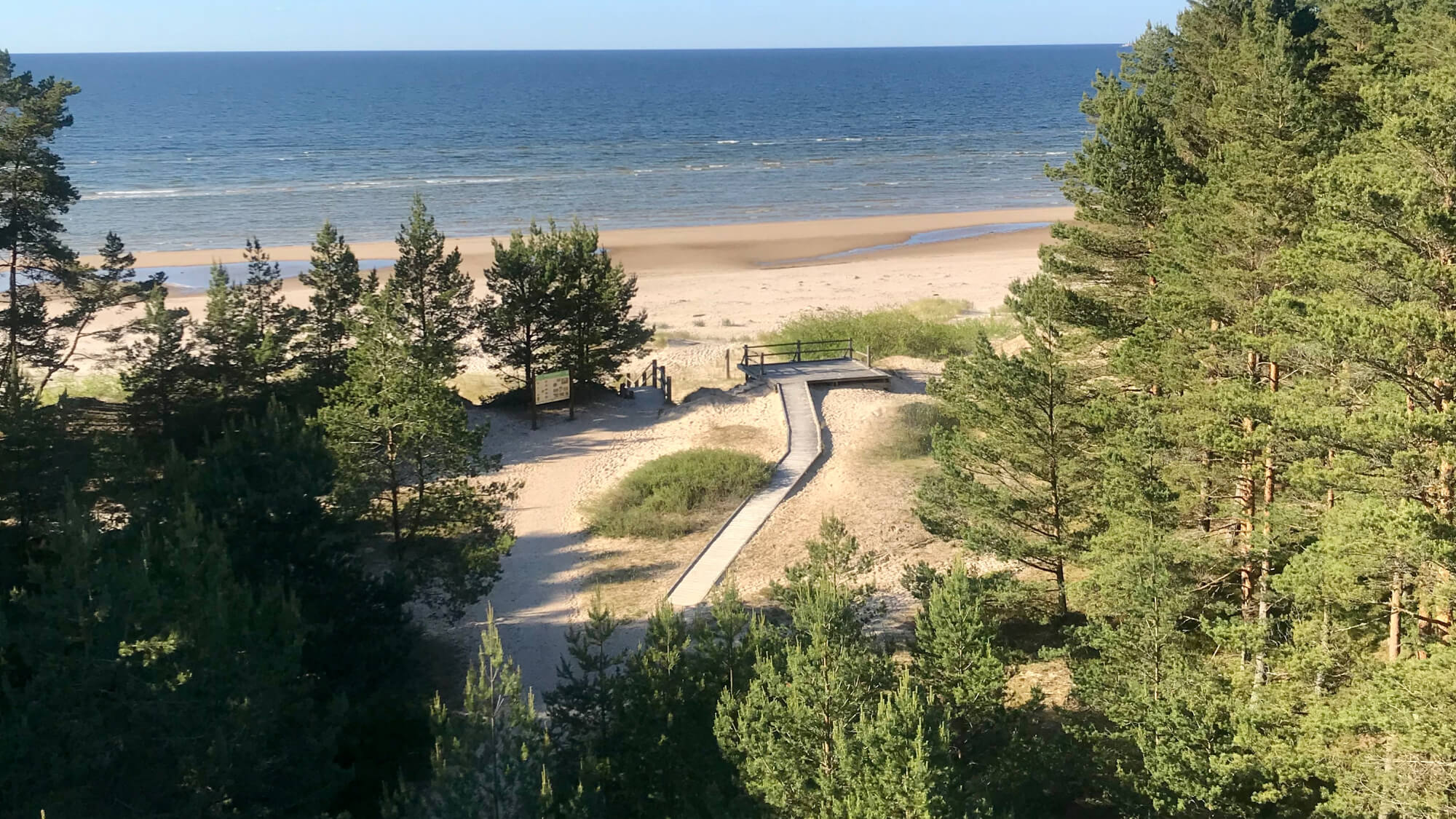
For some, the ultimate energy boost is a ginger shot. For others, it’s the invigorating mix of seaside air and exploring new places. Ragakapa Nature Park serves up just the right kind of energy cocktail—quick, refreshing, and located just 20 km from Riga. It’s perfect for anyone looking for a fulfilling experience on a budget, as entry to the park is free! With seaside air, scenic boardwalks, ancient pine trees, and the charming Jūrmala Open-Air Museum, it’s a recipe for a memorable outing.
So let’s go, explore Ragakapa nature park together!
Note: Make sure you check the working hours of the Jurmala Open Air Museum as it closes relatively early. And if your driving into Jurmala during summer season don’t forget to by the pass for your car.
Ragakapa’s trail is an adventure all its own, winding up and down through the dunes on wooden boardwalks and stairs. Along the way, you’ll be treated to ever-changing views of the forest from various heights. And if all those steps wear you out, plenty of benches await, inviting you to pause and breathe in the salty seaside air.
The true stars of the Ragakapa nature trail, however, are the trees. Ancient and majestic, yet gnarled and twisted, these pines were originally planted to stabilize the shifting dunes. Over time, they’ve transformed into living sculptures—each one unique, with forms so captivating they could star in a movie about witches.
The Not-So-Secret Ingredient of Ragakapa Nature Park – Jūrmala Open-Air Museum
As if the beautiful nature trail wasn’t enough, Ragakapa Nature Park also spoils visitors with a peek into history and the opportunity to learn about the region’s fishing heritage.
Traditional Latvian Homes in Jūrmala Open-Air Museum
Much like the Latvian Ethnographic Open-Air Museum, the Jūrmala Open-Air Museum features traditional Latvian homes with thatched roofs and other farm buildings. Peeking through the window of a small sauna brought back childhood memories of the countryside, where families who didn’t have showers would heat up the sauna every weekend. I remembered sitting in the dim heat, birch twigs in hand, and a wooden tub filled with stove-heated water—a simple yet unforgettable ritual.
But I have drifted too far into nostalgia. Back to the museum!
Fishing Tools and Boats in Jūrmala Open-Air Museum
You can also step into living spaces and rustic workrooms brimming with intriguing, if slightly intimidating, tools. What might look like medieval torture devices to some are actually traditional implements used for crafting boats and other fishing gear.
Outside, the museum grounds reveal even more curiosities: boats resting in the open air, heavy anchors, a whimsical wooden frog sculpture, and a replica of a vintage wheeled bathing cabin—perfect for preserving modesty while enjoying the salty sea. The centerpiece, however, is the historic fishing boat Undīne. In short, this museum is a delightful trove of unique artifacts rarely seen in everyday life.
On our way to the museum, we took the boardwalks of the Ragakapa nature trail, but you might choose to return through the forest paths to change up the scenery.
Is Ragkapa nature park worth visiting?
I love a mix of nature and history Ragakapa nature park offers, so I would call this a nice, simple Sunday outing. The trail isn’t too long though, so if you are short on your step count you could walk by the beach or even attempt to reach the mouth of the Lielupe River. And if your adventure falls on a chilly day – don’t forget to bring some hot tea or coffee with you.
Shall we release our inner child, embracing the joy of play and exploration, or pause for a bittersweet reflection on how something once grand and mighty can fade and crumble with time? These are the captivating contrasts awaiting you at one of Kurzeme’s lesser-known gems: Cīrava.
Prepare to be surprised – I certainly was, and in the most delightful way, during my visit to Cīrava.
Every good story has an intro. On your way to Cīrava Forest Park, where fun-filled discoveries await, start by warming up your imagination with the “Trail of Legends,” featuring intricately carved wooden sculptures along the path.
Look out for a wooden figure of a mighty man holding a sword – who could he be? Nearby, you’ll spot women wearing crowns who appear a little sad – could there be a story behind their expressions? And don’t miss the giant wooden sword, like something out of a storybook, waiting for a brave soul to claim it. With no explanations provided, it’s the perfect opportunity for a fun guessing game with your travel companions.
Let’s Play Some Games in Whimsical Cīrava Forest Park
Many trails wind through Cīrava forest park. Which one will you explore first?
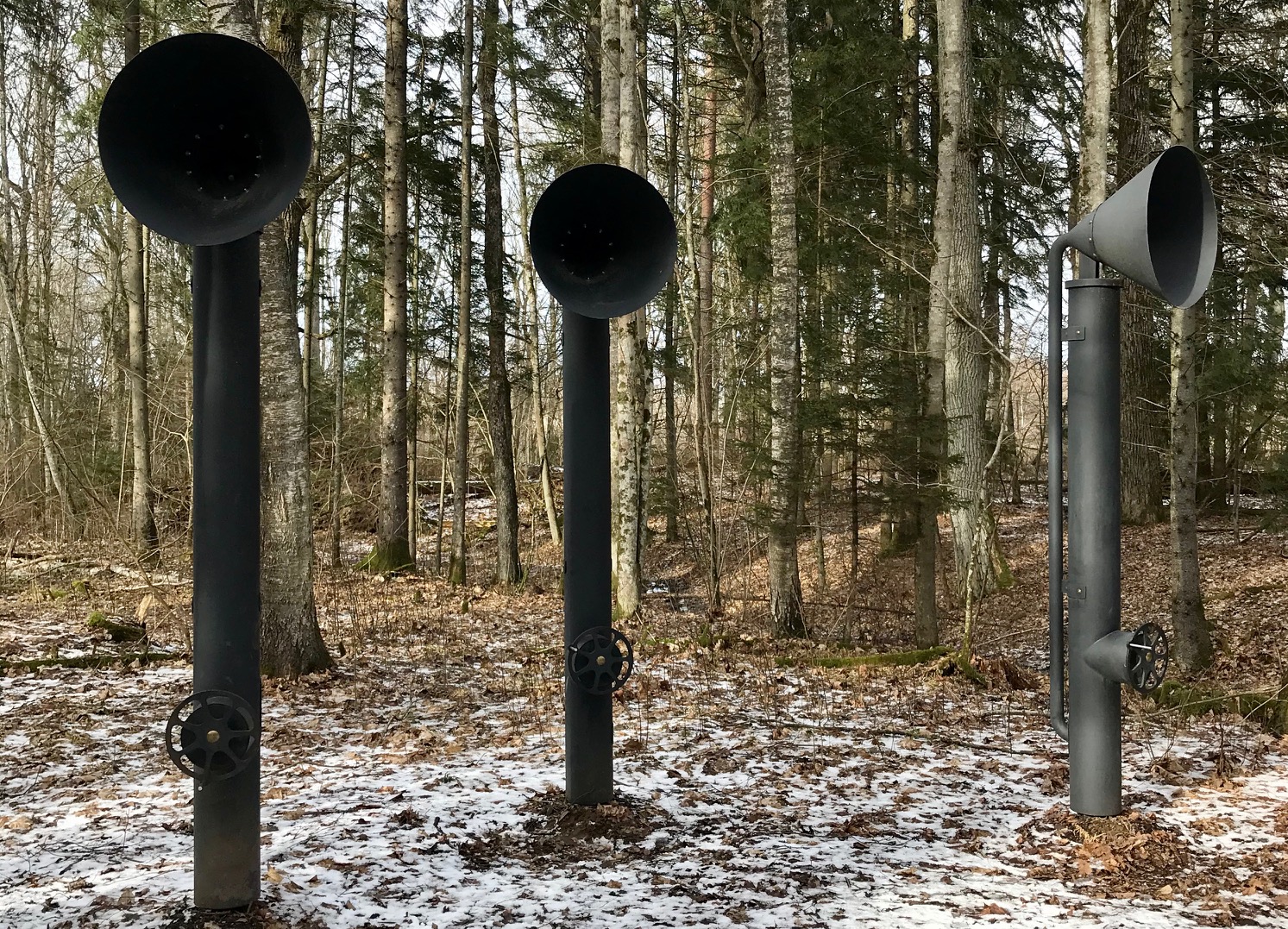
On the Sound Trail, you’ll discover enchanting musical installations – a metal harp that sings when struck with mallets, massive trumpets that call to the forest, and melodic metal drums that echo through the trees. It’s a journey for the ears as much as the eyes.
For those seeking adventure, the Beaver Trail awaits with fun activities. There are climbing structures, a ball-in-the-hole game, outdoor Twister, and more, all inviting you to play and explore.
But if you prefer a quieter experience, the park has plenty to offer. A meandering stream follows parts of the trail. Along the way, you’ll find several swings, each offering a perfect view of the little river below, inviting you to sit back and take it all in.
The forest itself is a stunning mix of nature’s contrasts. One moment you’ll find yourself surrounded by towering evergreens, and the next, you’ll step into a grove of birch trees, their branches bare and delicate in the winter air. Some areas of the forest floor are bare, while others are lush with green moss, creating a variety of textures beneath your feet. As long as you keep your eyes open there is something to see.
As you wander along the Straight Passage, keep an eye out for whimsical wooden sculptures. One of my favorites is the fisherman, who dreams of catching a giant fish but instead reels in a frog – a playful and charming sight hoping to make you smile even in the depths of the winter.
We’re exploring Cīrava’s attractions a bit out of order. The first thing that likely caught your eye upon arrival was the towering Cīrava Manor. It stands as a haunting reminder of its past, with windows boarded up and its façade slowly crumbling. It must have been hard to resist the urge to explore it immediately – and now, we finally will.
The side of the manor facing the road has withstood the test of time the best. But as you circle around this former beauty, you’ll notice the decay: one of the towers is half-collapsed, and the colonnade that once held a portico has lost its roof. Yet, it’s easy to imagine how magnificent Cīrava Manor once was, proudly displaying its unique shape in its prime. It’s a beauty fading away, lost to neglect, which feels heartbreaking.
Not far from the manor, you’ll find another grand, abandoned building with a massive colonnade at the front. You might be surprised to learn that this was once a horse stable. Like the manor, it’s locked up and off-limits, but its sheer scale and grandeur hint at the stories it holds from its past.
What Else to See in Cīrava? Kaleidoscope and Swings With a View of the Manor
After visiting the manor, a restless traveler can follow signs around the pond to Grasshopper Park, where whimsical wooden sculptures and an outdoor kaleidoscope awaits. I’m always enchanted by the creativity that transforms ordinary objects into unique outdoor attractions.
The highlight of this walk, however, was a two-person swing with a breathtaking view across the lake to the manor. It’s a magical spot for sitting shoulder-to-shoulder with your travel companions, soaking in the serene beauty.
Is Cīrava worth visiting?
I truly believe Cīrava Forest Park is a wonderful place for families with kids. But even as adults, we found plenty of magic and fun in the park’s unique installations. The creativity behind each one is truly inspiring. On the other hand, the grand old buildings offer their own type of intrigue, pulling you into their mysterious past. It’s a perfect blend of playful discovery and historical charm.
If you’re not keen on waiting in line to visit Sigulda, or if you’re simply craving something new this autumn, Koknese offers one of the most breathtaking spots to immerse yourself in the golden hues of fall. While the town is captivating year-round, it’s during golden autumn that Koknese truly comes alive, with its vibrant colors and tranquil landscapes. Picture yourself strolling leisurely through Koknese Park, the crisp air around you, colorful leaves fluttering from the trees, and the satisfying crunch of fallen leaves beneath your feet…
Koknese Park feels like stepping into two different worlds.
On one side, the park unfolds into a beautifully curated garden, with vibrant flowers, whimsical sculptures, and peaceful ponds that echo the charm of a centuries-old manor.
As you wander through, you’re bound to encounter a playful surprise: the “Fauna’s Head” fountain. At first glance, it looks dormant, almost lifeless and a bit scary. But turn your back for just a second, and suddenly, water bursts from Fauna’s mouth with mischievous glee. It’s a little trickster hidden in plain sight, adding a touch of whimsy to the landscape.
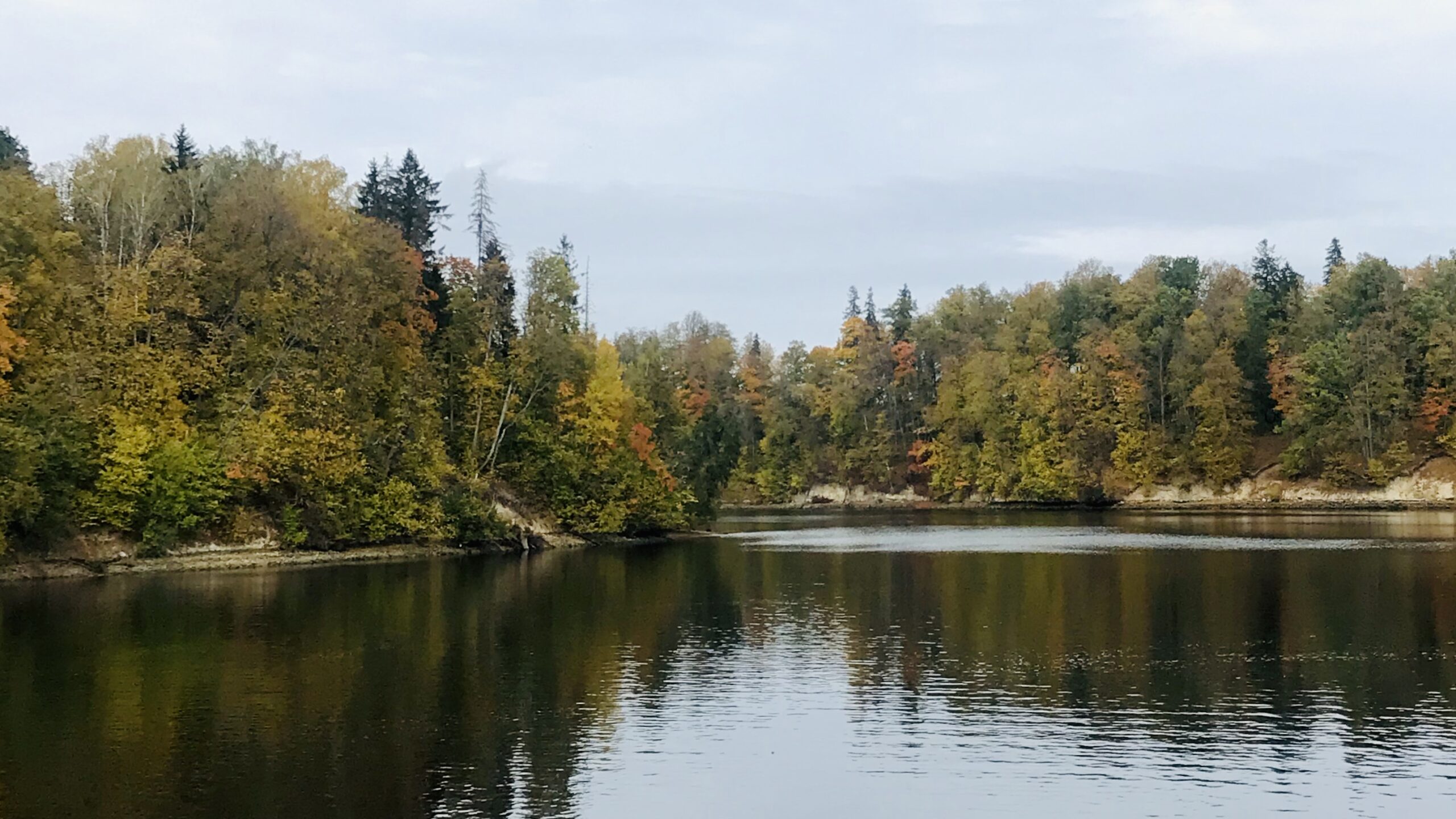
On the other side of the park, a completely different vibe takes over. Here, the beauty is quieter, wilder, and untamed. Trails covered in golden and orange leaves wind their way through towering trees, guiding you toward the Daugava River. Across the water, the forest’s brilliant colors reflect on the surface, while the distant silhouette of Koknese Castle rises dramatically against the autumn sky. It’s a scene so picturesque, it could be torn straight from a postcard.
And just when you think the magic of Koknese Park is complete, you stumble upon a hidden gazebo tucked away among the trees—an idyllic spot to pause and capture the serene beauty of this autumn paradise in a photo.
The Replica of the Pērses Waterfall – A Story of Koknese’s Lost Wonder
Have you ever heard of the Pērses Waterfall? If not, prepare to be amazed by this fascinating piece of history. Once, it was the tallest waterfall in Latvia, reaching a majestic height of 3 meters. But today, it’s nothing but a memory – swallowed by the rising waters caused by the construction of the Daugava Hydroelectric Power Station.
If you’ve read my previous post about Salaspils, you might recall the Daugava Museum’s photo projection showcasing the places in Latvia that were submerged when the hydroelectric plants were built. And the Pērses Waterfall is one of those sites. Sadly, it’s lost to time, and we’ll never see it in its full glory again—only preserved in old photographs in zudusilatvija.lv.
It’s certainly a bit heartbreaking. Imagine the power and beauty of that waterfall, its cascading waters creating an unforgettable natural spectacle. But here’s the twist in the tale—there’s a small glimmer of light in the story. In Koknese Park, by the tranquil pond, a fountain was created in 2019 to replicate the Pērses Waterfall.
The replica gives Koknese Park an extra layer of romantic charm, and for those who know the story of the Pērses Waterfall, it evokes a sense of nostalgia for the lost beauty that once graced this land
Did you know Koknese actually has 2 castle ruins? Surprise!
In addition to the famous Koknese Medieval Castle ruins, you can also explore the lesser-known and less preserved remains of the Koknese Manor’s New Castle.
The Koknese Medieval Castle Ruins, sitting dramatically on the banks of the Daugava River, are the most famous and for good reason. These towering walls, mostly in ruins now, invite you to explore their remains and imagine centuries of history. As you wander through, you’ll come across old cannons—an interesting detail. These cannons were once buried in the river after the castle was destroyed, only to be rediscovered and pulled out from beneath the water years later.
But that’s not all—the castle’s basement hides something chilling: a torture chamber. Behind a tiny door, you’ll find replicas of some of the most infamous medieval instruments of torment, such as the breaking wheel and iron chair. A glimpse into a darker time in history, they serve as a stark reminder of the castle’s more gruesome past.
As you take in the surroundings, you’ll be amazed to learn that Koknese Castle used to sit high atop a hill, commanding a stunning view of the landscape. But after the construction of the hydroelectric dam, the castle now lies nearly at water level. To see how drastically the landscape has changed, check out zudusīlatvija.lv , a fascinating website documenting Latvia’s submerged history.
A short walk through Koknese Park will lead you to the ruins of the Koknese Manor’s New Castle. These ruins are much less preserved, with only parts of the foundation remaining. It’s surprising, considering the castle was built relatively recently, in 1894, by a local baron. Unfortunately, it was destroyed during World War I.
If you’re traveling by car and looking for another attraction in Koknese to complete your itinerary, head to Likteņdārzs.
This unique park is still in the process of growing and evolving. The trees are slowly taking root, and the pathway lined with tiles bearing the names of those who’ve contributed to the park’s creation is gradually expanding. If you do visit, be sure to check out the viewing platform. From there, you’ll get a breathtaking view of the Koknese Castle ruins.
Unfortunately, I don’t have any pictures to share. But you can check the official ones from their website.
Is it worth going to Koknese in golden autumn?
Of course, you can enjoy the golden leaves in Riga’s parks too, but nothing beats the thrill of discovering a new place. This one will stay with me, its quiet historical charm almost palpable, and the perfect view of the vibrant trees reflected in the river.
When the weather turns cooler, many Latvians feel an irresistible pull to explore a bog trail. There’s something about the crisp autumn air mingling with the earthy, marshy landscapes that perfectly captures the essence of the season. But what do you do when you’ve already wandered through the popular bog trails near Riga? That’s the question I faced—until a quick search led me to the Great Kangari Nature Trail (Lielo Kangaru taka), just an hour’s drive from the city. This hidden gem promises both a peaceful bog trail and an impressive observation tower—a perfect combination for an autumn adventure.
The Kangari Observation Tower and Its Stunning Views
The 33-meter-high observation tower stands proudly at the trailhead, immediately catching your eye and inviting you to explore. Its design is bold and striking—crafted from black metal with vibrant orange accents that catch the sunlight. Unlike the rustic wooden towers you may have climbed before, this one feels modern and artistic. For a truly cool photo, try looking straight down through the railings—the structure creates a mesmerizing tunnel effect, perfect for a unique shot.
Climbing the winding staircase, each step brings you higher above the trees. At the top, the view opens up in every direction—a vast expanse of treetops stretching to the horizon. In the distance, a half-overgrown lake peeks through the foliage. We’ll head there soon, but for now, you take a moment to soak in the view.
Above, thick, fluffy clouds drift lazily, their shadows rolling over the forest below. It’s a small detail, but something about watching those shifting shadows catches me off guard. I never really stopped to think about how clouds cast shadows. So this is your reminder to stop, take in a deep breath and notice the simple wonders all around you.
.
What Sets Great Kangari Nature Trail Apart?
The 2-kilometer loop begins with a shaded forest path, where tall trees form a natural canopy overhead. Along the way, you’ll notice informational stands suggesting exercises to try as you walk. Yet, no one seems to pay much attention to them—including me. My excuse? A coat isn’t exactly the best workout attire.
The Changing Landscape on Great Kangari Trail
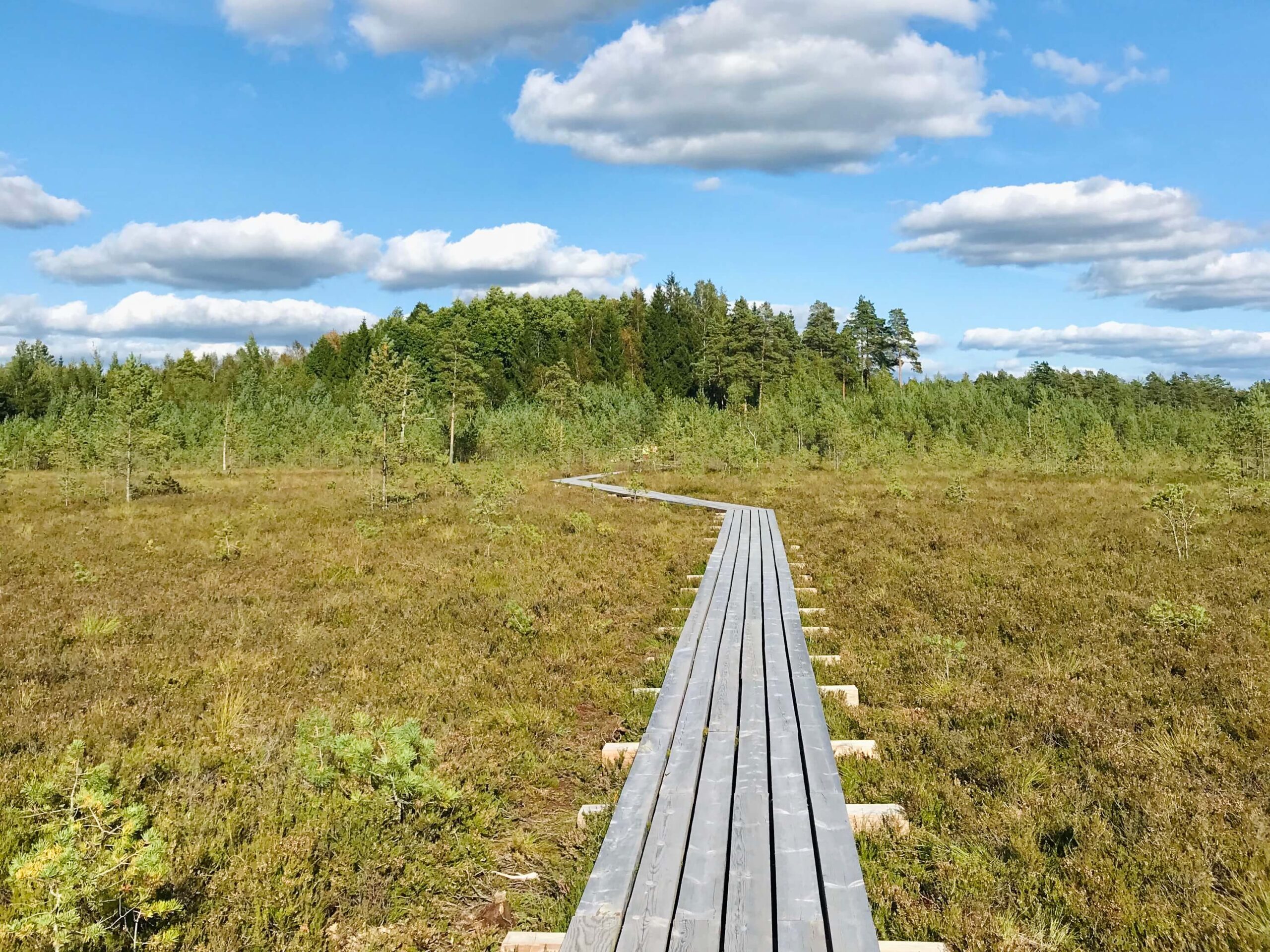
Before long, the forest transitions into the open expanse of the bog, and the wooden boardwalk takes over, guiding you deeper into this untouched landscape. Towering trees give way to the low shrubs and hardy vegetation characteristic of a bog. The shift in scenery is captivating, and this time of year, the trail is dotted with clusters of mushrooms—a delightful surprise for the observant walker.
While the observation tower bustled with activity, the trail itself felt calm and quiet. Even the prime spot – the bench by the overgrown lake we saw from the top of the tower is unoccupied. It looks perfect for sitting down for a cup of tea. I hope you packed some with you?
Comparing the Great Kangari Nature Trail to Cenas Bog or Ķemeri Bog, the most striking difference is how much drier this bog feels. Both Cenas and Ķemeri are lush, with numerous lakes—you can even go paddleboarding there. By contrast, Kangari Bog resembles a large sponge with only one big lake.
I must admit, there’s one thing I didn’t quite understand. The signs along the trail indicate that in one direction, there’s a lake, and in the other, Burlakkalniņš. We found the lake, but I still don’t know exactly what Burlakkalniņš is. I must have missed it, even though we walked the entire trail. It’s probably because we weren’t sure what to look out for. According to the wisdom of the internet, Burlakkalniņš was once a hideout for highway robbers. Perhaps you’ll be more observant and spot it. If you do, please let me know where I should look to finally find Burlakkalniņš myself.
Is Great Kangari nature trail worth it?
The Great Kangari Nature Trail sees fewer visitors compared to the bog trails closer to Riga, making our walk slower and quieter, which, in my opinion, more than makes up for the longer drive. The colors and atmosphere are perfect for the autumn vibe. But the biggest highlight, without a doubt, is the tall, stunning observation tower offering incredible views
More Attractions Nearby Great Kangari Nature Trail
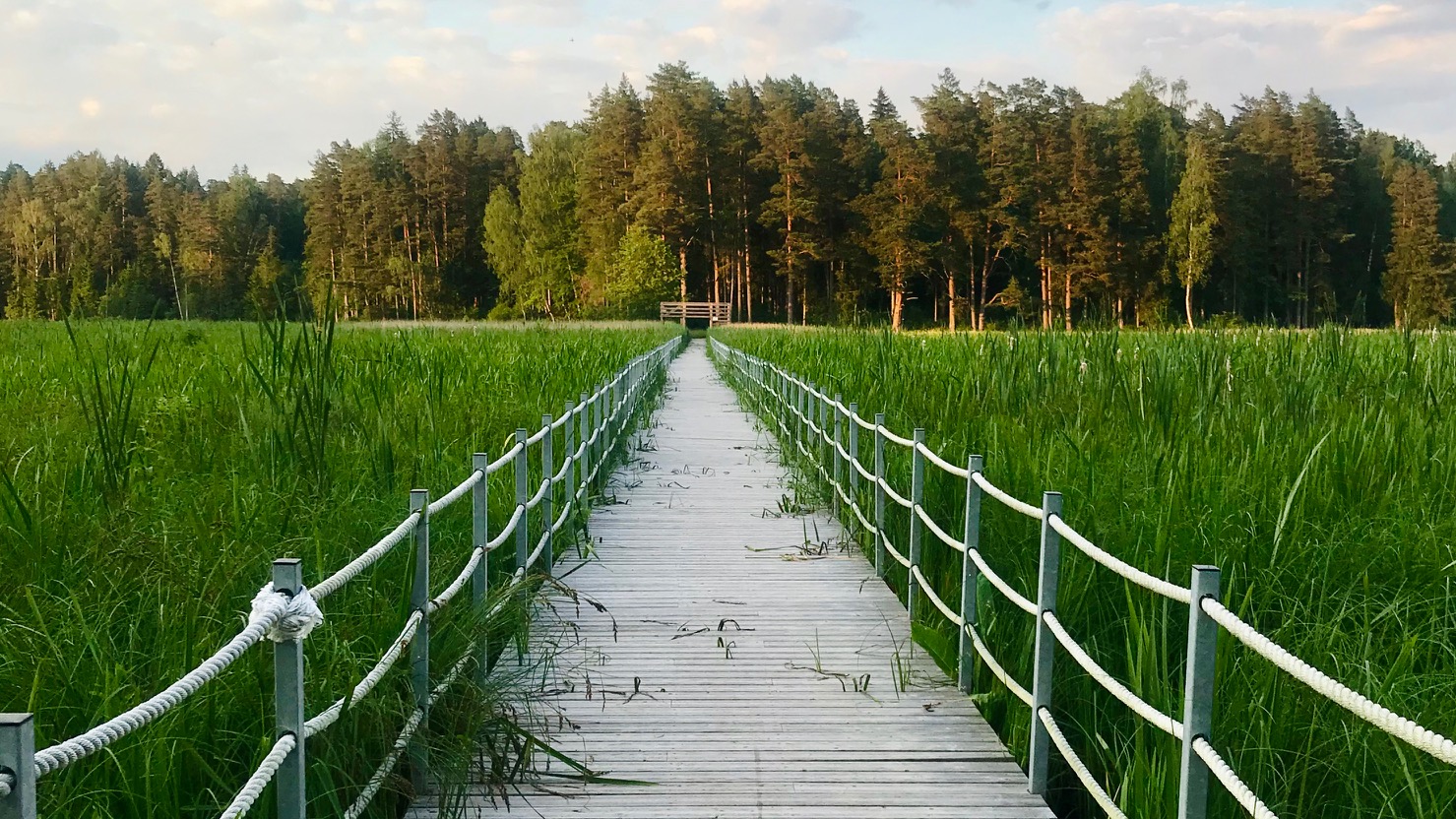
If you’re exploring Kazdanga attractions, you absolutely have to stop at the Kazdanga Walkway, which stretches across the overgrown lake! It’s like Kaņieris’ little cousin living in Kurzeme. While the reeds at Kazdanga’s lake still need a bit more time to grow to the height of those in Kaņieris, it remains a stunning and unique spot to visit year-round. After taking in the view, if you’re feeling adventurous, you can wander through the forest that wraps around the lake or head over to Kazdanga Castle for another thrilling experience. That is, of course, if you’re not afraid of ghosts!
In summer, the overgrown Kazdanga lake is green, lively, and sun-drenched, while in winter or early spring, the grasses turn a dry, grey-brown.
The most beautiful view unfolds either from the beginning of the wooden walkway, where it divides the lake into two parts, or from the observation platform in the middle of the lake. It’s not tall, but it offers a different perspective of the overgrown lake.
I must say, there’s probably no unphotogenic angle here!
To get to the next attraction in Kazdanga you can either walk around the lake through the forest or return to your car and drive to Kazdanga Palace.
If Your Not Afraid of Ghosts – Stop at Kazdanga Palace
You can reach the castle via a stone bridge, which, as it turns out, has a rather uninviting name—”The Bridge of Moans.” Do I want to know? Probably not.
The castle itself is a beautiful example of classical architecture, hiding a tranquil park behind it.
Right in front of the castle, you’ll also find the “Tree of Love” adorned with locks. In Latvia there is a tradition for the newlyweds on their wedding day to put a lock somewhere special, typically on a bridge to lock in a long lasting marriage.
The castle itself is a lovely example of classical architecture, hiding a peaceful park behind it. Right in front of the castle, you’ll find the “Tree of Love,” draped in locks from couples who’ve participated in the Latvian tradition of locking their love in place—newlyweds often add a lock to a bridge or other special place to symbolize their lasting bond.
Make sure to take a moment to admire the wooden sculptures scattered throughout the park and learn about the legend of Kazdanga’s name. Here’s a little teaser: kaza means goat. And if you’re feeling adventurous, try to find the famous Grotto where the Baron is said to have sipped his tea. Unfortunately, I couldn’t track it down, but maybe you’ll have better luck!
Is Kazdanga worth visiting?
The Kazdanga lake is a hidden gem that is beautiful in any season. But if you wish to explore the Kazdanga Palace park I would recommend going in late spring or summer when the fields are green. It was a bit gloomy in early spring.
As there is a bit of a drive from Riga to Kazdanga, I would rather recommend combining these attractions with something else, for example…
Ventspils is a city that brings out the inner child in every visitor. Every attraction here seems to have a bit of magic and fun in its DNA, making a weekend trip to Ventspils feel like an adventure. It’s a late summer Sunday—too chilly for the beach—but that’s no problem. I’m inviting you on a quest: your mission is to find as many of Ventspils’ famous cows as possible. And along the way, we’ll discover plenty of other exciting tourist attractions in Ventspils. There’ll be a touch of history, a dash of childhood nostalgia, and two very special trains.
Come, let’s find out what to see in Ventspils together.
When visiting Ventspils Market Square, timing matters. Why? Because the magic lies in the smallest details!
Have you noticed the tiny golden dot on the largest clock face in the square, marking the 33rd minute? This small yet meaningful detail highlights Ventspils’ very own local time. Yes, you read that right—Ventspils has not only its own currency but also its own “local” time. Midnight in Ventspils strikes at 00:33, and noon arrives at 12:33.
Why the odd timing? Latvia is crossed by several meridians, meaning Ventspils’ true solar time is slightly out of sync with the rest of the country. To honor this cosmic quirk, the Market Square clock chimes a little fragment of “Uz priekšu Kurzeme” (“Forward, Kurzeme”) at 00:33 and 12:33. At all other hours, it sticks to the national schedule and plays “Pie dzintara jūras” (“By the Amber Sea”).
Another fascinating feature in Ventspils market square is the well, which doubles as a compass. It also looks a bit like a sundial! Could it actually function as one too? That’s a mystery you’ll have to solve for yourself. But don’t forget to tell me when you figure it out!
Please note: If you’re visiting Ventspils, the fountains are a must-see. But there’s one thing to keep in mind—they’re not available year-round. In winter, the fountains take a well-deserved nap, waiting for warmer days to dazzle visitors again.
The grandest of Ventspils’ fountains is undoubtedly Fregate Valzivs. At first glance, it resembles the towering masts of a majestic sailing ship. But as you draw closer, something truly magical unfolds. Fine sprays of water shoot from the masts, creating a delicate mist that sparkles in the sunlight. It almost looks as if the fountain is steaming. This stunning creation was inspired by one of the ships from Duke Jekabs fleet, adding a historical touch to its beauty.
Not far from here, you’ll discover the Sun Boats (location). There’s a local legend that on sunny days, the fountain plays with the light, casting little rainbows in the mist as the sunrays dance across the water. It’s a fleeting moment, almost like a natural wonder, and only those who are in the right place at the right time get to witness it.
And then, there’s the Umbrella (location)—a delightful, playful fountain in Ventspils that definitely isn’t doing its job as an umbrella. Instead of shielding you from rain, water pours down from inside, creating a whimsical scene that’s sure to make you smile.
When I think of a port district, I imagine something strictly industrial—bustling, gritty, perhaps even a little grim. But the Ventspils Promenade is anything but that. It’s a peaceful and picturesque spot, perfect for a leisurely evening stroll on a sunny day. Lined with benches and featuring an exhibition of gigantic buoys, it’s a unique and surprisingly serene corner of the city.
Now, technically speaking, these buoys aren’t gigantic—they’re standard size navigation buoys. But until my trip to Ventspils, I had no idea they were so enormous! Standing next to them really puts their scale into perspective (check out the photos for comparison).
For the curious minds, each buoy is accompanied by a plaque explaining its purpose. So, as you wander, you can pick up some interesting maritime knowledge. And as a bonus, the backdrop of the harbor adds to the vibe of this fascinating Ventspils attraction.
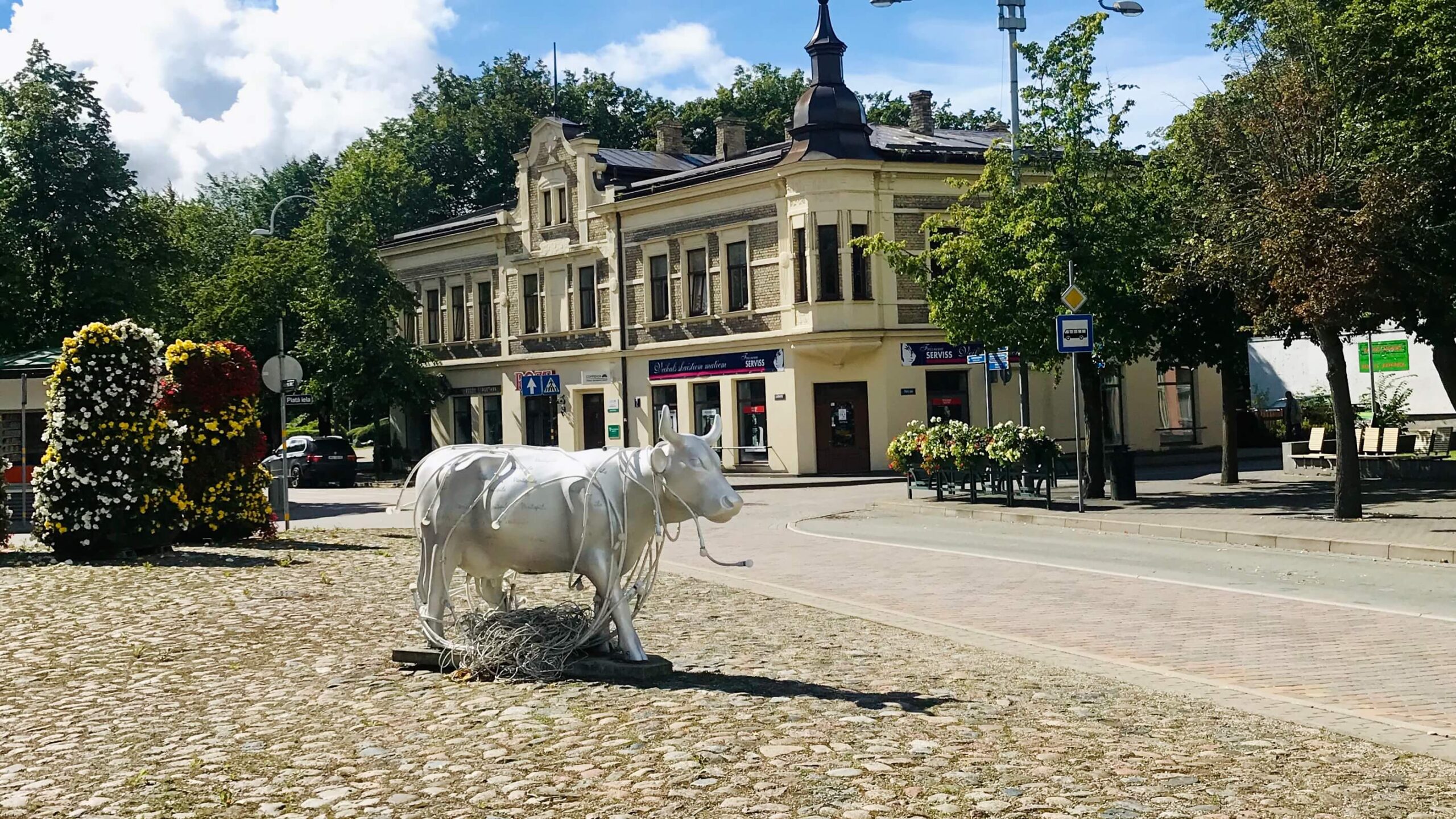
Oh, and don’t forget to keep an eye out for a couple of Ventspils’s iconic cows in this area. One of my personal favorites from this trip is nearby—a quirky cow with flippers, half-dipped in what looks like oil, located close to the Ventspils Castle. It’s definitely one to add to your “cow quest”!
Continuing with the maritime theme, Ventspils offers a rare opportunity to get up close and personal with real fishing vessels. You can step aboard Azova and Grots to walk their decks and imagine life at sea. These retired ships provide a fascinating glimpse into the world of seafarers and are a must-see in Ventspils for those curious about ships.
And while we’re here, don’t miss another Ventspils attraction – the nearby observation tower. It’s small but offers a great vantage point to take in views of the beach from above.
The Journey Is as Important as the Destination – The Road to Ventspils’ Southern Mole
The walk to the Southern Mole is an adventure in itself. Along the way, you’ll encounter a stretch of wall art created by the local art school. These murals, spanning a considerable length, are full of Ventspils-inspired imagery. Keep an eye out for creative nods to the city, like the giant boot with a mouth from Reņķa Dārzs or the silhouette of Ventspils Castle.
Want to make the walk more engaging? Challenge yourself or your companions to decode the meaning behind each artwork and how it connects to Ventspils.
As you continue, you’ll also pass Matrozis, the sailor cow, standing proudly on guard. Finally, as you near the Ventspils Southern pier, your attention will likely be captured by its unique structure, built from massive interlocking blocks that create an intriguing pattern. It’s a sight worth pausing to admire before reaching the end of the mole and gazing out over the endless sea.
How to Explore Ventspils Without a Lot of Walking? Take the Tourist Train
If walking long distances isn’t your thing (or simply isn’t possible), the Ventspils tourist train is the perfect solution. Starting from the Ventspils Port Street promenade (right where the Duke Jēkabs ship is docked), this charming little train lets you explore the city’s highlights without breaking a sweat.
As you ride, you’ll pass through the industrial area, catch glimpses of the harbor’s ships, and glide through some of Ventspils’ cozy residential neighborhoods. The train makes its way past the Southern pier, which reaches deep into the sea, and you can spot the Azova fishing boat we visited on our Ventspils itinerary a bit earlier. Along the way, I counted seven cows—let’s see how many you can spot!
In short, the train gives you a quick yet thorough peek at most of Ventspils’ well-known sights.
Grownups Can go Sledding Too – Ventspils Adventure Park Lembergs Hat
Lembergs Hat will be the most fun for the kids—there are all kinds of exciting attractions, from bumpy boats to trampolines, guaranteed to make their eyes light up. But if you’re an adult (or just a kid at heart) and haven’t tried summer sledding yet, now’s your chance! I did, and it’s an absolute blast. There’s something thrilling about the little tickle in your tummy as you zoom down the mountain, nestled in your inflatable sled.
The best part? The tickets (5 rides) are per sled, not per person! This means you can buy one ticket, and share with anyone brave enough to join in on the fun.
Not into sledding? No worries! You can still climb up the mountain to meet the friendly statue guarding the top. Fun fact: the statue honors deer that were once released in the Ventspils area.
A ride on the narrow-gauge train seems to be one of the most popular things to do in Ventspils, but what really fascinated me was the process of how the train gets turned around to go in the opposite direction. It’s probably not something that keeps you up at night, and I myself never thought much about it until I stood at the station, watching as the steam-powered locomotive slowly made its way toward the end of the tracks.
To catch the action, you’ll need to arrive at the Kalna station (the one near Lembergs’ Hat) about 10 minutes before the train departs. When the train halts, the still-steaming locomotive is uncoupled from the carriages and carefully placed onto a circular wooden turntable. This platform is then rotated to spin the locomotive around so it’s ready to go in the opposite direction.
Once the “show” is over, you can purchase a ticket and hop on either the open or closed carriage for a scenic ride through the forest. At the other end of the line, you’ll pass anchors and see the train depot, where coal and a water pump are used to fuel the steam locomotives. In this Ventspils attraction you can choose to either ride one way or take the full circular route. I’d go for the loop as you have to get back to your car somehow.
For modern-day folks accustomed to constant hustle and bustle, the train feels very slow. In a world of high-speed trains and cars, it’s easy to forget that, not too long ago, this was considered fast travel—and a luxury of movement we often take for granted today. And who knows? That could be a great conversation starter with your fellow passengers on the three-kilometer journey.
The Ventspils Anchor Trail, with its massive, historic anchors, is a place that feels timeless—like it’s been here forever. For me, it brings back childhood memories of wonder and discovery. One of its most charming features is the old hand-pulled ferry. It’s a small wooden platform you can tug across the pond by pulling on a chain, offering a simple yet delightful experience.
Nearby, you’ll find the “Jungle Trail,” an obstacle course for children, where they can climb, crawl, and test their agility on a variety of fun challenges. It’s a spot that blends nostalgia for the past with the thrill of childhood exploration.
The Magnificent Windmill at the Ventspils Seaside Open-Air Museum
Among the treasures of the Ventspils Seaside Open-Air Museum, the most striking for me is the towering windmill. Bright and spacious, it invites you inside to explore its inner workings and see what makes it tick. Don’t forget to read the story about the Native American statue—it adds a touch of intrigue to your visit!
The other structures in the museum—houses, barns, and even a summer kitchen equipped with a massive cauldron—may remind you of similar open-air museums in Riga or Jūrmala. But one unique exhibit stands out: an ancient clock with a giant stone suspended within it, a fascinating relic of timekeeping from the past.
Can You Use Ventspils Cows as a Psychology Test?
If you’ll ask a Latvian: What to see in Ventspils? The most likely answer your going to hear is Ventspils cows.
I’m willing to bet that everyone’s favorite Ventspils cow says something about their personality! Of course, this is just a theory I came up with, and I haven’t exactly looked into the scientific basis for it, but think about it—everyone tends to choose a cow that left a lasting impression on them… and surely there’s some deeper explanation for why we’re drawn to one cow over the others.
Take Miks, for example, who was taken with the large flower-cow sculpture. It must be a real challenge to create and maintain a cow made of living plants! And he is always up for a challenge and interested to get to the bottom of how something works. On the list of things to see in Ventspils there is also the traveling cow, the cow by the mirror, the cow with the flying person holding onto it so that the wind doesn’t blow him away… Ventspils has a lot of fun cows to choose from.
So, while you’re on your cow treasure hunt, I recommend quietly observing which cow your companions seem most drawn to and then trying to figure out what that might reveal about their personality.
Next place to see in Ventsils the Reņķa Dārzs (Renka garden) feels like walking into a childhood memory, brought to life with a touch of surreal charm. Here, you’ll find larger-than-life objects that appear in the mural near the Southern Mole—like the giant boot with a gaping mouth and a broad-brimmed hat. These whimsical creations are said to have belonged to the legendary giant Lutausis, blending fantasy with nostalgia in a way that feels both playful and a little dreamlike.
But that’s not all! Scattered around the park are massive insects that look straight out of a nightmare to me. I hope they will not haunt your dreams. There is also a delightful herd of stone sheep, and expansive green lawns perfect for a leisurely stroll or a picnic. Benches are thoughtfully placed throughout, inviting you to pause, relax, and take in the park’s unique atmosphere.
Reņķa Dārzs is a place that can make you feel like a kid again, surrounded by creativity, humor, and just the right touch of the unexpected.
And this is also a very whimsical end to our list on what to see in Ventspils comes to an end.
Is Ventspils worth visiting?
I know Ventspils is the top destination for traveling with kids. But I do believe it can be a lot of fun for adults and elders as well. Everything is well maintained and peaceful and in summer – the city is in full bloom.
Did my guide on what to see in Ventspils was helpful?
It’s a Sunday, the warmth of the sun is still lingering and there are soothing sound of crickets filling the air. We’ve got just a few hours to spare—perfect for a spontaneous escape from Riga. So, let’s hop in the car and head towards Vidzeme, where a unique cave, a forgotten bobsleigh track in its slow decay, and the peaceful Kubesele Nature Trail await, just an hour’s drive away. And we’ll likely still make it home for dinner. It’s a short trip, but one filled with plenty of surprises along the way. Were are we going? We are headed to Murjani and Kubesele.
It’s one of Latvia’s many “devil’s residences,” where, according to legend, the devil collects the souls of the damned. If you listen closely, you might even hear their whispers in the darkness…
But don’t worry, there’s nothing scary here—just a touch of mystery and a bit of fun.
Once you’ve conquered the ridiculously steep stairs, you’re greeted by a cliff. A small spring gurgles near the cave’s entrance, while moss and ancient engravings decorate the rocks. Tree roots hang down from above, adding to the enchanted atmosphere. The entrance to Inčukalns Devil’s Cave looks like a crack in the rock, so you’d think it couldn’t be that big, right?
Wrong. As soon as you step inside, you realize just how wrong you were. The cave opens up into a vast, dark, dome-shaped chamber. I remember saying there were no caves like this in Latvia after visiting Helmes Cave in Estonia. Sure, the Helmes tunnels are longer, but Inčukalns Devil’s Cave is impressive in its own way.
During winter, this dark chamber becomes a sanctuary for bats. Because of this, the cave is closed off during the colder months to protect their winter rest, making it a summer-only road trip destination.
The climb back up is another challenge, but after that, we’re ready to head to our next stop on the road trip to Murjāņi. This time, it’s something man-made and almost forgotten.
Explore Murjāņi Old Bobsleigh Track Before it Fades Away
You might have guessed it—our next stop on the Vidzeme road trip is indeed the Murjāņi Old Bobsleigh Track, with all its mysteries.
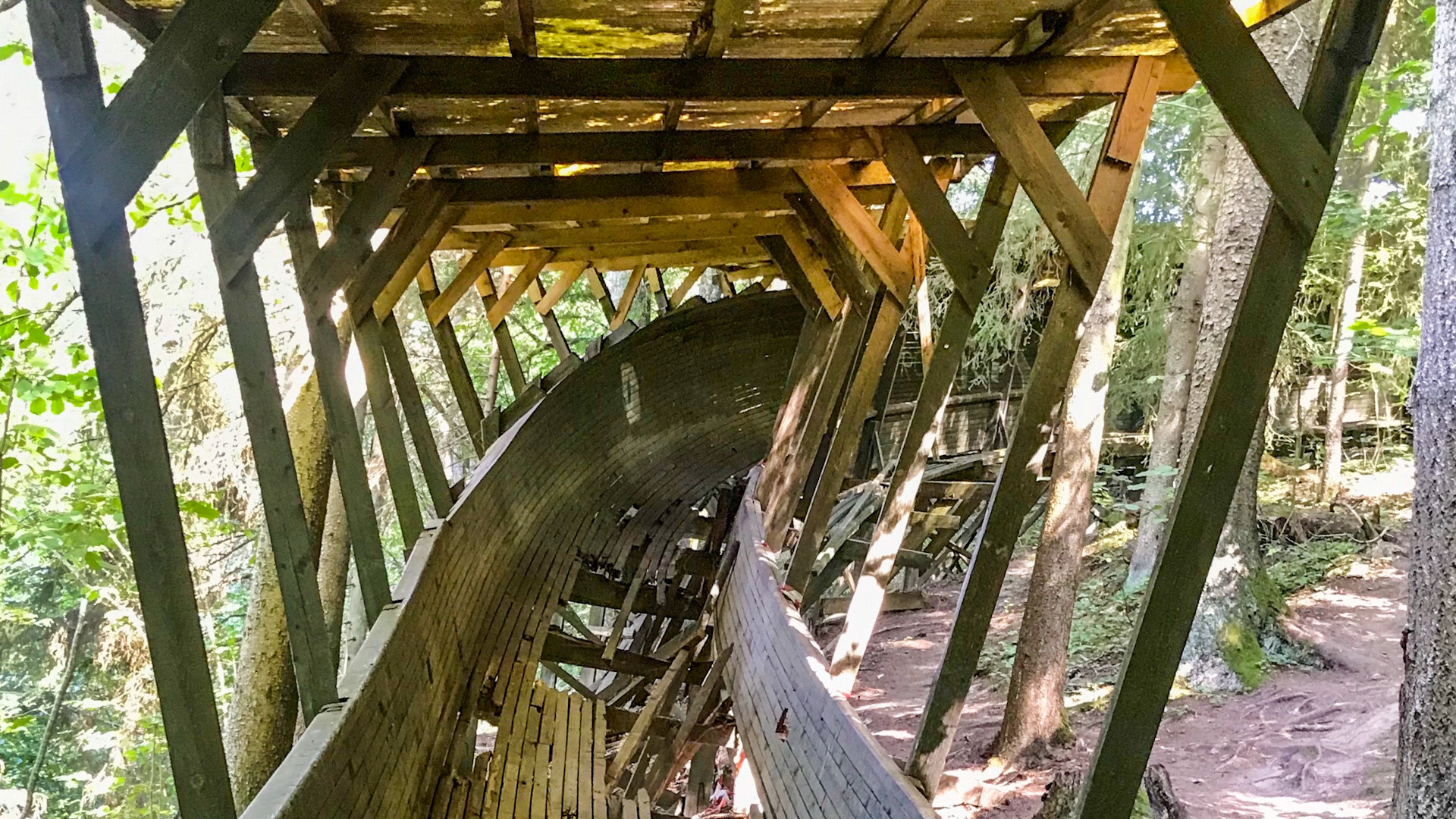
As we approach the abandoned site, we’re surprised to find that the wooden section near the road is remarkably well-preserved. From here, we can climb onto the track and walk along the wooden structures where once only bobsleigh carts raced. But the higher up we go, the more the Murjāņi Old Bobsleigh track starts to show its age. Planks are missing, and the path becomes increasingly rough. At the highest point, the track has crumbled into a pile of boards. It’s like a metaphor for the cycle of life.
Along the way, we come across rusted remnants of old sports equipment—handrails, a weightlifting bar, and something that looks disturbingly like an ancient torture device… There are a few buildings scattered around as well, and though one door stands open, I wouldn’t dare step inside. That’s how horror movies start!
It’s fascinating how nature has gradually claimed this once-bustling track. Since the Sigulda track opened in the ’80s, it’s been left untouched, slowly being overtaken by the forest. So visit Murjāņi Old Bobsleigh trackwhile you still can.
Today sure felt like an adventure movie! But we have one last stop on our Vidzeme road trip agenda. We were planning to head further into Sigulda, but as we’re driving, something catches our eye – the stunning tower of Krimulda Church. Change of plans!
A Peaceful Break in Kubesele Nature and History Trail
Krimuldas Church captivates with its simple yet striking elegance.The orange brick patterns adorn the white church like lace adorns the edges of a high-end handkerchief.
But there’s more to discover. As we stroll around the beautiful church, a couple of signs catch your eye. One marks the start of the Kubeseles Nature Trail. The other points to something intriguing—a labyrinth.
A Small Surprise of Kubesele Nature trail – The Labyrinth
If you haven’t visited the labyrinth at Valguma pasaule, you might be puzzled at first. You’d probably expect a maze of cleverly placed walls. But instead, what you’ll discover is an artwork on the ground. That’s because this isn’t your typical maze—it’s a meditative labyrinth, designed for quiet reflection. You don’t need to search for the right path; it’s already laid out before you. All you have to do is follow it from start to center. It’s a place to disconnect from the world, to zone out, and let the journey guide you. It might not be for everyone, but we find it truly fascinating.
Afterward, we walk down a set of stairs, taking a moment to stop and admire the view. It’s a simple, peaceful scene—fields in their summer prime—but something about it catches my attention. It’s one of those moments that makes you pause and truly appreciate the beauty around you.
The Mouth of the Kubesele Cave
And now, for the second cave of the day! The Kubeseles Cave isn’t as large as Inčukalns Devil’s Cave, but it has its own legend. It’s said to be the hiding place of the chieftain Runtiņš. Judging by the cave’s wide mouth, though, it seems unlikely he could have hidden there without being spotted. What do you think?
Then the Kubeseles Nature Trail takes us deeper into the forest, and as you walk, you notice the path becoming narrower and more overgrown. Eventually, we reach a point where we need to turn back, missing a few smaller landmarks along the way. If you plan on exploring Kubeseles Nature Trail further, I’d recommend wearing long pants and sturdy shoes, as the path can be muddy and a bit challenging at times. But for now, it is time to head back to Riga.
Is Murjāņi and Kubesele worth doing as a day trip from Riga?
This little adventure has been the perfect way to spend a sunny Sunday. It’s the kind of trip that doesn’t require much planning or effort, but still offers new experiences, fresh air, and the chance to make memories.
Now, whenever someone asks me for a quick getaway near Riga, I’ll have another fantastic option to offer, alongside the usual recommendations for the Blue Hills of Ogre, Ķemeri Swamp or Kaņieris reed trail.
The sun is shining, the air is crisp, and adventure is calling. Today, we’re heading out on a cycling journey through the picturesque Salaspils area. This route primarily follows the dam, where cars are absent, making it perfect for someone like me who hasn’t cycled in years but still remembers how! But the spots on our agenda are just as accessible by car, so the choice of transport for your own adventure depends entirely on your preference.
As someone who lived in Salaspils for a while and moved to Riga several years ago, I was surprised to see how much the city has changed. Many landmarks in Salaspils have been freshened up, and the city itself has become incredibly bike-friendly, with most destinations accessible via cycling paths.
So let’s find out what to see in Salaspils together!
We arrive in Salaspils with bikes loaded in the car, and parked by a friend’s house, but there should be public car parking available near Salaspils station. Or alternatively if your comfortable loading your bike in the train, you could also get to Salaspils by the railway.
Urban Area of Salaspils
To reach our first destination, we begin with a leisurely ride through the charming streets of Salaspils.
To reach our first destination, we begin with a leisurely ride through the charming streets of Salaspils.
The city welcomes us with its family-friendly, suburban vibe. Playgrounds echo with the laughter of children, and a quaint public garden tucked into the courtyard of a highschool catches our eye. As we pedal along, hidden gems of urban art make us pause—like a mural of coat of arms, interconnected by a circle of friendship. This colorful piece symbolizes the bond between Salaspils and its partner cities, infusing the urban landscape with creativity and warmth.
Next, we ride to Salaspils Beach, a serene spot along the Daugava River. Benches, a playground, and lush grass create a peaceful setting that begs for a summer picnic.
Nearby, the ruins of St. Juris Church catches your attention. Only two small fragments of the walls remain, marked by a cross. Standing here, I recall childhood excursions to this spot, where we learned about its history as a 14th-century architectural monument that has been destroyed and rebuilt multiple times.
Along the Dam to Riga HPP
Our wheels hum as we pedal along the dam, heading towards the Daugava Museum. The path is peaceful, with people strolling leisurely and chatting. The strong headwind makes the ride a bit challenging, but the open sky and the river beside us make it all worthwhile.
Approaching the hydroelectric power plant, the path narrows, and we have to step off our bikes to navigate the steep descent safely. Crossing the dam requires a steady hand—it’s a tight stretch with traffic on one side and the river on the other. But once we’re across, we need to pause to admire the view as you can see the roofs of Riga from over here. Look, that’s the TV tower right there!
Dole Manor Park and Daugava Museum – Just Next Door to Salaspils
Finally, we arrive at Dole Manor Park, a lush green oasis brimming with history and scenic beauty.
Inside the Daugava Museum
Our first stop is Dole Manor, home to the Daugava Museum, which we’re eager to explore before its doors close for the day. The exhibits draw you in with stories of ancient archaeological discoveries and snapshots of life on Dole Island before the hydroelectric plant altered the landscape forever.
The image projection on the wall stops us in our tracks—photographs of majestic cliffs, waterfalls and many other places that now lie submerged beneath the water. It’s a bittersweet moment, seeing what has been lost in the name of progress. I knew the sad story about Staburags, but I was unaware of how much more was lost forever.
A Monument to the Lost Homes
Deeper in the park, we stumble upon a poignant sight: the monument to the flooded homes. Stone silhouettes of houses stand as quiet tributes, carved with care. Run your fingers over the cool stone, and you may almost feel the weight of the memories submerged.
Exploring the Historic Fishermen’s Cottages
Wandering further, we discover the fishermen’s cottages—charming wooden structures with moss-covered thatched roofs that blend seamlessly into the surrounding trees. They feel as if they’ve always been here, guarding their secrets against the passing years.
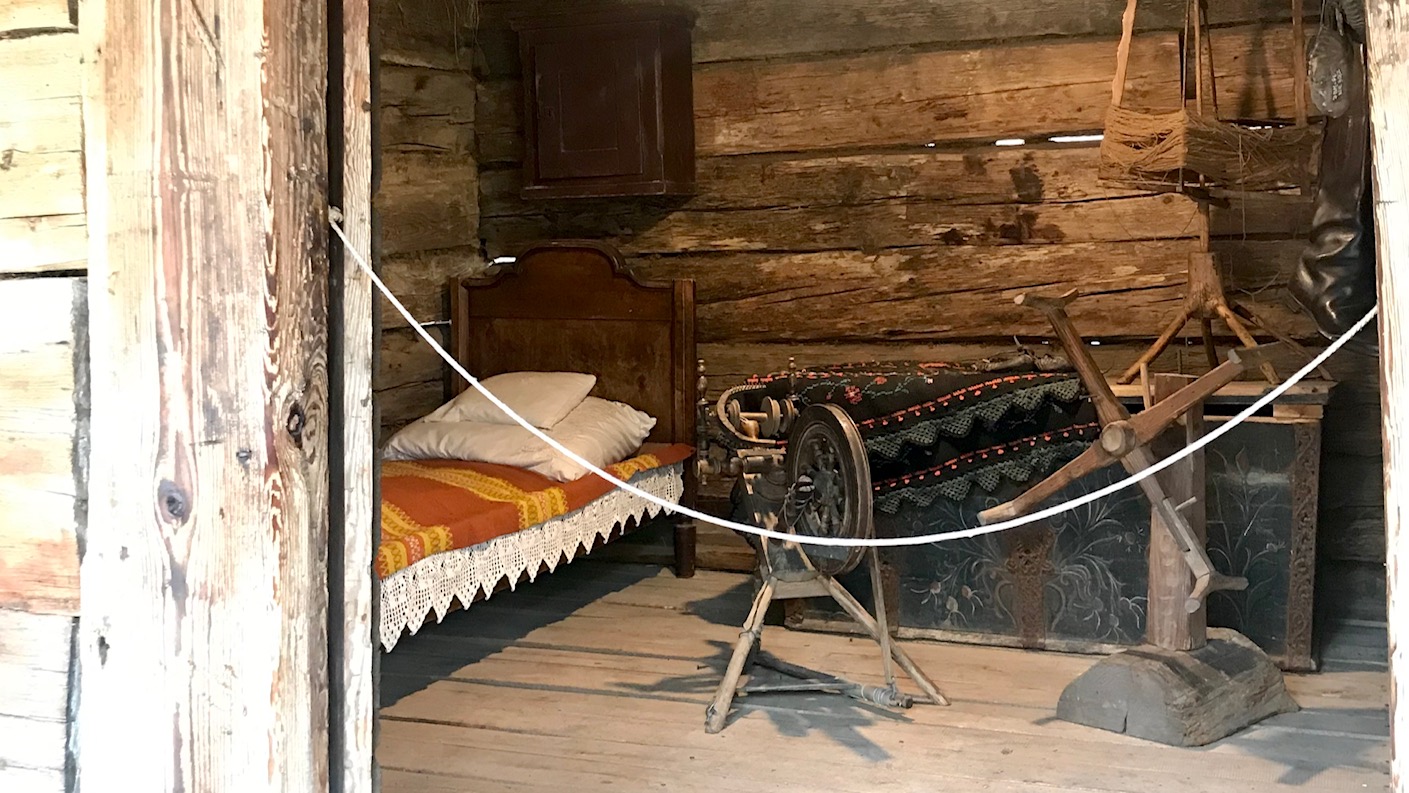
Inside the first cottage, you discover a living space. The small beds catch your attention. Did people really fit in these tiny frames? A friendly guide explains the mystery: people used to sleep almost sitting up, curled slightly with high headrests. It’s an odd yet fascinating detail.
The second cottage houses an impressive collection of old fishing tools and gear. I can not tell what half of these are used for.
After our serene journey through the green expanses of Dole Manor Park, it’s time to retrace our route. The hum of our bicycle tires against the path and the rustle of the wind accompany us as we pedal back.
But this time, as the familiar cross of St. Juris Church ruins comes into view, we don’t head back into the city just yet. Instead, we shift gears and cycle onward, for one last stop in Salaspils.
Onward we ride to the Ako Monument, an iconic Salaspils landmark. As a child, I wasn’t impressed—just a wooden “A” and a story about a chieftain who lost his head. But seeing it now I am struck. It has either been transformed or I am just seeing so much more as I am older.
The monument is surrounded by mounds and variously sized rocks. It gives off Stonehenge vibes. And if you look closely you’ll spot the delicate wood carvings on the letter A itself. I think those may be telling the story of Ako, but that is up for you to de-code. And look, there are even some carvings on the rocks too! I almost missed those.
That is it for our cycling adventure through Salaspils today. So take a quick glimpse at the view of river Daugava once more and let’s paddle back to grab lunch in a local cafe.
What Else is there to See in Salaspils?
If you’re not ready for the adventure to end, explore Salaspils Botanical Garden. Stroll among outdoor plant displays and tropical treasures in the greenhouse.
Stay safe while cycling through Salaspils
Be prepared for strong winds along the dam.
Take special care when crossing the narrow section near the hydroelectric plant.
Expect varied terrain, from smooth asphalt to gravel paths.
Is it worth going cycling in Salaspils?
This route might just rekindle my love for cycling. It’s not overly long, with plenty of intentional stops that break up the ride and add meaning to the journey. The Daugava River feels like a constant companion, weaving through the experience and connecting each destination. Yet, at every stop, the river reveals a new perspective—sometimes serene, sometimes powerful—keeping the scenery fresh and the ride engaging.
What do you do when your travel list is bursting with must-see places along the coastline from Riga to Kolka, and you need a break in nature to recharge your batteries? You plan the perfect day trip, pack a picnic, and hit the road. This road trip to Kurzeme combines enchanting nature trails, encounters with friendly wild horses, and a tranquil finale at the Kolka Cape.
Chances are you’ve been to this area before, as it’s known for its pristine white sand beaches, just a short distance from Riga. However, you might have missed the enchanting nature trail here, which is famous for its vibrant botanical plantings and picturesque wooden cottages.
Lāčupīte Arboretum Nature trail feels like stepping into a hidden, romantic jungle. Winding paths are shaded by rhododendrons (a must-see when in bloom), and charming details create an almost dreamlike atmosphere. Whether you’re here to lose yourself in thought or take a thousand photos, it’s the perfect start to your Kurzeme road trip.
Here, irregularly shaped stones extend outward from the shore into the water, where waves crash in dramatic bursts. The stones’ varied shapes and colors create a natural mosaic that is a photographer’s dream.
It’s an ideal spot for a quick pause—a 10-minute detour on your Kurzeme roadtrip to snap some photos and enjoy the refreshing breeze. And if you feel like lingering longer, a wide sandy beach right next door offers the perfect place for a picnic you hopefully packed with you.
But if not, let’s continue our road trip to Kurzeme with another adventure.
A lush green meadow blends seamlessly into a shimmering lake, where wild horses and cows roam freely across the expansive field. Watching their carefree adventures is a joy in itself.
For me, this place embodied freedom—a moment of pure serenity.
Next, venture to the Kaltenes Kalvas Nature Trail. This hidden gem in Kurzeme feels like a pocket-sized version of the mystical Pokaiņi Forest. The trail’s rugged beauty lies in its thick, untamed woods, where moss-covered rocks of all sizes lie scattered across the forest floor. According to legend, the Devil himself scattered these stones here.
Kolka is a place where the land meets the sea in a breathtaking dance. Begin your visit with a climb up the 16-meter-tall wooden lookout tower, where the panoramic views were nothing short of spectacular.
From there, you can wonder barefoot along the beach, the water lapping at your feet as you make your way to the very tip of Kolka Cape. Along the way, the forest revealed its quirky barrel-shaped cottages, adding a dash of whimsy to the journey.
Kolka Cape (Kolkasrags)
At the cape’s end, you’ll find a small pile of stones—the weathered remnants of an old lighthouse. With every storm, the pile grows smaller, and one day, it may vanish entirely. But for now, it stands as a quiet monument to the past, with the silhouette of the current lighthouse visible far out at sea.
At first, I struggled to see what made this beach special compared to others. But there are 2 points of subtle magic:
Two Waters, Two Temperatures: On one side of the cape is the sea; on the other, the gulf. Test the waters—often, they feel different! One side may surprise you by being warmer than the other.
Colliding Waves: At the cape’s tip, waves often meet from opposite directions, crashing together at an angle. Unfortunately, the wind wasn’t in our favor, so we missed this phenomenon during our visit—but it’s something to look out for.
As the day winds down, our road trip to Kurzeme is coming to an end. But Kolka is renowned for its stunning sunsets, so if you plan to stay the night here, be sure to witness the sun dip below the horizon—a truly unforgettable experience. If not then have a safe journey back home or to your accommodation for the night.
Is this road trip from Riga to Kolka worth it?
This journey from Riga to Kolka offered exactly what we were looking for: peaceful moments, breathtaking scenery, and a chance to recharge. By the end of the day, I felt deeply satisfied with our Kurzeme road trip itinerary—and delightfully tired.
While we managed to fit everything into a single day, there was a lot of walking, so this road trip to Kurzeme could easily be spread across two days for a more relaxed pace.
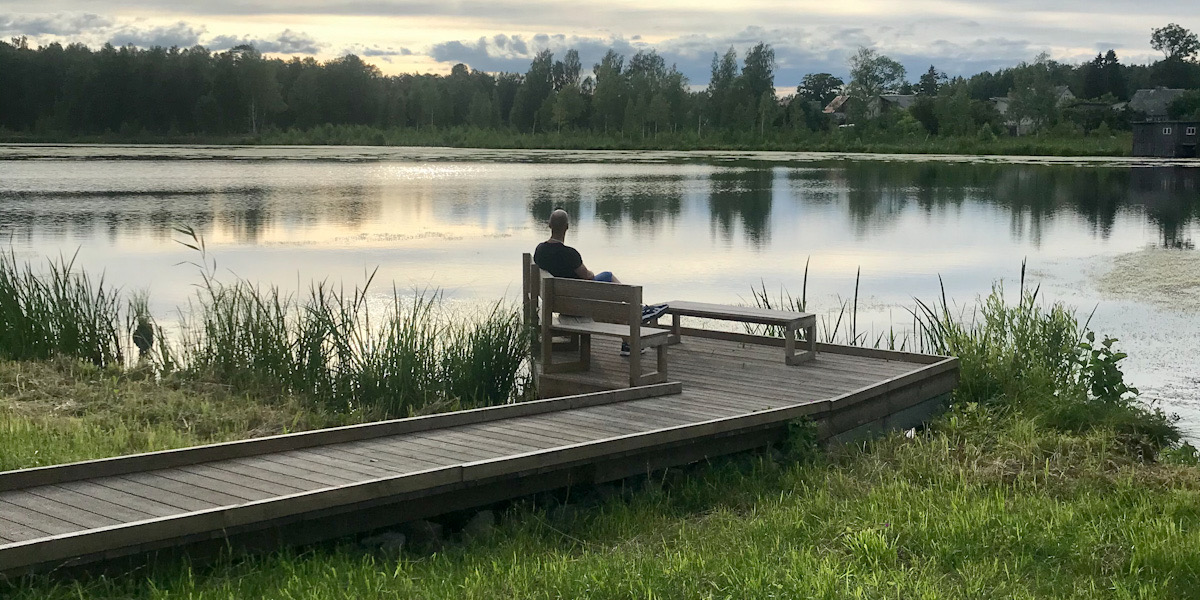
A question that never gets old—where can you find peace? Nestled by the tranquil shores of Lake Alūksne, serenity awaits. The best way to soak in this calm is on a summer evening, perched on a bench by the water. Or take a leisurely stroll to discover Alūksne’s hidden gems—climb one of Latvia’s tallest viewing towers, marvel at the unexpected sight of a temple in Latvia, and explore the historic ruins of Alūksne Castle.
This time, Alūksne wasn’t our destination but a stop on our way back from Estonia. With limited time, we couldn’t see all tourist attractions of Alūksne, but Pilssala and Tempļa Kalna Park stole our hearts. Curious why? Let me share the magic!
Walking along the well-kept paths, you can’t help but marvel at how thoughtfully this place is designed. Wooden boardwalks draw you closer to the water, while the lush green spaces seem to whisper, “Stay a while.” And the lamp posts—just look at them! Slightly bent, they appear to lean into the wind, adding a playful charm to the setting.
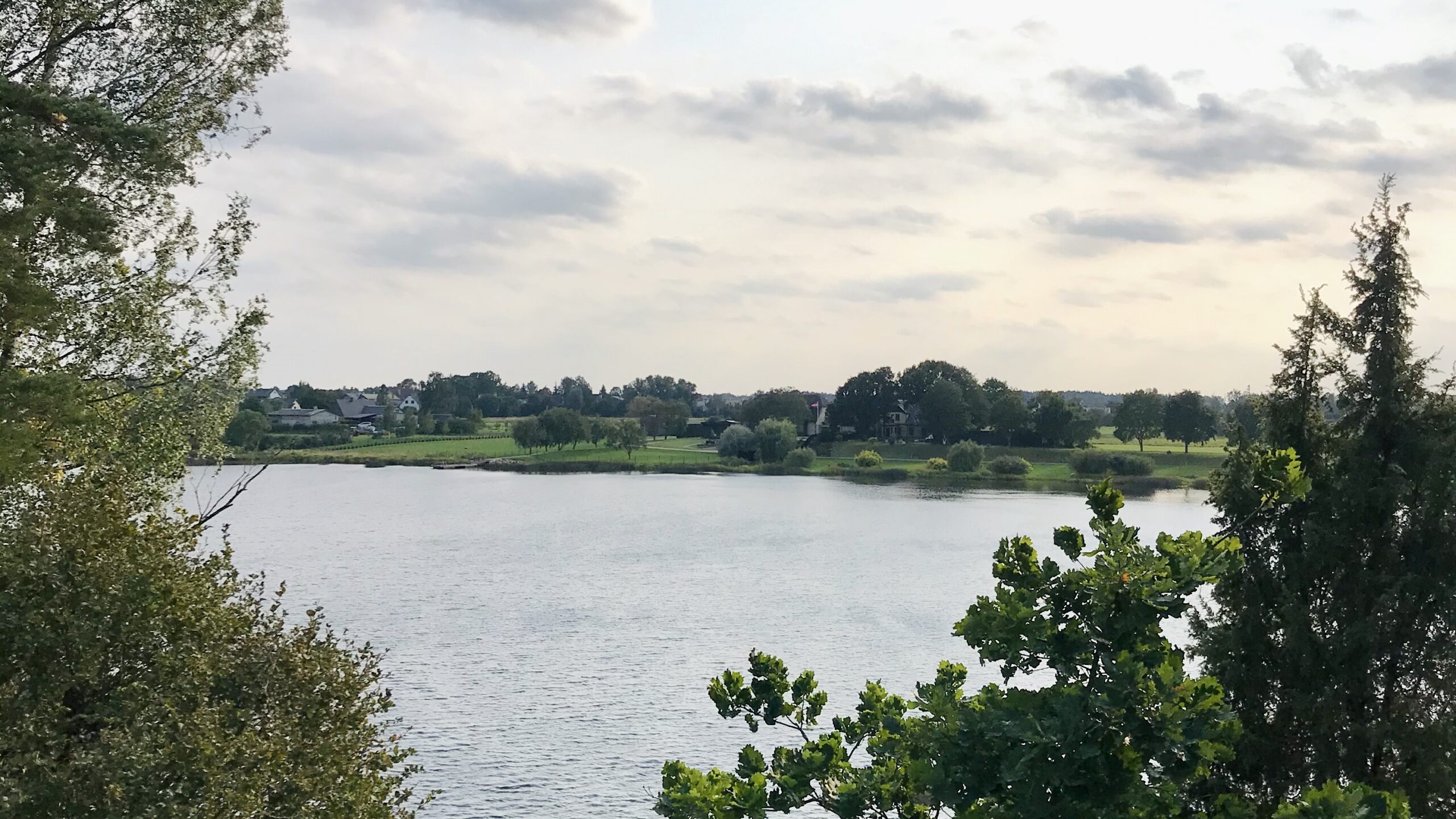
We notice stations where you can rent bikes, canoes, and catamarans—perfect for a day spent gliding over the water. The lake feels vast and tranquil, its surface almost mirror-like as the evening light softens. It’s easy to imagine spending the entire day immersed in the serenity of Lake Alūksne.
But the hour is growing late, and we decide to keep moving, eager to see as much of Alūksne’s attractions as we can before the sun dips below the horizon.
Our walk takes us across multiple bridges, each with its own unique character. The most famous is the “singing” pedestrian bridge on Tempļa Kalna Street, known to play music every hour during summer. Tonight, unfortunately, the timing isn’t on our side. Better luck next time, I suppose.
A Temple in Latvia? The Temple of Glory aka Rotonda
Latvia and temples—two concepts that rarely go hand in hand. As Latvians, we’ve had our own rich history of pagan gods and traditions, but to my knowledge, we didn’t worship them in temples. Yet, as we wander through Tempļa Kalna Park, a classical temple emerges before us, stopping us in our tracks. The Glory Temple—Rotunda—perches gracefully atop a small hill, its six elegant columns reaching skyward. It feels both out of place and perfectly at home in this tranquil setting.
Contrary to what one might think, this isn’t a tribute to Greek gods. Instead, it’s a memorial to the Great Northern War, uniquely honoring those on both sides of the conflict. The temple’s design adds an air of grandeur, inviting visitors to climb the hill for a closer look or capture its striking form in photos.
Yet one question lingers: why did someone choose to build a Greek-style temple here in Alūksne, so far removed from its classical roots?
How Many Attractions of Alūksne Can You Spot from the Viewing Tower?
Our next stop is the towering 37.8-meter wooden observation tower. Each step up the spiral staircase builds anticipation, and by the time we reach the top, the panoramic views are nothing short of breathtaking.
At the summit, an informative display highlights the attractions of Alūksne and nearby sights scattered across the landscape. Let’s make it fun—how many landmarks can you spot? Use the telescope provided for a closer look. From here, I can see the elegant Alūksne New Palace and the spire of its Evangelical Lutheran Church standing proudly in the distance.
If heights and stairs don’t scare you, this tower is the perfect starting point for your trip to Alūksne. It offers not only stunning views but also a chance to familiarize yourself with the attractions of Alūksne in one convenient, awe-inspiring place.
As the light fades, we make our way to Pilssala, where the medieval ruins of the Livonian Order’s fortress stand. They have seen a lot, so only a tiny part – the weathered stone walls and the restored southern tower are left to tell stories of knights and battles long past. The tower, with its wooden additions and pointed roof, is the most photogenic part of the ruins, and we can’t resist capturing it.
Now the sun has dipped below the horizon and it is time for us to end our Alūksne adventures and head home.
Thoughts?
Wouldn’t it be wonderful to stay here for a few days? I imagine waking up in a cozy lakeside cabin, sipping morning coffee by the water, and starting the day with a refreshing swim. With more time, we could explore more tourist attractions of Alūksne e.g. wander through Manor Park and admire the unique architecture of Alūksne’s New Palace up close.
Even in just a few hours, Alūksne leaves a lasting impression. The best part? Many of its highlights are within walking distance, making it easy to experience its charm, whether you’re here for a short visit or a longer stay.
We use cookies to ensure that we give you the best experience on our website. If you continue to use this site we will assume that you are happy with it.