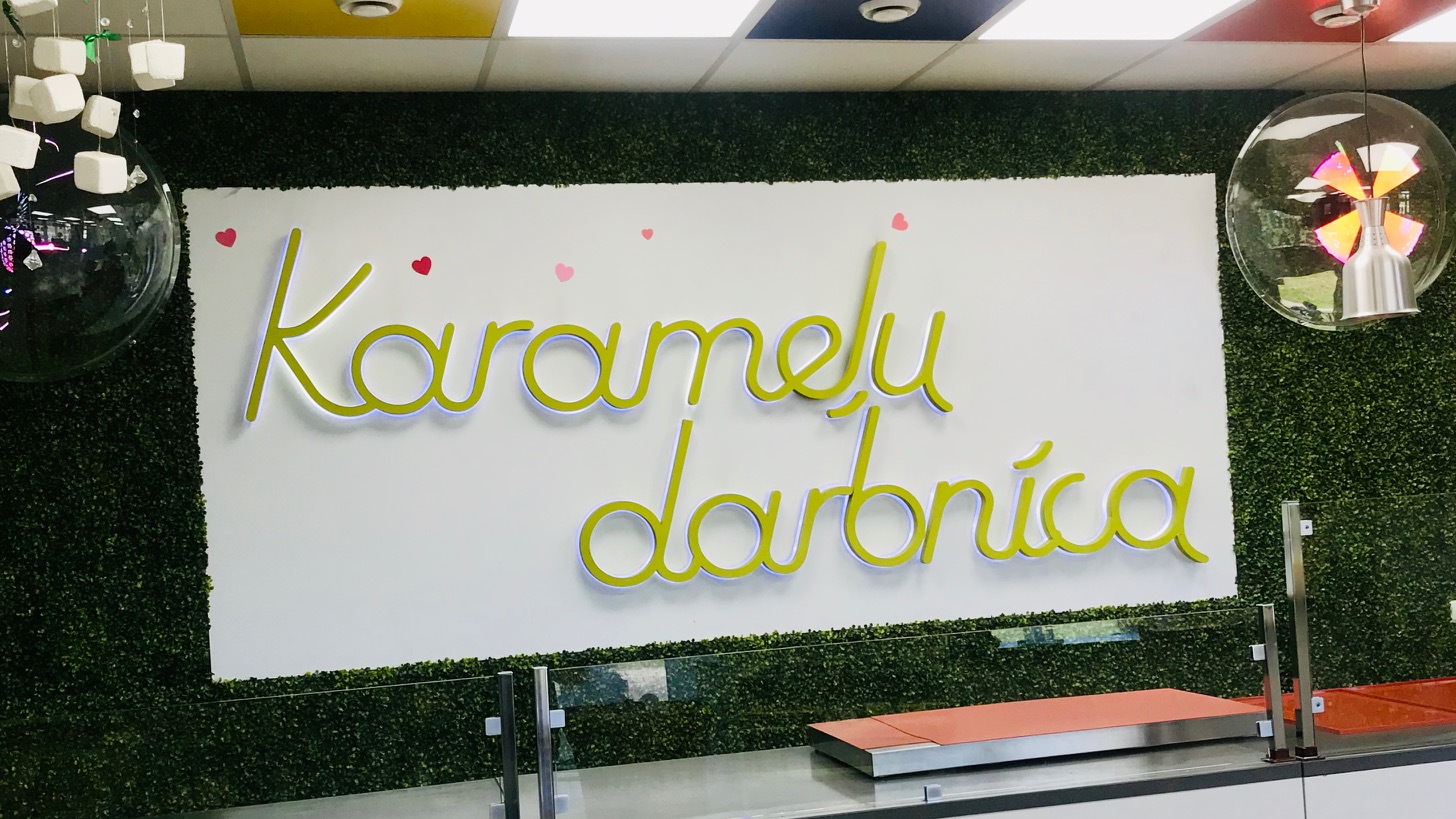
Do you (or your kids) have a sweet tooth? If so, you might be curious about how delicious treats like caramels are made. Let’s take a journey to the Caramel Factory (Karameļu darbnīca) in Jelgava, where their Caramel Workshop gives both kids and adults the chance to unravel the mystery behind the intricate designs hidden inside delicate caramel sticks. Have you ever wondered how they do it?
The Caramel Factory is a charming, family-run business nestled in Jelgava. It’s the perfect stop for picking up unique and scrumptious sweets that make great gifts. For instance, one of my relatives will soon be receiving a pack of malt caramels—a treat I can’t wait for them to try! Have you ever tasted anything like that? I haven’t yet, but I’m eager to hear what they think.
The factory isn’t just about selling sweets, though. They also offer public tours and live caramel-making demonstrations throughout the year. Keep an eye on their Facebook page (Latvian) for updates on these fun and delicious events.
The Candy House (But Not the One from Hansel and Gretel)
From the moment you step into the Caramel Factory, you’re transported into a world of whimsy and sweetness. Cheerful flower pots and playful beetles perched on a tree greet you at the entrance, infusing the place with a charming, light-hearted energy. It’s so cute, you’ll almost want to stop and take photos. But trust me, don’t linger outside too long—there are delicious treats and a fun, free guided tour waiting for you inside!
Sample the Caramel Factory’s Sweet Treats
Before the workshop begins, you’ll have the chance to sample a selection of delightful sweets. My personal favorite was the whipped candy—a light, fluffy treat with the texture of marshmallow and the taste of cotton candy. It was so good that I couldn’t resist buying an entire bag! But if that’s not your thing, there are plenty of other options to choose from, including rich chocolates, fruity surprises and, of course, a variety of delicious caramels.
A Live Caramel-Making Demonstration
Here’s a sneak peek of the fun discoveries that await: did you know they cut hot caramel with scissors? It’s one of those fascinating little details that makes you question if this actually happened or if it was a whimsical dream.
The live caramel-making demonstration is a real treat, especially for kids. They’ll have fun guessing which natural ingredients are responsible for the vibrant colors of the caramels. And even the adults might be caught off guard when they learn the source of the blue dye. Any guesses? If you’re thinking blueberries, think again.
For adults, the real magic lies in watching the caramel come to life. You’ll get to witness the sugar being melted, kneaded, and stretched, before—yes—being snipped with scissors into perfect little pieces. I won’t spoil all the secrets (you’ll need to visit to see for yourself), but let me just say, you’ll be mesmerized as the hot sugar transforms into a gooey, slime-like texture, before it’s carefully shaped into delicate caramel sticks with intricate flower designs hidden inside.
When Your Mouth Starts Watering, It’s Time to Make Your Own Candy
As if watching the caramel-making process wasn’t enough, here’s where things get even more fun—you or your little ones can try making your own candy! For just a small fee (about €3 when I visited), you can roll up your sleeves and create your very own caramel treat. You’ll pick your favorite shape, and a skilled artisan will guide you through every step. Here’s my slightly lopsided, slightly bent creation, but hey, who cares about perfection when it tastes this good?
Overall, it’s a perfect rainy day activity in Jelgava with kids. Or even without them. Why not? When I got home, my boyfriend asked if it felt strange to be the only one there without children, as everyone else had little ones with them. I just shrugged and said, “Well, now I know how they make caramel!”
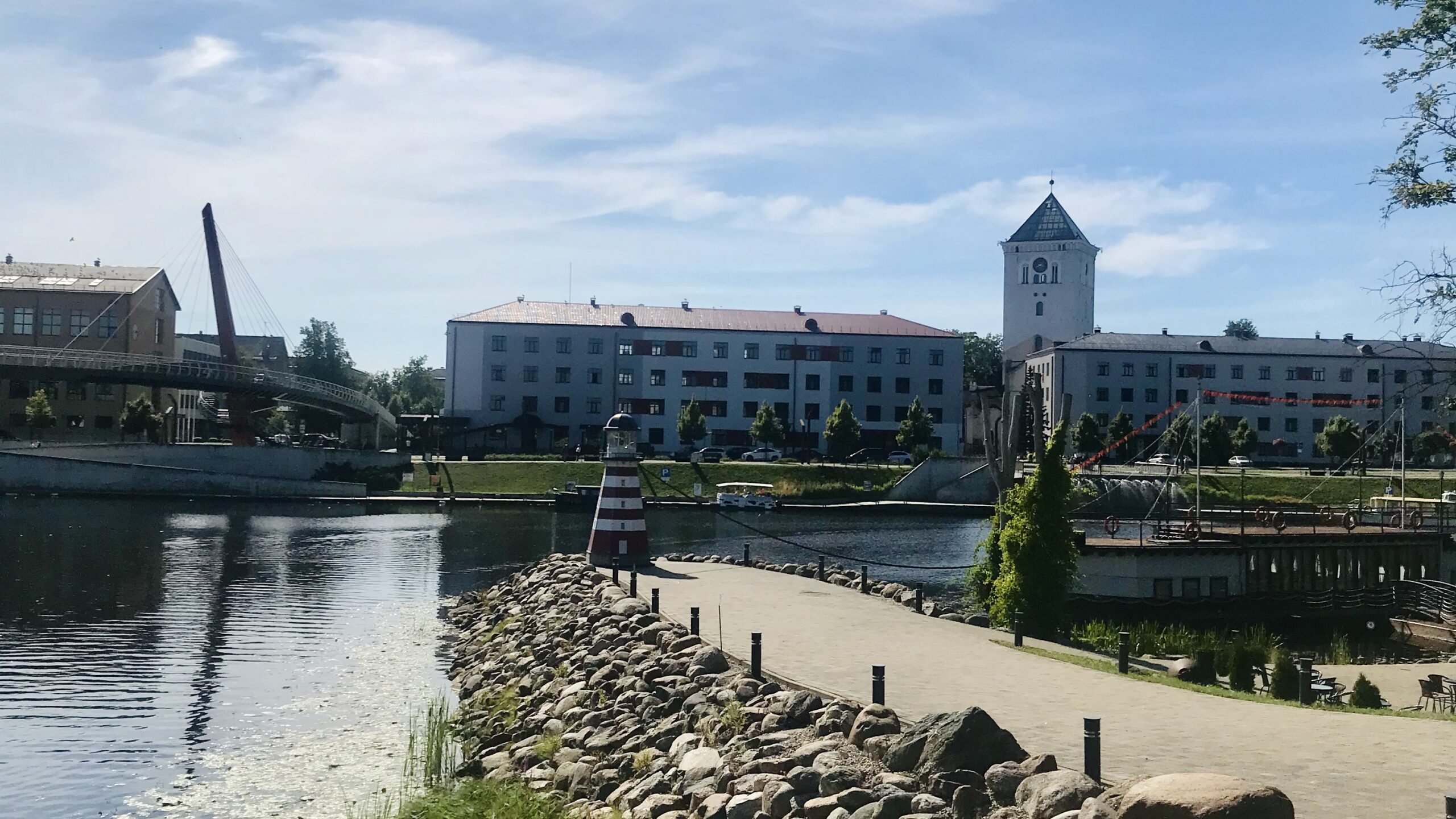
Let’s meet in Jelgava, the city I call home! We’ll climb the tower of St. Trinity Church (which is actually not a church!) and be treated to stunning panoramic views of the city. Along the way, we’ll uncover fun facts about Jelgava’s rich history at its museums, and I’ll introduce you to quirky sculptures, the wild Palienes Meadows (where, if you’re lucky, you might even meet some horses!), and many more of Jelgava’s unique attractions.
Sounds like the perfect plan for a day trip to Jelgava, doesn’t it?
To kick off our list of what to see in Jelgava, we’ll start with the iconic St. Trinity Church Tower. The fascinating stories you’ll uncover here will be the perfect prologue for all the discoveries that lie ahead. Let’s dive in!
The Holy Trinity Church in Jelgava was once a church, but it no longer serves as one. However, as you can see, it still maintains the appearance of a church from the outside. It’s a truly beautiful building.
Today, inside, you’ll find a museum that tells the story of Jelgava in a fun and interactive way, with a touch of gamification! To prove that, let me share an interesting fact you can discover here: Did you know that, in the past, Jelgava had a floating raft bridge that had to be dismantled every fall and reassembled every spring?
For a museum to be engaging, it’s not just about the story – it’s about how the story is told. I often struggle to focus on long descriptions, so I usually just glance at the exhibits without diving into all the details. But here, the history of Jelgava comes alive through games, videos, and audio, which really capture your attention and leave you eager to learn more.
What will you discover in Jelgava’s St. Trinity Church?
On the 3rd floor, step into a room where you can hear the sound of horses’ hooves echoing on the ancient streets of Jelgava. In the center, you’ll find an interactive map that shows how the city has evolved over the years, along with fascinating facts about its history.
On the 4th floor, don’t miss the digital fashion show showcasing Jelgava’s fashion through the centuries, with a special focus on wedding dresses.
If you’re curious about what a “baptism machine” is, or how this historic building looked when it was still a church, make sure to check out the audio recordings on the 5th floor. These recordings offer the full story of St. Trinity Church Tower’s history, including what happened to the tower and why there is now a glass pyramid at the top.
And as the cherry on top, climb to the top to explore the exhibition hall and observation platform, where you’ll enjoy beautiful panoramic views of Jelgava.
After that, let’s stretch our legs at my favorite place to see in Jelgava – Pasta Sala.
Fountains, sculptures, picturesque walking paths, and activities for every taste. Intrigued yet?
One Island – 3 Different Sculpture Parks
Is that a horse? And what’s that mysterious shape over there? As you step into the first sculpture park, you’ll find yourself surrounded by a stunning collection of fireclay sculptures, thoughtfully nestled among lush greenery. Each sculpture tells its own unique story—some abstract, others more recognizable—but all of them are captivating in their own way. These masterpieces were created during the Fireclay Sculpture Symposium, an annual international event held right here in Jelgava.
As you explore, you’ll notice that many of the sculptures feature tiny holes and openings. The reason behind this? At the end of the symposium, these sculptures are set ablaze from the inside out in a mesmerizing performance, transforming into fiery works of art.
And as night falls, the magic doesn’t stop. Soft, ambient lights gently illuminate the sculptures, casting enchanting shadows and revealing their intricate details in a whole new light.
In the heart of Pasta Sala, you’ll come across a fence, behind which the heads of various sand sculptures peek out, inviting your curiosity. You’ve likely heard about Jelgava’s famous sand sculptures, right? Every summer, a grand event showcases the latest masterpieces, each one more impressive than the last. These intricate creations are at their finest right after they’re completed, but over time, nature takes its course, and they slowly begin to decay, making way for the next generation of sand art to take center stage next year.
Check prices and working hours for sand sculptures here.
Finally, the third sculpture park is tucked away at the far end of the island. As you make your way there, take a moment to enjoy the tranquil atmosphere and breathtaking views of the river. The sculptures here are made fromwood and have a fun, whimsical charm. Some of them seem to hint at fairy tales, adding a touch of magic to the surroundings. My favorite? A horse, flipped upside down.
The Romance of Pasta Island in Jelgava: Teahouse, Lighthouse, and a Ship
Where could that mysterious melody be coming from?
On warm summer evenings, as the sun dips below the horizon and twilight blankets the sky, Pasta Island in Jelgava transforms into a place of pure romance. Lights begin to shimmer, and the fountains across the river burst into a dazzling symphony of colors. Yes, technically, the fountains aren’t on Pasta Island—they’re on the opposite bank—but you can appreciate their beauty from here. And if you’re feeling adventurous, you can cross the river and experience the thrill of walking right underneath them.
Adding to the magic, a soft glow embraces the quaint lighthouse and the St. Trinity Church Tower, painting an enchanting backdrop perfect for an intimate evening stroll.
But on sunny days, my favorite way to enjoy the island is a bit different. I love stopping by the charming teahouse for a cup of coffee and a decadent pastry. My regular spot is one of the outdoor tables, offering a serene view of the lighthouse and the nearby ship—which I’ve come to learn serves as an event hall. It’s a tranquil moment of indulgence, made even better by the soft, mysterious melody that drifts through the air.
Where does that music come from? I haven’t figured it out yet. So I hope it isn’t only in my head.
Activities on Pasta Island, Jelgava: Something for Every Taste
After your stroll, you have a choice: move on to the next place to see in Jelgava or embrace a bit of adventure with one of the many outdoor activities available. During the warmer months, you can:
Bask in the sunshine on the sandy beach.
Explore the Lielupe River from a new angle with a boat ride, a paddle in a kayak, or a glide on a SUP board.
Break a sweat at the outdoor fitness area—though I’m no expert, the equipment looks top-notch.
Traveling with kids? Let them burn off some energy at the vibrant playground.
When winter arrives, Pasta Island transforms into a magical escape with its ice rink, perfect for skating your way to some frosty fun!
Cross Jelgava’s Mitava Bridge and Say Hi to the Famous Student Sculpture
Want to Make a Wish? Then head over to the Mītava Bridge, another popular activity to enjoy in Jelgava. Pause at the center of the bridge to take in the stunning views of the river and Pasta Island. Afterward, make your way to the Jelgava Student Sculpture.
To me, “Jēkabs Ceriņš” (the sculpture’s name) looks a bit gloomy, almost as if he could use a cup of hot coffee—especially on a rainy day. Perhaps student life isn’t always a breeze. But there’s a legend: if you rub the handle of his umbrella and make a heartfelt wish, it just might come true!
After snapping a photo with one of Jelgava’s most iconic attractions, it’s time to chart a course for another hidden gem: the Svēte Floodplain Meadows Boardwalk. On the way, we’ll make a quick stop to capture yet another of Jelgava’s unique landmarks, one that carries a powerful story of its own.
Discover Jelgava’s Wheel of Time 100: 100 Years, 100 Stones
Here, much like in the church tower, the story unfolds in a truly captivating manner. Latvia’s years of existence are symbolized by stones carried on people’s heads—a poignant metaphor for the weight of history and responsibility. But each person is also a mirror. When you gaze into it, you see yourself, a reminder that we are the ones who shape and carry the legacy of our nation. It’s a deeply moving and thought-provoking message.
I know I promised we’Il go to the meadows, but if you are interested in history and architecture there is one more attraction you may want to check out while your in this part of Jelgava…
Discover the story of 3 magical chests in Jelgava Old Town House
In the summertime, this place feels alive with nature’s vibrant energy. Bright green reeds sway gently in the breeze, shimmering patches of water peek through the foliage, and the occasional pop of purple blossoms adds a splash of color. (Thank you, helpful information board, for teaching me that these lovely flowers are called purple loosestrife!)
I’ll admit, I was initially skeptical about the Svēte Floodplain Boardwalk. Its location within the city, so close to residential houses, had me wondering if it could truly offer a peaceful escape. But I’m happy to report that my worries were pointless. The area is wonderfully serene, with the soft, rhythmic chirping of grasshoppers providing the perfect summer soundtrack.
The boardwalk itself is an impressive wooden network that meanders through the lush greenery. You may be pleasantly surprised by just how extensive it is. The paths are divided into two sections, separated by a short walk along a gravel road. The smaller section winds around a pond, making it the perfect choice if you’re hoping to spot a duck or two. The longer section twists and turns, branching out in various directions with multiple exits to explore. In total, the boardwalk stretches 1,665 meters, offering plenty of room for a satisfying, leisurely walk.
Later, we’ll talk about the Lielupe Floodplain Meadows, another stunning spot to explore in Jelgava. But here’s what makes this boardwalk special: because of the pond and nearby ditches, water is present here even during the summer. This means you don’t have to wait for spring floods to enjoy the sight of aquatic plants dipping into the water. That said, I can only imagine how wild this place must look during the dramatic spring overflow.
And if you’re still feeling energetic after your walk, there is still plenty to see in Jelgava. Next up, let’s head over to Jelgava Palace to admire its grand exterior!
Explore the Exterior of Baroque Gem – Jelgavas Palace
I was immediately drawn to the color palette of Jelgava Palace—the deep red facade accented with crisp white details and dark highlights. It’s a bold choice that leaves a lasting impression. If you paid attention in history class, you might already know that Jelgava Palace holds the title of the largest Baroque-style palace in the Baltic States.
But did you know there’s also a beautiful park right next to the palace? Complete with a charming little bridge, it’s the perfect place to escape the summer heat beneath the shade of its trees.
Finally, we’ll head to the Lielupe Floodplain Meadows, keeping our fingers crossed for a chance to spot one of the majestic wild horses that call the area home.
Climb Jelgavas Observation Tower, With a Chance to See Wild Horses
Climb up the observation tower, and with a bit of luck, you might catch a glimpse of a wild horse. Even if only as a distant silhouette in the grass.
Although the horses like to play a hide and seek, the beautiful views from the tower make the visit worthwhile. On one side, you’ll see the charming rooftops of Jelgava, with the iconic spire of St. Trinity Church Tower standing proudly alongside other church spires. On the other side, a serene, postcard-perfect view of the river unfolds, meandering gracefully through the landscape.
As for the wild horses, spotting them is always a matter of luck. These free-roaming animals live on their own terms. On cooler days, you might be fortunate enough to see them ambling near the fence, their movements exuding quiet grace. Other times, they may be mere specks in the distance or hidden entirely from view.
On my most recent visit, a scorching summer day, I didn’t see a single horse, which is why I don’t have a picture of these magnificent creatures to share.
Before I wrap up, one crucial reminder: please don’t feed the wild horses! It’s vital to respect their freedom and natural habitat so they can continue to thrive in this beautiful space.
Bonus – Moose, the Symbol of Jelgava
These spots aren’t part of the main Jelgava day trip itinerary, but if you happen to pass by, they’re worth stopping to snap a quick photo. First thing you need to know is that a moose appears on Jelgava’s flag. Because the moose holds special significance for the city, you’ll also find two moose sculptures scattered throughout Jelgava.
One of them greets visitors in Ozolskvērs (location) which is conveniently on the way to the “Wheel of time 100” sculpture. Why not make a quick stop? Ozolskvērs also features a lovely children’s playground and a remarkable tree—an oak. After about 250 years of life, it was cut down and transformed into a unique art installation called “Time Train.”
The second elk sculpture stands in Langervaldas Forest (location). This one is crafted from wood, and it’s accompanied by a few other wooden friends. The Langervaldas forest itself is crisscrossed with a network of walking paths, making it an ideal destination for those wanting to escape the hustle and bustle of the city and immerse themselves in a peaceful forest walk.
And with that, my list of must-see spots in Jelgava comes to a close—for now, at least!
FAQs about Day trip to Jelgava
How to get around Jelgava?
If you’re looking for a more eco-friendly option, Jelgava is a bike-friendly city. This is actually the way I get around town. Nearly everywhere, you’ll find bike lanes and parking spots for bikes. During the summer season, you can also spot Bolt scooters on the streets. Most of the route should be walkable for pedestrians, although the walking trail in the Svēte floodplain meadows is a bit farther from other attractions, so it would take about an hour to reach on foot. But for those who are driving, there always seems to be a free place to park in Jelgava.
Where to Eat in Jelgava?
If you’re going for breakfast, brunch or lunch I’d recommend Brokastnīca. I also think Shikisushi serves pretty good sushi.
Thoughts?
I might be biased, but I do think Jelgava has some pretty great and engaging museums and a lot of picturesque places for walks. We also have a lot of fun events happening in Jelgava throughout the year, combining the sightseeing with a sculpture festival or farmers market would be even more fun. So I hope to see you in Jelgava one day!
The Uzupis constitution proudly declares, “Everyone has the right to love and take care of a cat.” And if that’s not a clear sign that Vilnius truly understands the art of cat appreciation, I don’t know what is. Cats are incredible, aren’t they? With their sassy attitudes, their endless curiosity, and their penchant for naps in the most impossible of positions. And right here in Vilnius, there’s a place where these wonderful creatures are not just admired—they’re celebrated. Welcome to the Vilnius Cat Cafe, or as the locals call it, Kačių Kavinė.
This cozy café is home to 15 rescue cats from local shelters, all of whom have found their forever home here, living it up in style. It’s the perfect place to sip on a coffee, pet some adorable furballs, and just enjoy the peaceful feline vibes. So, naturally, this is where we’re headed today!
My only hope is that my own cat at home doesn’t find out where I’ve been. Otherwise I have a feeling I’ll be in for a lot of explaining when I get back.
How to get there: By walking from Vilnius Old Town
What You Need to Know About Visiting Vilnius Cat Cafe?
The best way to secure a spot at the Vilnius Cat Café is to book ahead. However, during weekdays, you can sometimes get lucky with a walk-in (like today).
Once we’re inside, a friendly staff member guides us you through some simple rules:
Slip on your “bahils” (slipper covers) to keep everything pristine.
Wash your hands
No feeding the cats (they’re on a special, star-level diet).
No picking them up (Vilnius cat cafe cats are rescues, so that may trigger some not so happy memories ).
Petting them and playing with them is totally allowed, as long as the cats are on board with it.
All clear? Great, now we can be seated.
The Purrfect Vibe in Vilnius Cat Cafe
If a cat were to design the interior of their dream café, this would be it. Everything in this place screams “cat,” and it’s as delightful as a laser pointer chase for a playful kitty.Cozy beds and snazzy cat trees are strategically scattered around the room, ensuring the resident felines have plenty of places to nap, stretch, and show off their impeccable lounging skills.
The rooms are bright and cheerful and on the walls, you’ll find paintings of—you guessed it—cats, with shelves filled with more cat-themed trinkets than you could ever dream of. I love it!
Vilnius Cat Cafes Catbook
Alongside the menu, you’re handed a special edition of the “Catbook”—the Facebook for cats. It’s where you can find profiles of all the kitties, complete with their names, pictures, and little bios. Who’s the shy one? Who’s the playful rascal? Who needs a personal hairdresser (I’m looking at you, fluffy gray cat)? It’s an interactive guide to navigating your future feline friendships. Just reading through it is tons of fun. One of my favorite books, paws down.
A Cattochino Please!
Now, let’s take a look at the menu! While the food isn’t the main draw of visiting a cat café (that would, of course, be the cats), enjoying a meal and a drink is a great way to support the café and its furry residents. So, with a hungry stomach and an excited heart, we take a glance at what’s on offer.
As you flip through the menu, it’s clear that there’s an added touch of feline flair. Not all of the dishes have a cat-themed name, but that’s okay—there’s still plenty to make you smile. Between the hearty pastas and fresh salads, you’ll spot the charmingly named “MurBurger” and “Cattochino”. And many of the hot caffeinated beverages come with a cat shaped cookie or a paw print on top of the milk foam which takes them to the next level of cuteness.
As our orders are being prepared, it’s time to say hi to true stars of Vilnius Cat Caffee—the cats!
The Stars of Vilnius Cat cafe – the Cats
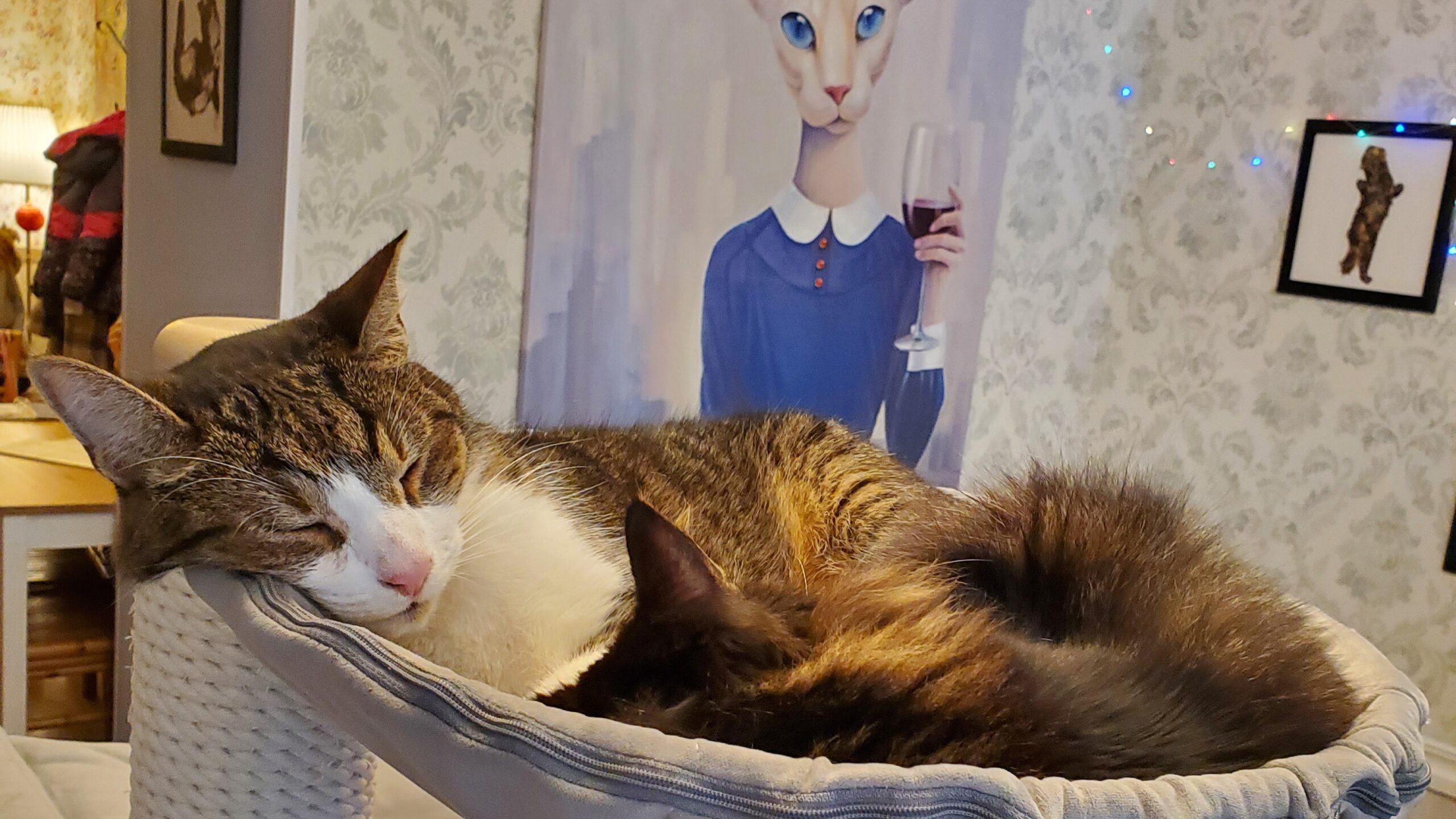
Around the Vilnius Cat café, the cats are living their best lives, each in their own perfect state of relaxation. A fluffy gray kitty, the one who seems to have a permanent appointment with a personal hairdresser, is nestled into a cozy basket. Nearby, a white cat, wearing a bell around her neck (because she, like many completely white cats is deaf), has claimed the highest perch of a towering cat tree. There she curls up in a perfect, pristine little ball of fluff.
Did you know that cats sleep anywhere from 16 to 20 hours a day? And although the inhabitants of Vilnius Cat caffee might look like the most cuddly creatures on the planet, they’re likely in the middle of a very important catnap, dreaming about laser pointer chases, jumping high enough to knock things off shelves, or basking in the warmth of a sunbeam. So, while we’re tempted to snuggle every sleepy kitty in sight, it’s probably best to leave these dozing furballs in peace.
But don’t worry—luckily for us, there’s one curious kitty making its way across the room. It’s got a little more energy, and clearly, it’s not afraid of a little attention. As soon as this adventurous soul starts padding toward our table, the competition for its attention intensifies. Everyone’s trying to get its attention, meowing and cooing in hopes of being the chosen one. But we’ve got a little advantage—our hands are free since our murburgers haven’t arrived yet. So I slowly raise from the seat and carefully approach the kitty. Then I slowly pet its head. It’s pure bliss. The cat seems pretty content too, so if you want to – go ahead and pet the little furball too!
Of course, cats are cats. They’re the masters of choosing when they want attention, and they’ll happily ignore you when it’s not on their terms. So while not all the kitties are in the mood for a cuddle, the good news is that with so many cats in the Vilnius Cat café, you’re bound to find one who’s ready for a little human affection. Come, let’s go see who else in the mood for some pets today!
What are your thoughts?
Did I say cats are amazing? Just being in their presence makes me happy and it seems that the little inhabitants of the cat cafe look pretty happy and content with their lives in the public eye. It also seemed that the employees of the cafe truly cared about the cats and their wellbeing which was amazing to see. So if you are a fellow cat lover – I’d recommend you to stop here for a lunch.
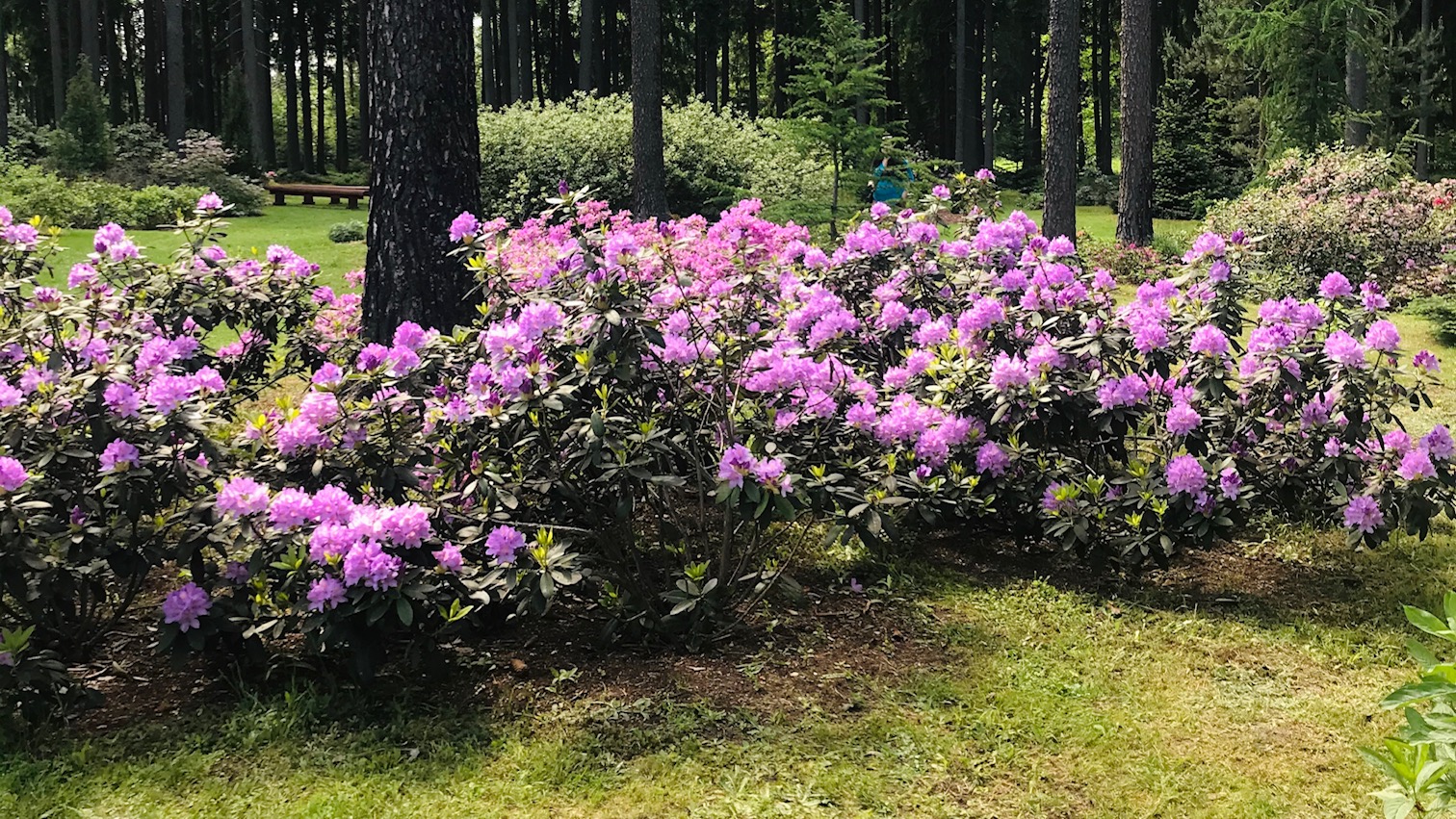
Mid-June at Kalsnava Arboretum is a truly magical experience. As rhododendrons burst into full bloom and the first peonies delicately unfurl, the arboretum transforms into a vibrant haven of color and fragrance. You can immerse yourself in clouds of rhododendrons, climb a towering lookout for sweeping views, wander through tunnels draped in pipe vines, or retreat beneath the sprawling, protective canopies of majestic thuja trees.
Managed by Latvia’s State Forests, Kalsnava Arboretum was originally established as a scientific collection of woody plants. Today, it has evolved into a serene sanctuary where guests can connect with nature, draw inspiration, and rejuvenate their spirits.
Rhododendrons, Rhododendrons and MORE Rhododendrons
Wandering into the rhododendron grove feels like stepping into a storybook forest, a place where you can easily lose yourself. The bushes, in full bloom, resemble soft clouds, and you’re surrounded by a dazzling array of vibrant colors. Shades of orange, pink, yellow, and violet create a dreamlike atmosphere. With each step, new varieties of plants unfold before you, and the outside world fades into oblivion. You become fully immersed in the serene, otherworldly beauty of this rhododendron paradise.
Timing your visit to coincide with their flowering season is key to fully experiencing this enchanted oasis. It offers a rare opportunity to capture a treasure trove of stunning photographs and create unforgettable memories that will stay with you long after you leave.
If you are wondering, these pictures were taken on June 12, 2022.
Kalsnava Arboretum Peony Extravaganza
In addition to the rhododendrons, Kalsnava Arboretum also boasts a stunning collection of peonies, featuring early, mid-season, and late-blooming varieties. Today, only a few of the peonies had begun to bloom, but the promise of vibrant blossoms throughout June is unmistakable.
With over 300 varieties carefully planted in thoughtfully arranged clusters, the peonies form a breathtaking kaleidoscope of colors that will make your heart skip a beat. Is it even legal to have this much beauty in one place?
Trees that Grow Downwards, Tunnels, and Other Wonders of Kalsnava Arboretum
The blooms are absolutely stunning, but there’s so much more to explore in Kalsnava Arboretum. Next, you’ll encounter enchanting tunnels overgrown with a variety of climbing plants. Clematis vines twist through the air, while other fascinating plants, like those with leaves shaped like tiny pipes, drape over the tunnels like large blankets. Though I can’t name most of them, they create a stunning green tapestry that’s simply mesmerizing.
Then comes a delightful surprise. Did you know there are trees that grow upside down? In front of you, you’ll find several “Inversa” spruces, carefully cultivated to grow downward rather than upward after the grafting point. These unique trees take on shapes that resemble clouds, and just like with cloud gazing, you might spot “animals” or “magical creatures” hidden within their whimsical forms.
And there’s the little Thuja maze, inviting you to get lost in its twists and turns.
But it’s the towering Thujas that truly captivate. These giant trees have grown so massive that you can slip beneath them and discover a cozy nook, like a tiny woodland hideaway nestled within their branches. Surrounded by their protective canopy, it feels safe and peaceful, with the earthy scent of the forest filling the air. This is probably how bunnies and other little creatures feel when they hide beneath the trees.
While the flowering plants have to be timed just right to fully experience their beauty, these evergreens are a year-round delight. And, of course, there are countless other tree species to explore and enjoy.
Kalsnavas arborētumā vajadzētu augt arī ūdensrozēm, bet gadā kad es arborētumu apmeklēju, diemžēl, esot veikta dīķu tīrīšana un ūdensrozes pilnā godībā atkal varēšot redzēt tikai nākamgad. Kas nozīmē, ja tu šo rakstu lasi 2023. gadā vai vēlāk – tev veicas – redzēsi vairāk par mani.
Kalsnava Arboretum Observation Tower
And as if the arboretum’s ground-level beauty weren’t enough, Kalsnava arboretum also boasts a 25-meter-high lookout tower. From this elevated vantage point, you can take in a sweeping panoramic view of the surrounding landscape, explore the intricate patterns of the flowerbeds, and admire the thuja trees, standing like soldiers in perfectly ordered lines, all from a completely new perspective.
What a perfect way to cap off an unforgettable day.
What are your thoughts?
As someone diving into the world of gardening for the first time (this year marks my attempt to create my own garden), my visit to Kalsnava Arboretum was pure joy and inspiration. Even my grandmother, a seasoned gardener, was utterly enchanted.
But this is not just a haven for gardening enthusiasts—it’s a treasure for anyone who appreciates the artistry of nature, loves discovering peaceful landscapes, or seeks a perfect photo backdrop.
I’ve spent quite a bit of time in this quiet little town in Kurzeme region of Latvia, and after wandering its paths together with the locals, I’ve come to realize that Aizpute has two distinct themes. Art, hidden throughout the city streets and showcased in the Aizpute Art Park, and history, preserved in its castle ruins, churches, and the museum archive.
If you’re planning a visit to Aizpute Latvia, let me take you on a journey through the places that caught my eye.
Visiting this unique place in Aizpute is a whirlwind of emotions. The art is whimsical, unsettling—with snakes and monsters hiding in closets and a nude women in a bathtub—yet at the same time it’s thought-provoking, undeniably creative, and beautiful. It feels like walking through someone else’s dreams and nightmares.
Here, I’ve included photos of a few sculptures created by Ģirts Brumsons, but there are far more to see. The unexpectedly full of surprises, but to discover the rest, you’ll need to visit Aizpute yourself.
Aizputes Street Art – A Touch of Creativity in Daily Life
Each year, Aizpute hosts an artist residency, welcoming creators from around the world to leave their mark on the town. One delightful example is the panda with a baby, sculpted by a Japanese artist, which brings a playful and charming vibe to its surroundings.
Other notable pieces of street art include murals, such as the fallen apples (Location) and the “God Bless Latvia” mural , which features a stunning landscape framed by a triumph arch. A fun thing to do is try to find Latvian symbols encoded in this artwork. Location
Another highlight is the train mural(location), which pays tribute to Aizpute’s historic narrow-gauge railway. This train once connected Aizpute to Liepāja, meandering leisurely through the countryside before faster modes of transport took its place. For those curious about this chapter of Aizpute’s past, the Aizpute Museum offers a deeper dive into its history.
Turns Out the Smallest Art Gallery in the World is in Aizpute Latvia
Typically, peeping through a keyhole isn’t encouraged. But in Aizpute, there’s one keyhole you simply must look through.
Behind it lies the smallest art gallery in the world. The artwork is so tiny—just 10x10x10 cm—that you might struggle to make out its details. I certainly did. But I’m curious: what will you see when you peek inside?
As you wander the charming streets of Aizpute, I challenge you to find it. Look for a large brown door with a tiny golden keyhole. Need a hint? There’s a small plaque on the wall nearby that tells the whole story.
The Bench in Memory of Singer Martiņš Freimanis
You might have heard of talking rocks, but how about talking benches? Aizpute has one.
This special bench plays voice recordings (in Latvian) and songs by Martiņš Freimanis, a beloved Latvian singer who tragically passed away years ago.
Even if you don’t know much about Martiņš, the bench is worth visiting for another reason: the view. From here, you can take in one of the most beautiful panoramas in Aizpute. A serene mill lake mirrors the sky, green trees sway gently in the breeze, and the church spire peeks out from the woods across the water.
It’s a view that soothes the soul and lingers in your memory.
Exploring Aizpute’s Rich History
Livonian Order Castle Ruins and the Knight with Changing Outfits
One of the most popular attractions in Aizpute Latvia is the Livonian Order Castle Ruins. However, even more famous than the ruins themselves is the knight’s sculpture that stands guard over them. During various holidays, the knight mysteriously appears dressed in themed costumes—whether it’s a midsummer flower crown or a Christmas elf hat.
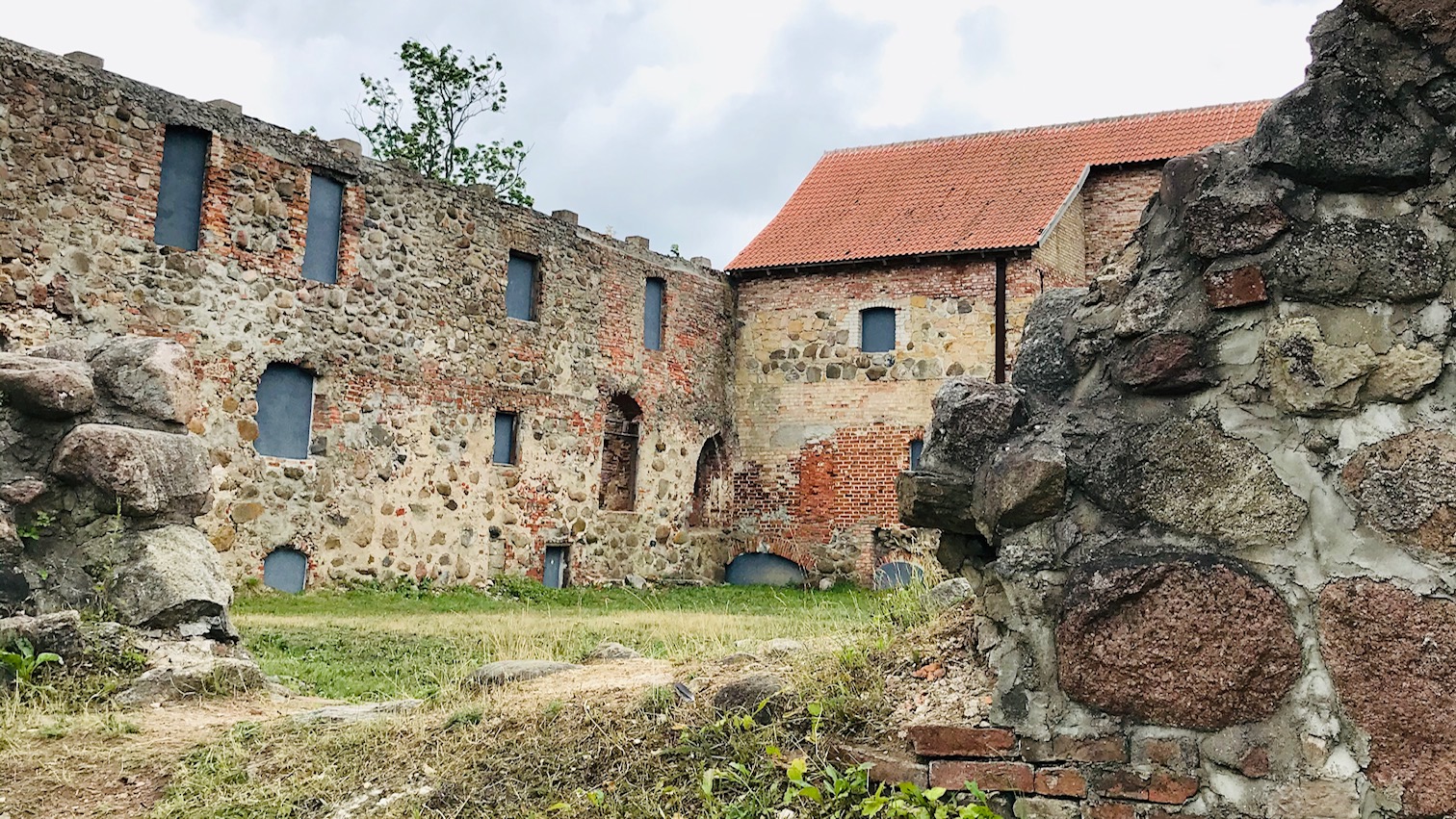
The castle ruins, while not as expansive as those in Rauna, have their own charm. Personally, I feel it’s a shame that the windows were bricked up during preservation efforts. Here’s an interesting tidbit: during the Soviet era, apartments were built within the ruins, and people actually lived there.
Right next to the ruins, you’ll find another historical building: the Pilskrogs, built in the 19th century. Today, it serves as a venue for various events.
St. John’s Evangelical Lutheran Church – A Hilltop Gem
One of Aizpute’s most picturesque views is of St. John’s Church, perched at the top of a hill. Climbing up offers a closer look at the church’s unique architecture, and it’s worth noting that this church is considered one of the oldest in Kurzeme.
Nearby (approximate location) , you’ll find a little red bridge and a trail leading to Misiņkalns, the highest point in Aizpute Latvia. Misiņkalns nature park is crisscrossed with small forest paths perfect for quiet walks. In winter, the hill transforms into a sledding spot for children and families. The area also features a motocross track, a memorial for political deportees, and the Misiņkalns Cemetery.
Cool Off at the Aizpute Swimming Spot
If you’re visiting Aizpute in summer, don’t miss the town’s swimming area. It’s clean, well-maintained, and perfect for a refreshing dip after sightseeing. A short walk from the swimming area leads to a man-made waterfall, which, as it turns out, locals sometimes use as a natural shower.
The Latvian city of Aizpute is less touristy than many other Latvias cities, but it is definitely very artistic. So it will be a good fit for those who have already explored all the most popular spots and are looking for other, less known corners of Latvia.
Once upon a time, Grand Duke Gediminas had a vivid dream of a mighty iron wolf howling atop a hill—signifying that a great city would one day rise in that very spot. Today, that city is Vilnius, the vibrant capital of Lithuania, brimming with creativity, rich history, and delightful surprises.
Gediminas is said to have been hunting when he discovered the site. Now, we’re on a “hunt” of our own—seeking out what to see in Vilnius for free. Let’s go!
How to get there: You can get to Vilnius by car, airplane, public transport. But all the free things to do in Vilnius listed here are in walking distance from each other
To find your way to Vilnius Cathedral, just scan the skyline for a white tower with a dark, pointed spire and a cross on top—it also has a clock.
Admire Vilnius Cathedral and Bell Tower
When you reach Cathedral Square, you’ll notice that this tower stands separate from the cathedral itself. Why? Well, it wasn’t originally built as a bell tower; it was born as a defensive structure and was repurposed as the city expanded. I’d say it’s found its true calling now!
Vilnius Cathedral itself is mostly white, and when sunlight hits it, it almost seems to glow. It’s a great reminder that something grand doesn’t need vibrant colors. The white cathedral is simply elegant. For me, the most captivating part is the delicate molding on the portico, which resembles flowers. Others might be drawn to the detailed statues. What catches your eye?
I believe you can enter Vilnius Cathedral for free, but you’ll need to pay to climb the bell tower. Since we’re focusing on free things to do in Vilnius, that’s not in the cards today. But don’t worry—there’s another free spot with panoramic views of Vilnius coming up soon. But first, let me show you one more thing in Cathedral Square.
Make a Wish at Vilnius Miracle Tile
I believe in miracles—do you? Great! Look down and search the pavement of Vilnius Cathedral Square for a miracle tile. It has “miracle” written on it, in Lithuanian: Stebuklas.
I found it!
Now, for your wish to come true, step on the tile and turn three times while making your wish.
Exterior of the Palace of the Grand Dukes of Lithuania
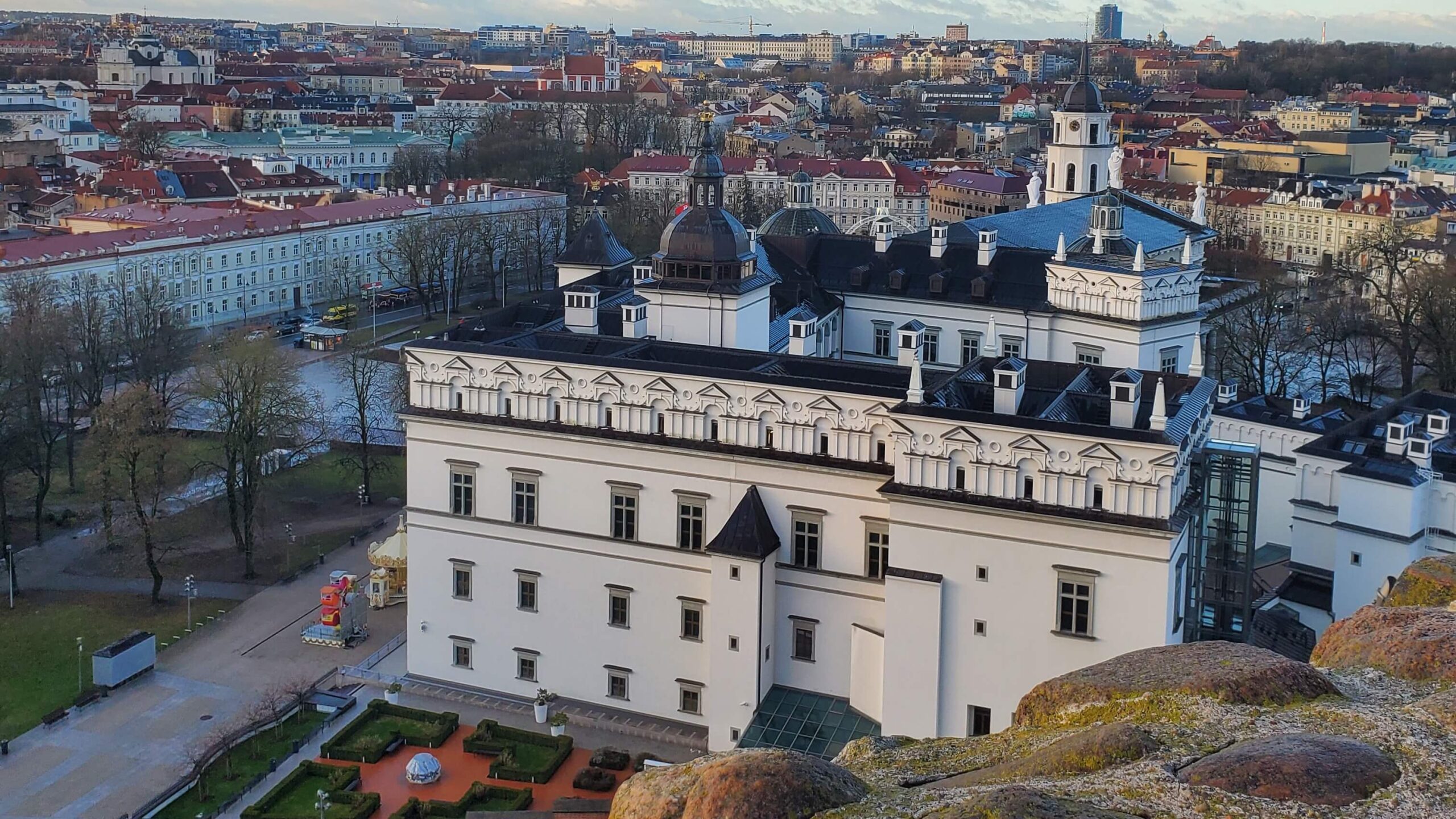
Next to Vilnius Cathedral stands another grand white building: the Palace of the Grand Dukes of Lithuania. You’ll need to buy a ticket to explore the museum inside, but the exterior is free to admire.
An interesting detail I want to bring your attention to is the clock with the golden sun. It’s quite an interesting puzzle to solve. I can’t seem to find 5 o’clock—can you?
On the hill next to the Palace of the Grand Dukes stands an octagonal structure with a Lithuanian flag fluttering atop it. That’s Gediminas Tower, the last remaining structure of the Vilnius Upper Castle.
And it marks the spot where Gediminas saw his infamous iron wolf.
I promised you a free panorama of Vilnius, and they say the views from the hill on which Gediminas Tower sits are spectacular. The only question is: how do you get there? The main path seems blocked off for repairs.
But fear not, fellow explorer! There’s another way.
Simply go around the Palace of the Grand Dukes, where you’ll find a complex of other buildings. On the other side of the hill, there’s another staircase leading upwards for panoramic views of Vilnius.
The climb isn’t very high, but it’s not easy either, as the path is covered with round cobblestones that can be slippery. If you’re worried about that, there’s an alternative: a funicular that can take you to the top. But that isn’t free.
From the top, you’ll spot many Vilnius attractions, like the TV Tower, and you’ll get a great angle of the Palace of the Grand Dukes too.
Let me make a game out of it: count how many churches you can spot. There are 28 churches in Vilnius Old Town (at least, there were when I last checked). You won’t be able to see them all from up here, but let’s see who can spot more—me or you!
Next we’ll walk deeper into Vilnius Old town to see what free attractions are hidden there.
While you’re exploring Vilnius Old Town, you stumble upon a little street adorned with artworks on the walls of surrounding buildings. Come closer and explore!
To those unfamiliar with the backstory of Literatai Street, it might seem like a contemporary art space filled with puzzling pieces—there’s an installation of knives nailed to a wall and even someone’s fake tooth. At first, I didn’t get it either.
Turns out, this wall is a tribute to Lithuanian literature, with each artwork representing a story or an author. Unfortunately, I don’t know much about local literature, nor can I read the words written on the walls, but once you know the backstory, everything clicks into place. Decoding the street art here becomes a fun exercise for your imagination!
Can you get smarter just by walking through a university? I’d say you can if you learn something new about it!
Let’s take a quick walk through the Vilnius University complex to enjoy the charming architecture. One spot I want to show you is the picturesque inner courtyard, with a colonnade and faded portraits and coats of arms adorning the walls.
If you look up, you’ll also see a pale square where part of the facade seems to be missing, revealing a sequence of numbers and characters. What’s that about? If you figure it out, let me know!
Then you walk through a small gate and find yourself in another courtyard of Vilnius University. This one has a special tower adorned with zodiac signs. Seems fitting since this is the Observatory Courtyard. I love the layered, multi-colored look of the buildings here, and the ones in this courtyard are supposedly the oldest in the whole ensemble.
Just a quick stop: we’ve already visited the Vilnius Miracle Tile, but if you need an extra dose of good luck, there’s also a lucky belly you can rub. It’s hidden in plain sight on one of the liveliest streets in Vilnius!
What to See in the Vilnius Independent Republic of Užupis
On April 1, 1997, the residents of Užupis declared their quirky corner of Vilnius an independent republic. Was it a joke? The April Fools’ Day timing might suggest so—but here we are, decades later, and Užupis continues to be celebrated as an unofficial independent republic. With its own president, constitution, anthem, and flag, Užupis embodies creativity and free-spirited charm.
It’s also a stroke of marketing genius for this whimsical part of Vilnius, and I must admit, I’m intrigued. So, let’s “cross the border” and uncover the fun, unconventional attractions Užupis has to offer.
Unless, of course, you see street art as mere vandalism. If that’s the case, you probably won’t find what you’re looking for here—and that’s perfectly fine. As we’ve already seen, there are plenty of other free things to do in Vilnius.
Your introduction to Užupis’ artistic world begins at the border, marked by a sticker-plastered sign. Just beyond it, you’ll meet the Užupis Mermaid, a petite sculpture lounging by the river. Legend has it that she lures visitors into Užupis, and those who fall under her spell may find themselves staying forever.
Beneath the nearby bridge, you’ll find the Swing of Destiny: a chair suspended just above the river. Depending on the water level, you might be able to reach it and swing while contemplating life. However, it seems that today, destiny has other plans—since the water has nearly reached the seat, making swinging impossible for now.
Exploring the Creative Spirit of Užupis: Art, Constitution, Angels, and Cats
From here, you find yourself at a crossroads. Which path will you take?
To the left: Wander along a wall covered in street art and words, leading you to the Užupis Art Incubator. This vibrant space is filled with conceptual street art—some of it I don’t quite understand, some share deep thoughts, and some are downright hilarious. Location
To the right: Discover the Užupis Constitution, proudly displayed on a wall in multiple languages. This manifesto perfectly captures the district’s free-spirited mindset. Location
Straight ahead: Encounter the symbol of Užupis—a majestic angel, having hatched from a metal egg, blowing a horn to proclaim the district’s artistic freedom and revival. Keep walking, and you’ll find a cat perched on a fence, waiting for you. According to local legend, rubbing the cat’s ear will free you from fear—especially the fear of truly living. Location of the cat
And this is where we wrap up our walk and our what to see in Vilnius guide.
Thoughts?
Vilnius is very walkable and very budget friendly – as you can see there are plenty of free things to do in Vilnius. Which makes it a perfect weekend city break filled with quirky art and historic landmarks. I enjoyed my stay here and I hope my guide on what to see in Vilnius for free will help you plan your own Vilnius itinerary.
Planning a day trip to Talsi and Sabile? In just one day, you’ll tick off nearly every box on a “classic Latvia day trip” bucket list. Want to climb an observation tower for a bird’s-eye view over the treetops? Talsi’s got you covered. How about a tiny but charming waterfall? Yup, it’s here too. A peaceful stroll on a picturesque promenade? Of course! And let’s not forget the famous photo spot with gigantic buttons on the wall – an Instagram moment waiting to happen.
Ready to hit the road and uncover what to see in Talsi and Sabile? Let’s go!
Warning: Parts of the drive that are near Sabile are off-road (dirt paths, sand, rocks), so please evaluate if your car is fit for this route beforehand. If it isn’t you could just visit Talsi.
What to See in Talsi?
Talsi’s main attractions are nestled in the heart of the city, among its iconic hills. Each hill is marked with a sign, so if you’re up for a fun challenge, why not play a game of “catch them all,” but with hills instead of Pokémon? For the highest viewpoint, let’s head just outside the city to Kamparkalns, where you can enjoy an elevated view and a breathtaking panorama of the surrounding landscape.
The 28-meter-tall wooden observation tower offers fearless travelers a stunning view, stretching across a sea of treetops. To help you navigate, informative signs at the top point you towards various landmarks in the distance, making it easy to appreciate the surrounding landscape.
What to See On Talsi Promenade? Lake Views and Latvian Sun
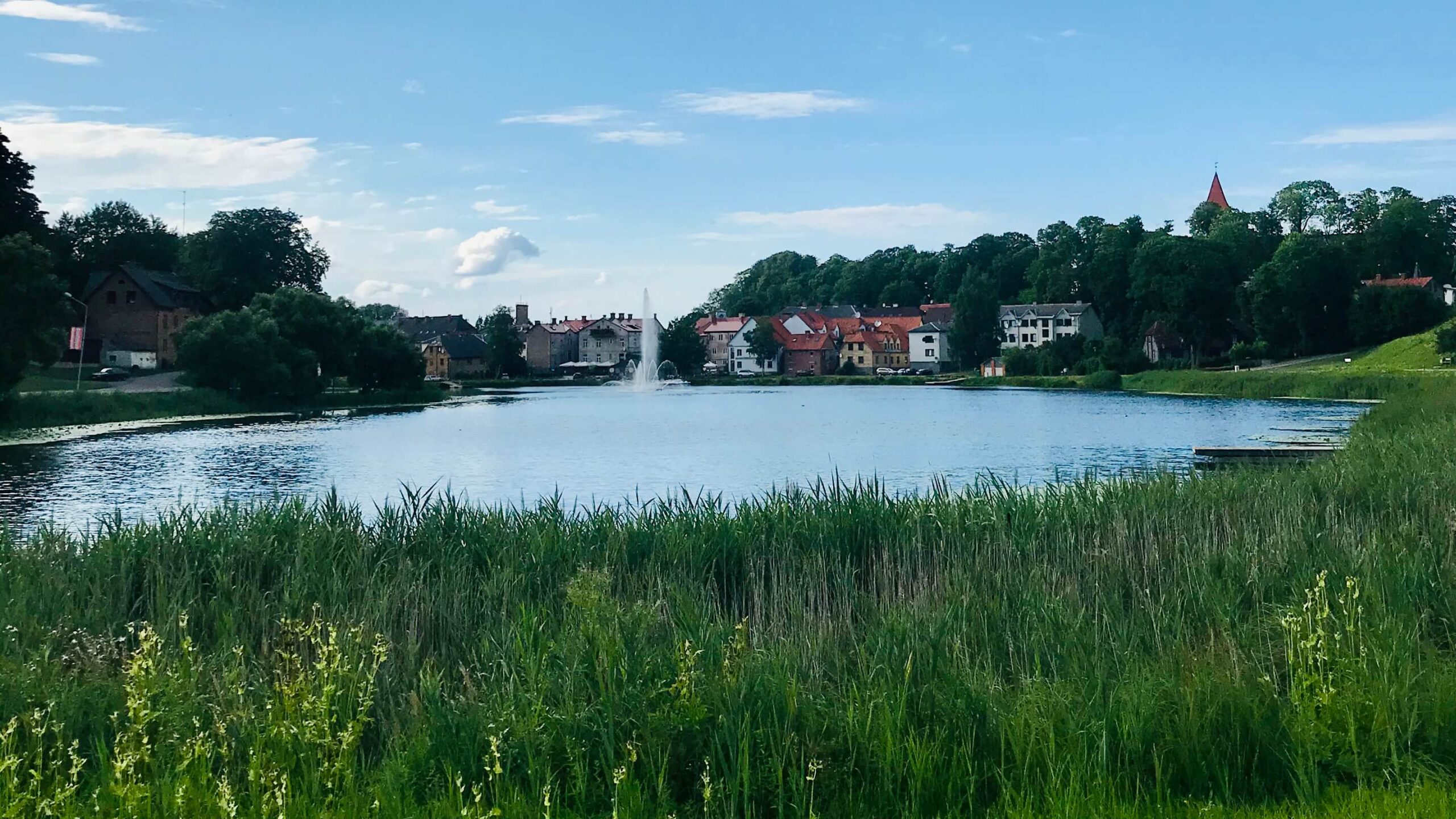
On one side of the lake, a charming wooden boardwalk invites you to take a leisurely stroll, offering a scenic view of the fountain and the picturesque houses of Talsi on the opposite shore. Speaking of pictures, the promenade also showcases a variety of artworks by different artists, each with a unique style, all portraying the beauty of Talsi.
On the opposite side of the lake, you’ll find an intriguing environmental art installation known as the “Sun of Latvia.” Be sure to take a moment to closely examine the golden sphere — if you look carefully, you might just spot the outline of Latvia hidden within its design.
Giant Buttons: a Slice of Talsi’s Quirky Charm
And of course, no Latvia road trip would be complete without stopping for a photo op! Not only does the town boast nine iconic hills, but it’s also home to nine vibrant, oversized buttons. These colorful buttons can be found on the wall of the Talsi Tourism and Active Leisure Center, right next to the lake – a perfect spot for a fun and quirky photo..
Don’t Forget Talsi Church – Majestic in Its Simplicity
I would say – take a moment to admire the beautiful carvings above the door, but in truth, the entire white church with its sharp spire is stunning. At first glance, it may seem rather simple, but a closer look reveals many intricate details that add to its charm.
What to See Around Sabile?
This time, we’re focusing on the sights around Sabile rather than the town itself – an open-air art park and a charming little waterfall. But if you haven’t explored Sabile yet, You can always check out the town as well. One spot you might want to visit is the quirky Sabile doll garden. It used to freak me out as a child, but now I find it quite intriguing.
This waterfall is relatively small—one might even call it tiny—with water gently cascading over stone-like steps (which I believe are rock layers?), creating delicate streams. Thanks to a dry summer, the flow isn’t as strong as the photos on Google might suggest, but the landscape remains charming, with water carving its way over the textured rocks.
Just a heads-up: be cautious when approaching, as the stairs can become slippery in wet conditions, and a few steps may feel a bit wobbly. Despite this, it’s a peaceful, picturesque spot that won’t take up too much of your time!
A Chance to Train Your Imagination: Pedvāle Art park
I’ll be honest – this place might not be everyone’s cup of tea. My grandma for instance would just see a stick that is stuck in a stone. But for me, abstract art has a special charm. It invites you to engage your imagination, to ponder what the artist had in mind, and to share different interpretations with those around you. Is that pile of rocks a glass mountain, or something else entirely? And do you see a city in that metal sculpture? Essentially, this vast meadow is home to a variety of environmental art pieces, most of them crafted from stone and metal, each one offering a unique experience to those who take the time to look closely.
This Talsi-area itinerary is best suited for travelers who enjoy man-made attractions with a touch of nature, rather than those seeking untamed wilderness hikes. Talsi exudes a peaceful, quiet charm that feels like a gentle escape from the hustle and bustle.
In theory, you can cover everything in one day if you’re an early riser starting from Riga. But if you prefer a slower, more relaxing pace, consider splitting the journey. Dedicate one day to exploring Talsi, another to Sabile, and spend the night unwinding at a cozy campsite in between. It’s the perfect way to enjoy the best of both worlds!
What Else to See in Kurzeme togather Talsi and Sabile
What’s worth seeing in Rauna? You could spend hours at Rauna Staburags, watching tiny streams of water trickle down its moss-covered surface. But this natural wonder is just the beginning. Rauna offers so much more—impressive castle ruins, the mysterious Rauna Devil’s Cave, scenic nature trails, and other charming surprises.
And the town itself? It’s a hidden gem of Latvia—pristine, thoughtfully maintained, and a pure delight to stroll through.
So, lace up your walking shoes and join me on an adventure to uncover the treasures of this hidden gem of Latvia!
Rauna, like many Latvian towns, boasts its own Devil’s Cave, and this one carries a sense of intrigue. According to a nearby information sign, the cave was once buried and later excavated, which might explain why it isn’t as well-known as others. And true to its mischievous name, this cave enjoys playing tricks on unsuspecting visitors like you! At first glance, it appears small and unassuming.
But take a few steps in, round the corner, and a hidden chamber suddenly opens up—larger and more enchanting than you’d expect.
The Nature Trail Winds Further
Actually, the Devil’s Cave is part of the Health Trail, a scenic path that winds through the forest and leads to another intriguing spot—the Old Water Mill. Unfortunately, we’ve arrived during the height of summer, after weeks of relentless +30°C heat, and it seems the water levels have suffered. A modest trickle flows through one corner of the mill, leaving the rest bone-dry. It’s easy to imagine how much more impressive this spot would be during wetter seasons like spring, with the mill brought back to life by gushing streams.
From here, the trail is said to continue all the way to Rauna’s center, offering even more to explore. But, as we haven’t done our research, we decide to turn back here. What lies further down the path? Perhaps that’s a mystery for your adventure to uncover!
Had we followed the Health Trail, the White Cliffs would undoubtedly have been one of the highlights along the way. But lucky for us, these charming cliffs are also easily accessible from Rauna’s town center. Near the arched bridge over the Rauna River, the pale sandstone formations rise elegantly on the opposite bank. Their soft, milky hue makes them stand out among Latvia’s more common sandstone cliffs.
And the area near the arched bridge, where the river meanders peacefully, holds its own quiet charm. It’s the kind of spot that practically invites you to pause for a quick photo—or simply soak in the serene beauty. Whether you’re exploring the trail or just passing through the town, this is a stop well worth making.
I’ve explored my fair share of medieval castle ruins, but the Rauna Castle Ruins truly stand out. Their size and height are remarkable, setting them apart from many of the Livonian castles scattered across Latvia. Unlike other ruins, which often feel more like outlines of what once stood, these retain significant portions of their towering walls, offering a vivid glimpse into their former grandeur. While entry into the ruins is prohibited for safety reasons, they are undeniably impressive, even from the outside.
Nearby, informative signs bring history to life, detailing the layout of historical structures like the old dairy house and the original cobblestone paths. As you take it all in, you’re treated to a picturesque view of the white Rauna Lutheran Church and the charming town below.
The castle’s surroundings are just as enjoyable. The well-maintained area includes a playground, skatepark, football field, and a serene pond with a fountain at its center. A whimsical road sign warns of ducks, and if you’re lucky, you might spot a family of them paddling happily around—or catch a glimpse of the large fish gliding beneath the surface. It’s a delightful mix of history and modern-day charm.
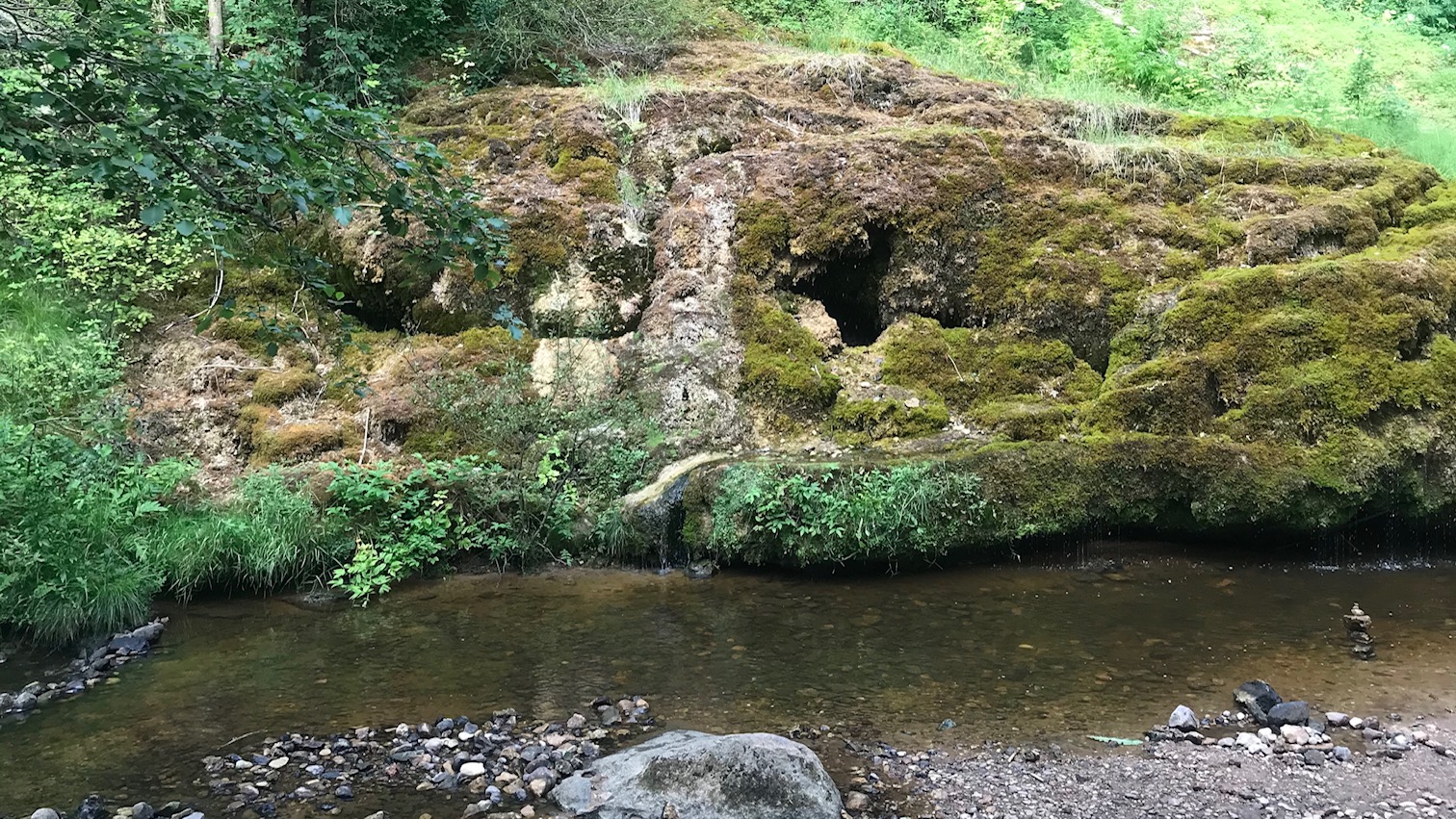
Rauna Staburags immediately captivates anyone who sees it. Water cascades over the moss-covered rock in countless delicate streams, creating a mesmerizing, almost otherworldly scene. At first glance, it seems as if the water flows through tiny holes in the rock, but on closer inspection, you realize it’s an optical illusion—the water glides effortlessly over the lush, green surface of the moss.
This is a place that soothes the soul. It’s easy to lose track of time here, meditating on the tranquil flow of water or focusing your attention on stacking stones to create a tower that would accompany many of its kind made by other travelers. Building these towers is no easy feat—it demands patience and balance, with each stone carefully placed to keep the tower standing strong.
However, let’s all do our part to protect this natural treasure. Admire its beauty with your eyes, but resist the urge to climb or touch the rock. Preserving its delicate ecosystem ensures this unique wonder remains just as breathtaking for future visitors to enjoy.
What are your thoughts?
Oh, It has been a couple of years but I can’t stop thinking about magical Staburags. It may be my favourite waterfall. And it turns out that there are many more hidden gems here. So I truly and wholeheartedly recommend visiting Rauna if you wish to get off the beaten path.
So you’ve ticked off all the must-see attractions in Sigulda Latvia. What now? We always knew there was another side of Sigulda—a hidden, untamed beauty—waiting for us to explore. Yet, somehow, time had never been on our side. Until now. This time, we’ve set out to uncover Sigulda’s lesser-known treasures: Kraukļu Hill Cave and Peter’s Cave, tucked away in the enchanting Vējupīte ravine. Imagine a lush forest valley with dramatic cliffs, babbling streams, and trails that twist and turn, leading you up, down, and deeper into nature’s embrace.
Put on your hiking shoes and let’s explore the hidden gems of Sigulda Latvia together!
We park by the roadside, excitement already building as we spot the marker pointing us toward Dauda Waterfall hiding in the woods of Sigulda. With the trail clearly laid out, we set off, anticipation growing with every step. Soon, the soft gurgle of water reaches your ears. This is it! So naturally, we veer off the path, following the sound with eager steps.
And there it… is?
In front of us is a little cascade, doing its best to impress. I pause, squinting at it. Sure, Latvia doesn’t have towering waterfalls like Croatia, but this? It looks more like a leaky water pipe. I can’t help but wonder if someone discovered the perfect angle to make this humble trickle seem grand in photos.
But something feels off. Out comes Google, and as I scroll through the pictures, the truth becomes clear. The real Dauda Waterfall is taller, grander, and… definitely not this.
This might actually be a broken water pipe!
Back on the trail, our determination is renewed. A few minutes later, the sound of water shifts—deeper, stronger. Our pace quickens, and then, just around a bend, we see it. The 2.4-meter-high Dauda Waterfall cascades gracefully down the rock wall, exactly as the pictures promised.
My only regret? Not seeing it in winter. When Jack Frost weaves his magic, these flowing streams are said to freeze into breathtaking icicles, turning the waterfall into a crystalline masterpiece.
Next, we need to hop in the car, as our next hidden gem in Sigulda Latvia is a quick drive away.
Less Known Walking Trail in Sigulda: The Sateseles Spring Trail
Our goal is to explore two caves, which we’ll reach soon enough, but honestly, I wasn’t expecting the journey to them to be this captivating. As we wander, you spot a sign for Sateseles Spring. Curiosity piqued, we glance down and are met with a long, twisting staircase descending deep into the earth, winding alongside a striking red-orange rock wall. At the bottom, a small pipe releases the spring’s fresh waters, trickling gently.
As we wander forward, the path opens up before us, revealing a breathtaking view of treetops stretching out below, a sea of green. And there, suspended from a sturdy tree branch, is a swing—perfectly placed, as if inviting us to sit and take in the beauty of the landscape of Sigulda.
From here, the trail continues into the forest, where more stairs wind their way through the trees, leading us toward Vējupīte river and more stunning natural wonders.
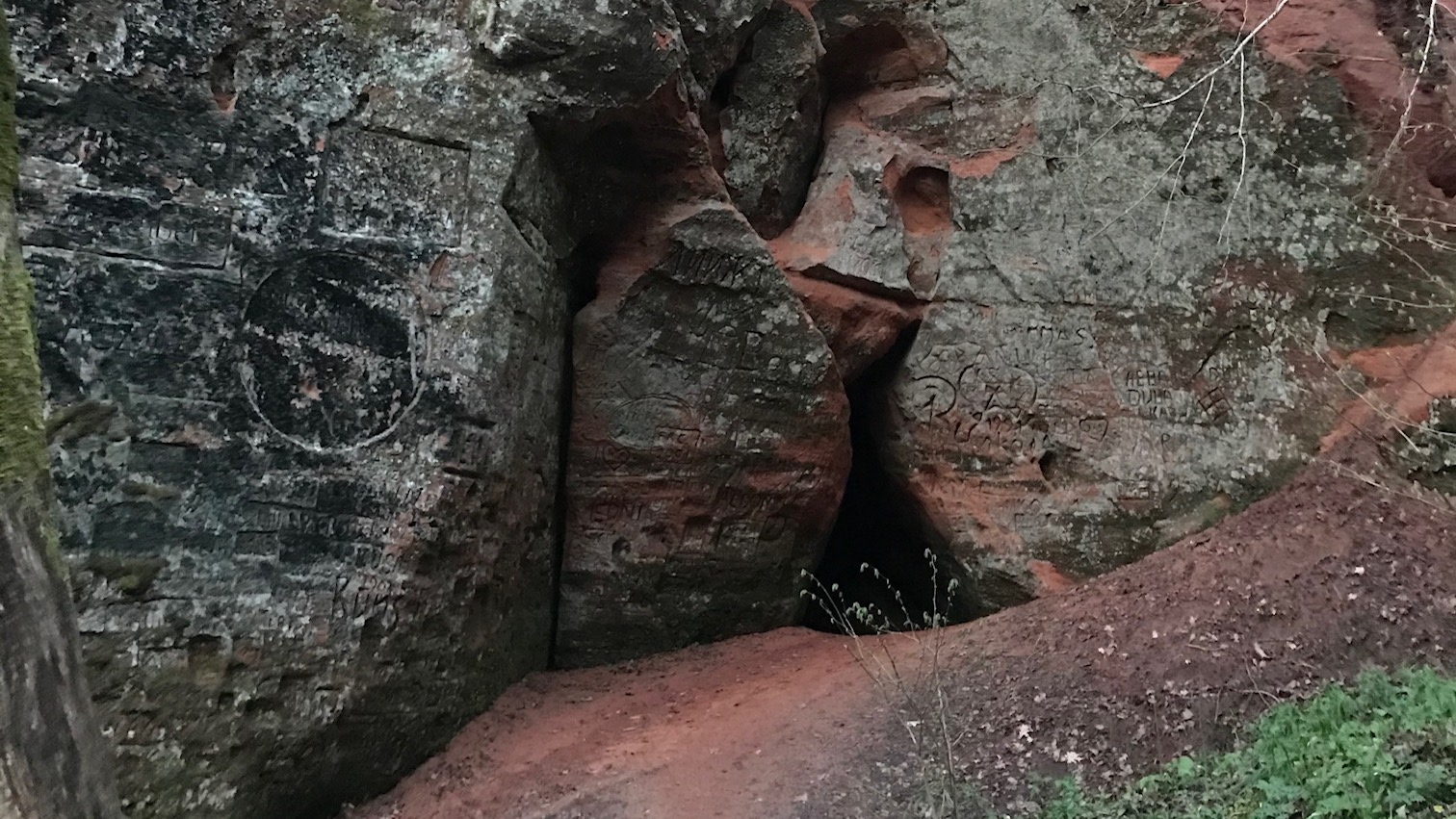
While everyone knows Gūtmaņa Cave, few venture to Kraukļu Hill Cave in the Raven Gorge. Tucked into vibrant orange cliffs, this cave feels like a secret that Latvian town of Sigulda keeps for its most curious explorers.
The cave is a striking sight, its cliffside resembling a half-haphazardly folded fabric, with deep folds and wrinkles marking its surface. The mix of orange and grayish-blue hues on the facade is absolutely stunning, though the walls bear the scars of countless visitors, each unable to resist carving their names or dates into the soft sandstone.
Just nearby, a set of stairs invites us to ascend toward Paradīze Hill, known for its sweeping views. Unfortunately, with the sun sinking low, we’ll have to cut our visit short. But we’re not done yet. We have one more of Siguldas less-known sights waiting for us.
Following the trail deeper into the ravine, we navigate wooden pathways, sandstone cliffs, and dense trees.
Along the way, a whimsical surprise awaited us—a tiny gnome statue nestled into a cliffside alcove. It’s equal parts charming and haunting, like something out of a movie where statues come to life after dark. Fingers crossed it will be in the same place when we come back!
Then we reached Sigulda’s Pēterala. It looks like a narrow, vertical crack carved into the sandstone wall. It’s as if a giant had thrown an axe, and this jagged opening is all that’s left, a striking mark on the stone.
And with that our Sigulda Latvia adventure is over, so let’s hurry to the car while the last rays of the sun still light our way. With so many stairs and trails this is not a place to be in the dark.
And what are your thoughts?
I wonder how many staircases we conquered today? Anyways, Latvian town of Sigulda has a magical way of surprising you at every turn. Between the natural beauty, the sense of discovery, and the physical challenge of climbing all those steps, it’s an unforgettable experience. If you’re looking for an adventure off the beaten path, these lesser-known spots in Sigulda Latvia are calling your name.
Sigulda is brimming with natural wonders. Our ~14km route for hiking in Sigulda covers only part of cities most famous attractions, but trust me, it’s more than enough to leave you breathless. Both from the stunning beauty and the effort of the hike! Along the way, you’ll sweat it out, but your hard work will be rewarded with breathtaking views over treetops, dramatic cliffs, and an abundance of fresh, crisp air. And, of course, no hiking trip in Sigulda would be complete without a visit to the legendary Gūtmaņa Cave—one of Latvia’s oldest and most iconic tourist attractions.
Before attempting to hike Sigulda in winter please carefully evaluate your abilities as the paths can be very, very slippery in snow. I felt it multiple times and there was a place where the only way down the hill was by sliding on my but. In other seasons the trail is much more manageable. Also what you could do is explore the attractions in chunks and reduce the distance by driving between the furthest points.
So if I haven’t yet scared you away – let’s start our winter hiking in Sigulda.
We started our Sigulda hiking with a stunning view over the treetops, where the distant horizon blurs into a soft mist—one of those quintessential sights that immediately comes to mind when you think of Sigulda. As the name suggests (Keizars = ruler), the view truly feels fit for a king. But it’s also the perfect spot to quietly sip tea or coffee, letting your gaze wander over the river as it winds its way below.
Note: Here, we accidentally chose the more dangerous route, heading down a steep mountain that was especially slippery in the winter, making our way along the river towards the Devil’s Cliffs. According to Google Maps, there’s an alternative option to reach the rock formation—taking the road to the Pedestrian Bridge over the Gauja River, and then following a path from the bridge to the cliffs. This route might be a safer choice, so when your hiking in Sigulda I’d recommend trying that instead!
Siguldas Devil’s Cliffs and the Walk by Gauja River
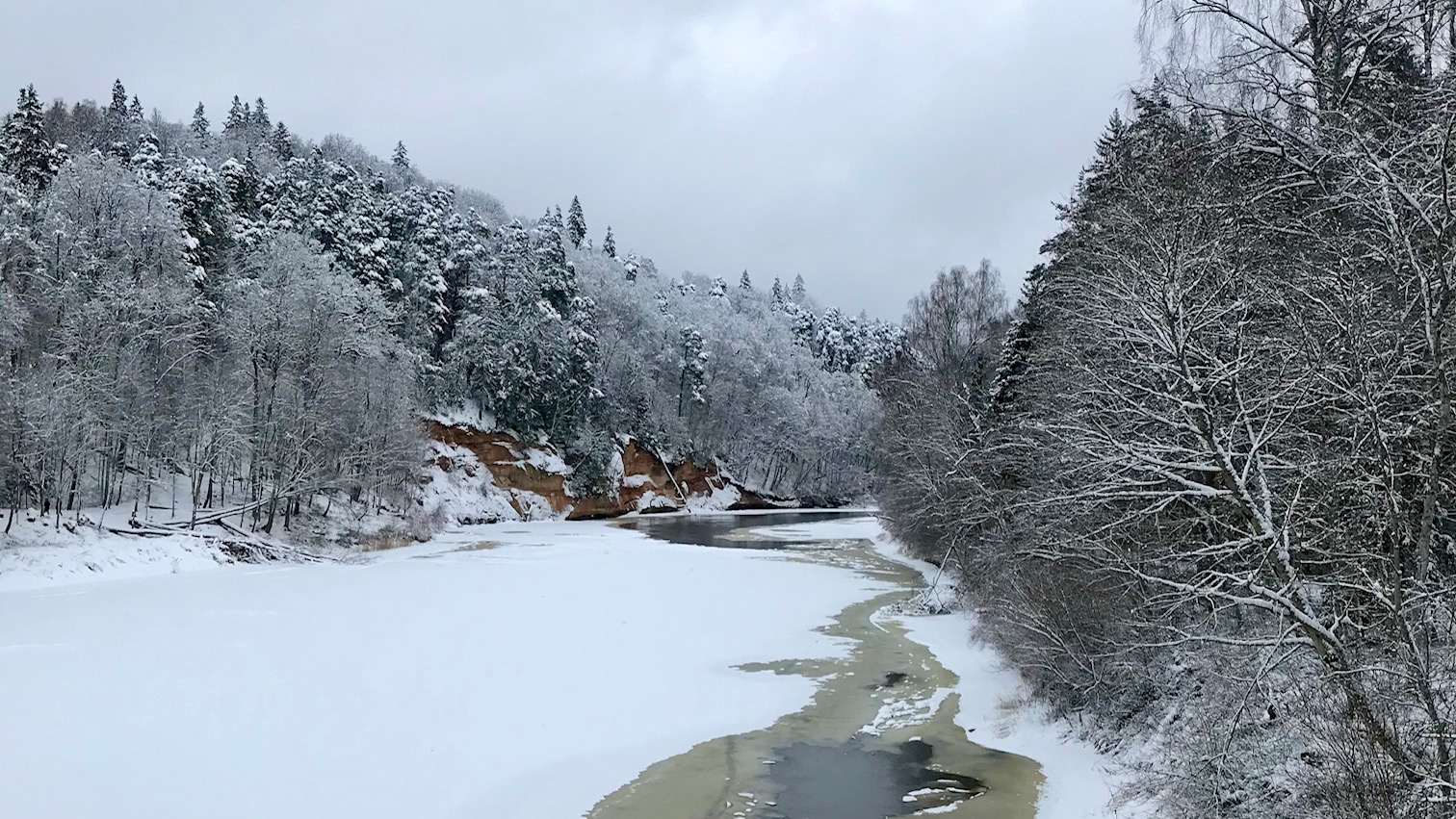
For a while, we enjoy the serenity, walking along a beautiful forest path by the river, the snow crunching beneath our boots. Soon, we reach a picturesque spot where, across the Gauja, you can see orange-brown cliffs rising from the landscape. Hidden within them lies the Devil’s Cave, an ancient cult site shrouded in mystery. Though we can’t get close to it, the thought of its hidden presence adds to the allure of the place. And, of course, the view is stunning.
The main purpose of the bridge is to help people cross the river, but often these bridges are beautifully designed and highly photogenic—and the Siguldas Pedestrian Bridge over the Gauja is no exception. Especially in the snow when everything is covered in white.
I can’t quite remember where I first heard it, but when I was a child, someone told me that the first time you cross a bridge you’ve never walked over before, you can make a wish. I’m not sure if it’s true, but it certainly doesn’t hurt.
Next, we continued along the other side of the Gauja, following the Piķene valey trail. The path winds through a forest, with rock outcrops appearing on one side. If you keep a careful eye out, especially in winter when the temperatures really dip, you might spot a small frozen waterfall, its ice forming delicate icicles. Further along, you’ll find the Little Devil’s Cave, recognizable by its column-like formation that divides the cave’s entrance in two.
Note: This place was super slippery in snow
After a substantial walk, we reach a road crossing and are faced with a decision. One sign points towards the Bridge over Gauja, leading us back to the other side of the river, where we could visit Sigulda’s New Castle or the Ferris wheel. The other path would take us towards the Krimulda castle ruins.
We opted for the Krimulda Castle, but I have to admit, it turned out to be the most underwhelming stop of the entire hike as not much remains of the castle. To heal our broken hearts, we decided to press on to the iconic Gūtmaņa Cave, knowing it would make up for the disappointment.
Can You Imagine Hiking in Sigulda Without Stopping at Gūtmaņa cave?
I’ve visited this cave at least 10 times, but each time, I’m still surprised by just how large it is. The walls are covered with thousands of markings, scars left by centuries of visitors.
Among the many inscriptions, you can spot names, dates, and even some that commemorate various schools. Apparently, there was a time long ago when the cave wasn’t protected, and people could pay to have their own engraving carved into the walls. It’s fascinating to think about how this place has witnessed so much history and is possibly the oldest tourist attraction in Latvia.
It’s time to start our journey back, following the shortest route on the map. But considering the distance we’ve already covered, it’s not exactly a quick return!
However, if you’re up for some extra cardio, there’s one more stop to make: the famous Ferris wheel and the iconic letter “S”! To reach them, we must conquer the dreaded stairs of doom. But the climb is worth it, as we’re rewarded with stunning panoramic views and the perfect photo opportunity to commemorate our hike through Sigulda. But now – back to the car!
Thoughts?
This hiking route in Sigulda wasn’t easy, but we made it—and what an experience it was! Seeing the city in the winter palette of whites and grays gave it a completely new feel. It’s as if Sigulda transforms with each season, making it a place you’ll want to return to again and again. But fair warning—it’s not for the faint of heart! You’ve got to have a passion for hiking to truly enjoy this adventure
We use cookies to ensure that we give you the best experience on our website. If you continue to use this site we will assume that you are happy with it.