Author: ArmandaG

  • What to See in Diocletian’s Palace in Split? Self Guided Walk

    What to See in Diocletian’s Palace in Split? Self Guided Walk

    Today, we’ll be exploring Diocletian’s Palace in Split—a place that is both in ruins and alive at the same time. How is that possible, you may ask? The boundaries between Split’s old town and the former Roman emperor Diocletian’s palace are very blurry. One might even say they’re non-existent. After the emperor’s grand retirement home was heavily damaged, former inhabitants of the nearby Solin built new houses within the ruins of the palace, incorporating parts of the old structure into their new buildings.

    Many centuries have passed, but even today, in Diocletian’s Palace, you can see ancient ruins blended with living houses, lively cafes, shops, and bars. So, let’s explore it together!

    P.S. I’m not a historian, just a regular tourist. I find my facts on the internet, so feel free to suggest corrections if I get something wrong!

    Make sure you increase the video quality in settings for the best viewing experience 😉

    !!!! This is a 360 video, so you can drag the screen around when the video is playing and the camera will move around to show you different angles. Also you may need to adjust the quality of video to higher in video the settings.


    Cost: Outdoors areas listed are free. If you wish to go in cathedral or in museums, you would have to purchase entrance ticket for those.


    Length: Took us ~1,5h to explore and wonder


    How to get there: If your close to center – walk. If your further take public transport.


    What to see in Diocletian’s palace:

    Discovering Diocletian’s Palace’s Dark Basements

    Location

    We enter the palace through its dark basements. It’s spacious, with massive columns supporting the stone ceiling. Here, you won’t find elegant detailing; everything is rough, stained, and a little spooky. This was once where prisons stood and persecutions took place.

    Diocletian's Palace basement

    And here’s a fun fact: for a time, the basements of Diocletian’s Palace were used for discarding waste and sewage. Ironically, this is said to be the reason they’re so well-preserved.

    Diocletian's Palace Cellars

    Daytime Splendour at the Grand Peristyle Square of Diocletian’s Palace

    Location

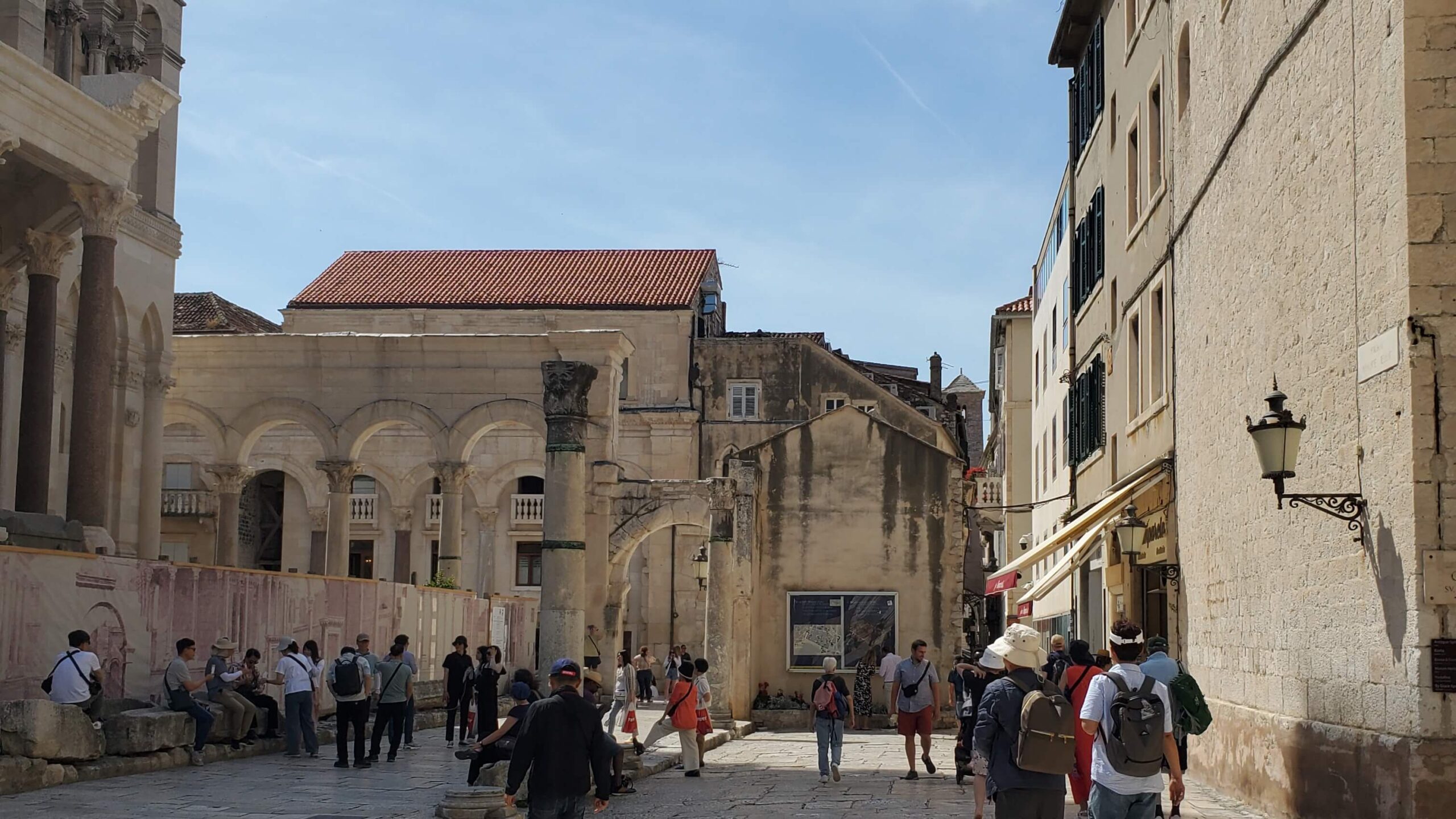
    Next, we head to what I call the heart of Diocletian’s Palace—the Grand Peristyle, also known as the main courtyard where the emperor used to entertain his guests.

    Inside the palace, it’s not uncommon to see a piece of stone with inscriptions or a freestanding column fragment. These ancient relics fit organically into the ruin-like scene. And yet, somehow, modern-day ice cream shops and bars blend in too.

    The column surrounded peristyle is breathtaking, with so many intricate details and the St. Domnius church tower rising above it. No wonder there are soooo many people here!

    Diocletian's Palace peristyle

    We had an honest debate about what came first—the grand columns or the building with little balconies that seem to incorporate them into its exterior. I am guessing the columns. Anyways, it is really cool.

    And randomly—there’s a sphinx here! If you are wondering, yes, the internet confirms it came all the way from Egypt.

    Sphinx in Diocletian's Palace

    Nighttime Adventures at the Grand Peristyle Square of Diocletian’s Palace

    During the day, you might catch a historical dance performance in the peristyle. But the party doesn’t end when the sun sets. In the summer, you might stumble upon live musical performances here.

    Diocletian's Palace at night

    There’s something magical about sitting on centuries-old staircases under the stars, listening to live music on a warm summer night. If you’re into adult drinks, the nearby bar lets you enjoy the tunes with a cocktail served right on the palace’s peristyle steps.

    I don’t drink, so I can’t tell you about the prices, but I definitely enjoyed the vibes.

    The Historic Cathedral of St. Domnius in Diocletian’s Palace

    You never know how destiny will play out.

    What was once Diocletian’s mausoleum has now become a Christian church named after St. Domnius, a saint Diocletian himself persecuted.

    The exterior’s most beautiful feature (in my opinion) is the detailed bell tower. You can climb it and visit the cathedral if you purchase an entrance ticket. 

    St. Domnius Cathedral, Split

    The Skeleton of Former Glory – Vestibule (Rotonda)

    Location

    While exploring you hear a faint sound of someone singing.It sounds a bit like a church choir, but it’s not coming from the church. It’s likely the a cappella singers in the vestibule.

    But it is a bit hard to find it if you are looking for a rounded building as it doesn’t appear to be rounded from the outside. So by the time we came across it the singers were already gone, and all that was left was the tips box. Better luck next time! But it doesn’t stop us from exploring the Rotonda itself. 

    The vestibule is a round hall built of bricks. If you look up, you’ll see that the dome which once covered it is long gone, leaving a circular opening that reveals the sky.

    Diocletian's Palace vestibule

    This room once served as a transition from the peristyle to the emperor’s private apartments. This is not how it used to look back then though. It is said to have statues, mosaics and marble slabs. Now, all that’s left are the bare bones, but its shape is still intriguing. And don’t miss the intricate details on the entry gate!

    Vestibule Gate decorations

    Split’s Old Town Streets in Diocletian’s Palace’s Belly

    It feels like every time you walk around Diocletian’s Palace, you discover another charming little street you hadn’t seen before. The winding pathways between the houses are perfect for exploring.

    At many points during your visit, you’ll face a choice of which direction to take, as there are often multiple paths. It’s hard to predict where they’ll lead, so my advice is to follow your heart. The path will definitely take you somewhere interesting.

    Split Old Town

    On one turn you find someone’s laundry drying on a wire. Behind the next there may be a lively restaurant (there are a lot of those here), or a little garden or just some historic houses overgrown with ivy.It’s fun no matter what!

    By just wondering is how we found this great photo spot of the bell tower.

    Split Old Town

    Step Outside Diocletian’s Palace to Meet Gregory of Nin

    Location

    Looking through the Golden Gate, you’ll spot a tall statue surrounded by people. Many of them are engaged in an unusual activity—rubbing the statue’s toe. What’s going on here?

    This is the statue of Gregory of Nin, a Croatian bishop who introduced the Croatian language into religious services, forever shaping Croatia’s religious landscape. Rubbing his toe likely began as a sign of respect, but today it’s believed to bring good luck.

    Gregory of Nin in Split

    Meet the Roman Soldiers by the Golden Gate

    Location

    Looking to snap some fun travel photos to send to your friends? Then approach the Roman soldiers guarding the Golden Gate (or those at the peristyle). Don’t worry—they’re friendly and work for tips.

    You’ll get three poses: the polite one where everyone smiles, the one where you’re ready to attack, and the one where you’re doomed, with the soldiers at your throat. All in good humour, of course!

    Me and my new friends

    But while you’re having fun with your new friends, don’t forget to check out the Golden Gate itself. Built as the main entrance to Diocletian’s Palace, it’s quite grand.

    There is also a detail many may miss. If you stand beneath the gate and look up, you’ll see monstrous heads carved into the bottom of the decorative blocks.

    Split Golden Gate

    Thoughts?

    Whether you’re here to learn, explore, or simply enjoy the atmosphere, Diocletian’s palace will leave you with lasting memories. After all, where else can you see such an intriguing blend of the ancient, the old and the new?

    Kravicas ūdenskritums Bosnijā un Hercegovinā

    View my full Croatia – Bosnia and Herzegovina itinerary
  • A Visit to the Latvian Ethnographic Open-Air Museum

    A Visit to the Latvian Ethnographic Open-Air Museum

    What was life like for Latvian farmers in rural areas a couple of centuries ago? If you don’t know the answer, the Latvian Ethnographic Open-Air Museum may be an eye-opening experience for you. It certainly was for me.

    So, come along for a walk through a peaceful forest where Latvian homesteads, churches, and other buildings from the 17th to 20th centuries have found their forever home. Much like wise old grandmas and grandpas, they have countless stories to share.


    Cost: Have to purchase ticket. View prices and working hours.


    Length: We walked ~5km and spent a bit more that 3h there (including food pause), but we didn’t check out everything


    How to get there: Public transport (buss) or driving.


    Similar experiences: Jurmala open air museum, Ventspils open air museum, Kuldiga museum


    What to see in Latvian Ethnographic Open Air museum:

    Life Before Electricity

    Latvian Homesteads in the Ethnographic Open-Air Museum

    The setting couldn’t be more idyllic. You are walking through a lush forest, and one by one, beautiful old wooden houses with straw roofs, overgrown with bright green moss, come into view.

    Houses in Latvian Ethnographic Open-Air museum

    Although these buildings were born in different times, sometimes even centuries apart, and were brought to the Latvian Ethnographic Open-Air Museum from various places around the country, being here today makes one feel like they are in a little village frozen in time.

    Shall we peek inside? Absolutely!

    What’s Special About Churches in the Latvian Ethnographic Open-Air Museum?

    You’ll notice it as soon as you step in. No, it is not the pleasant aroma of old wood that hits you. No, it’s not the intricate woodwork detailing around the window arches or the statues on the pulpit, although they are all honourable mentions.

    It’s the stunning painted wooden ceiling. Above you is a sky filled with fluffy clouds and angels watching over you. It is very impactful. Can you imagine this room as it once was, illuminated by the flickering light of candles and a church choir singing? I get goosebumps thinking about it.

    Church in Ethnographic Open-Air museum of Latvia

    After you have soaked this in for a while, it is time to move on. There is still a lot to explore. Here’s a tip: when you visit other churches in the museum (and yes, there are several), keep your eyes open for a ceiling adorned with hundreds of painted stars and listen carefully to hear some organ music.

    A Fun Game Called “What Is That?”

    On our journey through the Latvian Ethnographic Open-Air Museum, let’s play a little game. I will point out an object, and you have to guess what it is. Though I am not a historian or an anthropologist, I am your everyday tourist, so I might get something wrong as well.

    Come on! Let’s try it. What is that?

    Wood plank with a hammer

    I don’t know the official name, but I believe it is a thing you use to call everyone who’s out and about home for a meal. So, like an early version of an alarm or a pager?

    The Houses in the Latvian Ethnographic Open-Air Museum Are Sisters, But Not Twins

    Next, we wander into one of the many family houses.

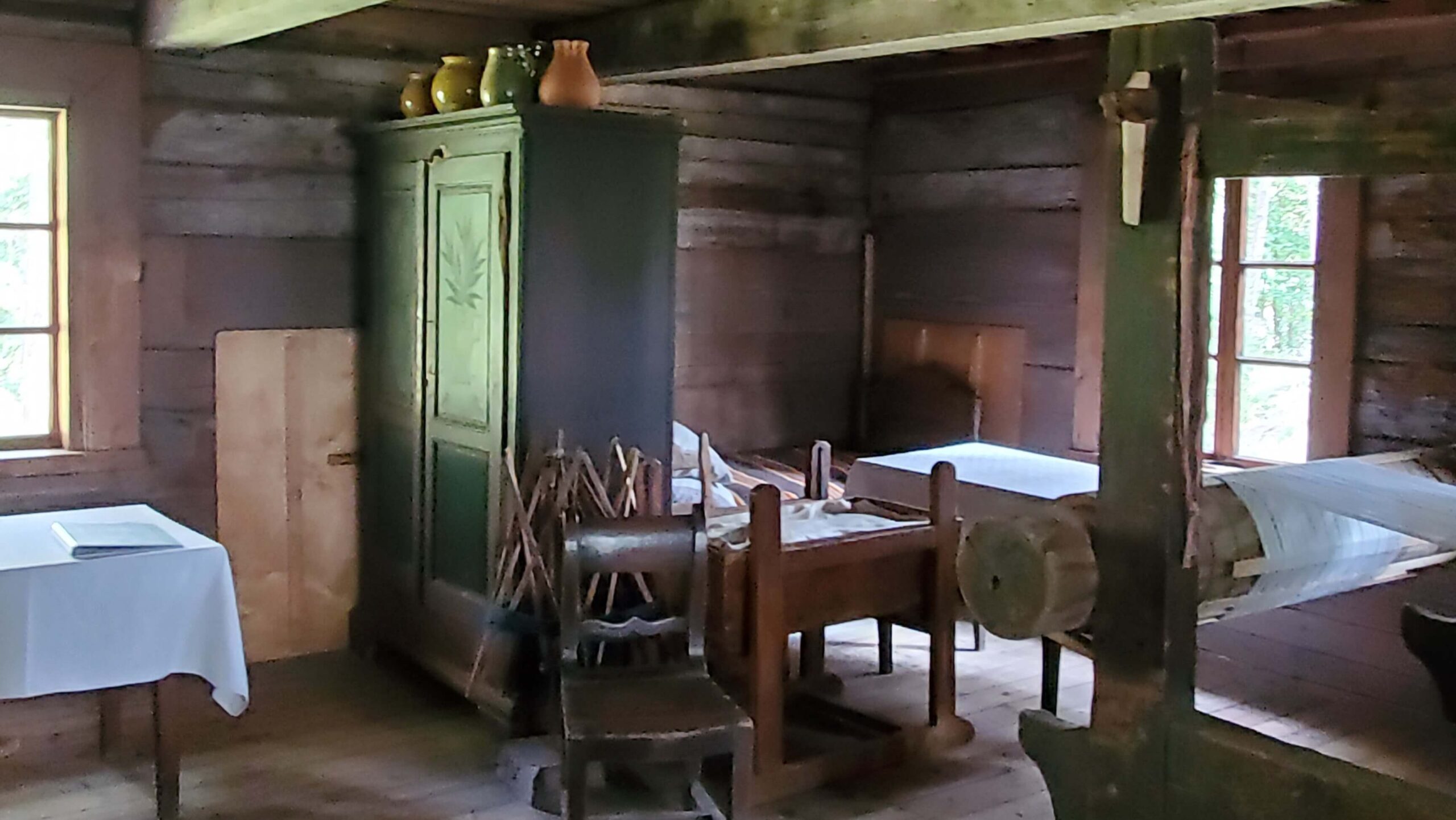
    The living space is quite compact. Families used to eat, work, pray, and sleep all in one large room. This makes sense, as a smaller house was easier to keep warm during those harsh Latvian winters.

    A home in Ethnographic Open-Air museum of Latvia

    Although nowadays this setting with the rough, exposed wood walls, clay pottery, and beautiful old cradle looks quite romantic, life back in the day was hard with no running water, no electricity, and only as much food as you were able to collect to survive the winter. To be honest, real-time travel isn’t something I dream of!

    As I mentioned before, in the Latvian Open-Air Museum, there are many homes to visit. And with each house you peek into, you start to notice the differences. A richer house may have a wooden floor. A poor man’s house would have only cold rock to step on.

    And there are regional differences too. Here is a fun fact from one of the Open-Air Museum employees to prove it: Only in Latgale did people sleep on top of wood-burning stove walls to keep themselves warm. Bet you didn’t expect that? Or maybe you did, as you may find references to that in folklore (I think).

    Top of the woodburning stove
    This is what I mean with a top of woodburning stove

    What Is That?

    A chest full of colourful clothing

    It’s the ancestor of today’s closet—the dowry chest. Filled with goods some very handy lady crafted in preparation for her married life.

    In the old storage house, you’ll find a whole collection of these adorned with various paintings.

    Not Only Homes Tell Stories

    Schools, saunas, and barns in the Latvian Ethnographic Open-Air Museum have something to say too. Are you willing to listen?

    Latvian Sauna House Traditions

    The sauna has always been important in Latvian culture and traditions. It wasn’t only the place for washing up. It was the place where new life came into the world, as well as the place where it all ended, as that’s where people received their last washing up after they had passed away.

    Just like in the church we saw earlier, as soon as you walk in, you are greeted by the smell of old wood. But this time, it is mixed with smoke. Interestingly, the earliest saunas didn’t have chimneys—these were added later.

    It takes a bit of time for your eyes to get used to the dark (remember, no electricity). But when you finally start to regain your eyesight, you spot big buckets for holding water and birch brooms. Just like a family had left it after the weekly bathing session.

    A sauna house in Latvian Ethnographic Open-Air museum

    Old Windmills of the Latvian Open-Air Museum

    Another fascinating sight at the museum is the collection of old windmills. I believe there are three in total, and all have long since retired. But standing at the base of these towering structures, you can easily imagine their blades turning in the breeze, grinding grain into flour, which was a staple in the Latvian diet.

    The Pig House and Other Utility Buildings in the Latvian Ethnographic Open-Air Museum

    How many of these have you heard of? And how many have you seen?

    • Threshing barn
    • Summer kitchen
    • Food storage barn
    • Meat smoking house
    • Pig house

    All of them used to be part of Latvian farmers’ daily life. Some of them have slowly faded from memory, while others have morphed into niche hobbies. All can be explored in the Latvian Ethnographic Open-Air Museum.

    Pig house in Latvian Ethnographic Open-Air museum

    To me the pig house holds a special place in my heart as I remember being so small that I was able to get inside of it. Now looking at the tiny building it seems impossible. 

    Another Round of Our Favourite Open-Air Museum Game

    Here is a harder one. What is this contraption?

    Wooden structure with straw on it

    A torture wheel, perhaps? I don’t think so. Could it be the device separating straw from the grain? Very possible.

    Life With Some Electricity: The New Farmer’s House in Latvian Ethnographic Open-Air museum

    A couple of hundred years can change a lot.

    If you are a millennial who had a grandma living in the countryside or you’re a bit older, the youngest of the Open-Air Museum houses (the new farmer’s house from the 20th century) may just feel like a story from your own childhood.

    This house is a blast of colours. There are colourful paintings of what look to be Latvian power signs on the walls and ceiling. And every surface has a hand-embroidered textile on top of it.

    House in Latvian Open-Air museum

    In the centre of the living room proudly sits a radio and a wire phone. What a luxury!

    But still—no electric lighting?

    It may feel like electric light bulbs have been around forever. They were invented in the 19th century, right? But it turns out my grandma grew up in a house with no electricity. She’s a bit over 70. And my mother said she used to visit her grandma, who lived in a house with a well instead of running water and petrol lamps instead of electric lighting.

    That is an interesting thing to wrap one’s head around. Until you realise there are still people today living with no reliable source of power. Then it morphs into quite a humbling experience.

    So, how much have we walked? Around 5 km? It doesn’t feel like it. But maybe it is time to head back. And as it is the season, maybe as a reward, we could end our adventure with a glass of refreshing kvass in the Open-Air Museum’s café. Sounds like a plan!


    The Latvian Ethnographic Open-Air Museum is more than just a collection of buildings; it’s a living history lesson that immerses you in the essence of Latvian rural heritage. Whether you’re a history buff or simply curious, this museum offers a rich tapestry of stories that connect past and present, opening our eyes to where we have come from and the progress we’ve made.

    What to Know About Visiting the Latvian Ethnographic Open-Air Museum

    Summer Season vs. Winter Season

    I visited in the summer, as that is when you can explore most of the houses. In the winter, only a few of them are open.

    However, in the last couple of years, they have also held a special light garden event during the winter. So, if you are visiting Latvia in the off-season, keep your eye out to see if something similar happens again.

    Special Events at the Latvian Ethnographic Open-Air Museum

    Throughout the year, there are various special events like the Latvian craft market and some traditional Latvian celebrations, such as the solstice, that are held in the museum and offer a variety of fun activities. Check their website for upcoming dates.

    Food and Drinks at the Latvian Open-Air Museum

    In the summer season, there are two cafés. I have been to only one of them, and that one offered some typical Latvian meals like cabbage and sausage, toasted rye bread, cold beetroot soup, etc. I don’t have info about winter season.

    But you can also bring a picnic with you as a more budget friendly option.

  • What to See in Nin, Croatia? The Perfect Day Trip from Zadar

    What to See in Nin, Croatia? The Perfect Day Trip from Zadar

    Have you heard of Nin, Croatia? What if I told you that this charming little town just ~30  min drive away from Zadar is the place where the Croatian state was born? In fact, Nin is known as the “first political, religious, and cultural center of medieval Croatia.” I have to admit, if this had been a pop quiz question, I would have failed. I only discovered this gem because of Nin’s famous salt fields. But that’s the beauty of travel, right? To explore, discover, and learn something new.

    So, let’s hop in the car and explore what to see in Nin, Croatia!


    Location: Nin, Croatia


    Cost: Viewing everything from the outside is free, but if you wish to do the guided tour in salt fields, that has an entrance fee


    Length: We spent a bit more than a hour on sightseeing. But if you wish to visit a beach or tour the salt fields calculate in more time.


    How to get there: By a car. We parked in paid parking next to entrance to Nin’s Old town.


    What to see in Nin, Croatia:

    Experience the Unique Charm of Nin’s Salt Fields

    Location of viewing platform ; Location of Nin Salt Fields tour & museum

    Another pop quiz: How is salt made? There are three main methods of salt production—rock salt mining, brine extraction, and sea water evaporation. In Nin, you can witness the latter.

    Nin salt fields

    As I understand it, the process involves large saltwater pools where seawater is collected. The water then moves through a series of pools, gradually evaporating until only salt remains.

    But, of course, I’m no expert. If you want to learn more, you can take a guided tour at Nin Saltworks, where they’ll explain everything in detail. Just be sure to plan ahead; when we visited, there was no visible salt in the fields. As it’s a natural salt production that happens too. 

    For budget travellers, there’s also a free alternative: you can view Nin’s salt fields from a small observation platform by the roadside. That’s what we did, and I must say, even though the seawater is quite murky and the setup is purely functional, the Nin’s salt fields are quite scenic. Don’t you think so?

    Nin Salt fields

    Walk Across the Iconic Nin Bridge

    Location of Nin Bridge

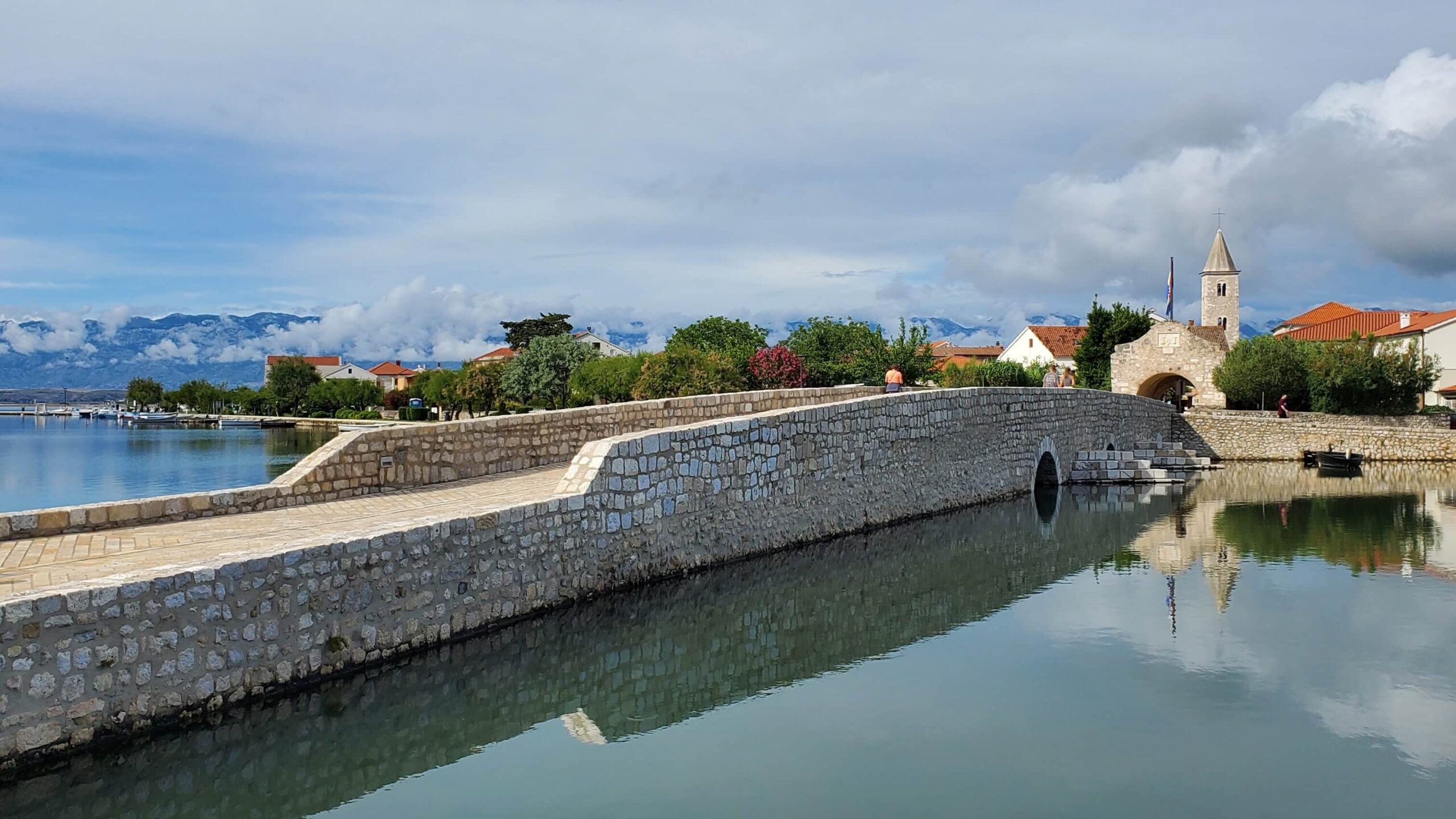
    I spy with my little eye… a beautiful old bridge. Made of stone, with a stunning backdrop of city rooftops and misty mountains, the bridge in Nin is guarded by a statue of Branimir of Croatia, a former ruler. I’m not well-versed in its history, but it’s so picturesque that it belongs on a postcard.

    Bridge in Nin, Croatia

    What to See in Nin’s Picture Perfect Old Town?

    By now, you know how the story goes in Croatia- we enter the old town through a grand stone gate and are greeted by streets full of souvenir shops, ice cream cafes and historic buildings. 

    So what tourist attractions does Nin, Croatia have in store for us?

    Old town gate in Nin, Croatia
    Tower in Nin

    Meet Gregory of Nin (Again)

    Location of Gregory of Nin in Nin, Croatia

    If you’ve visited Split, you might recognize a familiar face. In Nin, you’ll find a slightly smaller version of the statue of Gregory of Nin. Yes, the same one whose toe everyone rubs in Split for good luck.

    But that’s no surprise—he’s called Gregory of Nin, after all. If you’re wondering who he was, Gregory was a bishop who introduced the Croatian language into Croatian religious services, which had previously been conducted only in Latin.

    Gregory of Nin statue

    Discover the Silent Power of Nin’s Miniature Holy Cross Church

    Location of Church of Holly Cross Nin, Croatia

    In the midst of some ancient ruins stands a tiny church. From just looking at it you can tell it has stood here for a very, very long time. 

    Holly Cross Church in Nin, Croatia

    This is the Church of the Holy Cross, often referred to as the smallest cathedral in the world—though that’s not an official title.

    Inside this must-see of Nin, Croatia, it’s completely empty, with barely enough room to turn around. Yet, despite its size, there’s an undeniable sense of silent power when you step inside.

    And here’s a fun fact: the Church of the Holy Cross in Nin, Croatia also functions as a bit of a calendar. It’s positioned so that you can determine the time of the solstice based on the way the sun’s rays enter the church. Quite fascinating, isn’t it?

    Inside of Holly Cross church Nin, Croatia

    End Your Nin Day Trip with a Stroll Along Nin’s Charming Promenade

    Location of Nin promenade

    As charming as Nin’s old town is, it’s rather small, so before long, you’ll find yourself exiting through the stone gate on the other side.

    Gate in Nin, Croatia

    But right before the gate, on the left hand side is a little side path. If you take the turn, a beautiful promenade awaits you. The still water reflects the landscape like a mirror, with mountains in the background that look like they were painted. And if you look carefully – somewhere in between the both you’ll see strips of land that I believe are the Nin’s lagoon beaches.

    Promenade in Nin, Croatia

    By the way, Nin is one of the few places in Croatia with sandy beaches, along with some healing mud. So if you are into those kinds of stuff – do check them out. But if, like us, you’re eager to return to Zadar in time for sunset, this scenic route along the water will lead you back to the bridge where you started your hunt for attractions in Nin Old Town.

    What to See in Nin, Croatia in 360 video

    !!!! This is a 360 video, so you can drag the screen around when the video is playing and the camera will move around to show you different angles. Also you may need to adjust the quality of video to higher in video the settings.

    Thoughts?

    Nin’s proximity to Zadar makes it an ideal choice for a day trip. It’s charming, picturesque, and full of history. However, do keep in mind that dining can be a bit pricey. All in all, if you’re into sightseeing, I highly recommend a visit. So I hope my guide on what to see in Nin, Croatia will help you plan your own day trip to Nin.

    Kravicas ūdenskritums Bosnijā un Hercegovinā

    Enjoyed our story on what to see in Nin, Croatia?

    View my full Croatia – Bosnia and Herzegovina itinerary

  • What to see in Zadar, Croatia? Celebrating the Sunset

    What to see in Zadar, Croatia? Celebrating the Sunset

    On this very rainy day we will explore another Croatian coastal town – Zadar. It’s known for its beautiful old town and famous for its sunsets. Due to the horrible weather we will do a bit of a speed run through Zadar’s most famous tourist attractions, and then we will try to trick the rain by driving to the nearby Nin, which is truly a gem. Have you heard about it? But of course we will come back to Zadar for the sunset. We have to see if it is truly one of the most beautiful sunsets in the world. So grab your raincoat and let’s figure out what to see in Zadar together!


    Location: Zadar


    Cost: Free (if You just explore outside and don’t go in any of the attractions)


    Length: We spent ~4h in total to explore all the attractions listed below, but if you have time, I would recommend spending the whole day here as there is more to see in Zadar then listed.


    How to get there: Public transport or driving. We parked in paid parking close to Old town.


    What to see in Zadar:

    What to See in Zadar Old Town?

    When you’ve visited enough cities along the Dalmatian coast, you start noticing a pattern. All these cities have an old town that’s separated from the rest of the living quarters by thick walls, with a grand entry gate (or gates) that feels like a portal to another world. Once you step through, you’re transported from the everyday world into a land of beautiful old buildings, winding streets, and delightful surprises around every corner.

    Zadar’s Impressive Land Gate

    Location: Land gate

    There are multiple grand entry gates to Zadar’s Old town.

    But the gate you really can’t miss is the Land Gate. It’s adorned with the Venetian Empire’s coat of arms—the iconic winged lion—and some other truly impressive sculpture work. What other symbols can you find in this pic?

    Zadar Land Gate

    People’s Square of Zadar (Narodni Trg)

    Location: Narodni Trg

    Not even the rain can stop people mingling in Zadar’s streets. And one of the best spots for people-watching is said to be the People’s Square. Now, I’m not a huge people-watcher myself—I prefer admiring beautiful old buildings. Luckily, People’s Square has plenty of those too.

    If you look at the right you’ll see a building that is practically an art piece – adorned with multiple reliefs of what I believe are city scenes. The detailing is phenomenal! I think this is the Zadar Town Hall, but don’t quote me on that.

    Relief on a building in Zadar People Squere

    On the other end of Zadars people square you’ll spot a clock tower. That’s the city’s old guard. Let me impress you with some numbers. It was built in the 1500’s. The clock was added later in the 19th century.

    Zadar City Guard clock tower

    As I later found out there is also a Church of St. Lawrence hiding somewhere here, but I couldn’t spot it. Maybe you’ll have better luck playing detective than I do!

    On the third side of the square is the Zadar City Loggia. I don’t have a good photo of it (blame the rain), but it’s a building with grand columns and arches. It used to serve as a courthouse, but now it’s an exhibition hall. We peeked inside, and I loved that they’ve kept the giant stone judge’s desk as the centrepiece.

    Zadar Town Hall

    Wandering Through Zadar’s Old Town Streets

    When it comes to wandering through Zadars Old town streets it’s fifty shades of Beige. But it’s not a sad beige, as the textures and details bring it to life. And the little shops selling clothes, souvenirs, and even rubber ducks add a pop of colour with their vibrant window displays.

    Zadar Old town street

    If you wander without a plan, you might stumble across hidden gems like this charming little courtyard. Look up! I bet the neighbours on opposite sides could open their windows in the morning and enjoy coffee together.

    Courtyard in Zadar

    5 Wells Square in Zadar

    Location: 5 wells square

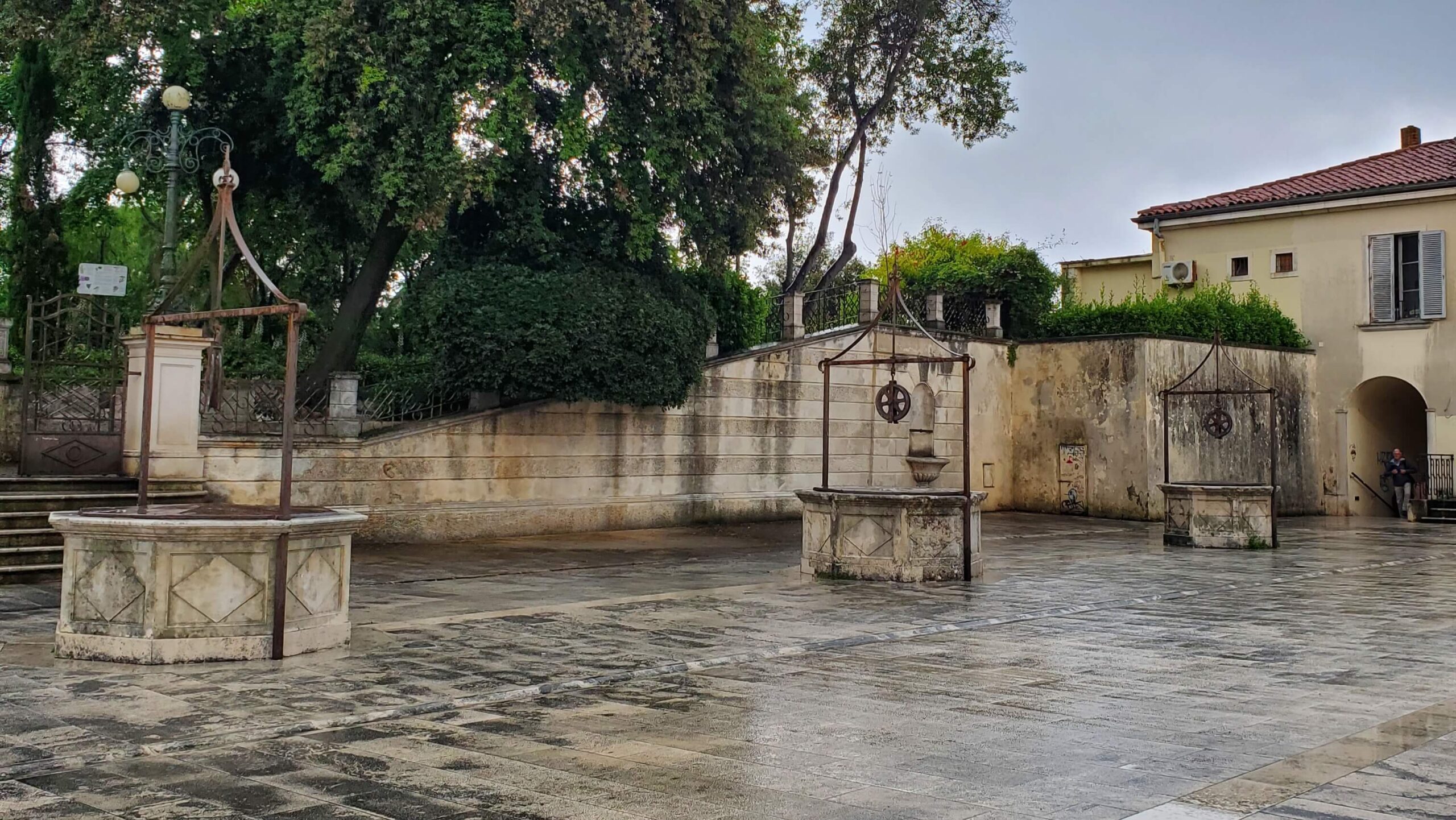
    For some reason, the image I associated most with Zadar before coming here was the 5 Wells Square.

    As you might guess, it’s a large open-air area with five identical wells. They’re no longer functional, though. The buckets are gone, and they’re locked with metal covers now, but they for sure are beautiful. Plus these wells have already served their time, back in the day, providing Zadar with water during turbulent times.

    5 wells square Zadar

    In the background, you can see Captain’s Tower, which was once part of the city’s defence system. And on the right, you’ll find the city walls and an entrance to Queen Jelena Madijevka Park – the oldest one in the town.

    Zadar’s Churches

    Location: St. Donatus church

    There is a lot to unpack in this scene. As there are 2 intriguing churches fighting for your attention in the same place.

    The smaller, round one is the Church of St. Donatus, dating back to the 9th century. What I find fascinating is that some of the parts from the old Roman Forum, on which it was built, were used in its construction.

    And that beautiful tower belongs to St. Anastasia’s Cathedral. I saw a blog post describing this church as “elegant,” and I couldn’t agree more. Just look at those ornaments above the window arches!

    Zadar Church of St. Donatus and bell tower of St. Anastasia's

    Climbing the bell tower is a top tourist activity in Zadar. It was on my bucket list too. But due to our plan of escaping the rain we thought we would come back to it later. But we never did. So if you do climb it, please let me know how it was!

    What to See in Zadar Promenade?

    Although I love Split’s palm trees, Zadar’s promenade might just be my favourite from all the promenades I visited during my Croatia road trip.

    Sunset on Zadar Promenade

    Location: Zadar promenade

    You start your walk on a narrow pathway by the old town walls and then come to this open area by the sea where the pavement stretches as far as the eye can see. I bet it’s beautiful any time of day, but it’s perfect for an evening stroll to catch the sunset.

    Let’s just take a moment to enjoy the peace and quiet.

    Zadar promenade

    The closer we get to the end of the promenade, the busier it becomes. We had this brilliant idea to watch the sunset from here, but guess who else had the same idea? Literally everyone else in Zadar.

    By now, the Sea Organ—a mystical musical instrument that plays haunting sounds created by the waves—was swarmed with tourists. No chance of getting a seat to hear its melody. So here is a pro tip: come at a different time of day to really enjoy it.

    Luckily, there’s plenty of space at the end of the promenade where we can sit. We watch the sun dip below the horizon, and the ships sail by. When a larger ferry passes, its waves give a boost to the Sea organ and we hear a long lonely howl from up here too. 

    And for those wondering—the sunset in Zadar is indeed beautiful.

    Zadar sunset

    Greeting to the Sun

    Location: Greeting to the Sun

    Once the sun sets, everyone, almost like they’re part of an organised group, moves to the next attraction.

    On Zadar’s promenade, there’s an installation of solar panels that collect light during the day and turn it into a playful light show after dark.

    People gather around it, forming a big circle, waiting for the “Greeting to the Sun” to come to life. At first, everyone seems a bit shy, hesitant to step onto the panels. Only the kids are having the time of their life, running around and doing tricks.

    A must see in Zadar - the Greeting to the sun

    The lights start off a bit shy too, but as the night grows darker, they shine brighter, displaying various colourful patterns. Visitors loosen up as well, eventually stepping onto the installation to snap that perfect selfie.

    Zadar Greeting to the sun

    What a perfect way to end the day in Zadar.

    What to See in zadar in 360 video

    !!!! This is a 360 video, so you can drag the screen around when the video is playing and the camera will move around to show you different angles. Also you may need to adjust the quality of video to higher in video the settings.

    Thoughts?

    As I mentioned earlier, we had very little time to explore Zadar due to our side quest to Nin. I’d rather call this visit a “starter” than the main course. But from what I saw, Zadar is yet another beautiful Croatian town with historic buildings and arguably the most walk-friendly promenade I’ve experienced on this trip.

    FAQs About traveling to Zadar

    Zadar vs Split. Which one to choose?

    Both cities boast charming old towns, stunning beaches, and mouthwatering seafood, so you really can’t go wrong with either.

    Now, I’ve heard that Zadar is supposed to be less touristy than Split, but honestly, from what I experienced, the crowds seemed pretty similar. The number of people wandering the attractions and streets felt about the same, and prices didn’t differ much either. That being said, I visited in the beginning of June, so the situation may be different in peak season.

    For me, the biggest difference between the two cities lies in the day trips they offer. If you’re dreaming of exploring Plitvice Lakes or Kornati National Park, Zadar is your best bet—it’s closer to both of these natural wonders than Split. Plus, Šibenik is just a short drive away from Zadar, making it an easy and worthwhile trip.

    How did we get around during our trip to Zadar?

    Although we had a rental car, Zadar’s old town is pedestrian only, so we left the car in one of the paid parking lots and explored by foot. The price of the parking lot was within our budget, but make sure you have cash on hand when traveling to Zadar, as the one we parked at was cash only.

    What to see in Zadar if you have time to visit only one place?

    There are more places to see in Zadar than we had time to explore in one day. But if I had to pick a one must-see in Zadar it would have to be the promenade with the Greeting to the sun due how to how unique it is.

    Liked our post on what to see in Zadar?

    Kravicas ūdenskritums Bosnijā un Hercegovinā

    View my full Croatia – Bosnia and Herzegovina itinerary

  • What to See in Bauska, Latvia? Bauska Day Trip Itinerary

    What to See in Bauska, Latvia? Bauska Day Trip Itinerary

    There’s a place in Latvia where roses never wilt, and a fairytale castle stands tall on the riverbank. Rumor has it that this castle has recently undergone a facelift and is now more stunning than ever. Intrigued? Well, that enchanting town is called Bauska.

    I recently found myself wandering its streets. So I can offer you an (almost) live report on what you can find inside the belly of Bauska castle as well as to give you some ideas on what to see in Bauska, Latvia.


    Location: Bauska, Latvia


    Cost: Some objects has an entrance cost (links bellow)


    Length: ~5,5km from bus station to all attractions and back


    How to get there: Public transport or driving.


    What to See in Bauska:

    Why take a day trip to Bauska, Latvia?

    Let me tell you, Bauska isn’t just charming—it’s convenient! You won’t need a royal carriage (aka a car) to get there. Which I know is an issue for some of the travelers. A simple bus ride from Riga will do the trick, and once you arrive, the town is very walkable. The entire route in this article covers about 5.5 km, so you’ll get your steps in without breaking too much sweat.

    To Reach Bauska Castle, Follow Bauska Nature Trail

    If you’re arriving in your private chariot, feel free to drive straight to the castle. But as we are on foot today, I suggest we take the scenic route along Bauska Nature trail. It follows the river and is separated from the rest of the city by a ground embankment, so we can imagine we are trying to sneak into the castle unnoticed. 

    Now, I’ll be honest: in February, the scenery might look a bit sad. At this time of the year most of the places in Latvia look as if all the color has been sucked out of them.

    But trust me, in any other season, it’s bound to be more vibrant and cheerful. And even in winter’s gray grasp, the trail is far more interesting than the day to day city scenes.

    Bauskas dabas taka

    The highlight of the Bauska Nature Trail is the “Corner of Happiness.” Here, you can capture the perfect photo with the castle already framed—no need for Instagram filters.

    You may have to have a little battle with the wind, as the frame turns in every breeze as if it had the mind of its own. But if that happens, don’t stress. Just punch it back to the position you wanted. It may be a bit of a challenge, but from the bright side – it is more customizable this way.

    Foto rāmis Bauskas dabas takā

    But now – let’s explore the most popular attraction to see in Bauska.

    What to See in Bauska Castle?

    Location: Bauska Castle

    Cost: There is an entrance fee. Check ticket prices and working hours.

    Bauska Castle is like a labyrinth. 

    Some stairs take you up, others down, and there are countless doors leading to an almost endless number of rooms to explore.

    The entrance fee is a bit steep at 9 euros, but honestly, the castle is impressive enough to justify the cost. And if you’re still undecided, you can always admire its grandeur from the outside for free.

    Bauskas pils no ārpuses

    Discover the Grand Rooms of Bauska Castle

    With each room you enter, you’ll notice an unusual pattern—the halls become emptier and emptier as you go. But oh, how grand they are!

    High ceilings soar above you, thick stone walls hold centuries of stories, and the decorative fireplaces give each room character.

    There aren’t many pieces of furniture, but the ones you do find are as grand as the rooms themselves. Massive wooden desks, intricately carved chests, and unbelievably small beds. And it makes sense – before the era of consumerism people just had way less stuff.

    Bauskas pils guļamistaba

    I always find the kitchen the most intriguing part of any historic estate. There’s always something surprising. For instance, this massive pestle looks like it could crush anything. What would you even use it for? Surely not herbs? 

    Virtuve ko var apskatīt Bauskas pilī

    Although many of the items are replicas of long-lost originals, as long as the place is able to set the vibe, it does not bother me. And Bauska’s Castle definitely makes you feel like you’ve stepped back in time.

    Learn Something New in Historic Exhibitions at Bauska Castle

    The castle also houses several exhibitions featuring ancient objects, weapons, and costume reproductions.

    Overall, exploring the grounds is a lot of fun, but get ready for my favorite part of Bauska castle – the tower.

    Bauska Castle Tower: A Panoramic Perspective

    As you enter the tower, something moving on the ground catches your eye. What is it? A ghost?

    You are a bit cautious, but gather the courage to approach it. Turns out it’s a projection telling the story of how Bauska Castle has evolved over the centuries.

    Then, you look up where the guts of the tower unfolds in front of you. You can see all the intricate details—the bare walls, wooden beams, and the roof. It’s like you’re peering into the tower’s very soul.

    Bauskas pils tornis

    The best part? You can climb the stairs to take in the views from above. It’s hard to say whether the views are more impressive from the top or the bottom. What’s your take?

    Bauskas pils torņa iekšpuse

    Before our trip, I tried to find out if there was an observation tower where we could see the city from above, as that is something I try to do in every city. But I couldn’t find any information. So discovering the Bauska Castle tower was a very pleasant surprise.

    Skats uz Bausku no augšas

    What to See in Bauska Other Than The Castle

    Bauska also offers a couple of quick photo spots to include on your what to see in Bauska list—beautiful, interesting places that are worth a stop but won’t require more than a few minutes to take in the view. So let’s do a speed run!

    Colourful Bauska Town Hall

    Location: Bauska Town Hall

    The Town hall is a neat, rosy building with a tower. Inside, you’ll find a tourism information center.  Click-click! And a picture is ready.

    Rātsnams ko iespējams apskatīt Bauskā

    The Evergreen Rose Alley of Bauska

    Location: Rose alley

    Right next to the Bauska Museum, there is an avenue of never wilting roses. 

    Look carefully! What do you see here?

    Mājas stūris Bauskas rožu alejā

    The more I look, the more interesting this place seems. At first, you probably notice houses worn by time, with fabric roses attached to the walls. But soon, you’ll realize how perfectly these romantic flowers complement the weathered buildings, creating a poetic contrast.

    Bauskas rožu aleja

    Walking by the street you spot a sign on one of the houses. “Come in the courtyard” it says. Hmm. Is that “Come to the dark side we have cookies?” type of a thing?

    Plakāts ienāc pagalmā

    Such signs always make me a bit suspicious, but just around the corner, I can spot a glimpse of a mosaic fragment. I’d read earlier that there’s a fish mosaic somewhere in Bauska, so I think this is not a trap and it’s safe to proceed and snap a picture of that, too.

    Bauskas zivju mozaīka

    Lastly, it is time for another more substantial tourist attraction in Bauska. We have to cross the river to get to this one.

    Learn Surprising Facts in Bauska Motor Museum

    Location: Bauska Motor Museum

    Cost: Has an entrance fee. Check entrance fees and working hours.

    Can you spot what this car is missing? That’s right—mirrors.

    One of the many interesting things you can learn at the Bauska Motor Museum is that mirrors weren’t always included in a car’s base equipment. They were actually optional accessories. Can you imagine? I shudder at the thought of road safety back in those days.

    Retro auto Bauskas motormuzejā

    The museum staff are very knowledgeable and eager to share fascinating facts about the retro cars on display. I’m someone who usually distinguishes cars by color, yet I am still intrigued by what a vintage fire truck and a trailer-summer house looked like.

    If you are not yet convinced, here’s another fun fact: did you know that cars without roofs used to be cheaper than fully enclosed ones? Why? Well, you’ll have to visit the Bauska Motor Museum on your own and ask the staff to find out.

    Retro auto ko iespējams apskatīt Bauskā

    With this our list of things to see in Bauska comes to an end and it is time to go back to the bus station to get back to Riga. Good that these buses run quite a few times a day!


    Thoughts?

    I would classify a day trip to Bauska as a very educational adventure as I learned a lot of interesting things. And as the 2 key attractions of Bauska – the Castle and Motor Museum are indoors, this is a great trip idea for the more gloomy seasons where there isn’t that much to do outdoors. But bring the coat anyways, as it gets quite chilly inside those castle walls.

    And if you enjoyed my list on what to see in Bauska – check out some other interesting places nearby:

  • Medems Bog Trail in Mārupe – A Nature Trail with Mirror Elements

    Medems Bog Trail in Mārupe – A Nature Trail with Mirror Elements

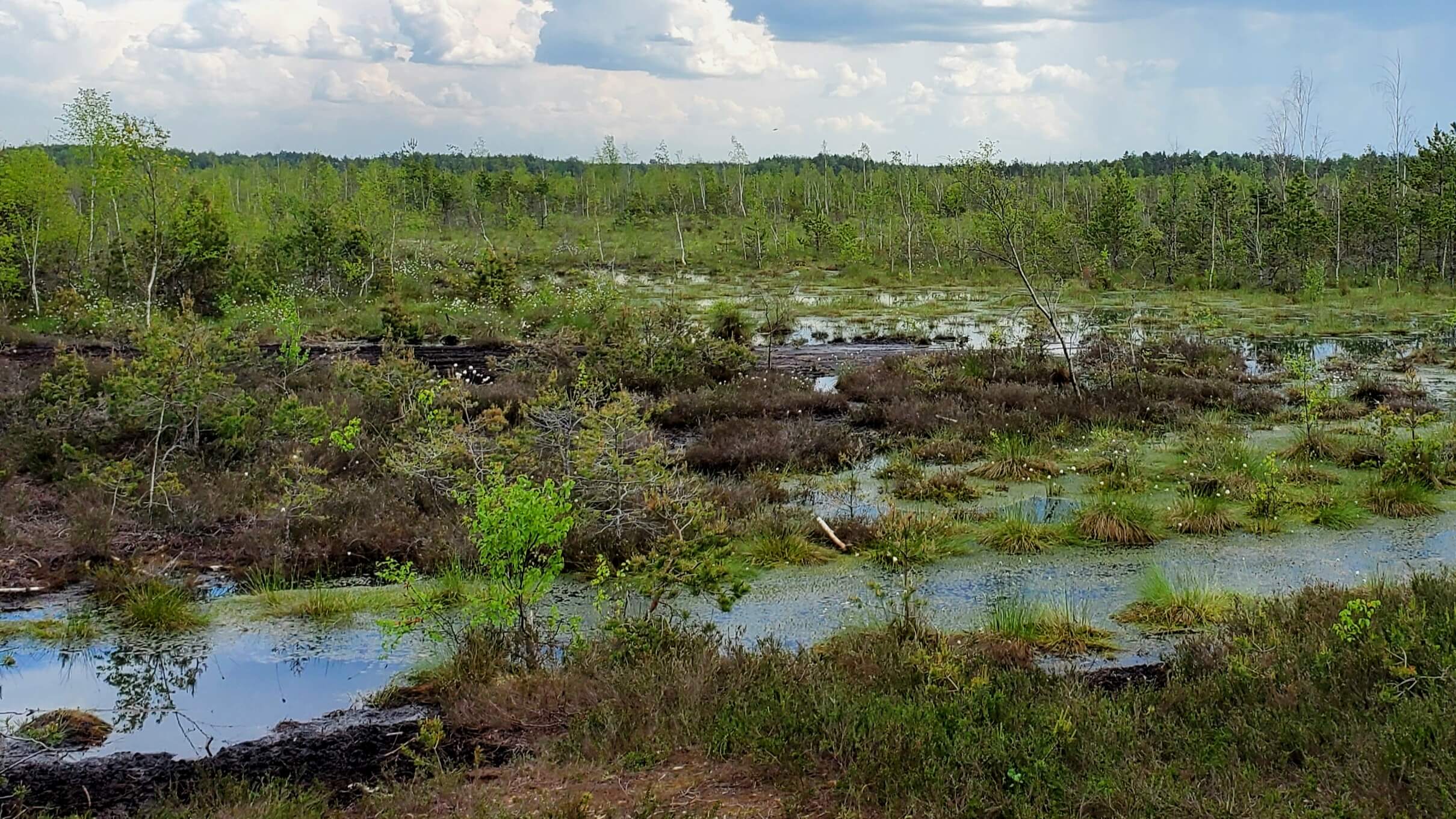
    Latvians love bog trails. They are a classic choice for dates, family hikes, and walks with friends. Just as I thought I had explored all the bog trails near Riga, a new one emerged. Yay! Now, we have the opportunity to explore the somewhat wild “selfie” trail in Medems Bog. So, armed with hiking shoes and insect repellent, let’s get closer to nature and discover what makes this bog trail unique.


    Location: Medama purvs


    Cost: Free


    Walking: ~6km


    How to get there: By a car


    Similar experiences: Lielie Kangari bog trail


    In this story:

    First Part of Medems Bog Trail. Here’s a Challenge for You – Find the Trail

    How does one get lost between three pine trees? Quite simply, by not following the signs.

    We parked the car at the start of the trail. Although the Medems Trail is well-maintained, there’s no designated parking area, so we had to leave the car by the roadside (in an area without prohibition signs, of course). But for adventure seekers, this is not an obstacle, right?

    When I mentioned we were going to a bog trail, you probably didn’t expect a walk through the forest. At least I didn’t. But it turns out that at the beginning of Medems Bog trail, you have to walk on a dirt road through a beautiful, quiet forest for a while.

    Mežs pirms Medema purva takas

    We walked. And walked. And walked. By some point, it started to feel suspicious. Then the road ahead ended to what looked like a potato field. Clearly, we made a wrong turn. So we headed back. Then we saw some people ahead. They will surely tell us where to go. Until suddenly, the people disappeared.

    What? It turns out that somewhere halfway, the road branches off, and instead of continuing straight as we did, you have to take the road that leads to the left. As a kind family we met along the way explained, there are painted signs on the trees indicating the correct path. Keep this in mind so you don’t miss it.

    It’s a Selfie Kingdom

    In my mind, the trail truly begins where the first bridge appears, revealing the unique charm of the Medema Bog Trail.

    This bog trail is different from others because it features mirrors. They are strategically placed on the Medema bog bridges, benches, and information boards. A selfie addict’s dream! Finally, you no longer need to ask a passerby to take a photo of you and your friends.

    Bloga autore forografē sevi Medema purva takas spogulī

    But in all seriousness, these mirrors beautifully reflect the surrounding sights and enhance the landscape. Greetings from my reflection!

    Spogulis Medema purva takā

    Second Part of Medems Bog Trail – (Almost) Untouched Nature

    Further along, the Medems Bog landscape changes – it becomes wilder. The paths become narrower and bumpier. The road gets muddier. The trees grow closer, and in your peripheral vision, you can observe water puddles along the sides of the trail. Some are murky like bog water, others clearer, like in a lake.

    Daba Medema purva takā

    Although such conditions require an adventurer’s spirit, I find this part of the trail, which feels less touched by human hands, intriguing. It’s something entirely different from city streets. How do you like this scenery?

    Medema purva takas posms bez laipas

    Third Part of Medema Bog Trail – The Well-Maintained Bog Boardwalk from the Marketing Pictures

    A bog trail must also have a bog boardwalk, right? It does! The next section of the trail is a wooden boardwalk that splits the field in half.

    Medema purva laipa

    Although it may not sound so appealing, the scenery has its own charm.

    Here you will also find educational boards about the Medems Bog in Latvian. And if you are very lucky, you might spot a lizard or other creatures.

    Informatīvs stends medama purvā

    Final Part of Medems Bog Trail is a Treat for Your Eyes

    And so we reach the end of the trail at a particularly picturesque spot by a bog lake. Frogs croak. Birds chirp. In May, the surrounding expanse is full of white flowers. Can anyone tell me what these beautiful blooming plants are?

    For those who pride themselves on completing this trail, there is an opportunity to take a photo by two especially large mirrors with the inscription “Medems Bog.” Let’s spread the good word that Latvia has yet another beautiful bog trail.

    Since the trail is not a loop, after a break at the bog lake, we head back along the same path to the starting point.

    Ezers Medema purva takā

    Before we part, a little warning: Choose your footwear carefully, because my sneakers looked like this after the walk.

    Netīras kedas

    Thoughts?

    Overall, I feel like this nature trails selling point are the mirrors. They not only allows you to take some fun selfies, but also enhance the landscape. I believe that this trail is best suited for those, who wants to be closer to the nature and are not afraid of physical activities and dirtying their boots.

    PS – remember about the safety – it is dangerous to go off the path in a bog!

    Atsegumi Vidzemes akmeņainajā jūrmalā

    Other attractions nearby Medams Bog Trail

    What Else To See in Latvia?

    What you need to know about Medams Bog trail?

    How long is the walk?

    We walked ~6km (including us getting lost).

    Are there any picnic spots in Medams Bog trail?

    No, unfortunately there are no picnic spots or even toilets.

    How accessible is the trail?

    As the trail is mostly off road it is not accessible for those with limited mobility or with strollers.

    What should I bring with me?

    Mosquito repellent, water and a spare pare of shoes to change into after the walk

  • What to do in Riga if it rains? Interesting and unusual museums

    What to do in Riga if it rains? Interesting and unusual museums

    And don’t run away at the word museum. In this list I have included only the ones that have left a permanent impression on me. In one of Rigas museums, you will have the opportunity to play games. In another, you will travel in time. And in yet another, you will work your imagination and admire some art.

    Come – let’s turn a rainy day in Riga into an adventure!

    If you already know which theme is closer to your heart’s desire click on one of the links:

    Or read the whole article to evaluate all the candidates.

    Riga Video Game museum


    Location: Enjoy the game


    Cost: There is entrance fee. Check prices here.


    Length: ~30min (or more if you love to play)


    Help! Which button should I press?

    In the past, consoles were a bit different. In the Riga video game museum You might just stare at the old consoles and puzzle over which button to press to make the main character move. Or the same as I – randomly press all the buttons and hope that Mario survives.

    Retro konsoles spēle Rīgas videospēļu muzejā

    The Riga video game museum is hidden on the second floor of a game store. It still has some growing to do to match the size and experience of the game museum in Krakow. But you can play several old consoles and a couple of arcade games. As well as see the exhibition of computers, Tamaguchi, all kinds of control input tools, and other gadgets from the gone by era.

    Videospēle ar arkādes spēlēm fonā videospēļu muzejā Rīgā

    This rainy weather activity is, of course, a matter of taste. While I was playing the games, I had a man on one side very enthusiastically telling his wife: “Oh look, this game is from the 80s…” But on the other side were a bunch of teenagers doing some button-smashing and admitting it wasn’t as interesting as they had expected.

    And if we talk about the minuses – there is very little space and the air is a bit stuffy. But I can live with that.

    Riga Art Nouveau Center


    Location: Riga Art Noveau Center


    Cost: There is entrance fee. Check prices here.


    Length: ~1h


    Congrats – you now have a super power. You can travel in time. So on a rainy day use this power to visit a luxury Art Nouveau apartment from 1903.

    Viesistabas interjērs Rīgas Jūgenstila muzejā

    This is not a museum where everything is hidden behind a glass. It’s a place where a day in families life has truly frozen in time.

    Intrigued? Read the full article.

    House of the Brotherhood of the Blackheads in Riga


    Location: House of the Brotherhood of the Blackheads


    Cost: There is entrance fee. Check prices here.


    Lenght: ~1h


    The House of the Brotherhood of the Blackheads is, for sure, one of the most eye-pleasing buildings in Old Riga.

    Rīgas Melngalvju nama fasāde

    But have you ever been bothered by the question – what is inside the House of Brotherhood of the Blackheads? Rumour has it that it’s a museum. And a rainy day in Riga is a perfect chance to explore it. 

    Inside the House of the Brotherhood of the Blackheads of Riga you will find three floors – historical cellars, staterooms, and luxurious ballrooms.

    Rīgas Melngalvju nama interjērs - krēsli un dīvāns

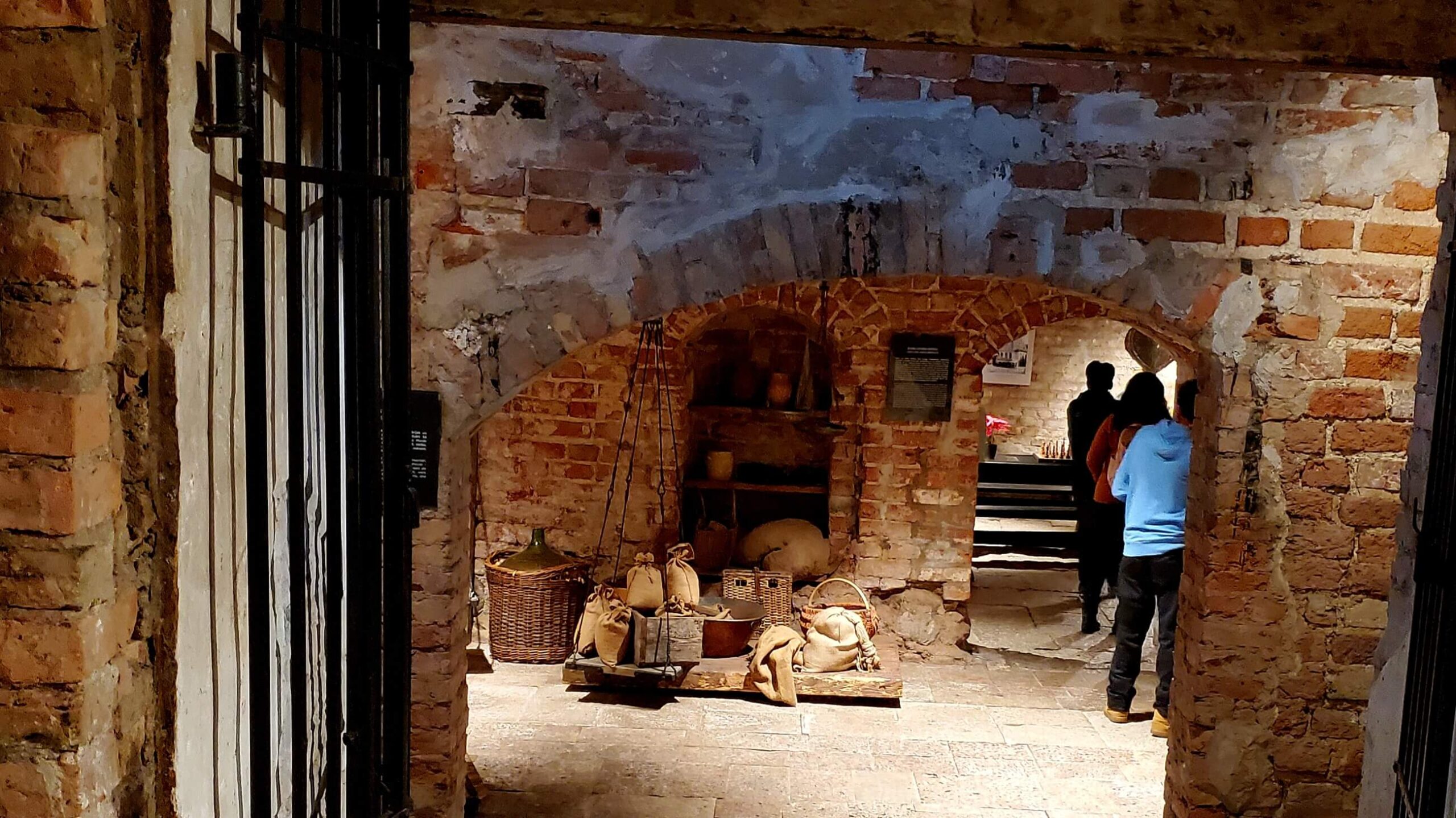
    The cellars have a somewhat intriguing, labyrinth feel and breath of history. You will see exposed ancient walls and a fire burning in a furnace somewhere deep down. To establish the vibe there are also various ancient objects – scales, barrels, and statues.

    Rīgas Melngalvju nama pagrabu izpēte lietainā dienā

    In the staterooms and ballrooms you will find luxurious interiors with decorative ceilings and beautiful stoves.

    Usually, when I travel, I see such views in palaces that are turned into museums. Here in Riga, it turns out that you can find them in the House of the Brotherhood of the Blackheads instead.

    Rīgas Melngalvju nama interjērs

    Digital Art House


    Location: Digital Art House


    Cost: There is entrance fee. Check prices here.


    Note: You have to book a specific time slot in advance


    When the paintings around you come alive it no longer mathers if it is rainy or if there is a blizzard outside. You have left the streets of Riga and entered into the land of dreams.

    From the exhibitions available ir Riga Digital Art house I recommend choosing “From Monet to Kandinsky”. In short – it’s a remix of popular modernist artworks turned into an animation that is then displayed on the walls, ceiling and floors. Complimented by pleasant music. And optionally (for extra charge) – a glass of wine.

    Do you have to be an art lover to enjoy this? No. If it is quite difficult for you to concentrate on static paintings in frames, Digital Art House in Riga could be a slightly dreamier and slightly more dynamic option for you.

    You’ll see glittering ballerinas turning into star dust and Scream fading in smoke. 

    But if you are an art enthusiast – when you see the works in different sizes and from other angles, nuances that you had not noticed before may be revealed. In my opinion, it’s quite good, dreamy relaxation for a rainy day in Riga.

    Projekcija uz sienām un grīdas

    And if you have already seen the Modernists, as I understand, Digital art house offers other exhibitions that change from time to time. But don’t skip your research. My friend ended up in an exhibition with a lot of naked buts and wasn’t too thrilled about it.


    Rain and cold cannot defeat those who have an adventurer’s spirit!

    Overall, there are many interesting museums to explore in Riga (I as a local haven’t even been to all of them yet), and the number of cultural and entertainment opportunities in the capital of Latvia continues to grow. So I will extend the list of things to do in Riga in rainy/cold weather whenever I try something new that is worth telling you about.

  • Riga Art Nouveau museum – your chance to time travel

    Riga Art Nouveau museum – your chance to time travel

    You are invited to someone’s home, but instead of traveling by car, you will journey by time machine. The destination? The year 1903, Art Nouveau era in Riga. Sounds impossible? Not at all. Because in Riga Art Nouveau museum a day in the life of a family from 1903 is frozen in time. 

    Looks like the owners may not be home today, but that’s actually a good thing. It means you can be a bit nosy and explore the pantry and bedroom—areas typically off-limits to guests. And the staff will share some interesting details too.

    So let’s visit the Riga Art Nouveau museum!


    Cost: There is an entrance fee. Check prices and working hours here.


    Lenght: ~1h


    How to get there: You can walk there from city center (~25 min). Or take public transport & then walk for a bit. Or take Bolt Taxi.


    Similar experiences: Ethnographic Open Air Museum


    What to expect in Riga Art Nouveau center:

    Expectations are set high before you even enter Riga’s Art Nouveau Museum

    There are ordinary buildings and then there are buildings like THIS.
    Of course, the Riga Art Nouveau Museum is housed in an Art Nouveau building that has all the charming details of that time.

    My knowledge of Art Nouveau architecture is minimal. But when we walk down the street, I can immediately tell which house is the one we are looking for.

    This one, thanks to its tower, stands out from the rest of the buildings. Although I must admit that the nearby building of the  School of Economics also made me want to stop and take out my camera.

    Rīgas Jūgendstila muzeja ēka

    Same as when you visit someone – you have to ring the doorbell to get in.

    After entering, you see a luxurious spiral staircase. It’s the one that appears in countless Instagram pictures. You have probably seen them if you have searched for images of the Riga Art Nouveau center.

    As we later learn from the video, the lobby and staircase were like the business cards of the owner of the house.

    What does this lobby say about him?

    Spirāļveida kāpnes Rīgas Jūgenstila muzejā

    I would say it screams money (laughs). And talks about good taste.

    I guess we should have worn something more elegant for such a visit. But don’t worry, there will still be a chance to dress up later. At least for a pic.

    Basement – Intro to The Story of Art Nouveau in Riga

    When visiting someone, you need to know how to conduct conversations with the host, so before entering the living room, let’s learn a little more about Art Nouveau itself. The digital part of the exhibition will help us.

    Get to Know Riga’s Art Nouveau Buildings In The Digital Exhibition

    Let’s start with Art Nouveau architecture in Riga. A visual story tells you about all those gorgeous buildings you can spot in the streets of Riga. So challenge yourself – try to find houses you have seen by looking at pictures or addresses and learn a little more about them.

    Ekrāns ar digitālo karti

    On the second screen, you can feel the bittersweet feeling of looking at what Riga once was. Do you know what the so-called “Bird meadow” was? It’s something related to gondolas in Riga. But I won’t tell you the answer. You will have to find it in museum.

    Watch The Video To Learn More About a Typical Art Nouveau Apartment in Riga

    Do you know which everyday things were new and considered luxury items in the Art Nouveau apartment? One of them is “the place where even the emperor walks by himself”. If you know what I mean. But to find out more, you will have to watch a video on one of the screens in the basement.

    In addition, you also can learn about the typical layout of the Art Nouveau apartment, which serves as an excellent introduction to the tour. I definitely recommend watching it before exploring further.

    Now that you know more about the period, you are ready for small talk. So let’s go to the apartment itself and see if the hosts are there.

    The Heart of The Riga Art Nouveau Museum – The Apartment Frozen In Time

    Time has truly frozen here.

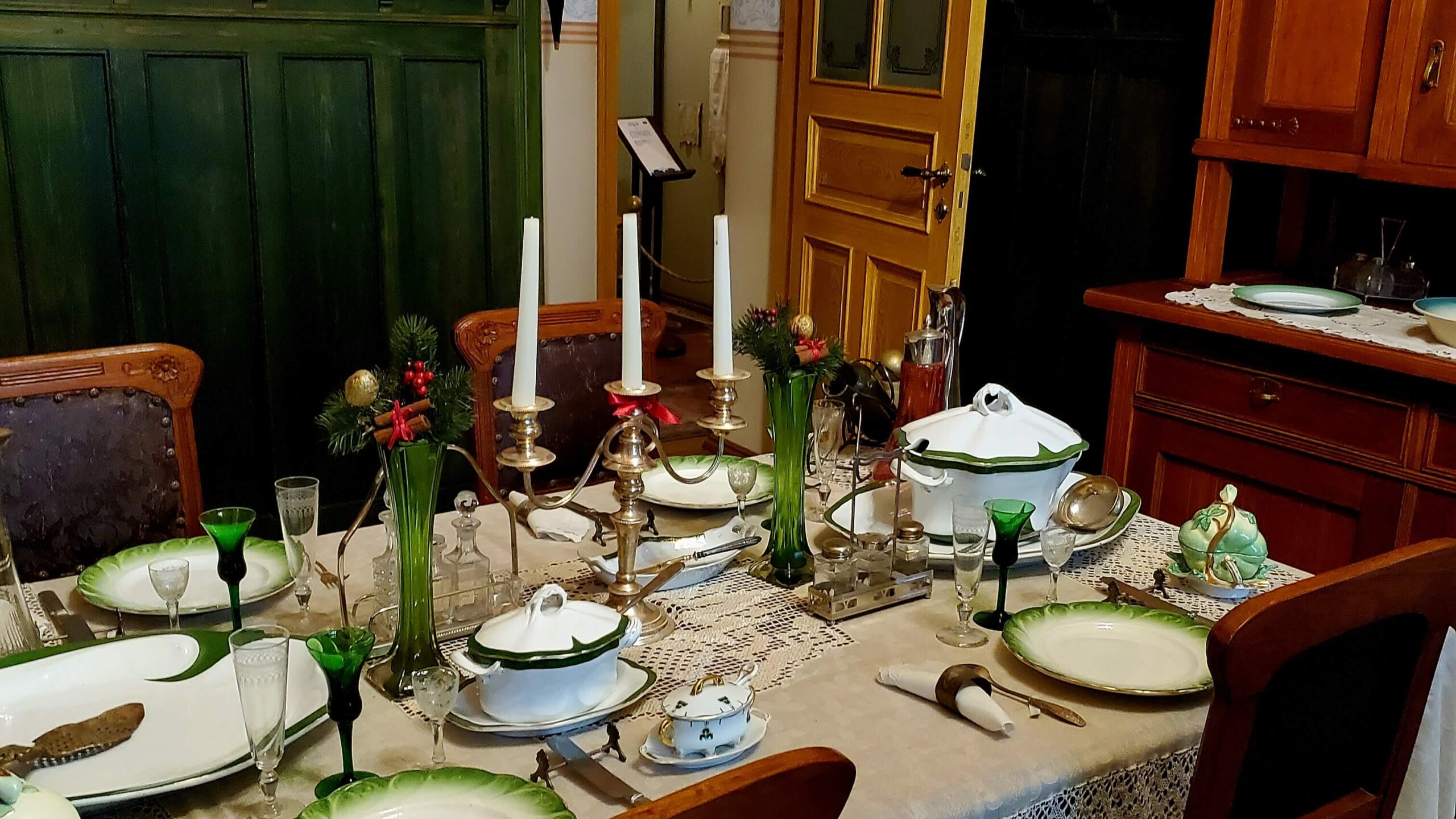
    You enter the room, and all the luxury of Art Nouveau opens before you – delicate decorations on the furniture, ceiling, curtains, and dishes. Everything is in its place – the chess pieces are arranged for the game, and the table is laid for dinner.

    Jūgendstila muzeja ekspozīcija ar kamīnu

    It is not difficult to imagine a young girl entering the living room and playing the piano. And a hostess that would invite you to sit on one of the fine chairs, because you have to kill time, as the maid haven’t finished cooking the dinner yet.

    I visited the Art Nouveau Center during the Christmas season. During that time of the year you can enjoy a lot of beautiful holiday decorations, postcards, and a grand Christmas tree with all kinds of ornaments. There is everything from ballet shoes to an ostrich.

    This is what holiday decoration dreams are made of! 

    But since the hosts are nowhere to be seen, it is a chance to look into those rooms where guests are not usually allowed, for example, the utility rooms. So let’s not miss out on that!

    Viesistabas interjērs Rīgas Jūgenstila muzejā

    In Riga Art Nouveau Museum You Can Find Unusual Items On Every Step

    Have you heard of a fridge that’s made out of wood? Yes, that’s a real thing.

    Koka ledusskapis

    The kitchen is one of the most interesting rooms in my opinion. You can find various unusual appliances in it. And funny dishes in the shape of animals. There is a squirrel, fish, and crab.

    And, of course, there is the old stove with metal rings. Stoves like that forever remind me of my great-grandmother’s house, which was sadly bulldozed a long time ago.

    What a fun adventure this has been! There are a couple of more rooms to explore in Riga Art Nouveau museum, but I will leave those for your imagination (or for your future visit).


    Thoughts?

    This place is one of my favorite attractions of Riga. I had a good time and learned a lot. If you are fascinated by old interiors, beautiful details, and people’s life many, many years ago, Riga Art Nouveau Center is the place to be.

  • Sunrise on a Paddle Board in Cenas Bog Trail

    Sunrise on a Paddle Board in Cenas Bog Trail

    It’s like you’re in a dream. The experience is way different than when you visit Cenas bog trail during the daylight hours. There is an aura of magic in the air. It is peaceful. It is dreamy. I have to say – sunset on the paddle board in Cenas bog together with Advaita Adventures may just be my favorite adventure of the year and definatley my favourite way to enjoy Cenas bog trail. And here is why.

    PS – this post is not sponsored, I bought this for my own money and I am writing about it purely because I loved the experience so much. 


    Location: Cena bog


    Cost: You have to purchase a ticket. Check out the prices and event dates here. You need to book in advance.


    Length: ~4h


    How to get there: By a car. Or the agency can transport you for an extra fee.


    Similar experiences: Paddleboarding or boat in Lake Kaņieris


    What to expect on sunrise paddleboarding in Cenas bog trail:

    The beginning of your paddle boarding adventure in Cenas bog

    It’s 4AM. Oh gosh, where have I gotten myself into again?

    But don’t run away now! Hear me out. The early rise is 100% worth it. As the experience will be magical.

    The adventure starts in pitch black dark. Here is an illustrative picture showcasing just how dark it is.

    Tumsa

    So you have to use a flashlight or the light in your phone to see the bog boardwalk which we need to follow to get to the place where we will get into the water.

    Everything around you is covered with thick fog. Above your head the stars are shining bright. After a while you can spot the silhouette of the first lookout tower. But there is still a long way ahead of you. 

    I am not gonna lie – to a couch potato like I, who avoids the gym like a fly avoids the bath, walking while carrying the paddle board and the equipment is not easy. I am surely huffing and puffing. But don’t worry – it is all going to be worth it. And this activity helps to wake up better than a coffee does.

    Also, it is slowly starting to get lighter. But everything is still covered in that mystical fog.

    We will get on the water even before the sun rises, but first – a workout for your hands as well. One has to pump air into their paddle board.

    After that a safety instruction follows. But don’t worry, it’s not a boring one. The guide is engaging and fully devoted to his duty. From him you learn how to steer the board and how to keep your balance. You don’t want to fall into the murky swamp water, do you? 

    Sup cenas tīrelī tumsā

    The feeling of complete peace you get when you climb on a paddle board in Cenas bog trail

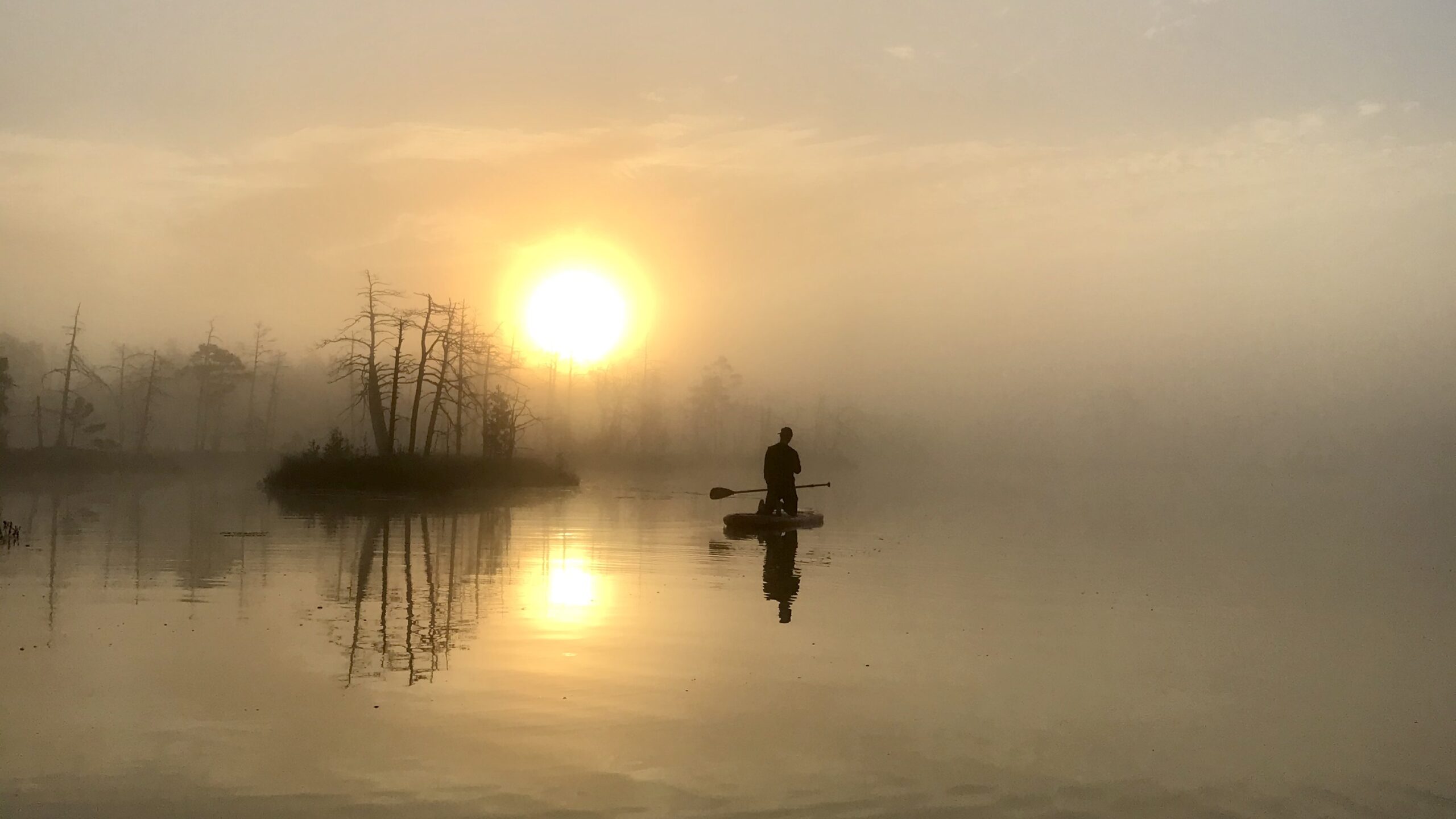
    Everything is still covered with white, dream-like fog. You can’t see the horizon. The only thing you can see are the silhouettes of the trees that softly blend into the fog. The water is completely still. It’s soothing like a lullaby.

    When everyone else has conquested their paddle boards as well we start rowing. Along your way, in the dark water you can spot water lilies. You pass by small islands inhabited by lonely pine trees. Some are broken, others are standing strong.

    Saullēkts ar sup Cenas tīrelī

    There is no movement. It’s only us and the foggy Cenas bog. If other paddleboarders get just a bit further from you, they disappear in the fog too. So you feel like you’re completely alone. But you are not afraid. You know you are safe.

    The best place to watch a sunset in Cenas bog trail is surely from a paddle board

    You know it’s almost the time for the sun to show up when the sky starts to get slightly pink. We turn around to drive towards the east. It’s not long until the sun appears, shrouded in smoke. The vibe has changed. 

    Now is the time you can take the best pictures. If you are afraid to pull out your phone, the guide will take photos of you and email them over later. But I have to say it is almost impossible to resist the temptation to take a picture in this breathtaking place. It is just too beautiful. 

    At this point other paddle boarding groups start to join you in the bog as well. But we just keep rowing further. As it is time for a light breakfast. The menu is simple and vegetarian friendly – a croissant and a sweet treat. No drinks though, so bring warm tea or coffee with you from home.

    Saullēkts Cenas tīrelī

    When the sun has fully risen the vibe has changed again. You have woken up from your sweet, foggy dream. The world has regained colors. Everything is crisp and clear – you can spot every strand of grass and every spider web on the tree. 

    One may even start to question whether everything you just saw was even real. For a moment longer we sit on the calm waters of Cenas bog, and then it is time to get out of the water, pack up our paddle boards and return to the car.

    But when all is said and done – sunrise paddle boarding at Cenas bog trail was truly one of a kind, unforgettable experience. 

    What season is the best for enjoying a sunrise in Cenas bog on a paddle board?

    I enjoyed my paddleboarding adventure in Cenas bog trail at the end of August. The day was warm. Water was as warm as milk too. So one may start to wonder if this adventure is suited for cooler seasons too? 

    According to our guide, they do organize paddleboarding in bogs in autumn time too. And the views are arguably even better as the bogs are gorgeous in autumn time and the contrast between the warm water and cold air makes the fog even thicker. You just have to make sure you dress up very warm so as not to freeze. 

    Meitene uz Sup Cenas tīrelī saullēktā

    Every time I tell my colleagues from abroad that Latvians love spending their weekends in a bog I get very surprised stares. In the bog? The place where Shrek lives? No. In the bog, the place that in the morning looks like the land of dreams. And now if anyone will second guess me, I will have pictures to prove it.

    Other Attractions Nearby Cena Bog Trail


  • What to See in Skaņaiskalns Nature Park and Dauģēni Trail

    What to See in Skaņaiskalns Nature Park and Dauģēni Trail

    It appears that someone has scattered nature wonders across Latvia as if planting seeds in the field. When you are sowing – some places get a sprinkle more than others. At Skaņaiskalns nature park, the wonders of nature have gathered in abundance—caves, cliffs, and werewolf pines—all nestled alongside the picturesque banks of a river. And as if nature’s beauty wasn’t enough, someone has added a touch of artistry with wooden sculptures, making this park a perfect destination for a weekend getaway. 

    For those eager to add extra steps to their journey, there is a chance to continue the adventure along the Dauģēni Nature Trail, which begins right where the Skāņaiskalns trail ends.

    So let’s venture towards Mazsalaca to explore both enchanting nature trails and discover which of the two suits you the best.

    Jump to:

    Skāņaiskalns Nature Park


    Atrašanās vieta: Starting point


    Costs: You have to purchase an entrance ticket at the beginning of the trail. Prices and working hours.


    How long is the trail: Skāņaiskalns ~3km one way (~6km roundtrip). In addition you can also do Dauģēni trail which is extra 10 km one way.


    How to get there: With a car


    Our adventure begins at the ticket booth of Skāņaiskalns Nature Park. Here, we face a choice: the forest trail or the asphalt road. Let’s embrace both, taking the forest path on our way in and the asphalt road on our way back. Variety is the spice of life.

    Do You Want to Become a Werewolf? Skāņaiskalns Werewolf Pine

    Amidst the forest, we encounter the mystical Werewolf Pine. There are no education signs. But I know a legend. In Latvian folk tales passing naked through a pine trunk during a full moon transforms you into a werewolf.

    While I doubt many would take up this challenge, the tree itself, with its knotted, pocketed trunk would be perfect for this sorcery. 

    Skaņākalna vilkaču priede

    These pines truly look extraordinary. So even if you have no desire to turn into a hairy creature with an intense need to howl at the moon, it is a perfect photo opportunity.

    Birds and Other Wooden Sculptures in Skaņaiskalns Nature Park

    When translated from Latvian to English Skaņaiskalns would translate as the ‘Mountain of good sound’ or something along those lines. So here is a pop quiz for you – who creates melodious sounds in the forest?

    Birds of course. Their beautiful songs accompany you through most of the nature trail. So the wooden sculptures of birds that are scattered through Skaņaiskalns are truly a perfect fit for the place. They beautifully fill in the gaps between natural wonders along the trail, to keep you engaged.

    Putna skulptūra Skaņākalna dabas parkā

    But birds are not the only ones immortalized in sculptures. In Skaņaiskalns Nature Park, you will also find sculptures of fish, people, and even a wooden bicycle you can ride.

    Skaņaiskalns Nature Park Angel’s Cave

    Soon enough we reach the first cliff of the day. If you’ve heard stories about the cliff in Skaņaiskalns that eco, when shouted at – screaming at this one, is pointless; it’s not THAT cliff. We will reach that one later. However, this one has its own charm. 

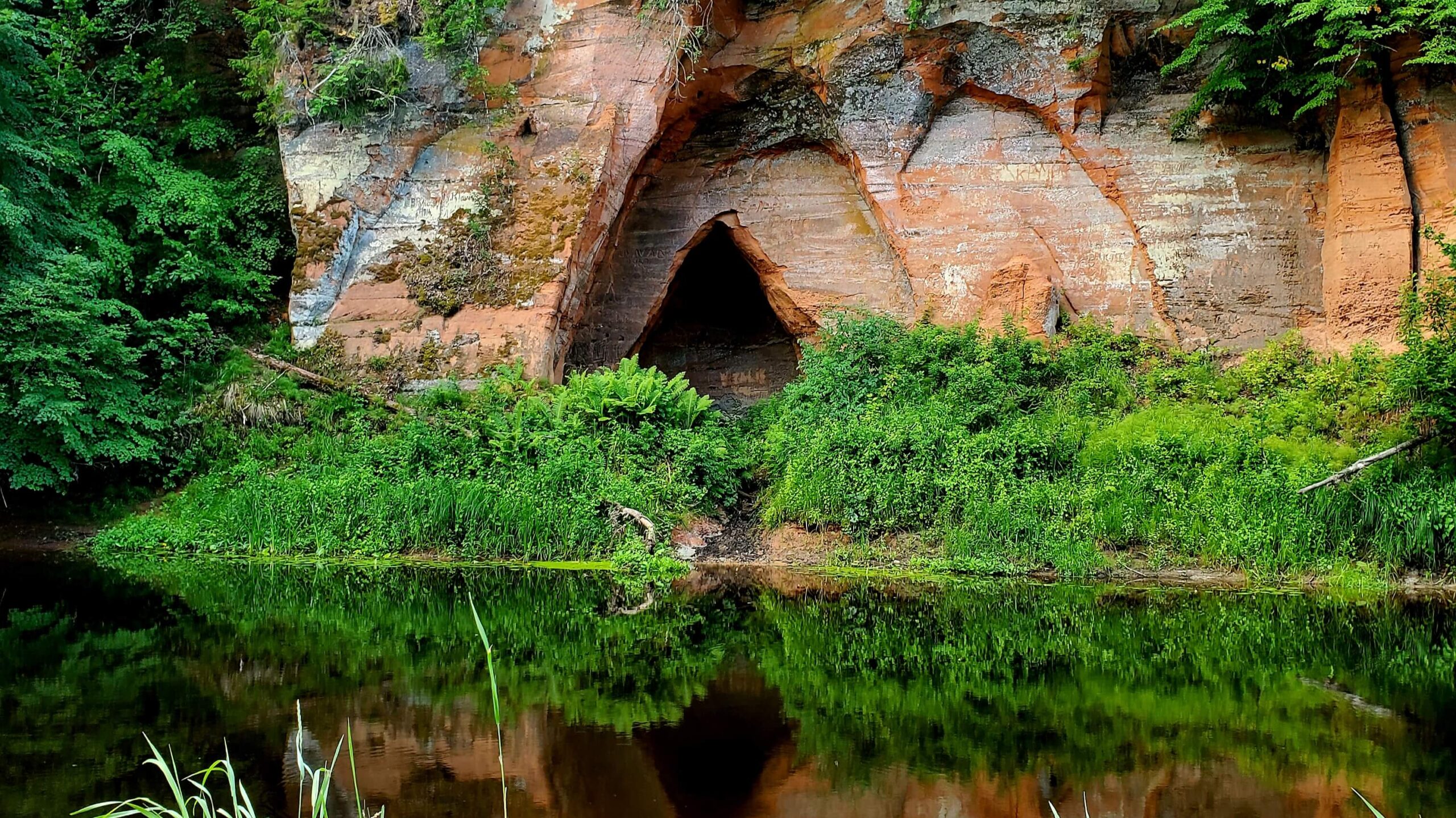
    It’s a beautiful orange – brown cliff on the riverbank, featuring the Angel’s Cave. Why is it called the Angel’s Cave? Look at the rock formation carefully. I can see a stylized angel there. Can you see it too?

    Skaņākalna enģeļu ala

    Work For Your Dreams – the Stairs of Dreams in Skaņaiskalns Nature Park

    Further along, we encounter an intriguing sign – the Stairs of dreams. Sounds romantic! 

    But as you approach this attraction, you realize they are tall wooden stairs which look rather worrying than dreamy. The idea is simple – if you have a dream, you need to think about it and count the steps as you climb up the stairs. If you count correctly, your wish will come true.

    Sapņu trepes Skaņākalna dabas parkā

    Well, I could climb and count the steps for you… But honestly, I’m already exhausted just looking at these stairs. I know one should work for their dreams, but this climb feels more like a nightmare. So I’ll pass. 

    Impressive Devil’s cave of Skaņaiskalns Nature Park

    Soon enough, you’ll recognise a pattern. Many names along this trail are associated with mischief. There is Devil’s Cave, Devil’s Stone, Devil’s Desk. And even a witches’ cottage, with the witch itself. This one doesn’t fly on the broom though. Looks like Latvian witches have propellers stuck to their backs. 

    Luckily for us, the Devil is not home today. So it means we can explore one of his residences – Skaņaiskalns Devil’s cave safely.

    The exterior of the cave is quite beautiful – orange-gray rock walls covered with moss and decorated with carvings. 

    Skaņākalna Velnala

    The inside of the cave is pitch black. One wouldn’t be able to tell if there was someone standing on the other end, or even – how long the tunnel is. So let’s bring out a flashlight! 

    Oh, it turns out the cave chamber is quite large. Larger than I expected based on the size of the entrance.

    The Skābuma baļļa (Sour Pool) with seemingly no sourness?

    What’s sour? Lemon juice is. But the Sour Pool is not. It’s actually a small cave from which a clear water spring flows.

    So why call it Sour then? Turns out the sourness comes from a legend. The same Devil whose residence we visited once spilled a local drink called “Sour”. And at that place where the sour was spilled the spring started flowing.

    Skābuma baļļa Skaņākalna dabasparkā

    I bet curiosity is probably tormenting you now. What is this mystical “Sour” drink?

    I’ll ease your torture – according to Delfi, “Sour” is a refreshing drink made by the people of Vidzeme from coarse rye flour. Now we both know more.

    View of the Neļķu Cliffs in Skaņaiskalns Nature Park

    Obviously one cliff is not enough. So here are some more!

    Neļķu cliffs can only be enjoyed from a distance. But they beautifully blend into the surrounding landscape and are quite photogenic. 

    If you are looking for the best spot to view these from, you’ll find that in Velna kancele (Devil’s desk).

    Skaņākalna Neļķu klintis

    All Paths Lead to the Skāņaiskalns Cliff

    And finally, we have reached the main attraction of the trail – the Skaņaiskalns Cliff. This is the cliff (or one may say a mountain) of sound, as this is the one that echoes back when you shout at it. Unfortunately, there is a wedding party here to take some pictures. So I feel a bit embarrassed to scream. Perhaps you will be braver?

    Vocal superpowers aside, it’s a large rock wall sitting on the opposite side of the river. An interesting detail are the many round holes in it. Could it be that there is something living in them?

    Skaņākalna klints

    Skāņaiskalns Dwarf Trail – Have We Teleported to Tērvete?

    For a little side quest on your way back…

    It’s no secret that in Latvia, wooden dwarfs are associated with Tērvete. It’s the place where most of Latvian children see this fairytail character in real life for the first time.

    So, when I spotted the first dwarf on the Skāņaiskalns Dwarf Trail, I couldn’t resist taking a photo and posting it on social media with the question, “Guess where I am?” To see how many of my friends will guess Tervete.

    The dwarfs here seem very busy – working with their little axes and saws. Building something.

    Koka rūķis skaņākalna Rūķu takā

    Dauģēni Nature Trail

    Sākuma punkts – pie Skaņākalna klints.

    When you are done exploring Skaņaiskalns …

    Should You Walk the Dauģēni Trail As Well?

    Good question.

    It depends on your interests and on how much time you have. If you enjoy long walks amidst nature, the Dauģēni trail offers an ideal opportunity. Stretching approximately 10 km in one direction, the trail takes you through a serene forest setting. However, compared to the Skaņaiskalns Nature Park, the Dauģēni trail has way fewer attractions. Its main allure lies in its untouched natural beauty. So if you are just after touristy places and photo spots… Then the trail might seem a bit boring to you.

    Also I find navigating Dauģēni trail a challenge (you’ll see why), so I wouldn’t recommend this one to people who tends to get lost easily. But we want to achieve our daily step goal, so we will explore this path as well.

    Upe Dauģēnu dabastakā

    Take Orientation on the Daugēni Nature Trail As a Challenge

    Do you like challenges?

    Good. Your first test is finding the trail itself, as there are no clear indications of the direction for “Dauģēni trail” at the Skaņākalnas cliff. However, there is a small forest path that starts from the camping area, which might be the one we are looking for. There’s no harm in trying, right?

    Let’s go.

    After a while, our perseverance pays off – there is a stand showcasing a map of attractions, confirming that we have indeed found the entrance to the Dauģēni trail. Hooray!

    It is so quiet and peaceful here (except for the bird songs). We are the only people here today. It’s us, the trees, the moss, and the blueberry bushes.

    To navigate our path, we have to rely on these small signs with icons of people, occasionally appearing on the trees.

    Takas zīmīte uz koka

    But when we get to the intersection… I warned you this will be a challenge. Can you please explain to me how to read this sign? What do those numbers mean? And why is one number indicated in several directions?

    Krustojuma zīme ar bultiņām un cipariem

    There is no network to check the map either. Therefore, we will have to rely on our logical thinking.

    Considering the map we previously consulted, it appeared that the majority of attractions were nestled alongside the river. So the wisest course of action seems to stay close to the river.

    So we walk. And we walk for a long time.  I am starting to feel a bit anxious that we are lost. But then, we spot a well-maintained picnic area. That must mean we’re heading in the correct direction, right?

    Where Is the Covs’ Cave of Dauģēni Trail?

    Let’s continue. 

    It’s hard to gauge how far we’ve walked. But finally, we see a sign “Govs ala” (Cov’s cave). While we should be pleased with this discovery, it also implies that we have unintentionally missed the Simaņu Rock—an exquisite formation with caves and a spring—and the huge Simaņu Rock.  I wouldn’t be a terrible teammate in an orienteering competition, would I?

    Oh well. Let’s just look for Covs cave on the opposite side of the river. Do you see anything?

    Dabas skats

    I don’t.

    The moral of the story here – always read the fine print.

    When you read the description of the attraction, you will find out that Cows’ Cave was once here. But it has since collapsed. This is now the site where the Cows’ Cave once was. This is one of those facepalm moments.

    But don’t worry – everything will only go up from here. There will be attractions on the Dauģēni trail that we will actually see.

    The Photogenic Boardwalk of the Dauģēni Trail

    After Cows Cave, you have to go through an overgrown meadow. We’re not the ones who give up easily, are we? And our endurance pays off. Because after a while, you get to a beautiful footpath with reeds growing on both sides. It’s Kanieri’s little cousin!

    Laipa ar niedrēm abās pusēs Dauģēnu dabas takā

    This photogenic place motivates us to go further. And as I said – it only gets better.

    The Pot of Gold at the End of the Rainbow – Dauģēni Rocks

    We have finally arrived at the most famous attraction of the trail – Dauģēni rocks.

    Dauģēnu klints

    .Here you’ll find some steps, that allows you to climb down and examine the cliff’s rough texture up close. These rocks bears a striking resemblance to the rocks at Skaņaiskalns. They share the same colour and both has those small round holes in them.

    Dauģēnu klints

    There is also a beautiful view from the cliffs. On the way here, time after time, the river delighted us by breaking the routine of the forest. But the view of the river valley from the top of the rocks is undeniably the most beautiful. Isn’t it?

    Skats uz upi no Dauģēnu klints

    This is where we go back along the same path. As I later found out – this is how we missed the bridge and another big rock which we could have seen if we walked a bit further. I guess I would really do terribly in an orienteering competition

    But that’s alright.

    We are back at Skaņaiskalns. So let’s take the other (asphalt) road to the parking lot. So we see some more attractions – Devil’s Rock and wooden sculptures. Including the Dwarf Trail, which I already talked about a little in this article.


    This was indeed an adventure. From the abundance of sights of Skaņaiskalns Nature Park to the untouched forest in the Dauģēni nature trail. And I hope you can appreciate my honesty – with all the ups and downs. But now it’s time to have dinner, spend the night, and see interesting places in Valmiera. I will tell you all about that in the next blog post.

    Atsegumi Vidzemes akmeņainajā jūrmalā

    What to See Nearby Skaņaiskalns Nature Park?

    Ko vēl apskatīt Latvijā?