
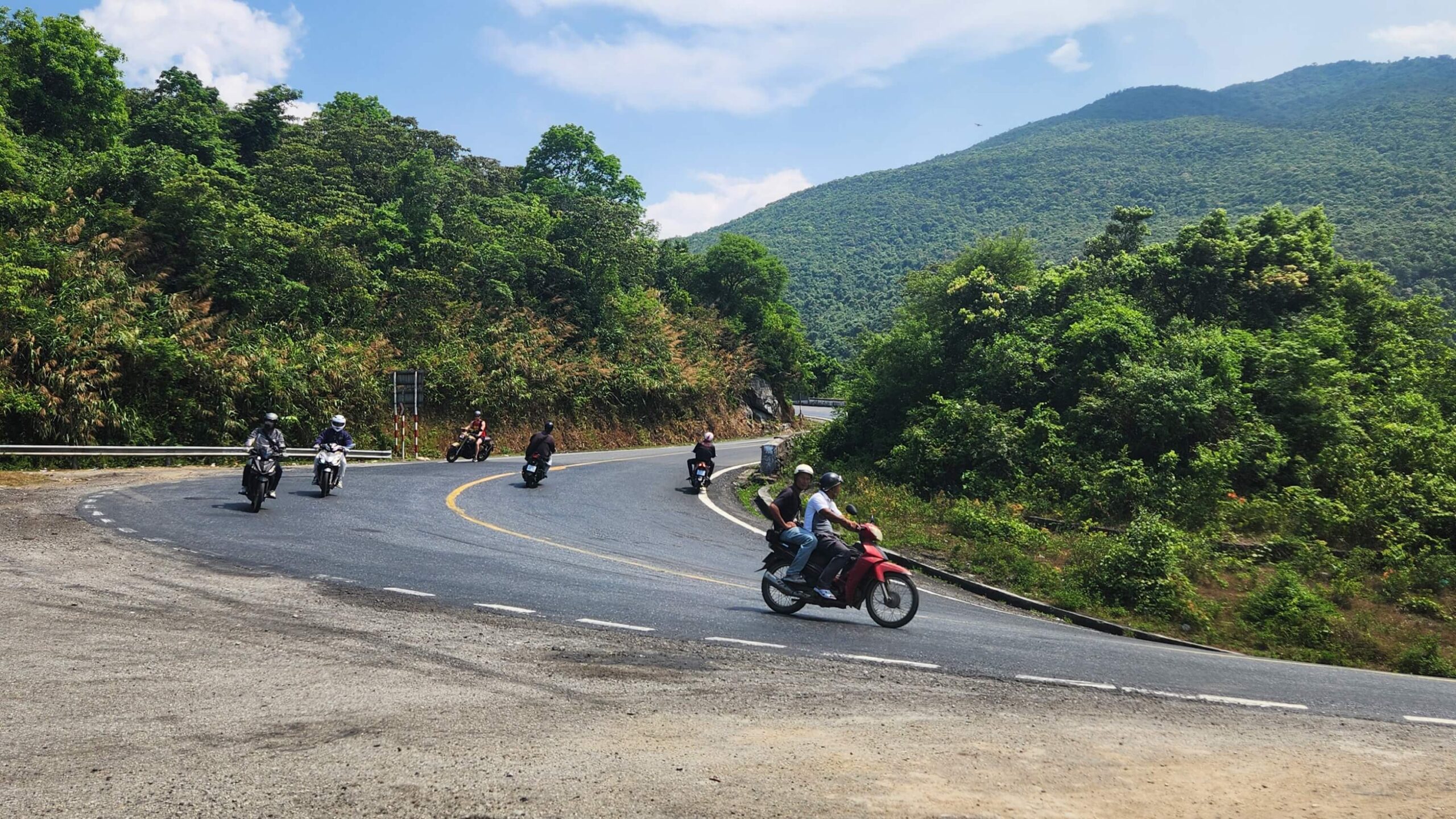
Imagine the road stretching out in front of you, winding its way along the mountainside. On one side, a cliff face blanketed in lush greenery towers above. On the other, the land falls away dramatically to the sea below. This is the famous Hai Van Pass. Would you dare take on this motorbike adventure while travelling through Central Vietnam?
My other half is a huge fan of motorcycle adventures, so I decided to get over my chicken self and add the ride from Da Nang to Hue—and back—to our Vietnam itinerary. It was definitely an adventure, just not at all the one I expected.
In this story, I’ll share our honest experience of riding from Da Nang to Hue via the Hai Van Pass, hoping you can learn from our mistakes if you’re planning to tackle this route yourself.
Before we jump in, there’s one thing I want to say. If you aren’t an experienced motorcyclist and don’t hold a motorcycle licence, please don’t attempt this ride on your own. Instead, book an easy rider—a local driver who takes you as a passenger on their motorbike. It’s a much safer option, and they’ll also take care of the route and itinerary for you.
For this trip, I was the passenger while my other half did the driving. Even with years of riding experience, he found the road challenging. The surface is uneven in places, and Vietnamese traffic rules are… well, non-existent. So stay safe.
Duration
2 days
Pace
Moderate
Transport
Motocycle
Overview of the ride from Da Nang to Hue
- Preparing for the drive from Da Nang to Hue via the Hai Van Pass
- The reality of driving from Da Nang to Hue via the Hai Van Pass
- Important: wear long sleeves when riding a motorbike in Vietnam in summer
- What happens if you get a flat motorcycle tire in Vietnam? A true story
- Other stops along the way from Da Nang to Hue and back
- What else to see in Vietnam?
- Is Hai Van Pass worth it?
Preparing for the drive from Da Nang to Hue via the Hai Van Pass
Our experience renting a motorcycle in Da Nang
For this drive, you’ll need a good motorcycle. Once you’ve found a rental spot in Da Nang (we simply Googled ours), check absolutely everything before you head out—otherwise you might end up with a broken tire and a check engine light blinking at you for half the ride like we did. More on that later.
To rent, you’ll need an international driving permit showing you hold a motorcycle licence, and you’ll have to pay a safety deposit in cash—so make sure you’ve got some on you.

What to do with the luggage?
We flew into Da Nang with two large suitcases. I’ve seen locals transporting enormous objects on motorbikes—I think we spotted someone carrying what looked like a street lamp post—but we’re not quite at that level. So the bags had to be stored somewhere.
If you’re going from Da Nang to Hue and back like we did, try to book the same hotel for the night you leave and the night you return, then ask them to hold your luggage in between. Ours was more than happy to store our big bags for us. If you’re only riding one way, there are motorcycle companies that offer luggage delivery instead.
The reality of driving from Da Nang to Hue via the Hai Van Pass
Early one morning, we set off. Before tackling the Hai Van Pass itself, we took a test ride out towards Lady Buddha to see the wild monkeys, which makes a great stop along the way from Da Nang to Hue with only a small detour. You can read more about it in my Da Nang story.
After that, we left the city behind and the road began to change. The busy streets gave way to windy roads and every so often we’d pass a tiny roadside café.

Hai Van Pass Gate
After around 36 km, we reached our first proper stop: the Hai Van Pass Gate, a leftover military structure that now serves as a small viewpoint.

There are a handful of little shops here, along with a café overlooking the mountains and coastline. We stopped to stretch our legs, and since you need to buy something if you want to take photos from the café’s viewing area, we grabbed a couple of Coke Zeros and some ice cream. But you can also get coffee if you prefer. Sitting on tiny plastic chairs, soaking in the panorama, life felt pretty great.

You can climb up the Hai Van pass gate for a higher viewpoint and behind the gate, a path climbs further up the hill, passing a couple of small bunkers before continuing higher. We gave it a go, but after twenty minutes of steep uphill walking in the intense heat, with little to see beyond trees, we admitted defeat and headed back down to continue exploring on two wheels.
Hai Van Pass
From there, we rode into the most scenic stretch of the journey from Da Nang to Hue—the winding mountain road the Hai Van Pass is famous for.
The views really were beautiful and thrilling. The road in front of you winds like a snake and towering trees and greenery-covered cliff faces rose on one side, while on the other there is the edge of a cliff with the sea far below. Every so often we’d pass tiny roadside shrines, little boxes housing altars tucked into the edge of the hillside.
But this is where reality didn’t quite match my expectations.
From all the stories I’d read beforehand, I’d imagined there would be plenty of places to pull over safely, take photos, and simply enjoy the scenery. In reality, I only remember one spot that actually felt safe enough to stop. So if you’re planning this drive, be prepared to enjoy most of the views with your own eyes—or mount a GoPro if you want to capture the experience hands-free.
The road to Hue after the Hai Van Pass
The Hai Van Pass itself isn’t particularly long—just ~21 km. The full ride from Da Nang to Hue, however, is around 100 km.
I think we somehow took the wrong route on our way to Hue because, after leaving the pass behind, the scenery changed completely. We rode through smaller towns, passed people burning piles of rubbish at the roadside, and spent much of the journey navigating around heavy trucks. I can’t honestly call this stretch beautiful. It was nerve-racking, and after nearly two hours without a proper stop, riding through the heat and dust, it became exhausting too.
Around this point, I started thinking I would have preferred to ride out to the Hai Van Pass, enjoy the scenic section, and then head back to Da Nang. Yes, you’d miss Hue, but you’d also gain another afternoon to explore Da Nang. Or, I’d seriously consider a one-way rental and returning via train rather than riding the full route there and back due to this part of the drive.
Fortunately, on the return journey we found a better route and made several more stops along the way. While a considerable portion of the road still wasn’t especially scenic, breaking the trip into shorter sections made the experience far more enjoyable.
Important: wear long sleeves when riding a motorbike in Vietnam in summer
We noticed that almost every local rider passing us on a scooter was covered from head to toe—long sleeves, long trousers, gloves, face coverings. All in 30-plus-degree heat. At first, we thought it looked completely bizarre.
Then, halfway through our journey, we discovered why.
Despite applying multiple layers of sunscreen, we’d been burnt to a crisp. Our skin was bright red, sore, and stinging. So, as counter-intuitive as it feels in that kind of heat, cover up. Long sleeves are far more effective than sunscreen alone when you’re spending hours exposed to the sun on a motorbike.
We rolled into Hue at around 5 p.m., which gave us enough time for a little sightseeing in the evening And our hotel, the Alba Spa Hotel, had a mineral water jacuzzi, and after spending the entire day on the back of a motorbike, that soak felt absolutely glorious.

What happens if you get a flat motorcycle tire in Vietnam? A true story
You’d think that in a country filled with motorbikes, everyone and their grandmother would know how to fix a flat tyre, right?
Well… not really.
We got a flat while riding over the bridge in Hue. It was 11 p.m., and every repair shop had already closed.
Thank goodness for Google Translate. With its help, my other half managed to explain the situation to some incredibly helpful taxi drivers, who called an emergency roadside repair service for us.
You’d think that would be the end of the story.
But not if you’re riding a “big bike.”
The mechanic arrived, took a look, had a go, and then explained that he couldn’t help. This wasn’t a scooter—it was a motorcycle—and apparently, that makes all the difference. So they called another repair service.
Any luck?
Not really.
At one point, we had two repair services, two taxi drivers, two mini-shop employees, and three random passers-by all standing around staring at this tyre trying to help. Not one of them could work out how to fix it.
After about two hours, everyone admitted defeat. We were told to find a repair shop in the morning, and my hero ended up pushing the 200 kg bike all the way back to our hotel— which thankfully was just a fifteen-minute walk. I genuinely admire his dedication.
The next morning, he visited three different repair shops.
Nobody could repair a big bike tire.
Nobody had the correct size inner tube.
So, in the end, he bought one that was slightly too small, borrowed a few tools, and somehow managed to fix it himself well enough for us to ride all the way back to Da Nang.
Long story short: people in Hue are very helpful and if you’re riding a scooter, you’ll probably find plenty of help—just ask the locals. But if you’re on a big bike, you’re out of luck. Be mentally prepared for that, and maybe watch a few videos on changing an inner tube before you go.
Or, you know… just don’t get a flat tyre.
Other stops along the way from Da Nang to Hue and back
These are the stops we made on our return journey from Hue to Da Nang.
Lang Co Beach
While researching the route, I’d marked Lang Co Beach as a potential stop.
I don’t know whether we ended up in the wrong place or whether my information was simply out of date, but this turned into a classic expectations-versus-reality moment.
It looked as though there had once been a large beach resort here, but it was either being renovated or demolished. All that remained were crumbling buildings, broken pathways, and a faded sign bearing the resort’s name. The walk down to the beach was littered with dry palm leaves and rubbish.

The beach itself was nice though—soft sand, blue water, and mountains rising in the distance. It definitely has potential.
But as it stood in 2026, I didn’t think it was worth the stop.
Lang Co Bay
This place, by contrast, was absolutely beautiful.

The road follows the lagoon, with deep blue mountains rising beyond the still water. On calm days, the surface reflects the sky, creating a stunning mix of different shades of blue. Hundreds of wooden poles stand in the water—I’m still not entirely sure what they’re for, though I suspect they’re connected to fishing—and a handful of fishing boats drift peacefully nearby.
The whole place has an incredibly calm atmosphere and was one of my favourite stops on the journey.

The Hai Van Pass was just as beautiful on the ride back as it had been the day before, and of course we stopped at our favourite little café once again. After that, it was simply a matter of getting back to Da Nang and returning the bike.
Continue your Vietnam trip
What else to see in Vietnam?

~1,5 flight
Hanoi
Vjetnams chaotic capital

1,5 h flight
Da Nang
Perfect mix of vacation vibes and cultural imersion
Is Hai Van Pass worth it?
Overall, it was an adventure. Not a smooth ride. Not what I was expecting. But an adventure.
So: be mentally prepared, make sure you get a good motorcycle, wear the right clothing, and build plenty of stops into your route from Da Nang to Hue, and you’ll be fine. Or—as I said at the start— if you don’t have a licence, get an easy rider to take you over the Hai Van Pass, and you can worry about nothing at all and simply enjoy the views.