
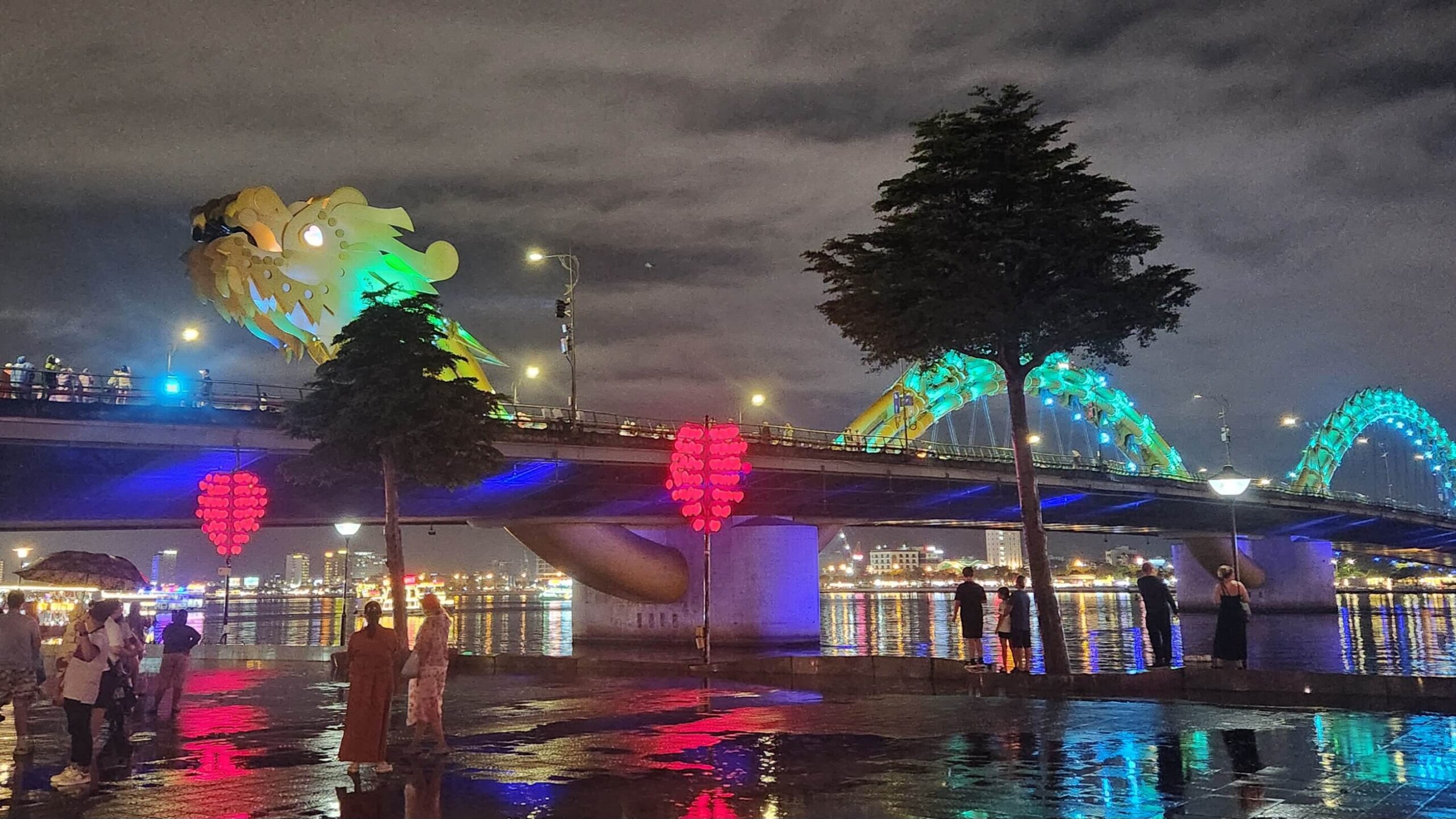
Da Nang, with its beautiful beaches and historic sights all within easy reach, is the perfect mix of laid-back vacation vibes and cultural immersion. You can spend the morning relaxing by the sea, the afternoon exploring ancient temples and caves, and the evening watching a bridge transform into a giant flamethrower. How cool is that?
Many people choose to stay in historic Hoi An, but I’m a firm believer that Da Nang makes a better home base for exploring Central Vietnam. So let me try to convince you by walking you through some of the most fun things to see and do in Da Nang—all discovered over the two days we spent there during our Vietnam trip.
Duration
2 days
Pace
Moderate
Transport
Grab taxi
Da Nang attractions overview
- Fun and unique things to see and do in Da Nang
- Visit Lady Buddha & Son Tra Peninsula (Monkey mountain)
- Riding the famous Hai Van pass: A must-do Da Nang Adventure for moto lovers
- Watch the Dragon bridge fire and water show
- Explore Love lock pier & Dragon carp
- Relax at My Khe Beach (Da Nang beach)
- Climb the Marble mountains & Am Phu cave
- Half-day trip from Da Nang to Hoi An to see the lanterns
- Where to eat local food in Da Nang?
- What to see near Da Nang?
- Is Da Nang worth visiting?
Check out my full Vietnam itinerary
Fun and unique things to see and do in Da Nang
Visit Lady Buddha & Son Tra Peninsula (Monkey mountain)
Free
As you approach Son Tra Peninsula, you can spot the slightly blurry silhouette of Lady Buddha—the Goddess of Mercy—standing proudly in the distance. At 67 metres tall, the white statue is roughly the height of a 20-storey building, making it impossible to miss.
Once you pass through the decorative gate, a large garden opens up, lined with rows of green bonsai trees depicting miniature scenes of the world. Somewhere among them, a tiny figure of an old man sits beneath the roots of one tree, presumably contemplating the meaning of life.

But what’s that – hiding in the shade beside a dark statue of what I assumed was Buddha? A wild monkey! We kept a safe distance and watched him pluck a bloom from a nearby plant before happily snacking on it.

This whole area surrounding Lady Buddha is known as Monkey Mountain—and for good reason. There are plenty of monkeys roaming around this part of Da Nang.
You’ll find even more of them closer to the base of the Lady Buddha statue, where they climb through the trees, wander across the grounds, and entertain the crowds of curious tourists with cameras. They don’t seem aggressive as long as you keep a respectful distance; they’re clearly used to people being around. I think the wild monkeys are kind of cute… and kind of fun.

Though the realisation that you never actually know there’s a monkey above you until the branches start shaking violently or someone spits something on your shoulder is a little unsettling.
From here, you can walk right up to the Lady Buddha statue and even step inside its base, where there is a small sanctuary. During our visit, people were praying inside, so we just peeked in to admire the altar and colourful walls but didn’t fully explore the inside so as not to disturb them.

Overall this is one of the best free things to do in Da Nang, so I’d genuinely recommend adding it to your Da Nang itinerary.
Riding the famous Hai Van pass: A must-do Da Nang Adventure for moto lovers
Pay for motocycle rental or driver
Are You Brave Enough to Conquer the Hai Van Pass?

Our Da Nang itinerary took a slightly different turn here. After visiting Lady Buddha, we headed off to ride the famous Hai Van Pass—the motorcycle route featured on Top Gear—and spent the night in Hue. It’s one of the most popular day trips from Da Nang, so if that kind of adventure sounds like your thing, hop over to my other travel story for all the details (including what happens when you get a flat tire in Vietnam).
But if motorcycling isn’t for you and you’re only here for what to see in Da Nang itself, let’s jump ahead to the day after when we return. For you, it’ll simply read as one continuous story.
Watch the Dragon bridge fire and water show
Free
Ever seen a fire-breathing dragon? Turns out they aren’t only a myth!
One of the coolest things to see in Da Nang is the Dragon Bridge—a massive bridge crowned by a giant dragon stretching across its entire length. At night, it truly comes alive, especially on weekend evenings when the famous fire show takes place.
After dark, the dragon lights up in a rainbow of colours that slowly ripple along its enormous body. Even if you don’t happen to visit on a weekend, this Da Nang attraction is still well worth seeing. But the fire show is something truly unique.
Right at 9 p.m., the dragon comes alive, breathing bursts of fire into the night sky. Stand close enough, and you can actually feel the heat from the flames shooting out of its giant head. How cool is that?

Once the fire show ends, it’s time to cool off. For the next couple of minutes, the dragon transforms into a giant water cannon, spraying everyone gathered near its head.
The best place to watch the show seems to be Love Lock Pier. Arrive early, though—even in the pouring rain, there was already a crowd of people waiting impatiently, bundled up in their raincoats.
Travel tip: The famous Dragon Bridge fire show takes place every Friday, Saturday, and Sunday night at precisely 9:00 PM.
Explore Love lock pier & Dragon carp
it has a few attractions of its own. At night, rows of glowing heart-shaped lights illuminate the pier, while Da Nang’s skyline sparkles across the river.
If you’ve ever been to Singapore, you’ve probably met the Merlion—half lion, half fish. Da Nang has its own mythical guardian: the Dragon Carp, a half-dragon, half-fish creature that continuously spits water into the river while standing watch over the pier.
So stop by to grab a picture of this fun fountain.

Relax at My Khe Beach (Da Nang beach)
Free, pay for sunbed rental
You could easily spend hours on Da Nang Beach. In fact, I still wonder how we managed to explore anything else when there was such a strong temptation to spend the day lying under an umbrella with a fresh coconut in hand.
We started by taking a walk along the shoreline of My Khe Beach, our feet in the warm water as the sand during the day was so hot you could bake eggs in it. Looking back, the beach stretched out with hotels and high-rises rising behind it, and if you looked closely, you could even spot the tiny silhouette of Lady Buddha in the distance. Da Nang Beach seems to be buzzing with tourists—people were swimming, relaxing, and even paragliding overhead.

Eventually, we rented a sunbed and an umbrella, grabbed a few refreshments, and spent a couple of hours alternating between splashing in the sea and simply doing nothing at all. One thing I’d definitely recommend is renting an umbrella. The Da Nang sun is on stereoids, so you’ll be grateful for the shade.
Climb the Marble mountains & Am Phu cave
Has entrance fee
Once upon a time, a giant sea dragon emerged on the shores of Da Nang to lay an egg. A girl hatched from it, and the shattered eggshell became five mountains, each representing one of the five elements. I have no idea what happened to the girl, but today, the area is known as the Marble Mountains.
There are actually two separate attractions here, each requiring its own ticket: the Marble Mountains themselves—a network of cliffs connected by walkways, caves, and temples—and Am Phu Cave, which depicts the Buddhist concept of hell.
We started with the Marble Mountains, taking the glass elevator to the top. It costs a little extra, but considering how much climbing you’ll be doing afterwards, it’s money well spent. As soon as we stepped out, a beautiful multi-level pagoda rose above us. The intricate detail carved into its pale grey tower is stunning, and the colour blends perfectly with the surrounding rock.

After snapping a few photos, we wandered along the winding paths, passing statues, smaller pagodas, and shrines that seemed to melt naturally into the landscape, blurring the lines between nature and man made. On the way I peeked inside a cave filled with the scent of incense, where an altar sat quietly beneath the rock ceiling, before admiring a few beautifully painted temple buildings.

Eventually, we reached the first lookout point, Heaven’s Gate, only to discover that the final stretch involves scrambling over steep, polished rocks that become incredibly slippery. It felt more like an obstacle course than a viewpoint. Fortunately, there’s another panoramic lookout nearby with a proper viewing platform that doesn’t require risking your life for a photo. I’d recommend skipping this one and heading there instead.

Then came the highlight of the Marble Mountains: a vast cave with a soaring ceiling, shafts of sunlight streaming through openings above, and a majestic Buddha statue sitting proudly at its centre. This is the Huyen Khong Cave. Although everything is made out of rock the atmosphere inside feels incredibly grand—just as if you were stepping into a great cathedral or mosque.

After taking it all in, we made our way back down and bought tickets for Am Phu Cave.
You get your first hint of what’s waiting inside before you even enter. As you cross the bridge leading to the cave, look down into the water and you’ll see human hands reaching up from below, as if pleading for help.

Inside, the cave opens into a surprisingly spacious chamber with a high ceiling. The journey begins in a judgement hall, where your sins are weighed before you’re sent deeper into hell itself. As you wind your way through the narrow passages, it’s not hard to imagine this really is what hell might look like. Creepy faces and monsters emerge from the rock walls, while gruesome sculptures show people being devoured by animals and tortured by demons.
It’s creepy.

Once you’ve made it through hell—and hopefully committed to becoming a better person afterwards—you can climb towards heaven. Here, the path is lined with lotus flowers, animal statues, and carvings of deities before leading to a small pagoda and an observation platform with panoramic views over the surrounding landscape. A few pigeons were cooing and circling overhead while we were there, almost as if they’d been sent from heaven itself. Just be careful on the way up—the staircases are steep and can become slippery.

It took us around two hours to explore the Marble Mountains themselves and just under an hour to visit Am Phu Cave, so make sure you leave yourself plenty of time for this Da Nang attraction.
Half-day trip from Da Nang to Hoi An to see the lanterns
As I mentioned earlier, plenty of people choose to base themselves in Hoi An—but I much prefer Da Nang, since Hoi An is, well, soooo crowded! Da Nang is much more chill. Still, I think Hoi An is an absolute must-see in Central Vietnam.

Luckily for us, Hoi An is only around 30 to 40 minutes away from Da Nang by Grab, making it perfect for an evening trip to see the magical, lantern-lit streets—and to make a wish by releasing a lantern of your own onto the water.
You can read more about it in my Hoi An day trip story.
Where to eat local food in Da Nang?
As I mentioned in my Hanoi story, our food experiences across Vietnam were a bit of a mixed bag—but I’m happy to report that Da Nang delivered, and I never once got sick from the food here. Here are the places we ate in Da Nang, starting with my favourite.

Bếp Ngon Việt – a small Vietnamese restaurant, perfect for lunch. I had the lemongrass skewers, which turned out to actually be baked around a grass stalk, served alongside DIY rice paper spring rolls: all kinds of vegetables you wrap yourself and dip into the sauce.
Thìa Gỗ Restaurant Da Nang—not quite as small – you press a button to call the waiter when you’re ready to order and quite busy. But I had an amazing, flavourful beef pho here, so I’d recommend it wholeheartedly.
Nhà An —a Vietnamese local food and vegan restaurant. This was a more touristy spot, which we visited first while we were still cautious about the food, but it was still good in our opinion. I tried salty pork wrapped in leaves that looked like grape leaves but definitely weren’t, served with a side of salad and rice noodles for dipping.
Continue your Vietnam trip
What to see near Da Nang?

~1,5h flight
Hanoi
Explore Vietnams chaotic capital

1,5 h flight away
Da Nang
Perfect mix of vacation vibes and cultural imersion
Is Da Nang worth visiting?
Yes. I know some people say Da Nang isn’t as culturally rich as Hanoi, but it has other things going for it—I’d call it simply cool. It’s a perfect mix of vacation vibes and sightseeing: the beach, the food, and fun places to see in Da Nang like the Marble Mountains all rolled into one. It’s also a great home base for exploring Central Vietnam, since both Hoi An and Hue are so easy to reach from here.
If a friend asked me where to stay while exploring this part of Vietnam, I wouldn’t send them to Hoi An first. I’d send them to Da Nang—beach in the morning, fire-breathing dragons at night, and a whole region’s worth of history just a short ride away. Honestly, what more could you want?