
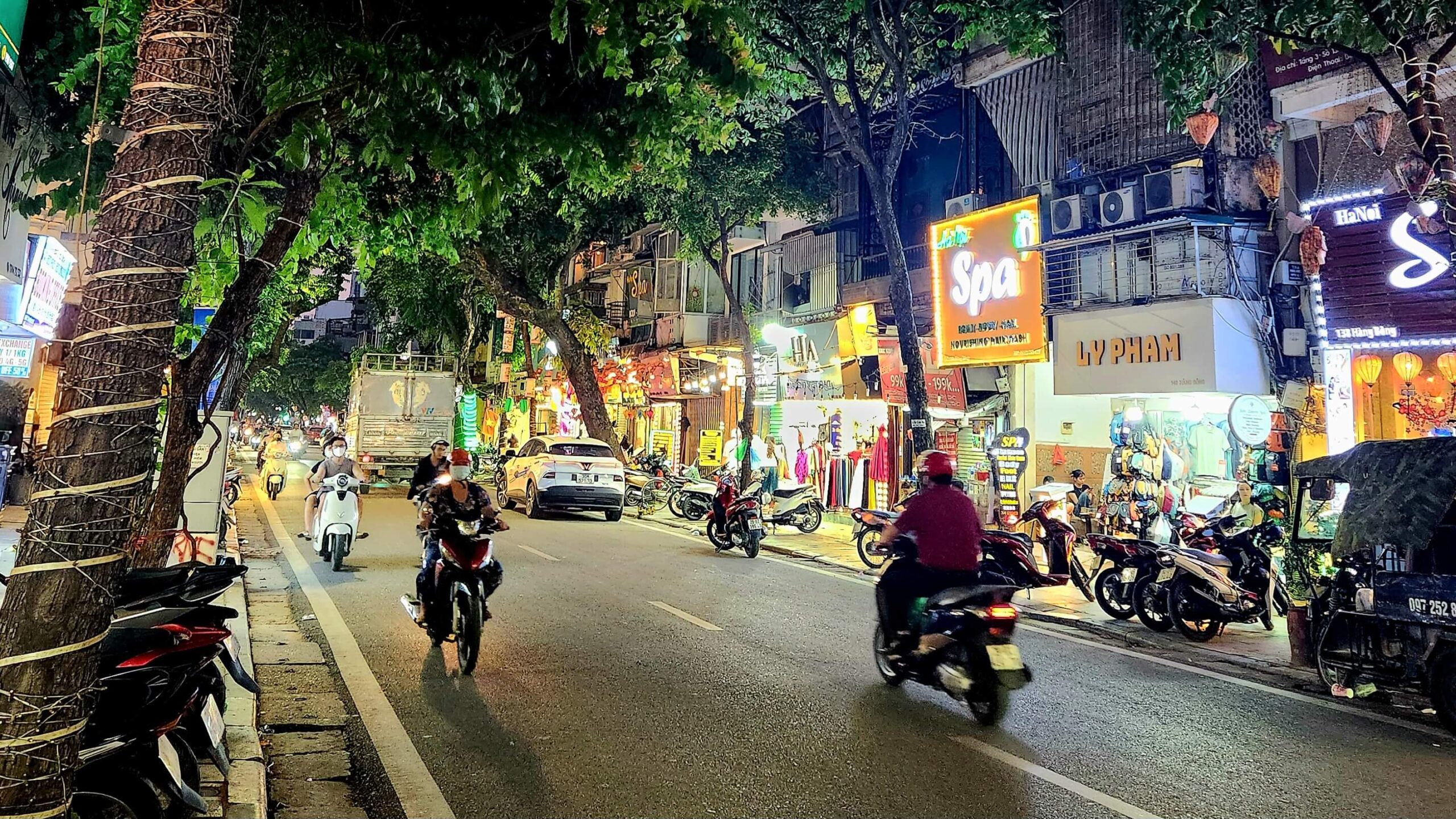
In the streets of Hanoi you’ll find vendors serving food to people sitting on tiny plastic chairs. An open-air haircut happening on the pavement, completely unbothered by the passing traffic. Scooters create traffic jams in a roundabout because everyone seems to be moving in their own direction. And in the suburbs you’ll find rice fields with old gravestones quietly nested in them.
Hanoi is a city of sharp contrasts — and many of them are the things you won’t find in the photos.
Most travellers associate Hanoi with the Old Quarter. But spend more than a day here and you’ll quickly realise that different parts of the city feel like entirely different worlds. Due to unfortunate weather, our original 2-day Hanoi itinerary quietly stretched into a 4-day Hanoi itinerary and we got to explore more Hanoi attractions than we originally planned.
So this is our honest, day-by-day Hanoi travel itinerary — what we did, what surprised us and what I’d do differently if I returned to Hanoi.
Duration
4 days
Pace
Moderate
Transport
Grab taxi
Hanoi itinerary overview
- Day 1 of Hanoi itinerary: stepping into the chaos
- Day 2 of our Hanoi itinerary: What to do in Hanoi beyond the Old Quarter
- Day 3 of our Hanoi itinerary: Out of the city and back again
- Day 4: Prison, ancient walls, and one very good massage
- Where to go after visiting Hanoi?
- FAQs about traveling to Hanoi
- Is Hanoi worth visiting?
Check out my full Vietnam itinerary
Day 1 of Hanoi itinerary: stepping into the chaos
If you’re flying into Hanoi from Europe, brace yourself — the culture shock starts before you even leave the airport.
Immigration queues can be long. Very long. What many first-time visitors don’t realise is that getting through arrivals in Hanoi can easily take a couple of hours, especially during busy periods. So arrive prepared, be patient, and don’t make any plans for your first evening that are time sensitive.
Once you finally make it to your hotel — whether by Grab or by bus if you’re watching your budget — there’s only one thing to do.
Head outside.
Because the best way to start your Hanoi itinerary isn’t by ticking off a list of Hanoi attractions. It’s by walking into the chaos and letting the city introduce itself.
Hanoi Old town
Free
The Old Town isn’t just a maze of streets lined with red flags, ageing buildings, and tiny shopfronts. It’s a vibe. A very specific, very alive kind of chaos.
The moment we stepped out of our hotel, it hit us — movement, noise, and scooters rushing past in every direction. It’s loud. And I’ll be honest: at times it’s a little smelly and not the cleanest place I’ve visited. But I’ve experienced the same thing in European cities too, and I think it’s worth saying out loud rather than pretending every corner of Hanoi is picture-perfect. Come prepared, and you’ll appreciate it for what it is.

I thought people were exaggerating when they said they’d seen strangers cutting each other’s hair on the street. I saw it within the first five minutes of walking through Hanoi’s Old Quarter. People were also eating lunch, smoking, selling fruit, sitting and chatting — all of it spilling out onto the pavement. In Singapore’s Chinatown, we heard how the five feet in front of the front door used to be the space where life happened. In Hanoi’s Old Town, it still does.

The ground floors of the buildings lining the streets are mostly filled with shops selling knock-offs and small cafés. Walking here is a constant exercise in awareness — motorbikes and cars appear from every direction, and by dinner time, enthusiastic café staff will be calling you over to try their food or stop for a beer. Same with the massage salons they do very active marketing. But it’s manageable and not a reason to exclude the Old Quarter from your Hanoi itinerary.
~8 min walk
Hanoi Train street
Pay for the drink
After wandering around the Old Quarter for a while with no real destination, I would recommend you to make your way to one of the most famous places to visit in Hanoi — Train Street.
I’ll admit, I never would have predicted that sitting on a tiny plastic chair, sipping coffee within arm’s reach of an active railway track, would become something people travel across the world to experience.
Hanoi proved me wrong.

Hanoi Train Street is a strange combination of everyday life and organised chaos. It buzzes with people waiting for the big moment — a train passing through a narrow street, squeezing between houses with barely any space to spare. The tracks run so close to the buildings that, from one of the small cafés lining the railway, you could theoretically reach out and touch the train as it passes.
Please don’t.
When train time approaches, you can no longer wander freely along the tracks. You’ll need to be seated inside one of the cafés, which means buying a drink. A coffee, a beer, a coconut — anything works. Arrive to Hanoi train street early if you want a good spot, and be prepared to wait. We visited Train street twice on our Hanoi trip, once during the day and once in the evening, and both times the train was late.
When it finally arrives, the train moves surprisingly slowly, and you can see passengers waving from the windows as it squeezes through the narrow passage. As long as you stay safely within the marked areas, it’s not frightening at all — just a bit thrilling.

One thing worth knowing: there have been discussions about the future of Train Street, with plans to move train services to a new high-speed rail system, which would eventually stop trains from running along these tracks. So if experiencing this unusual Hanoi attraction is high on your list you probably have limited time.
Walk
Late-night snack stop: Circle K
You’ve probably heard about Japan’s legendary convenience stores. Vietnam has its own version of that particular joy. The most popular chain we spotted around Hanoi was Circle K, and it’s worth a browse — especially for a late-night snack run. I picked up seaweed-flavoured crisps and a matcha-brown bean ice cream shaped like a fish. If you’re feeling braver, you’ll also find chicken feet and various seafood snacks on the shelves.
With this little treat the first day of our Hanoi itinerary comes to an end, so it is time to head to the hotel and re-charge.
Day 2 of our Hanoi itinerary: What to do in Hanoi beyond the Old Quarter
Day 2 of this Hanoi itinerary reflects our original plan of what we would have prioritised if we only had 2 days to spend in Hanoi. It brings together the essential sights, food, and a surprisingly perfect way to end the day. Vietnam wakes up early so we did too.
Vietnam Military history museum
Has entrance fee
War and its legacy have shaped Vietnam in ways that are impossible to ignore, so it feels right to spend time exploring the darker side of its history on our Hanoi itinerary rather than skipping past it. On the way, we spotted the HUGE concrete building and immediately wondered what it was. It turned out to be the Military history museum itself. We spent around four hours here and still didn’t have time to read all the information.

The outdoor exposition is the standout: US military aircraft and tanks lined up on one side, Vietnamese ones on the other, with a large victory column standing between them. Even without knowing much about military equipment, there was something intriguing about seeing all of it up close. The tower made from the wreckage of crashed aircraft was particularly haunting.

Inside, the museum tells Vietnam’s war history from Vietnam’s point of view. We skipped through the ancient history sections and went straight to the American War, where you’ll find photographs, artefacts, and written accounts in chronological order.
War is always a hard topic for me, so after the museum I genuinely needed something to warm my soul. A food tour felt like the right answer.
~35 min Grab ride
Hanoi food tour
Paid tour
Food in Vietnam isn’t just sustenance — as one of our guides put it, feeding the people you love is how Vietnamese people express love. So exploring the food scene felt like an essential part of understanding Vietnam on our Hanoi trip. We chose a food tour for two reasons: to try the local food, and to learn about the food traditions from a local
Full honesty: we did end up with upset stomachs afterwards and a couple other times during our trip, so it’s worth choosing your tour operator and the places you eat in carefully to avoid food poisoning. But the experience itself was still very interesting.

Our guide took us to three local spots — the kind with extra seating tucked away upstairs — where we tried bun cha (the pork and noodle dish famously eaten by Obama, where you dip noodles and herbs into a fish sauce broth), dry pho (a mix-it-yourself noodle dish with chicken, vegetables, and fried onions), and banh mi sandwich, which was good but felt a little too familiar to our palette compared to the others.
We finished with sticky rice, coconut ice cream, and the famous egg coffee — thick and sweet, and no, it does not taste like eggs at all.

Along the way our guide shared small but revealing details about daily life in Vietnam — from regional differences between north and south, to economic realities, to food traditions shaped by history. Even simple customs, like not banging chopsticks together, carry meaning rooted in times of hardship. Don’t bang your chopsticks together in Vietnam or you’ll call in the hungry ghost — a haunting reminder of the period when Vietnamese people were forced to give up all their rice and starve.
It’s these snippets of information that brings our Hanoi itinerary to life.
~13 min walk
Turtle lake (Hoàn Kiếm Lake)
Has entrance fee
After the food tour, we made our way to Turtle Lake — more properly known as Hoàn Kiếm Lake — to see the small island temple that houses two preserved giant turtles.
The lake itself is one of the nicest places to visit in Hanoi. Because living spaces in the city tend to be small, a lot of life spills outdoors here. In the evenings you’ll see groups of women dancing, people exercising, and couples sitting along the water’s edge.

There are two islands on the lake. One is a small structure we couldn’t quite figure out, and the other holds the temple. You pay a small entrance fee to cross the red bridge, and inside you’ll find all the elements of a traditional temple — detailed architecture, incense smoke filling the air, and a beautiful hall with an altar. And in the tiny yard you’ll see some fruit growing in the threes.

The unusual part is the side room, where two giant turtles are preserved and on display. They really are huge. The legend of the lake is explained here too, and it’s worth taking a moment to read while you’re there.
Overall it’s a short, calm and atmospheric stop that balances out the intensity of the Hanoi trip.
~18 min walk
Head spa in Hanoi
Has entrance fee
To end the day properly, I’d been wanting to try a Vietnamese head spa — a wellness experience where for 90 minutes or longer, your head, neck, and shoulders are completely pampered. It’s a perfect way to relax after a couple of days on your Hanoi trip, so if you’re into beauty treatments and relaxation, I’d recommend adding this to your Hanoi itinerary too.
The spa experience started with welcome tea, followed by a foot wash (which made me feel a bit awkward after a full day of walking around Hanoi, but there we go). Then came a long, thorough massage using hands, a head massager, what I think was a gua sha stone, and more. My hair was washed, and I even had a face mask applied.
For around €30 — a fraction of what you’d pay in Europe — it was outstanding. I chose a slightly higher-end establishment Serene Spa to make sure communication would be easy, and it made a difference.
And that’s the end of day two of our Hanoi itinerary.
As mentioned this was supposed to be our last night in Hanoi and we were planning to head to Sapa with an evening minibus the next day after an excursion in the morning, but the weather forecast was showing non stop rain so we pivoted and got an extra day and a half in Hanoi.
Day 3 of our Hanoi itinerary: Out of the city and back again
By day three of your Hanoi trip, you may have grown slightly more comfortable with crossing the street when it looks like absolutely no one is going to stop for you.
I never did.
The plan for today is to leave the centre behind for a few hours and then return for more classic Hanoi attractions in the heart of Vietnam’s capital.
Military jeep tour to Hanoi suburbs
Paid excursion | Book here
There are many sides to Hanoi, and I wanted to see what life looked like beyond the city centre. A local guide felt like the best way to do that — and the fact that the tour involved a military jeep made the decision even easier.
Riding through Hanoi in an open jeep, with rivers of motorbikes rushing past, wind in your hair, and no seatbelt, is thrilling in a way that would probably make safety regulations back home uncomfortable. But I loved it.

Once we left the city behind, the landscape changed completely. Green rice fields stretched out around us, gently moving in the wind, with occasional grave stones scattered between them. Our guide explained that families who couldn’t afford cemetery plots sometimes bury relatives in their own fields.
It’s exactly the kind of glimpse into local life that I never would have discovered without someone from Hanoi showing me around.

We visited a temple and drank lotus leaf tea sitting on a platform in a lotus lake, surrounded by flowers just beginning to bloom, water lilies, and colourful fish beneath the surface. Sitting there, sipping the bitter tea and talking with our guide about her life, culture, and worries for the future, felt less like a tour and more like a conversation with a friend.

The tour finished with a home-cooked meal — tofu, meat rolls, vegetables, rice, and soup — a full spread of little bits of everything, completely different from the food tour the day before.

If you want to understand a side of Hanoi beyond the usual attractions, I’d highly recommend adding a local-led excursion to your Hanoi itinerary.
Grab ride
Ho Chi Minh square
Entrance to the squere is free, Hochi Minh stilt house area has an entrance fee
Back in the city, we made our way to the area around the Ho Chi Minh Mausoleum and his former stilt house. Ho Chi Minh was the revolutionary leader and first President of Democratic Republic of Vietnam , and he remains one of the most important figures in modern Vietnamese history.
This is a place where the significance of what you’re standing in front of matters more than any visual spectacle. A large Vietnamese flag flutters in the wind, and the wide, concrete square feels faintly reminiscent of Tiananmen Square in Beijing.
The mausoleum itself — a plain, heavy concrete structure with columns — has limited opening hours and often long queues of two to three hours, so we chose to view it from outside instead. We timed our visit well: the guards were changing when we arrived, and watching them march into position was unexpectedly intriguing.

From there, we walked to the One Pillar Pagoda — a small, unusual temple balanced on a single pillar above a pond. It’s more of a quick photo stop than a long visit, but genuinely beautiful in its simplicity.

We then continued to Ho Chi Minh’s stilt house. The structure is modest: two simple rooms (one for work, one for rest) and an open-air space below for meetings. Its simplicity says more about the life views of a person that lived here than any exhibition could.

Practical tip: wear modest clothing for this area and expect a security check on the way in.
~20 min walk
Temple of Literature
Has entrance fee
Not far from Ho Chi Minh Square is the Temple of Literature — Hanoi’s most famous temple and the site of Vietnam’s first university.

I’ll be honest: I didn’t find it dramatically different from other temples we visited, and if I had limited time, I’d probably choose the Hoàn Kiếm Lake area over this one. But that’s a personal preference, and plenty of people would disagree, as the Temple of Literature often appears at the top of Hanoi attractions lists.

The entrance gate is beautiful, the bonsai trees in gardens are nice too, and there’s a large ceremonial bell and drum to see. What makes it more distinctive are the rows of stone turtles carrying large stone tablets on their backs, engraved with the names of scholars who studied here — although many of the inscriptions have faded over time.

If you hadn’t picked it up by now, the turtle is one of the four sacred animals in Vietnamese culture, symbolising wisdom, longevity, and stability.
At the end of the day, we attempted to visit the Lotte Tower observation deck, but the staff at the ticket office told us it was too cloudy to see anything. At €7 — steep by Hanoi standards — we decided to skip it.
Still, the contrast between the chaotic street life of the Hanoi Old Quarter and the polished shopping mall inside the skyscraper is striking. It feels like a glimpse of a very different Hanoi, one that is rapidly modernising and will likely look completely different in the near future.
And with that, we wrapped up day 3 of our Hanoi itinerary.
Day 4: Prison, ancient walls, and one very good massage
Our final day of this Hanoi itinerary feels like a mix of contrasts — history that’s heavy and difficult to sit with, ancient ruins hidden in plain sight, calm lakeside moments, and one very good massage to end the trip.
Hoa Lo prison (Hanoi Hilton)
Has entrance fee
The dark stone walls of Hoa Lo Prison are genuinely haunting from the moment you arrive.
The story told inside has two main parts: how Vietnamese political prisoners were held here under French colonial rule, and how American prisoners of war were later held by the Vietnamese during the American War.
The museum leans heavily on the first. Conditions under French rule were brutal — prisoners were crowded together with limited food, water, and warmth — and the exhibition highlights both the suffering and the revolutionary spirit many maintained, including repeated escape attempts.
The American section presents a very different narrative, showing captured pilots receiving medical care, packages from home and playing sports as if they were in a rehabilitation facility rather than in confinement. The contrast in perspective is striking, and it’s something you find yourself thinking about after you leave.
It’s an interesting, layered Hanoi attraction to spend an hour or two.
Coconut coffee
After all that heaviness, you’ll probably need a pick-me-up. Coconut coffee — made with thick coconut cream — is exactly the right answer. Cold, sweet, indulgent, and refreshing all at once. More of a dessert than a coffee, honestly, but a very good one. You can find it in any old school cafe in Hanoi’s old town.
~24 min walk
Imperial citadel of Thăng Long
Has entrance fee
When we first walked in and circled the flag tower, I felt a slight pang of disappointment — you can see it clearly from outside, and you can’t climb to the top. It made me wonder if this Hanoi attraction was really worth the ticket price. But the real discovery is on the opposite side of the complex.

Walk through the stone gate at the far end of the square and you find yourself in a completely different atmosphere. Lantern-lined paths run beneath the trees — some of them jackfruit trees with enormous fruit hanging low — and following them leads you through an unexpected mix of sights.

There are remains of the ancient citadel, weathered structures with curved roofs, exhibition rooms telling its story, a large ceremonial drum beside a turtle statue, and then — through a door in the ground — a wartime bunker with a meeting room and old telephone exchange.
It’s a strange but fascinating combination, and one of the more surprising stops in any Hanoi itinerary.


~11 min Grab ride
West Lake (Hồ Tây)
Free
Hanoi’s West Lake feels like it belongs to a different city entirely. Similarly to the West Lake I saw in China, it’s vast and calm, the far shore fading into mist, with a few modern buildings rising above the waterline. The pace here is noticeably slower. You’ll still see older men playing cards by the water, but none of the chaotic energy of the Hanoi old town.

In the middle, where the tree-lined road cuts through the lake, a terracotta-coloured pagoda peeks out — slim and elegant, with white statues in each of its windows.

There’s also a temple next to it, with all the usual elements you’d expect: prayer halls, bonsai trees, and the soft scent of incense. It’s a pleasant stop if you have time, but by this point in our Hanoi itinerary we had already visited quite a few temples, so it’s also understandable if you choose to skip this one.
After spending time by the lake, it doesn’t take long before you find yourself drawn back into the busier side of Hanoi.
~11 min Grab ride
Hanoi weekend night market
Free
If your visit falls on a weekend, the street leading to the Dong Xuan Market gets closed off and the whole market spills out onto the road — a long corridor of stalls selling clothes, little knitted animals, sunglasses, fruit, and colourful ice cream balls that looked like they were smoking.

Occasionally, an octopus tentacle on a stick appeared. I found those more alarming than appetising, but I’m sure they have their fans.
It’s not quite on the same scale as night markets in China, in my experience, but it’s fun to walk through.
~17 min Grab ride
Massage at Orient spa in Hanoi
We ended our last night with a massage. There’s no shortage of spas in the Old Quarter — you’ll hear invitations constantly as you walk the streets — but we chose Orient Spa because we could book and pay online, which mattered at this point as we were running low on cash. If you’re travelling to Hanoi, bring more cash than you think you’ll need, as paying by card in many places comes with a surcharge.
Like the head spa earlier in our Hanoi itinerary, the massage begins with welcome tea and a foot soak. We chose a signature massage combining Thai, deep tissue, aroma, and hot stone techniques.
I want to be clear: this is not a gentle experience. There was twisting, pulling, pressing, and at one point the therapist was sitting on my back. It was occasionally painful. But somehow, by the end, we felt completely relaxed.
Effective is the word.
Travel tip: bring a small amount of cash for a tip on top of your payment, as it goes directly to your therapist.
After the massage, we left feeling relaxed and slightly sleepy, and made our way back to the hotel. We fell asleep almost immediately, ending our Hanoi itinerary on a very good note.
Continue your Vietnam trip
Where to go after visiting Hanoi?

~3 stundu attālumā
Ninh Binh
Paradise on earth full of green rice fields and lotos covered ponds

1,5 h flight
From Da Nang to Hue on motocycle
Our adventures and lessons of driving a motocycle through Hai Van pass
FAQs about traveling to Hanoi
Kā visērtāk pārvietoties pa Hanoju?
How to get around Hanoi?
We used Grab (similar to Uber / Bolt) as you can see the price upfront and you can put the address in, so you don’t have to speak Vietnamese.
Where to stay in Hanoi?
If you are taking excursions or doing limousine transfers, those usually only offer pick up / drop off at Hanoi Old quarter which is why I would recommend this area. Also if you’re a walker like we are, Old Town is within walking distance from many attractions.
Do I really need cash, or can I just use my card/Apple Pay?
You need cash if you want to purchase something in street shops and street food stalls. The bigger establishments like hotels, supermarkets and convenience stores usually accept card but expect a surcharge for card payment, so cash will get you a better deal in most cases.
Is Hanoi worth visiting?
I think there’s a specific reason people visit Hanoi, and that reason is to experience the chaotic energy of city life in Vietnam.
Personally, I prefer the more serene landscapes of Ninh Binh and Ha Long Bay over the busyness of the capital — Hanoi was just a bit too messy for my taste at times. That said, I can absolutely understand the sense of adventure people are looking for here and the cultural insights I learned from the local guides are irreplaceable, so I would still recommend visiting as part of a Vietnam itinerary.
But if I’m being completely honest, I would spend less time in Hanoi if I were to plan the trip again, and instead allocate more time to places outside the city. But that’s just me.