Once home to a towering Soviet-era monument, Victory Park in Riga underwent a major transformation after the concrete memorial commemorating the Soviet Union’s victory in World War II was dismantled in 2022.
So today, the park tells a very different story—one of renewal, life and energy. Rumor has it, it’s now one of the most beautiful spots for a walk in Riga. But is that really true? We have to find out! And adding to its new charm, 2025 brought a bold feature: the Riga Ferris Wheel. Nestled on the edge of Uzvaras Parks, it offers sweeping panoramic views over the city’s rooftops. So join me for a stroll through this reimagined green space and see how this iconic part of Riga has evolved since its bold makeover.
How Uzvaras Parks (Victory park) in Rīga Looks After It’s Makeover
Stroll in Victory park in Riga
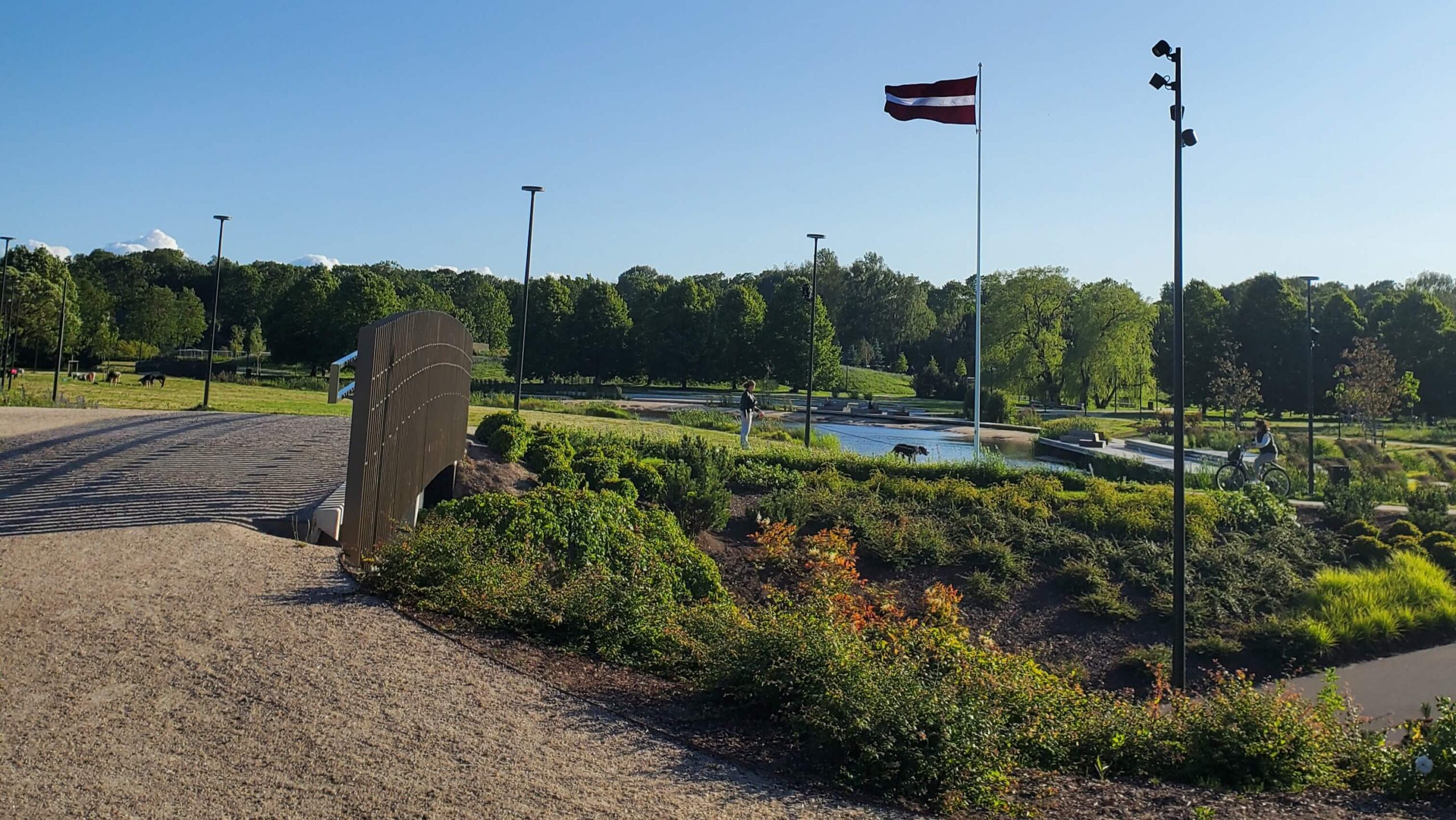
After its renovation, Victory Park in Riga has taken on a romantic new character. It’s now full of flowerbeds brimming with freedom-loving plants that seem to have wild, wind-tossed hair—grasses, bright orange rudbeckia, mysterious purple-budded blooms, and small, leafy bushes.
The wide green lawns are sprinkled with blooming meadow plants that evoke the feeling of Latvian Midsummer—when everything is lush, alive, and at its vibrant peak. At the heart of the renewed Victory Park in Riga lies a peaceful duck pond, its edges gently overgrown with tall reeds. And just beside this body of water—where the concrete monument once stood—the Latvian flag now proudly flutters in the wind.
Because Victory Park in Riga is a shared space for both walkers and those enjoying more active leisure, its paths are cleverly built on two levels. One is for people like us, who want to enjoy a peaceful stroll, and the other is dedicated to rollerbladers and cyclists.
But what happens when the two paths meet? Well, sometimes one crosses over the other via a small bridge, or slips under a grassy mound through a tunnel that looks a bit like the entrance to a hobbit house. I think those little tunnels in Victory park in Riga are quite iconic and fun!
Active Leisure in Riga’s Victory Park
As we continue our leisurely walk, we pass by several playgrounds with swings and trampolines. On sunny days, the sound of children’s laughter drifts through the air, echoing across the park.
At the far end of Victory Park in Riga, there’s a skateboarding area and a rental station where you can pick up roller skates—perfect for enjoying the park’s dedicated skating trails. In winter, this same spot offers ski rentals for snowy adventures.
And if you visit on a summer evening, don’t be surprised to spot a group or two doing outdoor aerobics, adding even more energy to this lively, shared green space.
Is Victory park in Riga worth visiting?
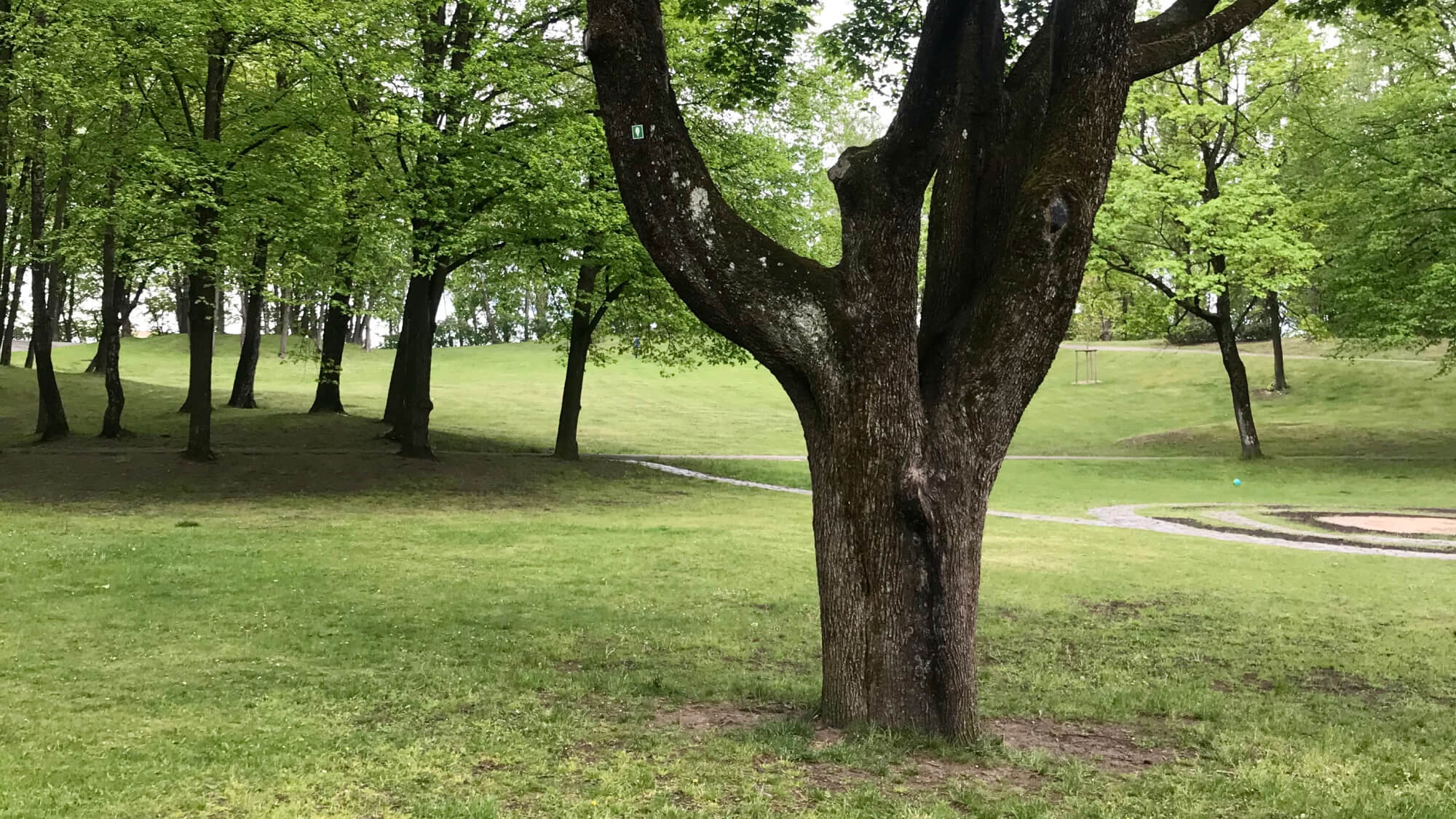
There’s no denying it—after the renovations, Victory Park in Riga has become a beautiful, lively garden, perfect for families, casual strolls with loved ones, or simply enjoying a peaceful walk on your own. If you want a little nature brake in th heart of Riga, this is the place to go.
It’s always a pleasure to discover a sightseeing spot right here in the capital that can be visited without much effort or long drives. This time, our journey takes us to Daugavgrīva, home to possibly the most impressive and eeriest fortress ruins in Latvia – the Daugavgrīva Fortress. And it turns out that just a stone’s throw from the fortress lies a lesser-known destination – the Daugavgrīva Nature Trail, offering a chance to explore floodplain lagoon meadows.
Daugavgrīva Fortress is considered one of Latvia’s most valuable military heritage sites, with origins dating back to the 17th century. Over time, it has been seized, shelled, bombed, conquered, and rebuilt. It has changed rulers multiple times and has even been visited by multiple monarchs. During World War I, some of the first Latvian riflemen units were formed here (source). In short, this fortress has a long and complicated life story.
In the late 20th century, the Daugavgrīva fortress lost its military importance and now seems to be slowly crumbling. However, there are rumors about plans for its restoration and maintenance. As of April 2025, the Daugavgrīva fortress is still open to visitors on Saturdays and Sundays during specific hours. The limited opening times only add to the intrigue – but before heading to Daugavgrīva, it’s definitely worth checking the latest updates to see if it’s still accessible to tourists.
When we arrive at the starting point of our adventure, we find the Daugavgrīva fortress hidden behind a moat and an earthen rampart, adding a sense of adventure even before stepping inside. So let’s gather our courage and walk through the gates guarding Daugavgrīva Fortress to find out what secrets lie within.
What Can You See Inside the Daugavgrīva Fortress?
It turns out the “belly” of Daugavgrīva Fortress is empty – inside is an overgrown outdoor area that looks rather abandoned and gloomy during the spring season. All the real adventure and spooky chambers are found in the fortress walls.
A tall tower also rises here with a crumbling top. My first thought was that it’s a watchtower. But after reading some information online, I lean toward it actually being an Orthodox church that once stood within the Daugavgrīva fortress grounds.
So let’s not waste time – off we go to explore the most interesting part of the fortress: the defensive walls. Their empty windows stare back at you like dark eyes.
Each Spooky Chamber of Daugavgrīva Fortress Has Its Own Style
Behind doors and window openings lies a labyrinth of dark, half-collapsed rooms. Interestingly, each chamber has its own unique vibe.
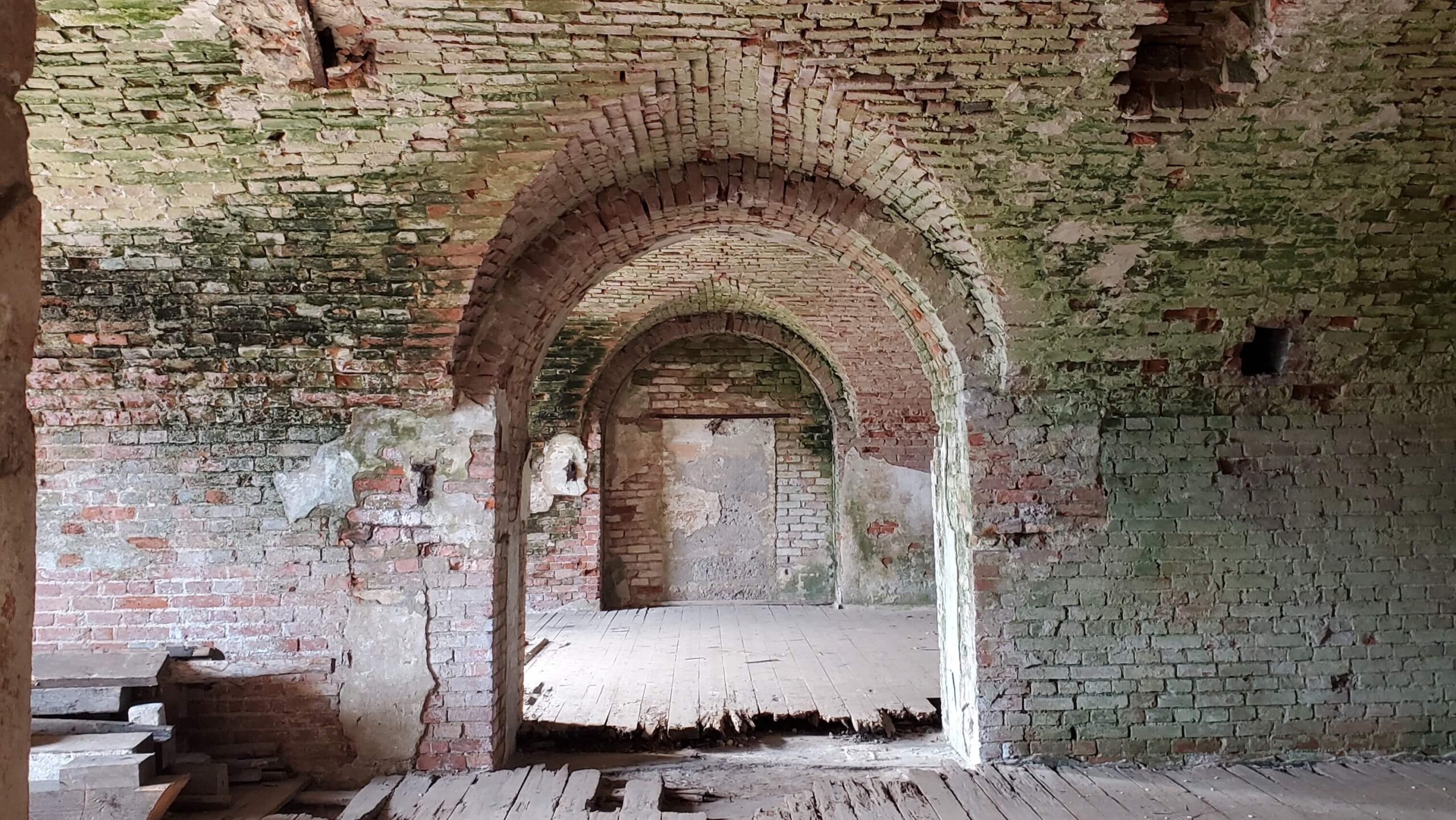
In the first one, the crumbling walls are covered with something green, and as you get closer, you can feel the cold and dampness radiating from them. Some floors are completely bare, while others are covered with old, broken planks. It’s creepy and fascinating at the same time – just watch your step! Some rooms even have informational stands about the Daugavgrīva fortress’s history, giving it a bit of a museum feel.
The next chamber greets you with a photogenic series of arches. The walls here were once painted, but now the paint is peeling off in large flakes.
Then there’s a room full of tree branches sticking out of the ground, adding to the ghostly atmosphere – as if the room has lost a battle with nature.
As you continue moving from room to room, you also come across a dark tunnel. Where it leads – who knows? Stepping inside makes your heart beat faster. You know how in video games, there’s always a monster hiding in places like this, right?
Finally, we reach a room where train tracks disappear into the darkness – time to pull out the phone flashlight. Pretty unsettling!
So, after playing hide-and-seek with the unknown, we’ve made a full circle. Daugavgrīva Fortress turned out to be far more interesting and diverse than I expected!
But if the Daugavgrīva fortress visit felt a bit too short, you can extend the adventure with a trip to the Daugavgrīva Nature Trail, just a few minutes’ drive away.
At the start of the Daugavgrīva nature trail, the first thing that catches the eye is a long, straight cobblestone path stretching endlessly into the distance. A gut feel tells me the sea might be at the end, but from here, you can neither see nor hear it.
In early April, nature is still asleep – the meadows on both sides of the path are golden-brown, and some of the dry grasses are soaking in large puddles.
Daugavgrīva Birdwatching Tower
Just a few dozen steps in, the Daugavgrīva birdwatching tower comes into view. This area happens to lie along one of Europe’s most important bird migration routes. If you’re into ornithology, you probably knew that already. If not, you’re likely more curious about the view from the top.
The tower’s high foundation suggests that water levels here are quite variable – meaning the landscape you see today might be completely different in just a few weeks.
Today, the wide meadows seen from the tower are completely dry and resemble a golden field swaying gently in the wind. Instead of grain, there are thousands of reeds – so tall they’d tower over me if I stood next to them.
Daugavgrīva The Nature Trail’s Boardwalk
In the middle of this vast reed field a boardwalk winds like a snake. Let’s go stretch our legs!
The Daugavgrīva boardwalk seems to be one-way with only a single passing spot, but since there aren’t many people on the trail today – just one man out walking his cat – it’s not a problem.
Seems like we’re here off-season, because today the meadows on either side are completely dry. That means that at the moment the Daugavgrīva trail lacks the charm seen in photos with flooded fields. All around is just a sea of dried grass, that makes you wonder if the boardwalk is even necessary.
Even though we’re still in Riga, apartment blocks are visible only in the distance, beyond the bare branches of the trees, giving the trail a peaceful and unhurried aura.
Around a bend, the Daugavgrīva nature trail leads into a small grove. Here, in the shade of the trees, the trail looks much more intriguing – the grass surrounding the boardwalk sinks into pools of water, reflecting the bare branches above.
We take a moment to enjoy the early spring landscape, until the Daugavgrīva Nature Trail leads us to a sand dune behind which the roaring sea awaits. From here, the choice is yours – continue along the coast or turn back.
Is Daugavgriva fortress and nature trail worth visiting?
Daugavgrīva Fortress turned out to be even more mysterious than I had expected. It’s one of those places where you feel like you’re in a video game. As for the nature trail – maybe we just didn’t come on the right day. It would’ve been much cooler if the meadows had been flooded.
Has visiting the market turned from a necessity to a trend these days? I would say yes, to some extent, at least for some people. You can find a gastro market in almost every big city. And a visit to the market on a Sunday, like enjoying a coffee and a freshly baked pastry in a Parisian bakery, is somewhat romanticized. Therefore, if you are not afraid of hustle and bustle and are attracted to unusual interiors, let’s go on a little adventure to Agenskalns market in Riga.
At the Agenskalns market, there will be neither shouting nor the smell of fish nor the saleswoman who catches you as you pass by and tries to convince you that you would look great in those knockoff boots. At least I didn’t meet her. So it is nothing like the markets I remember from my childhood. The shopping experience is deliberately romanticized to attract those people who go to the market on weekends not to look for the best deals but for entertainment.
But is it bad? For things to live, they must adapt to the times. That’s why many activities that used to be a daily necessity for people today get a second life and turn from a need into an experience. Therefore, perceive a visit to the Agenskalns market as a treasure hunt from which you will return either with new impressions, a full stomach, or local delicacies in a bag.
Interior of Agenskalns Market
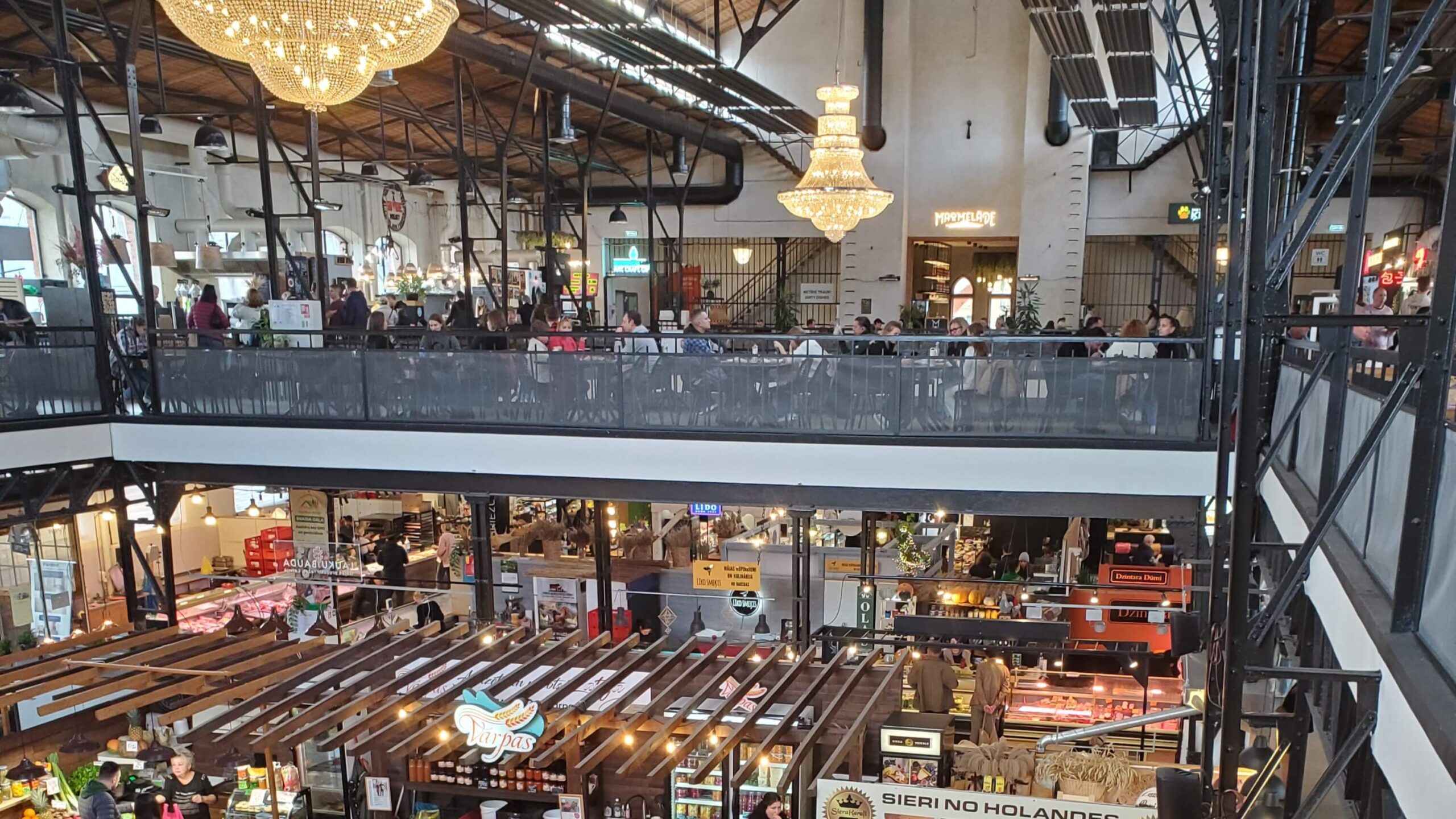
As soon as you enter the market, look up and appreciate the most intriguing feature of the place – the ceiling. They are designed in an industrial style with panels, pipes, and fans. It should not be a surprise that they most often appear in the pictures posted on social media. It is a market after all. But to create a surprising effect, someone has hung grand crystal chandeliers, which I think is a fun idea! Contrast like this always sticks in your memory.
Āgenskalns Market First Floor – Colourful Shopping Area
Is your reusable bag ready?
Let’s do some delicacy treasure hunting at the market stalls!
On the first floor of Agenskalns Market, you’ll find a variety of product stalls—colorful fresh fruits, tempting cheeses, fresh bread, Molberts ice cream, local craft beer, some more exotic things like olives and other goodies.
Every stall you pass by is a little different. In the bakery section, cakes sit proudly on the shelves. Your mouth starts watering as you imagine how sweet the glaze must be. I bet it literally melts on your tongue! But if you’re craving something savory, the large cheese wheels sit just as majestically as the cakes. And it’s not hard to imagine the smoky aroma you’d get from one of the smoked sausages.
However, in the autumn season, the real kings of the Agenskalns market are definitely the vegetables. Onions, cauliflower, and carrots are practically spilling over the edges of their crates.
Seeing the abundance of fresh produce gets the gears turning in your head, sifting through all the recipe ideas you could try.
Antique Hunting at Agenskalns Market
I’ll be honest, I’m a little bummed that we didn’t come to Agenskalns Market on a day when the Flea Market is operating. Hunting for delicacies is fun, but if we’re talking about romanticizing a market visit, then the stalls filled with the most eclectic mix of items sound like the ultimate adventure. Oh well… The experience will have to sit on my wishlist for a bit longer.
But before we head to the food area, if you don’t mind, I need to make a quick stop at the restrooms.
But what’s this? Guess what’s hidden in the basement on the way to the toilets? An antique shop! We definitely have to check it out.
The store’s shelves and tables are packed with all sorts of intriguing items. Here, you’ll find all kinds of pots, mugs, and small dishes. Let’s have a contest—who can find the most unusual item? I’m voting for that swan-shaped dish, but the game isn’t over yet!
Next, your attention is drawn to several record players and an impressive vinyl collection. I spotted a typewriter.
Deeper into “Skandinavs,”, you’ll find furniture and all kinds of trinkets—old matchboxes, coins, and jewelry. There’s even a shelf with used electronics, in case you happen to need, say, an iron. And at the very back, you’ll find clothes.
You could probably spend half the day carefully inspecting every treasure hidden on these shelves.
But my stomach is growling. So I vote to head to the Agenskalns Market food area. A little bird told me you can even find Georgian khachapuri there!
Agenskalns Market Food Area
The Āgenskalns Market food area is perfect for people who can never agree on what cuisine to choose. No arguments this time—there’s a little bit of everything here. In Āgenskalns Market you’ll find stalls offering Asian cuisine, Georgian dishes, pancakes, pizza, and other delights. For those interested, there are also liquid calories—wine, beer, and cocktails. Ironically, the only thing you probably won’t find here is Latvian cuisine.
All the food stalls share common tables, meaning you can enjoy a completely different meal from your friends, yet still sit together. Great! However, just like in other markets, you might have to fight for a table. It looks like it’s all based on a “first come, first served” principle. Not so great.
But if you do manage to claim a table, while you wait for your buzzer to signal that your food is ready, you can watch the hustle and bustle of the lower floor of Agenskalns Market, where people are busy shopping at the market stalls. It’s fascinating to observe all the movement and excitement.
And if people-watching isn’t your thing, we can check out what books are currently available at the book exchange station. Which one intrigues you the most? Stories about Spain? Or perhaps differentiated math exercises? Or… we could go play a game of table football.
Finally, the buzzer lets out a sharp beep—it’s time to pick up our meal.
Since I’ve been craving khachapuri ever since my trip to Georgia, I went for this hearty treat. It’s delicious. The bread feels a little different than in Georgia, but the cheese is just as rich, salty, and stretchy.
Bon appétit!
Is Āgenskalns market worth visiting?
I know opinions differ, and some people might disagree with me, saying that a trip to the market isn’t an adventure. But I believe that visiting Agenskalns Market is an interesting way to spend a leisurely Sunday in Riga. You’ll likely return home with vibrant impressions, a full stomach, and something extra in your bag to snack on later.
Weekday evenings often call for a short escape to unwind. While time doesn’t always allow for a trip outside Riga or a visit to one of the piers, we’ve found a route for a light and relaxing walk in our favorite local spots here in Pārdaugava. If, like me, you prefer tranquil, less industrial areas, parks are an obvious choice. Of course, living in a city means buildings and cars are part of the scenery, but these green spaces offer a refreshing escape.
Start your stroll at either park, and if you’re pressed for time, you can easily finish in the same spot. However, since both parks are quite small, combining them into one walk makes for a more enjoyable experience.
Dzegužkalns is a delightful pocket of greenery featuring an inviting open lawn that practically begs for a laid-back picnic. Tree-lined paths meander up and down gentle hills, creating a soothing rhythm for a stroll. The park’s charm lies in its simplicity: no grand landscaping or major landmarks, just a peaceful, well-maintained space.
It’s a favorite among joggers, fitness enthusiasts, and families with kids (thanks to the small playground). And there’s even a small outdoor stage tucked within the park.
Nordeķi Park offers its own unique charm. We come here to watch ducks gliding gracefully across the ponds and to check on the slow but promising restoration of the Nordeķi Manor.
Although the manor remains hidden behind a high fence and is still under renovation, you can see signs of progress. I’m hopeful that this historical gem will soon be fully restored.
Passing by you will also notice the statues within manors theritory on the opposite side of the pound. If we can believe the web, those were created during the 2005. sculpture symposium, “Tēlniecības desants.”
The park itself is well-maintained on one side, with a wide lawn, mature trees, and a children’s playground. There’s even a set of whimsical heart-shaped benches with leaves sprouting from their backs, adding a playful touch. We also stumbled upon a circular arrangement of plants that looks like it’s destined to grow into a miniature labyrinth – a guaranteed delight for the kids who always seem to be running through it.
When people think of Pārdaugava’s parks, Arkādija Park and Māras Pond are often the first to come to mind. And while they’re undeniably beautiful, if you’re ready to step off the beaten path, Dzegužkalns and Nordeķi Park offer a refreshing alternative. These two small but charming parks are perfect for a light spring or summer stroll, and are simply amazing in autumn colors, providing a peaceful retreat without straying far from the city’s pulse.
I’m not sure if there’ll be snow, but during Christmas in Riga, you can definitely count on plenty of beautiful decorations and fun activities. Winters in Latvia are quite cold and dark, so during December in Riga, we do our best to fill the city with light and festive cheer to warm everyone’s heart. Whether it’s a magical evening at a Christmas market or a frosty quest to find the most beautiful Christmas lights, there’s always something special to brighten the season.
Well, you sort of do. Step into Riga’s Art Nouveau Center, and you’re transported back to a 1920s middle-class apartment, frozen in time.
Exploring the great-grandparents of cooking appliances in the kitchen and diving into the Art Nouveau through the interactive exhibit in the basement is delightful any time of year. But during the Christmas season in Riga, the glamorous interiors truly shine in their festive finest. A ribbon draped here, a sprig of evergreen tucked there—that’s what Christmas dreams are made of. The crown jewel of it all is the magnificent Christmas tree, its branches adorned with whimsical ornaments from days gone by. Tiny ballet shoes, sugared apples, and little violins hang from its branches, each more charming than the last. You might find yourself standing there for a while, picking your favourite.
Riga Art Nouveau Center is a unique blend of history and holiday magic, making Christmas in Riga truly unforgettable. Hopefully, you’ve warmed up while exploring the cozy interiors, because next up are some of the best outdoor activities Riga in December has to offer.
On 2024 the market will open up at 29th of November.
Soak Up the Magical Atmosphere at the Riga Christmas Market
The setting of the Riga Christmas Market feels like stepping into a holiday fairytale. Nestled in the heart of Old Town, in a charming cobblestone square beside the magnificent Doma Cathedral, it’s as if you’ve stumbled upon a hidden elf village.
Each little wooden booth is strung with green garlands and twinkling fairy lights, casting a warm, golden glow against the winter chill. On frosty days, steam rises from bubbling pots of hot drinks, wrapping the market in a cosy, spiced aroma. The stalls are filled with handcrafted treasures and trinkets—beautifully made ornaments, cozy knits, and quirky gifts—all waiting to be discovered as you wander through.
At the heart of it all stands a grand Christmas tree, its branches adorned with simple baubles and soft lights. It’s a picture of timeless beauty, bringing back memories of childhood Christmases—the kind where magic felt just within reach.
Savour Heartwarming Treats at the Riga Christmas Market
One of the highlights of the Riga Christmas Market is indulging in festive treats while browsing the stalls. If your hands and nose are a bit cold, start with a steaming cup of spiced apple juice, sweet cocoa, traditional mulled wine or a fun winter cocktail. Any of them are sure to warm you up.
For snacks, don’t miss the gingerbread cookies, covered in sweet icing and shaped into everything from hearts to kittens. If you’re hungry for more, you’ll find hearty options ranging from traditional Latvian dishes like cabbage stew to more “exotic” Georgian khachapuri.
Feel the Magic of Live Music and Festive Fun at Riga Christmas Market
If the food and drink haven’t sold you yet, how about some carolling and live Christmas music? Every year, the market hosts concerts and festive events doubling and tripling the Christmas cheer.
Some of the highlights of the Riga Christmas market typically includes:
Lighting of Riga’s Grand Christmas Tree: A heartwarming event where crowds gather to count down to the magical moment when the tree lights up, officially marking the start of the Christmas season in Riga. In 2024 the three lighting ceremony is scheduled to take place on November 30th, 17:00 – 18:00
Santa Fun Run: Spread holiday cheer by dressing as Santa and joining this joyful run! Chances are you haven’t seen this many Santas in the same place. To participate, you’ll need to purchase a ticket, but it’s all for a good cause—proceeds from ticket sales go directly to charity. Learn more here. In 2024 Santas will gather on December 8th.
I’ll update this section with more details when the full 2024 program is announced. Or you can follow Riga Christmas Markets Instagram account for any announcements from their side.
Even the trashcans get festive during the Christmas in Riga
True or False: The First Decorated Christmas Tree Was in Riga?
The answer remains a mystery, as instead of conclusive proof, we have only legends shared over cups of hot chocolate on cold winter evenings. One such tale, proudly told by Latvians, dates back to 1510. It’s said that the Brotherhood of Blackheads, a guild of local merchants, decorated a Christmas tree in Riga’s Town Hall Square as part of their winter celebrations. Then they sang and danced around it, adding to the merriment. A jolly story indeed—until you reach the part where they burned the tree down. I don’t think Santa would approve of that.
To commemorate this event, a memorial plaque and a sculpture now marks the spot where the world’s first decorated Christmas tree is believed to have stood. Whether or not you choose to believe the story, if you’re visiting Riga during the Christmas season, it’s a fun little quest to find the plaque and snap a photo. And if you happen to be in Riga in December, don’t miss the stunning Christmas tree that graces the square each year. With the beautiful Brotherhood of the Blackheads building as a backdrop, its whimsical, rustic decorations and twinkling lights it creates a Christmas Card worthy scene.
Christmas tree near Melngalvju nams 2020
Lace up your skates and glide through Rigas Christmas Ice Skating rink
Celebrate the magic of Christmas in Riga by taking a spin at the city’s delightful open-air pop-up ice skating rink. Imagine gliding gracefully (or not so gracefully!) around a cheerfully lit Christmas tree, surrounded by a lively holiday atmosphere.
Festive music fills the air, blending with the laughter of skaters as beginners wobble and pros show off their impressive backward moves. The rink sparkles in enchanting pink, purple, and blue lights, while a brightly lit children’s Ferris wheel adds extra charm to this winter wonderland. It’s the perfect spot to soak in the Christmas spirit. And, believe it or not, I even spotted Santa himself skating here one evening!
The only downside? If you need to rent skates, be prepared for a bit of a wait in line. But trust me, the festive fun is well worth it!
Twinkling Lights and Festive Cheer: Riga’s Christmas Lights and Decorations
Each December, when the days grow darkest, Riga brings out its most cheerful Christmas decorations. So when the sun dips below the horizon, it’s time to bundle up in something warm and cozy, grab a steaming hot drink, and set out for a magical (and free) stroll through the beautifully illuminated city.
Christmas lights in Riga 2024
Where to find the most beautiful Christmas lights in Riga?
When it comes to Christmas decorations, Riga embraces a simple yet charming aesthetic, leaning into a rustic style and an enchanting play with light. The city’s parks and streets are typically adorned with strings of warm white lights and subtle ornaments.
There are some places in Riga where you typically can find Christmas Lights every year. One of the loveliest winter walks in Riga is along the canal, leading towards the Opera House. As you stroll, you’ll notice dozens of twinkling stars and crescent moons seemingly fallen from the sky and nestled in the tree branches. It’s as if the city has collected a bit of stardust and scattered it across the trees for the holiday season.
This year, Riga’s festive spirit is particularly resourceful. Near the Opera House, you can still catch remnants of the Staro Riga festival’s beautiful light installations, which continue to shimmer on both land and water.
Christmas lights in Riga 2024
From there, head towards Bastejkalns Park, where the trees have long been a part of Riga’s December glow. For as long as I can remember, this park has featured twinkling lights, but this year, the trees have been dressed in hundreds of delicate fairy lights, casting a soft, inviting glow throughout the park.
Bastejkalns 2024
FAQs about visiting Riga in December
What’s the weather like in Riga in December?
There is a chance you’ll be greeted with snow which can make Christmas in Riga magical. But there is also a chance that it will be just chilly and rainy. It’s always a bit of gamble. The temperature typically ranges somewhere between +5 and -5 Celsius, so I would highly recommend to bundle up.
Are things to do in Riga in December affordable?
Prices are always relative. But I believe you can enjoy Christmas in Riga on a budget as you can explore the old town, and enjoy the Christmas lights for free. The most pricy part is typically the food in the Christmas market, but if you don’t want to spend much you can still go for the vibes and maybe grab a cup of a non alcoholic hot drink as those tend to be more affordable.
Christmas in Vilnius
Is it worth visiting Riga in December for the Christmas vibes?
For those who seek it, Christmas magic can be found everywhere. While Riga may not have the grandeur of Christmas metropolises like Berlin, London, or Vienna, it offers its own unique and charming way of making the season special. So bundle up, grab a warm drink, and let the charm of Christmas in Riga fill your heart with joy. With its rich traditions, stunning decorations, and cozy atmosphere, Riga is the perfect place to create holiday memories that will last a lifetime.
What was life like for Latvian farmers in rural areas a couple of centuries ago? If you don’t know the answer, the Latvian Ethnographic Open-Air Museum may be an eye-opening experience for you. It certainly was for me.
So, come along for a walk through a peaceful forest where Latvian homesteads, churches, and other buildings from the 17th to 20th centuries have found their forever home. Much like wise old grandmas and grandpas, they have countless stories to share.
Latvian Homesteads in the Ethnographic Open-Air Museum
The setting couldn’t be more idyllic. You are walking through a lush forest, and one by one, beautiful old wooden houses with straw roofs, overgrown with bright green moss, come into view.
Although these buildings were born in different times, sometimes even centuries apart, and were brought to the Latvian Ethnographic Open-Air Museum from various places around the country, being here today makes one feel like they are in a little village frozen in time.
Shall we peek inside? Absolutely!
What’s Special About Churches in the Latvian Ethnographic Open-Air Museum?
You’ll notice it as soon as you step in. No, it is not the pleasant aroma of old wood that hits you. No, it’s not the intricate woodwork detailing around the window arches or the statues on the pulpit, although they are all honourable mentions.
It’s the stunning painted wooden ceiling. Above you is a sky filled with fluffy clouds and angels watching over you. It is very impactful. Can you imagine this room as it once was, illuminated by the flickering light of candles and a church choir singing? I get goosebumps thinking about it.
After you have soaked this in for a while, it is time to move on. There is still a lot to explore. Here’s a tip: when you visit other churches in the museum (and yes, there are several), keep your eyes open for a ceiling adorned with hundreds of painted stars and listen carefully to hear some organ music.
A Fun Game Called “What Is That?”
On our journey through the Latvian Ethnographic Open-Air Museum, let’s play a little game. I will point out an object, and you have to guess what it is. Though I am not a historian or an anthropologist, I am your everyday tourist, so I might get something wrong as well.
Come on! Let’s try it. What is that?
I don’t know the official name, but I believe it is a thing you use to call everyone who’s out and about home for a meal. So, like an early version of an alarm or a pager?
The Houses in the Latvian Ethnographic Open-Air Museum Are Sisters, But Not Twins
Next, we wander into one of the many family houses.
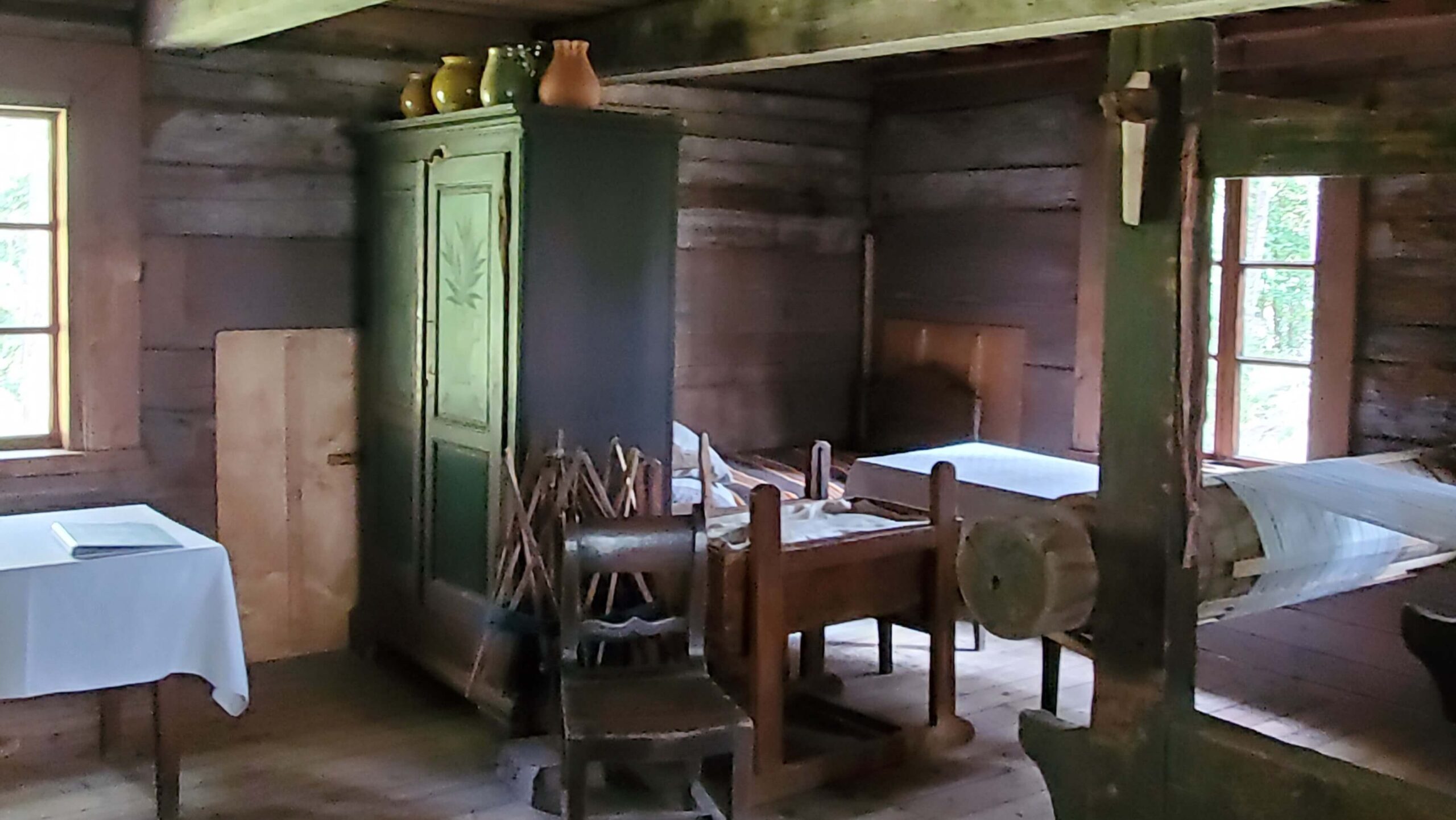
The living space is quite compact. Families used to eat, work, pray, and sleep all in one large room. This makes sense, as a smaller house was easier to keep warm during those harsh Latvian winters.
Although nowadays this setting with the rough, exposed wood walls, clay pottery, and beautiful old cradle looks quite romantic, life back in the day was hard with no running water, no electricity, and only as much food as you were able to collect to survive the winter. To be honest, real-time travel isn’t something I dream of!
As I mentioned before, in the Latvian Open-Air Museum, there are many homes to visit. And with each house you peek into, you start to notice the differences. A richer house may have a wooden floor. A poor man’s house would have only cold rock to step on.
And there are regional differences too. Here is a fun fact from one of the Open-Air Museum employees to prove it: Only in Latgale did people sleep on top of wood-burning stove walls to keep themselves warm. Bet you didn’t expect that? Or maybe you did, as you may find references to that in folklore (I think).
This is what I mean with a top of woodburning stove
What Is That?
It’s the ancestor of today’s closet—the dowry chest. Filled with goods some very handy lady crafted in preparation for her married life.
In the old storage house, you’ll find a whole collection of these adorned with various paintings.
Not Only Homes Tell Stories
Schools, saunas, and barns in the Latvian Ethnographic Open-Air Museum have something to say too. Are you willing to listen?
Latvian Sauna House Traditions
The sauna has always been important in Latvian culture and traditions. It wasn’t only the place for washing up. It was the place where new life came into the world, as well as the place where it all ended, as that’s where people received their last washing up after they had passed away.
Just like in the church we saw earlier, as soon as you walk in, you are greeted by the smell of old wood. But this time, it is mixed with smoke. Interestingly, the earliest saunas didn’t have chimneys—these were added later.
It takes a bit of time for your eyes to get used to the dark (remember, no electricity). But when you finally start to regain your eyesight, you spot big buckets for holding water and birch brooms. Just like a family had left it after the weekly bathing session.
Old Windmills of the Latvian Open-Air Museum
Another fascinating sight at the museum is the collection of old windmills. I believe there are three in total, and all have long since retired. But standing at the base of these towering structures, you can easily imagine their blades turning in the breeze, grinding grain into flour, which was a staple in the Latvian diet.
The Pig House and Other Utility Buildings in the Latvian Ethnographic Open-Air Museum
How many of these have you heard of? And how many have you seen?
Threshing barn
Summer kitchen
Food storage barn
Meat smoking house
Pig house
All of them used to be part of Latvian farmers’ daily life. Some of them have slowly faded from memory, while others have morphed into niche hobbies. All can be explored in the Latvian Ethnographic Open-Air Museum.
To me the pig house holds a special place in my heart as I remember being so small that I was able to get inside of it. Now looking at the tiny building it seems impossible.
Another Round of Our Favourite Open-Air Museum Game
Here is a harder one. What is this contraption?
A torture wheel, perhaps? I don’t think so. Could it be the device separating straw from the grain? Very possible.
Life With Some Electricity: The New Farmer’s House in Latvian Ethnographic Open-Air museum
A couple of hundred years can change a lot.
If you are a millennial who had a grandma living in the countryside or you’re a bit older, the youngest of the Open-Air Museum houses (the new farmer’s house from the 20th century) may just feel like a story from your own childhood.
This house is a blast of colours. There are colourful paintings of what look to be Latvian power signs on the walls and ceiling. And every surface has a hand-embroidered textile on top of it.
In the centre of the living room proudly sits a radio and a wire phone. What a luxury!
But still—no electric lighting?
It may feel like electric light bulbs have been around forever. They were invented in the 19th century, right? But it turns out my grandma grew up in a house with no electricity. She’s a bit over 70. And my mother said she used to visit her grandma, who lived in a house with a well instead of running water and petrol lamps instead of electric lighting.
That is an interesting thing to wrap one’s head around. Until you realise there are still people today living with no reliable source of power. Then it morphs into quite a humbling experience.
So, how much have we walked? Around 5 km? It doesn’t feel like it. But maybe it is time to head back. And as it is the season, maybe as a reward, we could end our adventure with a glass of refreshing kvass in the Open-Air Museum’s café. Sounds like a plan!
What to Know About Visiting the Latvian Ethnographic Open-Air Museum
Summer Season vs. Winter Season
I visited in the summer, as that is when you can explore most of the houses. In the winter, only a few of them are open.
However, in the last couple of years, they have also held a special light garden event during the winter. So, if you are visiting Latvia in the off-season, keep your eye out to see if something similar happens again.
Special Events at the Latvian Ethnographic Open-Air Museum
Throughout the year, there are various special events like the Latvian craft market and some traditional Latvian celebrations, such as the solstice, that are held in the museum and offer a variety of fun activities. Check their website for upcoming dates.
Food and Drinks at the Latvian Open-Air Museum
In the summer season, there are two cafés. I have been to only one of them, and that one offered some typical Latvian meals like cabbage and sausage, toasted rye bread, cold beetroot soup, etc. I don’t have info about winter season.
But you can also bring a picnic with you as a more budget friendly option.
Is Riga Open-Air museum worth visiting?
The Latvian Ethnographic Open-Air Museum is more than just a collection of buildings; it’s a living history lesson that immerses you in the essence of Latvian rural heritage. Whether you’re a history buff or simply curious, this museum offers a rich tapestry of stories that connect past and present, opening our eyes to where we have come from and the progress we’ve made.
And don’t run away at the word museum. In this list I have included only the ones that have left a permanent impression on me. In one of Rigas museums, you will have the opportunity to play games. In another, you will travel in time. And in yet another, you will work your imagination and admire some art.
Come – let’s turn a rainy day in Riga into an adventure!
If you already know which theme is closer to your heart’s desire click on one of the links:
In the past, consoles were a bit different. In the Riga video game museum You might just stare at the old consoles and puzzle over which button to press to make the main character move. Or the same as I – randomly press all the buttons and hope that Mario survives.
The Riga video game museum is hidden on the second floor of a game store. It still has some growing to do to match the size and experience of the game museum in Krakow. But you can play several old consoles and a couple of arcade games. As well as see the exhibition of computers, Tamaguchi, all kinds of control input tools, and other gadgets from the gone by era.
This rainy weather activity is, of course, a matter of taste. While I was playing the games, I had a man on one side very enthusiastically telling his wife: “Oh look, this game is from the 80s…” But on the other side were a bunch of teenagers doing some button-smashing and admitting it wasn’t as interesting as they had expected.
And if we talk about the minuses – there is very little space and the air is a bit stuffy. But I can live with that.
What to do in Riga if it rains for those who always wanted to time travel
The House of the Brotherhood of the Blackheads is, for sure, one of the most eye-pleasing buildings in Old Riga.
But have you ever been bothered by the question – what is inside the House of Brotherhood of the Blackheads? Rumour has it that it’s a museum. And a rainy day in Riga is a perfect chance to explore it.
Inside the House of the Brotherhood of the Blackheads of Riga you will find three floors – historical cellars, staterooms, and luxurious ballrooms.
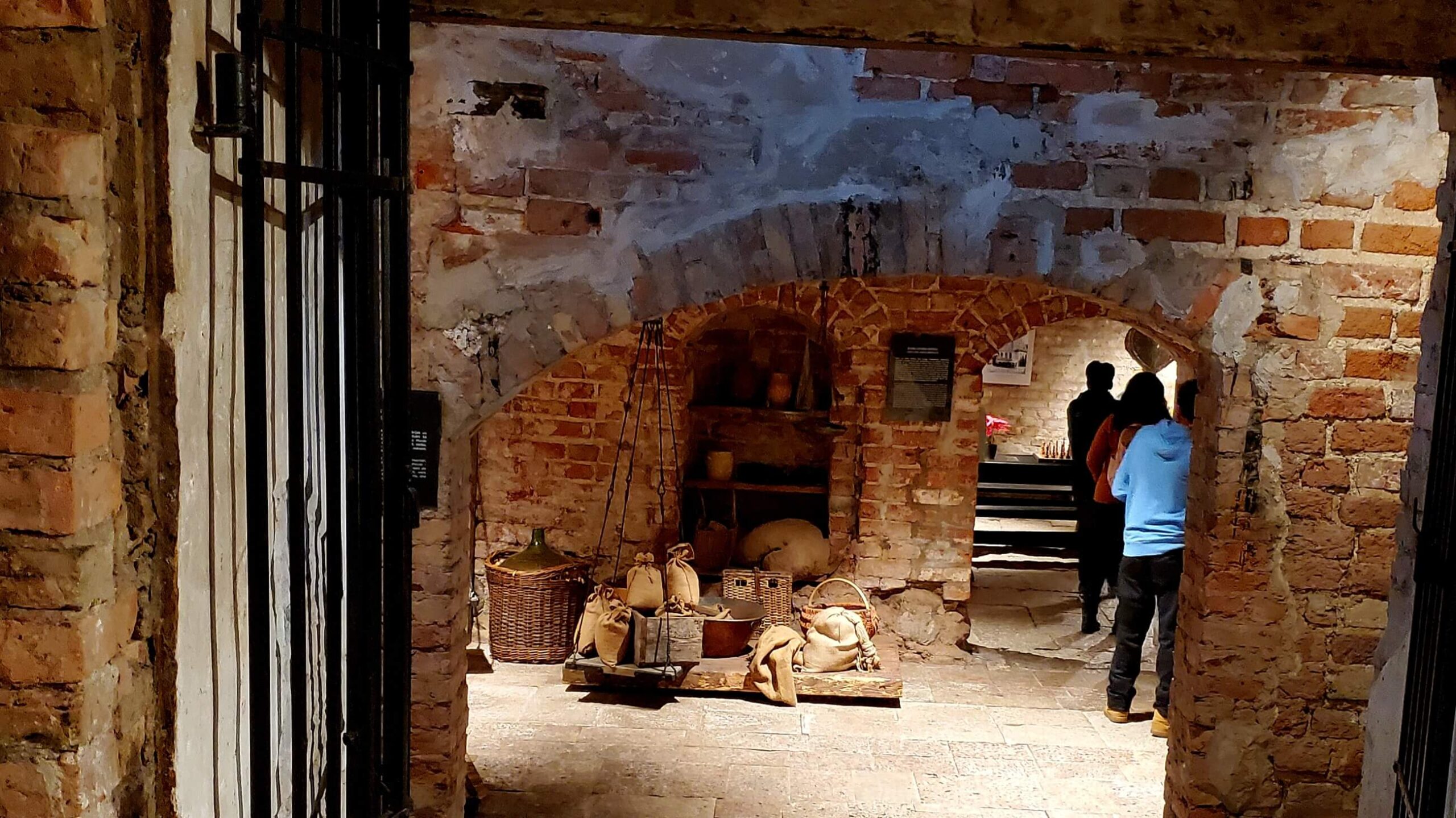
The cellars have a somewhat intriguing, labyrinth feel and breath of history. You will see exposed ancient walls and a fire burning in a furnace somewhere deep down. To establish the vibe there are also various ancient objects – scales, barrels, and statues.
In the staterooms and ballrooms you will find luxurious interiors with decorative ceilings and beautiful stoves.
Usually, when I travel, I see such views in palaces that are turned into museums. Here in Riga, it turns out that you can find them in the House of the Brotherhood of the Blackheads instead.
Fun fact!
Here you can fond a collection of some naughty tabaco boxes. On one, there was a person whose pants had been torn off by a dog, and his bottom was showing.
What to do in Riga in rainy weather for the dreamers
Note: You have to book a specific time slot in advance
When the paintings around you come alive it no longer mathers if it is rainy or if there is a blizzard outside. You have left the streets of Riga and entered into the land of dreams.
From the exhibitions available ir Riga Digital Art house I recommend choosing “From Monet to Kandinsky”. In short – it’s a remix of popular modernist artworks turned into an animation that is then displayed on the walls, ceiling and floors. Complimented by pleasant music. And optionally (for extra charge) – a glass of wine.
Do you have to be an art lover to enjoy this? No. If it is quite difficult for you to concentrate on static paintings in frames, Digital Art House in Riga could be a slightly dreamier and slightly more dynamic option for you.
You’ll see glittering ballerinas turning into star dust and Scream fading in smoke.
But if you are an art enthusiast – when you see the works in different sizes and from other angles, nuances that you had not noticed before may be revealed. In my opinion, it’s quite good, dreamy relaxation for a rainy day in Riga.
And if you have already seen the Modernists, as I understand, Digital art house offers other exhibitions that change from time to time. But don’t skip your research. My friend ended up in an exhibition with a lot of naked buts and wasn’t too thrilled about it.
Rain and cold cannot defeat those who have an adventurer’s spirit!
Overall, there are many interesting museums to explore in Riga (I as a local haven’t even been to all of them yet), and the number of cultural and entertainment opportunities in the capital of Latvia continues to grow. So I will extend the list of things to do in Riga in rainy/cold weather whenever I try something new that is worth telling you about.
You are invited to someone’s home, but instead of traveling by car, you will journey by time machine. The destination? The year 1903, Art Nouveau era in Riga. Sounds impossible? Not at all. Because in Riga Art Nouveau museum a day in the life of a family from 1903 is frozen in time.
Looks like the owners may not be home today, but that’s actually a good thing. It means you can be a bit nosy and explore the pantry and bedroom—areas typically off-limits to guests. And the staff will share some interesting details too.
Expectations are set high before you even enter Riga’s Art Nouveau Museum
There are ordinary buildings and then there are buildings like THIS.
Of course, the Riga Art Nouveau Museum is housed in an Art Nouveau building that has all the charming details of that time.
My knowledge of Art Nouveau architecture is minimal. But when we walk down the street, I can immediately tell which house is the one we are looking for.
This one, thanks to its tower, stands out from the rest of the buildings. Although I must admit that the nearby building of the School of Economics also made me want to stop and take out my camera.
Same as when you visit someone – you have to ring the doorbell to get in.
After entering, you see a luxurious spiral staircase. It’s the one that appears in countless Instagram pictures. You have probably seen them if you have searched for images of the Riga Art Nouveau center.
As we later learn from the video, the lobby and staircase were like the business cards of the owner of the house.
What does this lobby say about him?
I would say it screams money (laughs). And talks about good taste.
I guess we should have worn something more elegant for such a visit. But don’t worry, there will still be a chance to dress up later. At least for a pic.
Basement – Intro to The Story of Art Nouveau in Riga
When visiting someone, you need to know how to conduct conversations with the host, so before entering the living room, let’s learn a little more about Art Nouveau itself. The digital part of the exhibition will help us.
Get to Know Riga’s Art Nouveau Buildings In The Digital Exhibition
Let’s start with Art Nouveau architecture in Riga. A visual story tells you about all those gorgeous buildings you can spot in the streets of Riga. So challenge yourself – try to find houses you have seen by looking at pictures or addresses and learn a little more about them.
On the second screen, you can feel the bittersweet feeling of looking at what Riga once was. Do you know what the so-called “Bird meadow” was? It’s something related to gondolas in Riga. But I won’t tell you the answer. You will have to find it in museum.
Watch The Video To Learn More About a Typical Art Nouveau Apartment in Riga
Do you know which everyday things were new and considered luxury items in the Art Nouveau apartment? One of them is “the place where even the emperor walks by himself”. If you know what I mean. But to find out more, you will have to watch a video on one of the screens in the basement.
In addition, you also can learn about the typical layout of the Art Nouveau apartment, which serves as an excellent introduction to the tour. I definitely recommend watching it before exploring further.
Now that you know more about the period, you are ready for small talk. So let’s go to the apartment itself and see if the hosts are there.
The Heart of The Riga Art Nouveau Museum – The Apartment Frozen In Time
Time has truly frozen here.
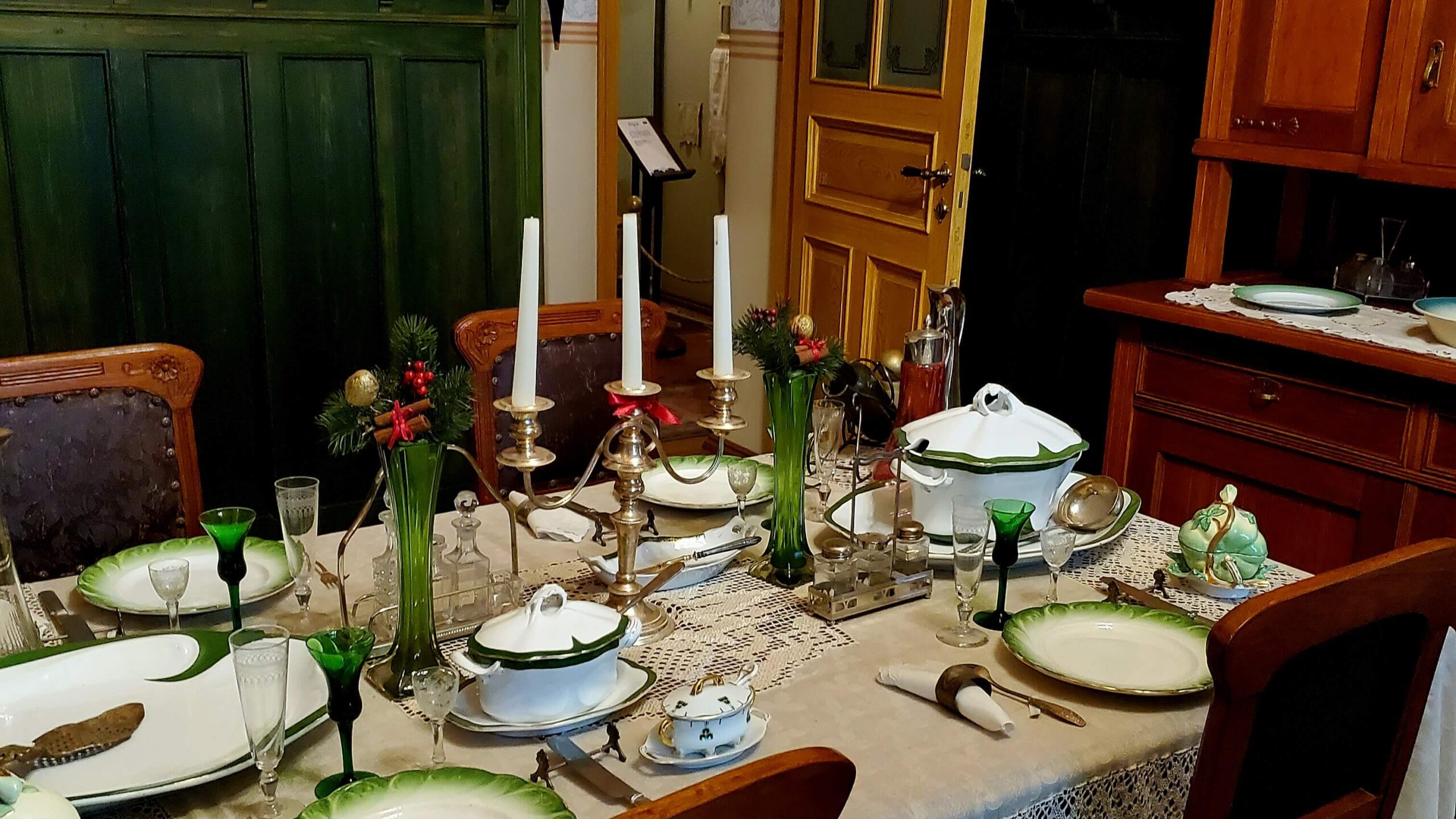
You enter the room, and all the luxury of Art Nouveau opens before you – delicate decorations on the furniture, ceiling, curtains, and dishes. Everything is in its place – the chess pieces are arranged for the game, and the table is laid for dinner.
It is not difficult to imagine a young girl entering the living room and playing the piano. And a hostess that would invite you to sit on one of the fine chairs, because you have to kill time, as the maid haven’t finished cooking the dinner yet.
I visited the Art Nouveau Center during the Christmas season. During that time of the year you can enjoy a lot of beautiful holiday decorations, postcards, and a grand Christmas tree with all kinds of ornaments. There is everything from ballet shoes to an ostrich.
This is what holiday decoration dreams are made of!
But since the hosts are nowhere to be seen, it is a chance to look into those rooms where guests are not usually allowed, for example, the utility rooms. So let’s not miss out on that!
In Riga Art Nouveau Museum You Can Find Unusual Items On Every Step
Have you heard of a fridge that’s made out of wood? Yes, that’s a real thing.
The kitchen is one of the most interesting rooms in my opinion. You can find various unusual appliances in it. And funny dishes in the shape of animals. There is a squirrel, fish, and crab.
And, of course, there is the old stove with metal rings. Stoves like that forever remind me of my great-grandmother’s house, which was sadly bulldozed a long time ago.
What a fun adventure this has been! There are a couple of more rooms to explore in Riga Art Nouveau museum, but I will leave those for your imagination (or for your future visit).
Is Riga Art Nouveau museum worth visiting?
This place is one of my favorite attractions of Riga. I had a good time and learned a lot. If you are fascinated by old interiors, beautiful details, and people’s life many, many years ago, Riga Art Nouveau Center is the place to be.
We use cookies to ensure that we give you the best experience on our website. If you continue to use this site we will assume that you are happy with it.