Category: Ceļojumi ārpus Latvijas

  • What to See in Tbilisi, Georgia? Tbilisi Itinerary

    What to See in Tbilisi, Georgia? Tbilisi Itinerary

    Our Tbilisi itinerary continues the rich tale of Georgia’s architectural wonders. While other destinations in Georgia highlight its breathtaking nature and modern innovations (like Batumi), Tbilisi unveils the country’s deep-rooted history and rich culture. From the imposing Chronicles of Georgia, where the nation’s past is etched onto towering pillars, to the Old Town’s labyrinth of streets, where colorful houses teeter on the edges of cliffs, the city of Tbilisi  is a living museum.

    Let me take you on a virtual journey through Tbilisi’s most captivating spots and we’ll find out what to see in Tbilisi together.

    Duration

    2 days

    Pace

    Fast

    Transportation

    Car

    Tbilisi itinerary overview:

    What to See in Tbilisi in 2 Days?

    With only two days to explore, our Tbilisi itinerary is packed. You may want to add an extra day in Tbilisi for a more relaxed peace. One day in Tbilisi wouldn’t bee nearly enough.

    Central Tbilisi Itinerary

    Walking Distance for the following attractions: ~3.5 km (from the Public Services Hall to the cable car, one way).

    Check out Unusual Architecture of Tbilisi Public Services Hall

    Tbilisi Public Service hall location

    Mushrooms? Jellyfish? Flower petals? What does this building remind you of? This extraordinary structure is one of the most striking examples of Georgia’s innovative architecture. A must-see in Tbilisi for lovers of avant-garde design.

    Tbilisi Public services hall

    Tbilisi Leaning Clock – an Instagram Spot?

    The Clock tower location

    The famous leaning clock of Tbilisi is hard to miss, but have you spotted the tiny hidden clock? The large clock tower, adorned with intricate mosaic tiles, houses a fun little secret—a minuscule, fully functional timepiece nestled beside a plaque detailing the weight of the Earth. It’s a clock within a clock.

    And while you’re here, don’t forget to capture a whimsical photo!

    Tbilisi šķībais pulkstenis
    Mazākais pulkstentiņš uz Tbilisi pulksteņa torņa

    A short stroll away, you’ll find the Anchiskhati Basilica, the oldest surviving church in Tbilisi. Though I couldn’t enter due to my attire, just peering inside revealed a dark, solemn interior—strikingly different from the grand, gold-laden churches I’m used to seeing.

    And a little further, you’ll stumble upon charming balconied streets, whispering tales of old-world Tbilisi with their carved wooden railings and pastel facades.

    Dekoratīvi balkoniņi Tbilisi

    Tbilisi Sulfur Baths

    Sulfur baths location

    You can visit the Tbilisi sulfur baths for a soothing soak or simply to marvel at their unique architecture. From the ground, a cluster of rounded domes rises like ancient turtle shells basking in the sun. But looks can be deceiving—what seems like pavement is actually the bathhouse roof, with the steamy chambers hidden underground.

    If you plan to indulge in this centuries-old bathing tradition, be sure to book your session in advance to secure your spot in this subterranean oasis.

    Ko apskatīt Tbilisi - sulfūra vannu kupoli

    Leghvtakhevi Canyon and Waterfall – Nature Wander in Heart of Tbilisi, Georgia

    Leghvtakhevi canyon location

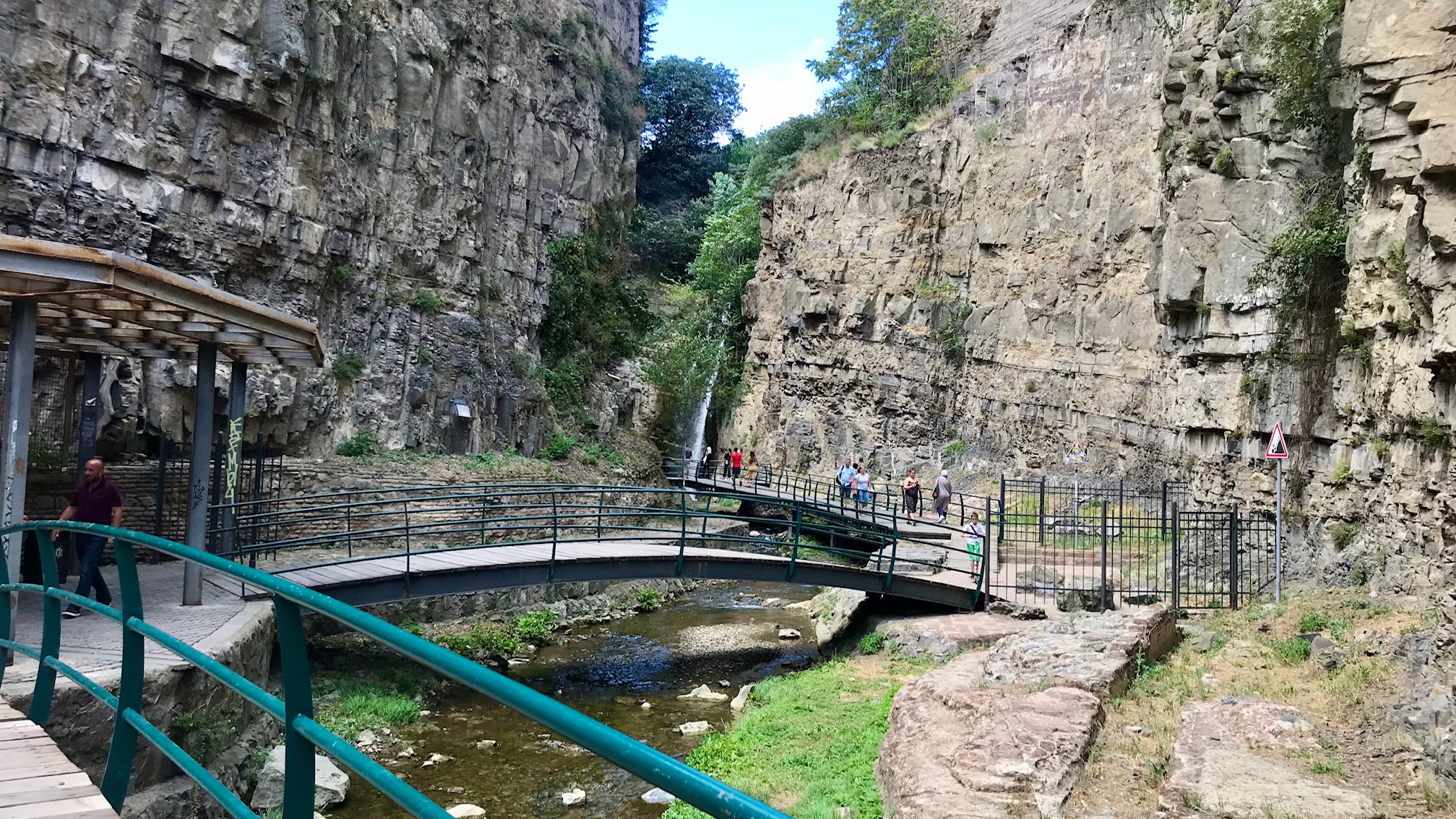
    Suddenly, the urban landscape vanishes, replaced by a stunning natural wonder—a 22-meter waterfall, cascading down rugged cliffs in the heart of the city. This was my absolute favorite spot in Tbilisi.

    First, you’ll cross the Lovers’ Bridge, its railings weighed down by tiny padlocks left by couples, a romantic tradition found worldwide.

    Apskates vieta Tbilisi - Leghvtakhevi kanjons

    As you venture deeper, Tbilisis pastel-colored houses teeter on the canyon’s edge, their delicate wooden balconies daring gravity. Would I step on one? Not so sure!

    Tbilisi nami kraujas malā

    And at the canyon’s end, the waterfall awaits—a serene yet powerful spectacle, a refreshing contrast to the bustling city just moments away.

    Leghvtakhevi ūdenskritums

    The Powerful Message of the Bridge of Peace in Tbilisi, Georgia

    The Bridge of peace location

    Tbilisi Miera tilts dienā

    A gleaming glass-and-steel structure, the Tbilisi Bridge of Peace tells the powerful story of unity between cultures and generations. But its real magic happens after sunset—when thousands of LED lights flicker across its surface, transmitting a hidden message in Morse code, listing the chemical elements that form the human body. A poetic tribute to our shared humanity.

    Tbilisi miera tilts naktī

    A Ride in Tbilisi Cable Car

    You have to purchase a ticket to ride.

    Aerial Tramway station

    Hike up the hill or glide above the city at ease? The cable car ride to Narikala Fortress is a no-brainer. It’s budget-friendly and offers breathtaking aerial views of Tbilisi’s rooftops and winding streets.

    But before boarding, take a moment to explore Rike Park and admire the futuristic Rike Concert Hall, its twin tubular structures resembling something from a sci-fi movie.

    Tbilisi trošu vilcieniņš

    A Must See on Your Tbilisi Itinerary: Narikala Fortress

    Narikala fortress location

    Stepping off the cable car, you’re instantly captivated by a breathtaking panorama of Tbilisi—a mesmerizing blend of ancient rooftops, winding streets, and distant mountains. Street musicians often fill the air with soulful melodies, and if you share where you’re from and leave a generous tip, you might just be treated to your national anthem played in your honor.

    Tbilisi no augšas

    To your right, the Mother of Georgia stands tall and resolute, a symbol of both hospitality and strength. In one hand, she extends a cup of wine to welcome friends, while in the other, she grips a sword, ever ready to defend her land. Up close, she’s awe-inspiring, but I do believe that this is one of the sights that are more impressive when viewed from the distance.

    Next, venture left to explore the Narikala Citadel, a fortress steeped in history. Follow the well-worn paths, check out the modest yet beautiful St. Nicholas Church, and wonder to the edge to look down—if you dare. But be warned: if heights make you queasy, this may not be the spot for you. Peering down from the fortress edge can send your stomach into a freefall! Some thrill-seekers even scramble up the crumbling ruins—though whether that’s officially allowed is anyone’s guess! I enjoy living so I wouldn’t try that.

    Ko apskatīt Tbilisi - Narikala cietoksnis

    Bonus Thing to Do in Tbilisi– Try Wine Ice Cream

    Of course, one has to try Georgia’s famous wine ice cream— I did it twice, just to be sure! The wine flavor is subtle but unmistakable. If you love wine, you’ll adore this unique treat, available at stalls near the Old Town, sulfur baths, and canyon area.

    Meitene ar vīna saldējumu rokā

    What Else To See in Tbilisi?

    If you have explored Tbilisi Old Town and have more time, here are the places I would recommend seeing next.

    National Botanical Garden

    Has an entrance fee.

    Location of Botanical garden waterfall

    Bamboo groves. Stone bridges. Waterfalls. Need I say more?

    I’m no botanist, but I can confidently declare that Tbilisi’s Botanical Garden is a breathtaking escape. Nestled in the heart of the city, it offers an exceptional view of Narikala Fortress. But my favorite part is what I call the “bridge district”, a hidden gem where multiple scenic bridges create a magical atmosphere.

    Tbilisi botāniskā dārza ūdenskritums

    First, you’ll encounter an enchanting arched stone bridge poised over a  waterfall—a scene straight out of a fairy tale.

    Next, a serene bamboo grove awaits, where another charming bridge crosses through. The bamboos steal the show here, though. Fun fact: Bamboo isn’t a tree; it’s actually a type of  a very tall grass?

    Finally, you’ll reach a picturesque suspension bridge, swaying gently over a babbling stream with a small waterfall in the background. It’s a perfect walk! 

    We explored this oasis right after visiting Narikala Fortress, as the garden’s entrance is conveniently nearby so I would suggest you do the same. 

    Tiltiņš Tbilisi botāniskajā dārzā

    Tbilisi Mtatsminda Amusement Park After Dark

    Mtatsminda park location

    Funicular station to get to the park

    Why go at night? Because from the summit, Tbilisi transforms into a sea of lights. The Holy Trinity Cathedral radiates a golden glow, while the TV tower flickers in an ever-changing dance of red, blue, and violet hues.

    Tbilisi televīzijas tornis naktī

    Reaching the top is an adventure in itself—starting with the iconic funicular ride, where the cityscape unfolds beneath you like a storybook coming to life. At the summit, a world of nostalgic charm and adrenaline-fueled excitement awaits. There are food stals, whimsical decorations and fun rides.  We set our sights on the Tbilisi Ferris wheel, eager for an even loftier view, but the night had other plans— the Ferris wheel isn’t operating, possibly due to the wind, so we have to settle for a roller coaster ride instead. But you could also try the free fall if you dare.

    Tbilisi no augšas naktī

    Impressive Chronicles of Georgia

    Chronicle of Georgia location

    Towering over the city, these massive dark pillars are impossible to miss. Their sheer scale and intricate carvings narrating the story of a nation are mesmerizing. Overlooking a pristine reservoir, this monument stands as a grand tribute to 3,000 years of Georgian history and 2,000 years of Christianity.

    Gruzijas hronikas - apskates vieta Tbilisi

    The air hums with an almost sacred stillness, amplifying the weight of centuries carved into stone. Standing beneath these colossal sculptures, you can’t help but feel minuscule, a mere flicker in the grand story.

    Skats uz baznīcu pie Gruzijas hronikām

    Tbilisi St. Trinity Cathedral

    Holy Trinity chatedral location

    Among Tbilisi’s countless churches, one stands out. The Holy Trinity Cathedral of Tbilisi, though relatively young—built in 1995—radiates a timeless majesty. Its golden dome glows against the skyline, a silent guardian watching over the city. Standing in the cathedral courtyard, one can’t help but marvel at its quiet grandeur—so imposing, yet so serene.

    Sv. Trīsvienības katedrāle Tbilisi
    Sv. Trīsvienības katedrāle Tbilisi tuvplānā

    Those are all the attractions on our Tbilisi itinerary. But somewhere in between the sights you’ll probably want to sample some local cuisine.

    Local Foods To Try on Your Tbilisi Itinerary

    Where to Try Best Khinkali in Tbilisi?

    The owner of our Airbnb described Zadiaqo (location) as the place to taste “the best khinkali in all of Tbilisi.” And I must say, they were indeed the most delicious khinkali we had during our trip to Georgia. It felt like a place where locals came to enjoy their Friday night dinner. 

    If you’re not familiar with khinkali, it’s a traditional Georgian dish that resembles large dumplings. The filling can be meat, mushrooms, or cheese. They are eaten in a specific way: you grab them by the twisted top (where the dough is pinched together), take a bite, drink the broth inside, and then eat the rest—except for the top. The top should never be eaten, as it is considered impolite.

    Gruzīņu Khinkali

    Where to Find Best Churchkhelas in Tbilisi?

    Churchkhela is a traditional Georgian sweet—nuts threaded on a string and dipped in thickened fruit juice. There are countless flavor combinations, including some unique ones like kiwi juice. My personal favorite, however, are walnuts dipped in raspberry juice.

    We spotted churchkhelas at many stalls in Tbilisi’s Old Town, but I believe the best ones were actually found at the market. I’d suggest visiting Dezertier Market (location) not a tourist spot—for a more authentic experience. 

    Churchkhelas

    Is Tbilisi worth visiting?

    Yes, because it offers a vibrant mix of sights (fortresses, modern architecture, waterfalls, and more) and flavors (khinkali, wine ice cream, traditional Georgian bread, and beyond). My two days in Tbilisi passed in the blink of an eye, but I do feel like I managed to visit Tbilisis most famous tourist attractions on this short and packed Tbilisi itinerary.

    Our Tbilisi Itinerary in Video Format

    Kravicas ūdenskritums Bosnijā un Hercegovinā

    Check out full Georgia road trip itinerary
  • Tips for Traveling in China & Planning a Trip to China From Personal Experience

    Tips for Traveling in China & Planning a Trip to China From Personal Experience

    When I started planning a trip to China, I quickly realized this would be the most planning I’ve ever done for any destination. My usual travel tools and go-to tips simply didn’t work the same way here. China plays by its own set of travel rules—and that’s part of what makes it so fascinating.

    But here’s the good news: once you’ve done the planning for your China trip, traveling in China is surprisingly smooth and easy.

    In this post, I’m sharing my essential tips for traveling in China—along with the real-life moments when those tips saved my skin (and a few times when they didn’t). Consider this your cheat sheet to planning a worry free trip to China.

    PS: Entry regulations to China change frequently and depend on your country of origin. Because of this, I won’t be covering immigration details in my Tips for Traveling in China. Please be sure to check the latest official sources for the most accurate and up-to-date information on the procedures you’ll need to follow before you go.

    Your Most Important Tool When Planning a Trip to China

    When planning a trip to China, your phone will be your ultimate sidekick: your wallet, your guide, and your voice. If it dies, so might your plans. So keep it well-charged and close… you’ll be relying on it more than you think.

    Skats pa logu Šanhajas tornī

    Tips for Traveling in China to Stay Connected

    How to Get Mobile Data When Traveling in China

    If there’s one thing you absolutely need when planning a trip to China, it’s mobile data. Without it, your mobile payment apps won’t work, you won’t be able to access maps for public transport, or use translation tools effectively. Staying connected is essential when visiting China.

    Here are three main options for getting mobile data when traveling in China:

    • eSIM – The most seamless option if your phone supports it. It’s easy to activate and works instantly—but usually doesn’t come with a Chinese phone number.
    • Roaming from your home operator – Often reliable and simple to use, but can get expensive and may have a cap on how much data you can get. Like eSIMs, it won’t give you a Chinese number.
    • Local SIM card – Offers data and a Chinese phone number, but can be tricky to set up.

    My personal experience

    If your phone supports eSIM, I highly recommend it. My travel partner used an eSIM and had zero issues the whole trip. Unfortunately, my phone doesn’t support eSIM, so I was planning to rely on roaming and a local SIM.

    I purchased a Chinese SIM card for travelers from a vending machine in the airport. Later I was desperately trying to set it up for nearly two hours, and even with the help of the Chinese-speaking hotel staff, it just refused to work. Total waste of time and money.

    Roaming worked great—for a while. My initial 300MB package lasted less than a week, so I bought another. That one worked too… until it ran out. When I tried to buy a third, I got an SMS from my provider saying I’d hit the limit for international data packages and couldn’t purchase any more. I didn’t even know that was a thing. With no data left, I was lucky the person I was traveling with had unlimited eSIM and could share their hotspot.

    Do I Need a Chinese Phone Number When Planning a Trip to China?

    Some popular attractions—like the Science and Technology Museum in Beijing—require booking through apps or platforms that require a Chinese phone number. You can only get one with a local SIM card. An alternative would be to find someone who has a Chinese number that would be willing to make the booking for you.

    My Personal Experience

    As mentioned above, I tried to use a local SIM for this exact reason, but couldn’t get it to work. I didn’t have Chinese friends who could help, but thankfully one kind hotel employee helped me book tickets to a museum I really wanted to see.

    Unfortunately, not all hotels are that helpful. At another one, the staff didn’t feel comfortable doing that so I missed out on another museum I was really excited to visit. If I had to plan a China trip again, I’d probably skip the vending machine SIM and go to a staffed shop where I would ask them to help set it up. Not sure if it really is an option, but I would try.

    Do I Need a Travel Adapter When Planning a Trip to China?

    China uses plug types A, C, and I. While newer hotels might have USB ports and in some metros I even saw wireless charging ports, many older ones don’t. So yes—bring a travel adapter. 

    My Personal Experience

    I packed a multi-purpose adapter with plugs for several countries, and it came in handy more than once—especially at the airport and in hotels without USB ports. 

    And as your phone is so important in China – if you see you’re running out of phone juice on the go – you can also rent portable power banks. But I did not use them, so i can’t comment if there are any issues for foreigners when trying to rent. I just saw them everywhere. 

    Nanjing iepirkšanās iela Ķīnā

    Tips for Traveling in China to Be Able to Pay for Things

    Do I Need Online Payments AND Cash When Planning a Trip to China?

    China is famous for being almost entirely cashless, with Alipay and WeChat Pay used pretty much everywhere. But here’s the thing: if you’re planning a trip to China, don’t leave your cash behind. Even in 2025, having some backup cash can really save you as it saved me—because sometimes, technology fails.

    My experience

    Every guide I read confidently declared, “China is cashless.” So I focused on setting up Alipay and WeChat Pay in advance. But being the paranoid traveler who likes to be prepared for anything, I still brought around €200 worth of RMB—just in case.

    Good thing I did.

    The first time I tried to pay with Alipay, it didn’t work—something about my foreign credit card not being valid. So I switched to WeChat Pay, which thankfully worked in most places… but not all. Some tourist attractions and grocery stores were Alipay-only, and even in a few restaurants that did accept WeChat Pay, something glitched and my transaction didn’t go through. Since I’d already enjoyed the meal, having cash saved me from a very awkward situation.

    Contrary to what I’ve heard when planning my trip to China, most vendors were happy to accept cash—as long as I had exact change. A lot of places don’t carry much (or any) spare change, so it’s worth preparing for that too.

    Steps to take before arriving in China

    • Set up Alipay before your trip and complete the document verification process. I followed a guide online to link my international card.
    • Set up WeChat Pay in advance and go through the ID verification as well. I followed an online set up guide.
    • Bring some cash in RMB. I exchanged mine at home. In total, I probably spent around €80–€100 in cash over the course of my 2 week China trip.

    Other Things to Prepare Before Traveling to China

    Do I Need a Translation App When Planning a Trip to China?

    While people in China are incredibly kind and often eager to help, English is not widely spoken. In many cases, you’ll get by with gestures, pointing, or using a calculator or scrap of paper to communicate prices—but having a reliable translator app will make your life so much easier.

    Most importantly, download the offline version of your translator app before your trip. While offline text translation is handy, keep in mind that image and voice translation features usually require an internet connection, which brings us back to the importance of staying connected.

    My experience

    The people I met in China were genuinely some of the friendliest and most helpful I’ve encountered while traveling. I still smile thinking about the person at the next table who out of good will jumped in to help us decode the hot pot menu.

    That said, the language barrier is real. I don’t speak Chinese, and only a few people we interacted with spoke fluent English. Staff in shops, restaurants, or tourist attractions would sometimes pull out their own translation apps right at the start of a conversation—but I still needed an app on my end to reply or clarify things.

    I found that Google Translate worked best when I had an internet connection via my travel buddies eSIM or roaming. However, since Google services are restricted in China, it didn’t work on public Wi-Fi, so I would highly recommend preparing a backup when planning your China trip. I tried Microsoft Translator, which was solid for written text but struggled with spoken language and image translation.  

    Make Sure You Have a Local Copy of Important Information

    China’s internet can be… unpredictable. One minute your app is working, the next it’s stuck loading forever. That’s why having offline backups isn’t just smart—it’s essential.

    When planning your China trip, it’s smart to save local copies or take screenshots of any crucial information—think QR codes for entrance tickets, insurance documents, booking confirmations, and train details. This way, even if your email or the app doesn’t work while you’re on the go, you won’t be left scrambling.

    My Experience

    I booked several tours and experiences through Viator, but the app’s reliability varied from city to city—it worked perfectly in some places but failed completely in others. On top of that, as you know I lost internet access halfway through my trip.

    Thankfully, my past planning self had already taken screenshots of all my QR codes, tour starting points, and pre-booked train seat details. Those saved screenshots turned out to be a lifesaver, allowing me to breeze through check-ins and get where I needed to go without stress.

    Ezers Ķīnā

    Tips for Finding Attractions and Planning a Trip to China

    Do I Need to Book Entry Tickets in Advance When Planning a Trip to China?

    Because of the daily visitors cap, even the free museums in China often require reservation to enter, and popular attractions can book out days in advance. There are a lot of people in China—and many of them want to visit the same famous attractions you’re planning to visit on your China trip. Think of it like trying to get a dinner reservation on Valentine’s Day—except every day is Valentine’s Day if you’re headed to the Forbidden City.

    Typically, bookings open 7–10 days ahead of time and sell out fast, so planning ahead is key if you don’t want to miss out. 

    My experience

    I visited during the off-season, and even then, places like the Science & Technology Museum, Shanghai Tower, and the Forbidden City required advance bookings to secure the dates I wanted. 

    Because I knew that Forbidden city tickets would disappear in a blink of an eye, and didn’t have a Chinese number to make the booking myself, I knew I wouldn’t stand a chance and decided to book a guided tour that included the tickets. Honestly, I’m glad I did, as this saved me a lot of hustle. I will talk more about that in another post!

    Other places, like the Temple of Heaven, Shanghai greenhouse or Lingyin Temple, during the off-season were more chill—you could grab tickets on the day. But I wouldn’t gamble on it for the big hitters.

    And of course there was the Shanghai planetarium which I couldn’t get the tickets to although it was free, because the WeChat app asked me for a phone number that I didn’t have. 

    How to book tickets to attractions in China

    1. Check the official website of the attraction. Most will redirect you to WeChat for booking e.g. this is what happened when I tried to book the Science & technology museum, so make sure you have that set up. Just note that it may require a Chinese phone number.
    2. If there’s no official website, try searching for the attraction on WeChat using its Chinese name. I had to do this for SoReal VR tickets and info on the Robot Exhibition center in Hangzhou. Again, some bookings through WeChat may require a local number.
    3. For attractions with paid entry, Trip.com can be a good option. The tickets might cost a bit more as it is a3rd party, but you usually don’t need a Chinese phone number. This is how I got the tickets to Shanghai tower.
    4. Check for guided tour options on Viator that includes the entrance tickets. I used the guided tour option for Forbidden city. Just choose an official tour company and be aware of the scammers trying to re-sell tickets for much higher price without any additional value. 
    5. If all else fails, try your luck with same-day tickets, but be aware that many spots might be sold out by then. mēģināt tās nopirkt uz vietas, bet rēķinies, ka var gadīties palikt ar garu degunu. 

    Tips How to Find Attractions and Activities When Planning a Trip to China

    In the beginning of your China trip planning, you may quickly realize that your usual go-to channels—like Google and TripAdvisor—just aren’t cutting it. Or at least that’s how I felt. A lot of the information is outdated or limited, especially if you’re trying to explore beyond the major tourist attractions. For example, I wasn’t able to find any information on SoReal Blast furnace there.

    So what tools did I use for planning my China trip?

    • Trip.com was by far the best English-language option for checking out attractions, buying tickets, and reading reviews.
    • Dianping is a Chinese alternative. It’s super helpful for finding local spots and up-to-date info on whether an attraction still exists or is open. But there are some limitations – you do need to download the app and would need to register to access some of the information, and the translations can be hit-or-miss. Still, I often used it to cross-check info.
    • Viator (by TripAdvisor) worked surprisingly well for booking guided tours.
    • For food and coffee spots, we used the built-in Food feature in Amap (China’s version of Google Maps). It was really handy for finding places nearby and checking reviews. 

    Should I Book a Guided Tour When Planning a Trip to China?

    While I usually prefer DIY travel, I’d highly recommend taking at least one guided tour—or even a food tour—at the start of your trip to China. It’s an amazing way to get a real feel for daily life here, plus you’ll discover insider tips on local foods to try and hidden gems to visit. After that, you’ll be much more confident exploring on your own.

    My experience
    I did three guided tours—two tip-based walks and one fixed-price tour of the Forbidden City—and honestly, these ended up being some of my favorite memories from the whole trip. Since reliable information on China can be hard to come by when planning your China trip, it’s tough to know the real stories behind the places you visit or whether the portrayals you’ve seen in the media are accurate.

    The guides shared fascinating details, like how Shanghai’s city planners actually consulted a feng shui expert when designing parts of the city. They also offered real insight into everyday life. For example, if you’re curious about how locals feel about traditional Chinese medicine versus modern pills or supplements, just ask—most guides are happy to share their perspective. A side note: there’s a whole philosophy around eating to heal your body, and it’s genuinely interesting. Worth looking into!

    Metro Ķīnā

    Transportation Tips for Visiting China: How to Get Around Efficiently

    Tips for Taking a High-Speed Train in China

    China’s high-speed trains are something else. Think smooth rides, futuristic stations, and speeds that make other countries’ trains look like they’re stuck in slow motion.But they’re also popular, which means you need to act fast—tickets go on sale 15 days in advance and can sell out quickly. So do yourself a favour and book trains in advance!

    Mana pieredze

    My experience
    If I understood things right, the official railway app requires a Chinese phone number—which quickly became my personal China trip planning kryptonite. So, I used Trip.com for all my train bookings. Yes, the tickets are a bit more expensive there, but honestly, it was worth the peace of mind knowing I had a confirmed seat on the train I wanted. During the rides I could see that all seats were really taken. 

    But you know what’s really cool? In China, your passport is your train ticket. No QR codes, no printouts. Just make sure you enter your passport details correctly when booking. And a heads-up: the self-service gates only work for Chinese ID holders, so as a foreigner, you’ll need to go straight to the staffed gate where they check passports.

    What Navigation App Should You Use When Planning a Trip to China?

    You’ve probably heard that Google Maps is pretty much useless in China—and yeah, that’s true. The locations are often inaccurate, so don’t count on it. Apparently, Apple Maps works well, but as an Android user… that wasn’t an option for me. So, what do you do? You have to go local and download a Chinese map app.

    My experience

    For planning my China trip and during my time in China Amap became my ride or die, and it was fantastic for both walking and public transport route planning. The app interface can be switched to English, which is a lifesaver. You can also find food, grocery stores, pharmacies etc. by using the in-built app features.

    That said, it doesn’t always recognize addresses when you type them in English. So I prepped like a nerd and saved all key names and addresses—hotels, airports, train stations, and major attractions—in Chinese in my phone’s notes app and in the favourites of the Amap itself. Then I just copied and pasted them into Amap when needed or retrieved my favourites. Super smooth.

    My Secret China Travel Tip: Save Addresses in Chinese

    Whether you’re using a Chinese map app or calling a Didi (China’s version of Uber), you’ll often need to input addresses in Chinese characters. Same goes if you’re asking locals for help—most won’t understand English names of places, but show them the Chinese version and you’re golden.

    How to find the Chinese place names & addresses when planning a trip to China?

    • For hotels, just message them after booking—they’ll usually send you their name and address in Chinese.
    • For attractions or train stations, a quick Google search with the English name + “Chinese name” prefix usually brings it up.

    Tips on Choosing a Transportation Option in China

    If there’s one thing I already miss from China, it’s how easy and well-planned their transportation system is. Cities like Beijing, Shanghai, and Hangzhou are incredibly connected—you’ve got:

    • Metro
    • Buses
    • Didi (China’s Uber)
    • Rental bikes

    I recommend taking the Metro when possible as that’s the most English friendly option..

    My experience

    China’s metro system is amazing. It’s clean, reliable, cheap (most rides we took cost just 2–8 RMB), and incredibly tourist-friendly. Signs, maps, and announcements are all in English, and transfer points are clearly marked. One detail I loved: some metro lines even show which train cars are cooler or warmer so you can choose your comfort level. How cool is that?

    If something’s tricky, they even announce clarifications in English—like if a transfer is on a different floor and people commonly miss it, they’ll call it out over the speakers every time a train pulls in.

    With Amap to plan routes, getting around was a total breeze.

    That said, metro hours can be limited—some lines stop around 10:30 PM, which caught us off guard once. For late nights or places off the subway grid, we used Didi, and that was super convenient too. I used the mini-program in WeChat to order and pay for rides—no extra apps needed.

    One heads-up: most Didi drivers don’t speak English, but since we had addresses ready in Chinese, it was never an issue.

    Bonus Tip For Traveling in China: Ask The Community

    When I was planning a trip to China and couldn’t find answers to a few questions—like whether I needed a train ticket as a foreigner or if my passport would work—I turned to a China travel Facebook group. Some kind people there helped me figure things out, and that community became a really valuable resource during my China trip planning. 

    Just be careful about what you share online to avoid any potential scammers.


    It was a lot of information wasn’t it? Well as I said planning a trip to China is a lot of work upfront. But hopefully this helps. 

    In summary, my 3 key tips for traveling to China would be to make sure you have a reliable internet connection, book at least one guided tour & download and set up all the required apps (WeChat, Amap, AliPay) in advance.  

    Good luck planning your trip to China!

    Kravicas ūdenskritums Bosnijā un Hercegovinā

    What to see in China?