Category: Europe travel

  • What to See in Diocletian’s Palace in Split? Self Guided Walk

    What to See in Diocletian’s Palace in Split? Self Guided Walk

    Today, we’ll be exploring Diocletian’s Palace in Split—a place that is both in ruins and alive at the same time. How is that possible, you may ask? The boundaries between Split’s old town and the former Roman emperor Diocletian’s palace are very blurry. One might even say they’re non-existent. After the emperor’s grand retirement home was heavily damaged, former inhabitants of the nearby Solin built new houses within the ruins of the palace, incorporating parts of the old structure into their new buildings.

    Many centuries have passed, but even today, in Diocletian’s Palace, you can see ancient ruins blended with living houses, lively cafes, shops, and bars. So, let’s explore it together!

    P.S. I’m not a historian, just a regular tourist. I find my facts on the internet, so feel free to suggest corrections if I get something wrong!

    Duration

    <1 day

    Cost

    Free

    Transportation

    Walk

    What to see in Diocletian’s palace:

    Discovering Diocletian’s Palace’s Dark Basements

    Location

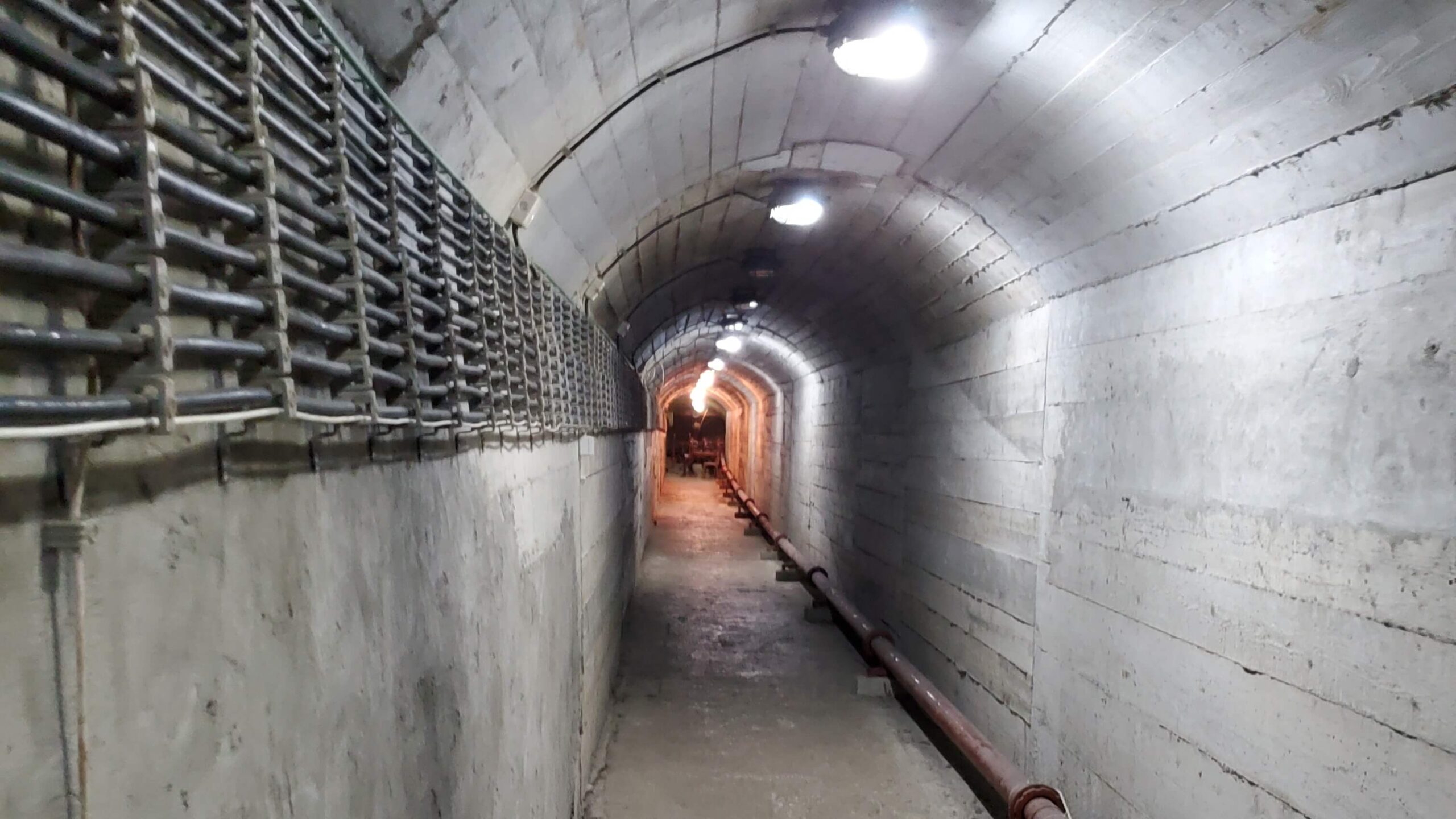
    We enter the palace through its dark basements. It’s spacious, with massive columns supporting the stone ceiling. Here, you won’t find elegant detailing; everything is rough, stained, and a little spooky. This was once where prisons stood and persecutions took place.

    Diocletian's Palace basement

    And here’s a fun fact: for a time, the basements of Diocletian’s Palace were used for discarding waste and sewage. Ironically, this is said to be the reason they’re so well-preserved.

    Diocletian's Palace Cellars

    Daytime Splendour at the Grand Peristyle Square of Diocletian’s Palace

    Location

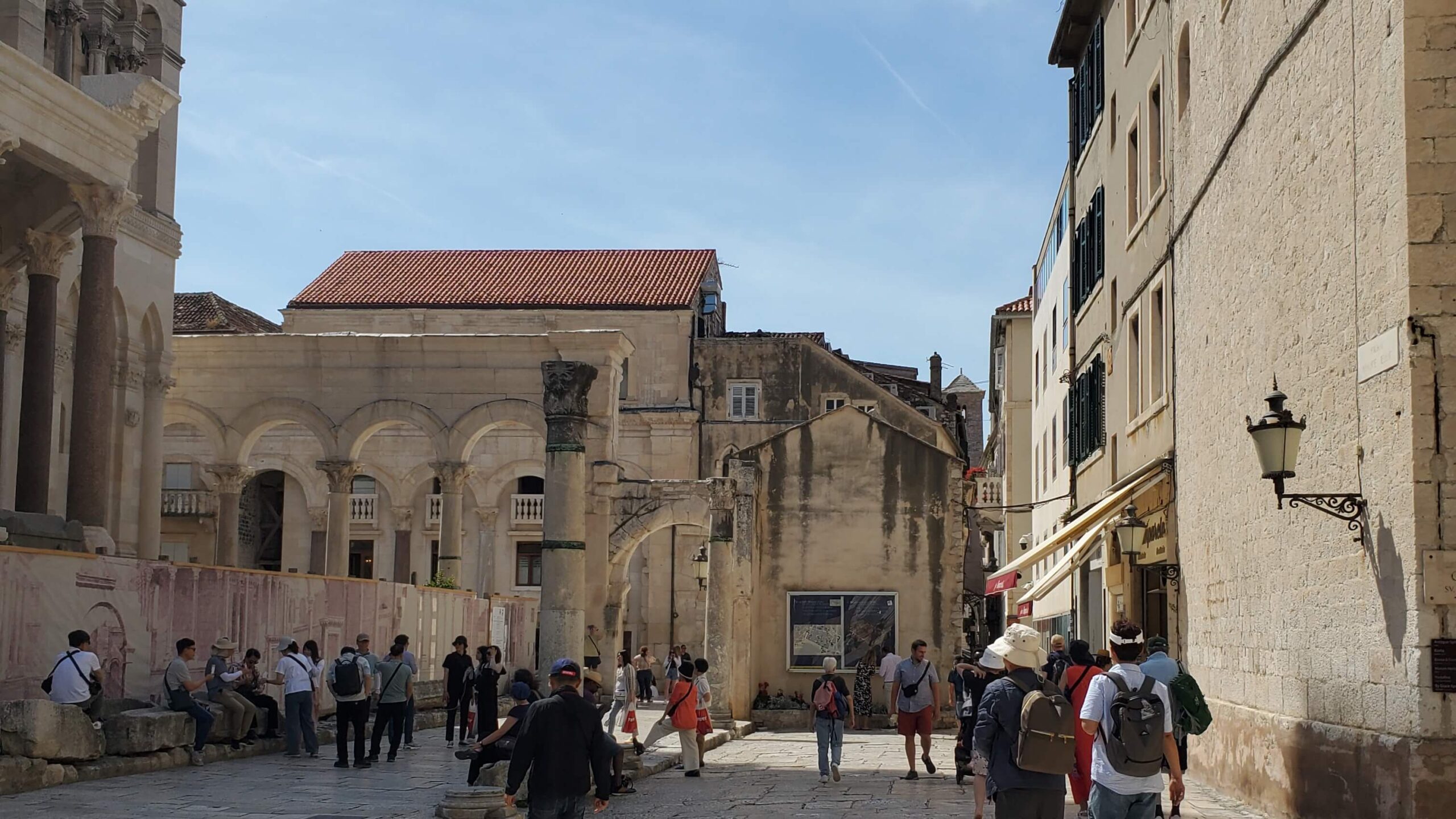
    Next, we head to what I call the heart of Diocletian’s Palace—the Grand Peristyle, also known as the main courtyard where the emperor used to entertain his guests.

    Inside the palace, it’s not uncommon to see a piece of stone with inscriptions or a freestanding column fragment. These ancient relics fit organically into the ruin-like scene. And yet, somehow, modern-day ice cream shops and bars blend in too.

    The column surrounded peristyle is breathtaking, with so many intricate details and the St. Domnius church tower rising above it. No wonder there are soooo many people here!

    Diocletian's Palace peristyle

    We had an honest debate about what came first—the grand columns or the building with little balconies that seem to incorporate them into its exterior. I am guessing the columns. Anyways, it is really cool.

    And randomly—there’s a sphinx here! If you are wondering, yes, the internet confirms it came all the way from Egypt.

    Sphinx in Diocletian's Palace

    Nighttime Adventures at the Grand Peristyle Square of Diocletian’s Palace

    During the day, you might catch a historical dance performance in the peristyle. But the party doesn’t end when the sun sets. In the summer, you might stumble upon live musical performances here.

    Diocletian's Palace at night

    There’s something magical about sitting on centuries-old staircases under the stars, listening to live music on a warm summer night. If you’re into adult drinks, the nearby bar lets you enjoy the tunes with a cocktail served right on the palace’s peristyle steps.

    I don’t drink, so I can’t tell you about the prices, but I definitely enjoyed the vibes.

    The Historic Cathedral of St. Domnius in Diocletian’s Palace

    You never know how destiny will play out.

    What was once Diocletian’s mausoleum has now become a Christian church named after St. Domnius, a saint Diocletian himself persecuted.

    The exterior’s most beautiful feature (in my opinion) is the detailed bell tower. You can climb it and visit the cathedral if you purchase an entrance ticket. 

    St. Domnius Cathedral, Split

    The Skeleton of Former Glory – Vestibule (Rotonda)

    Location

    While exploring you hear a faint sound of someone singing.It sounds a bit like a church choir, but it’s not coming from the church. It’s likely the a cappella singers in the vestibule.

    But it is a bit hard to find it if you are looking for a rounded building as it doesn’t appear to be rounded from the outside. So by the time we came across it the singers were already gone, and all that was left was the tips box. Better luck next time! But it doesn’t stop us from exploring the Rotonda itself. 

    The vestibule is a round hall built of bricks. If you look up, you’ll see that the dome which once covered it is long gone, leaving a circular opening that reveals the sky.

    Diocletian's Palace vestibule

    This room once served as a transition from the peristyle to the emperor’s private apartments. This is not how it used to look back then though. It is said to have statues, mosaics and marble slabs. Now, all that’s left are the bare bones, but its shape is still intriguing. And don’t miss the intricate details on the entry gate!

    Vestibule Gate decorations

    Split’s Old Town Streets in Diocletian’s Palace’s Belly

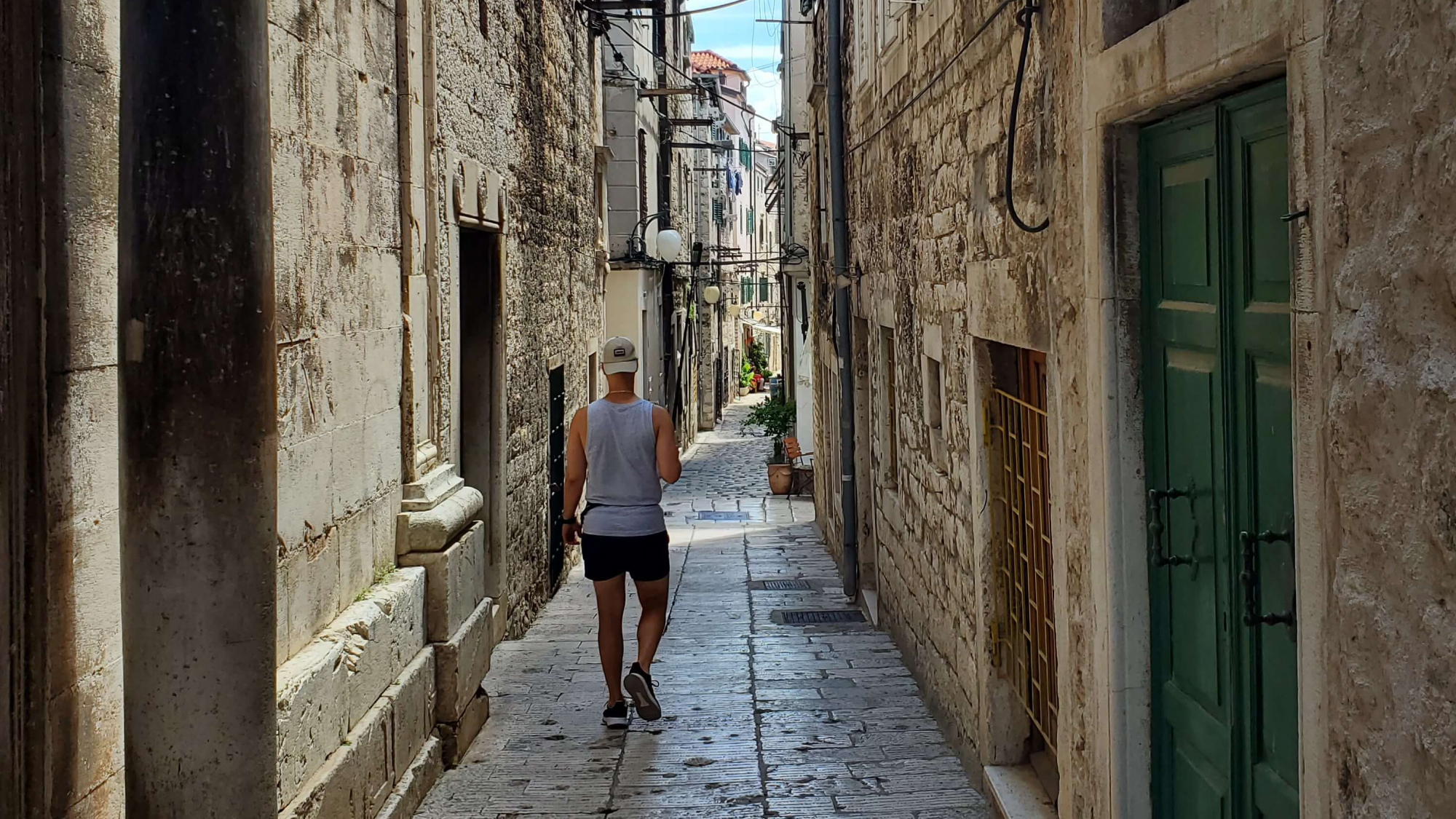
    It feels like every time you walk around Diocletian’s Palace, you discover another charming little street you hadn’t seen before. The winding pathways between the houses are perfect for exploring.

    At many points during your visit, you’ll face a choice of which direction to take, as there are often multiple paths. It’s hard to predict where they’ll lead, so my advice is to follow your heart. The path will definitely take you somewhere interesting.

    Split Old Town

    On one turn you find someone’s laundry drying on a wire. Behind the next there may be a lively restaurant (there are a lot of those here), or a little garden or just some historic houses overgrown with ivy.It’s fun no matter what!

    By just wondering is how we found this great photo spot of the bell tower.

    Split Old Town

    Step Outside Diocletian’s Palace to Meet Gregory of Nin

    Location

    Looking through the Golden Gate, you’ll spot a tall statue surrounded by people. Many of them are engaged in an unusual activity—rubbing the statue’s toe. What’s going on here?

    This is the statue of Gregory of Nin, a Croatian bishop who introduced the Croatian language into religious services, forever shaping Croatia’s religious landscape. Rubbing his toe likely began as a sign of respect, but today it’s believed to bring good luck.

    Gregory of Nin in Split

    Meet the Roman Soldiers by the Golden Gate

    Location

    Looking to snap some fun travel photos to send to your friends? Then approach the Roman soldiers guarding the Golden Gate (or those at the peristyle). Don’t worry—they’re friendly and work for tips.

    You’ll get three poses: the polite one where everyone smiles, the one where you’re ready to attack, and the one where you’re doomed, with the soldiers at your throat. All in good humour, of course!

    Me and my new friends

    But while you’re having fun with your new friends, don’t forget to check out the Golden Gate itself. Built as the main entrance to Diocletian’s Palace, it’s quite grand.

    There is also a detail many may miss. If you stand beneath the gate and look up, you’ll see monstrous heads carved into the bottom of the decorative blocks.

    Split Golden Gate

    What to see in Diocletians palace in 360 video

    Make sure you increase the video quality in settings for the best viewing experience 😉

    !!!! This is a 360 video, so you can drag the screen around when the video is playing and the camera will move around to show you different angles. Also you may need to adjust the quality of video to higher in video the settings.

    Is Diocletians palace in Split worth visiting?

    Whether you’re here to learn, explore, or simply enjoy the atmosphere, Diocletian’s palace will leave you with lasting memories. After all, where else can you see such an intriguing blend of the ancient, the old and the new?

    Kravicas ūdenskritums Bosnijā un Hercegovinā

    View my full Croatia – Bosnia and Herzegovina itinerary
  • What to See in Nin, Croatia? The Perfect Day Trip from Zadar

    What to See in Nin, Croatia? The Perfect Day Trip from Zadar

    Have you heard of Nin, Croatia? What if I told you that this charming little town just ~30  min drive away from Zadar is the place where the Croatian state was born? In fact, Nin is known as the “first political, religious, and cultural center of medieval Croatia.” I have to admit, if this had been a pop quiz question, I would have failed. I only discovered this gem because of Nin’s famous salt fields. But that’s the beauty of travel, right? To explore, discover, and learn something new.

    So, let’s hop in the car and explore what to see in Nin, Croatia!

    Duration

    1 day

    Pace

    Moderate

    Transportation

    Car

    What to see in Nin, Croatia at a glance:

    Experience the Unique Charm of Nin’s Salt Fields

    Location of viewing platform ; Location of Nin Salt Fields tour & museum

    Another pop quiz: How is salt made? There are three main methods of salt production—rock salt mining, brine extraction, and sea water evaporation. In Nin, you can witness the latter.

    Nin salt fields

    As I understand it, the process involves large saltwater pools where seawater is collected. The water then moves through a series of pools, gradually evaporating until only salt remains.

    But, of course, I’m no expert. If you want to learn more, you can take a guided tour at Nin Saltworks, where they’ll explain everything in detail. Just be sure to plan ahead; when we visited, there was no visible salt in the fields. As it’s a natural salt production that happens too. 

    For budget travellers, there’s also a free alternative: you can view Nin’s salt fields from a small observation platform by the roadside. That’s what we did, and I must say, even though the seawater is quite murky and the setup is purely functional, the Nin’s salt fields are quite scenic. Don’t you think so?

    Nin Salt fields

    Walk Across the Iconic Nin Bridge

    Location of Nin Bridge

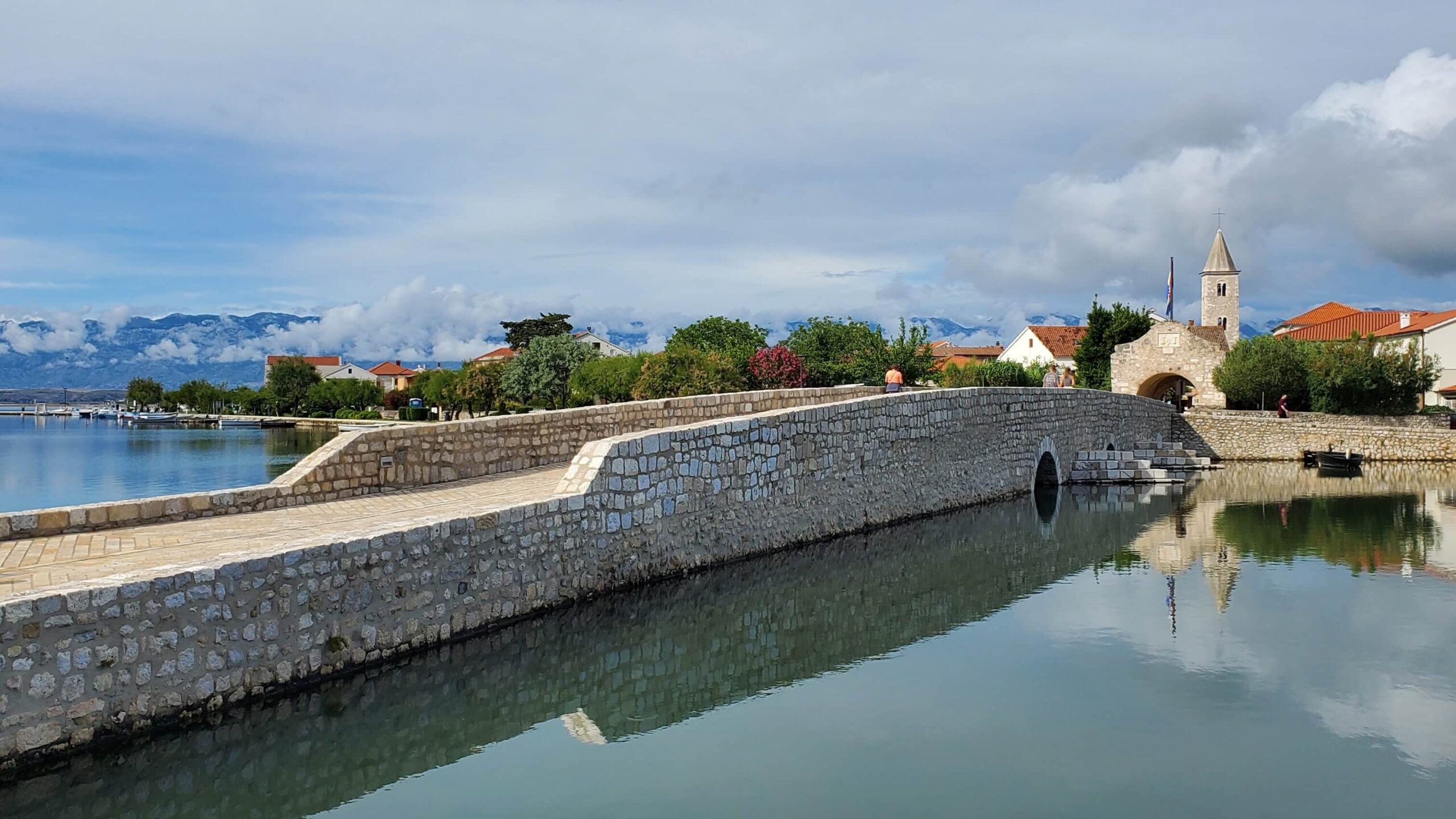
    I spy with my little eye… a beautiful old bridge. Made of stone, with a stunning backdrop of city rooftops and misty mountains, the bridge in Nin is guarded by a statue of Branimir of Croatia, a former ruler. I’m not well-versed in its history, but it’s so picturesque that it belongs on a postcard.

    Bridge in Nin, Croatia

    What to See in Nin’s Picture Perfect Old Town?

    By now, you know how the story goes in Croatia- we enter the old town through a grand stone gate and are greeted by streets full of souvenir shops, ice cream cafes and historic buildings. 

    So what tourist attractions does Nin, Croatia have in store for us?

    Old town gate in Nin, Croatia
    Tower in Nin

    Meet Gregory of Nin (Again)

    Location of Gregory of Nin in Nin, Croatia

    If you’ve visited Split, you might recognize a familiar face. In Nin, you’ll find a slightly smaller version of the statue of Gregory of Nin. Yes, the same one whose toe everyone rubs in Split for good luck.

    But that’s no surprise—he’s called Gregory of Nin, after all. If you’re wondering who he was, Gregory was a bishop who introduced the Croatian language into Croatian religious services, which had previously been conducted only in Latin.

    Gregory of Nin statue

    Discover the Silent Power of Nin’s Miniature Holy Cross Church

    Location of Church of Holly Cross Nin, Croatia

    In the midst of some ancient ruins stands a tiny church. From just looking at it you can tell it has stood here for a very, very long time. 

    Holly Cross Church in Nin, Croatia

    This is the Church of the Holy Cross, often referred to as the smallest cathedral in the world—though that’s not an official title.

    Inside this must-see of Nin, Croatia, it’s completely empty, with barely enough room to turn around. Yet, despite its size, there’s an undeniable sense of silent power when you step inside.

    And here’s a fun fact: the Church of the Holy Cross in Nin, Croatia also functions as a bit of a calendar. It’s positioned so that you can determine the time of the solstice based on the way the sun’s rays enter the church. Quite fascinating, isn’t it?

    Inside of Holly Cross church Nin, Croatia

    End Your Nin Day Trip with a Stroll Along Nin’s Charming Promenade

    Location of Nin promenade

    As charming as Nin’s old town is, it’s rather small, so before long, you’ll find yourself exiting through the stone gate on the other side.

    Gate in Nin, Croatia

    But right before the gate, on the left hand side is a little side path. If you take the turn, a beautiful promenade awaits you. The still water reflects the landscape like a mirror, with mountains in the background that look like they were painted. And if you look carefully – somewhere in between the both you’ll see strips of land that I believe are the Nin’s lagoon beaches.

    Promenade in Nin, Croatia

    By the way, Nin is one of the few places in Croatia with sandy beaches, along with some healing mud. So if you are into those kinds of stuff – do check them out. But if, like us, you’re eager to return to Zadar in time for sunset, this scenic route along the water will lead you back to the bridge where you started your hunt for attractions in Nin Old Town.

    What to See in Nin, Croatia in 360 video

    !!!! This is a 360 video, so you can drag the screen around when the video is playing and the camera will move around to show you different angles. Also you may need to adjust the quality of video to higher in video the settings.

    Is Nin worth visiting?

    Nin’s proximity to Zadar makes it an ideal choice for a day trip. It’s charming, picturesque, and full of history. However, do keep in mind that dining can be a bit pricey. All in all, if you’re into sightseeing, I highly recommend a visit. So I hope my guide on what to see in Nin, Croatia will help you plan your own day trip to Nin.

    Kravicas ūdenskritums Bosnijā un Hercegovinā

    Enjoyed our story on what to see in Nin, Croatia?

    View my full Croatia – Bosnia and Herzegovina itinerary

  • What to see in Zadar, Croatia? Celebrating the Sunset

    What to see in Zadar, Croatia? Celebrating the Sunset

    On this very rainy day we will explore another Croatian coastal town – Zadar. It’s known for its beautiful old town and famous for its sunsets. Due to the horrible weather we will do a bit of a speed run through Zadar’s most famous tourist attractions, and then we will try to trick the rain by driving to the nearby Nin, which is truly a gem. Have you heard about it? But of course we will come back to Zadar for the sunset. We have to see if it is truly one of the most beautiful sunsets in the world. So grab your raincoat and let’s figure out what to see in Zadar together!

    Duration

    1 day

    Pace

    Fast

    Transportation

    Car

    What to see in Zadar at a glance:

    What to See in Zadar Old Town?

    When you’ve visited enough cities along the Dalmatian coast, you start noticing a pattern. All these cities have an old town that’s separated from the rest of the living quarters by thick walls, with a grand entry gate (or gates) that feels like a portal to another world. Once you step through, you’re transported from the everyday world into a land of beautiful old buildings, winding streets, and delightful surprises around every corner.

    Zadar’s Impressive Land Gate

    Location: Land gate

    There are multiple grand entry gates to Zadar’s Old town.

    But the gate you really can’t miss is the Land Gate. It’s adorned with the Venetian Empire’s coat of arms—the iconic winged lion—and some other truly impressive sculpture work. What other symbols can you find in this pic?

    Zadar Land Gate

    People’s Square of Zadar (Narodni Trg)

    Location: Narodni Trg

    Not even the rain can stop people mingling in Zadar’s streets. And one of the best spots for people-watching is said to be the People’s Square. Now, I’m not a huge people-watcher myself—I prefer admiring beautiful old buildings. Luckily, People’s Square has plenty of those too.

    If you look at the right you’ll see a building that is practically an art piece – adorned with multiple reliefs of what I believe are city scenes. The detailing is phenomenal! I think this is the Zadar Town Hall, but don’t quote me on that.

    Relief on a building in Zadar People Squere

    On the other end of Zadars people square you’ll spot a clock tower. That’s the city’s old guard. Let me impress you with some numbers. It was built in the 1500’s. The clock was added later in the 19th century.

    Zadar City Guard clock tower

    As I later found out there is also a Church of St. Lawrence hiding somewhere here, but I couldn’t spot it. Maybe you’ll have better luck playing detective than I do!

    On the third side of the square is the Zadar City Loggia. I don’t have a good photo of it (blame the rain), but it’s a building with grand columns and arches. It used to serve as a courthouse, but now it’s an exhibition hall. We peeked inside, and I loved that they’ve kept the giant stone judge’s desk as the centrepiece.

    Zadar Town Hall

    Wandering Through Zadar’s Old Town Streets

    When it comes to wandering through Zadars Old town streets it’s fifty shades of Beige. But it’s not a sad beige, as the textures and details bring it to life. And the little shops selling clothes, souvenirs, and even rubber ducks add a pop of colour with their vibrant window displays.

    Zadar Old town street

    If you wander without a plan, you might stumble across hidden gems like this charming little courtyard. Look up! I bet the neighbours on opposite sides could open their windows in the morning and enjoy coffee together.

    Courtyard in Zadar

    5 Wells Square in Zadar

    Location: 5 wells square

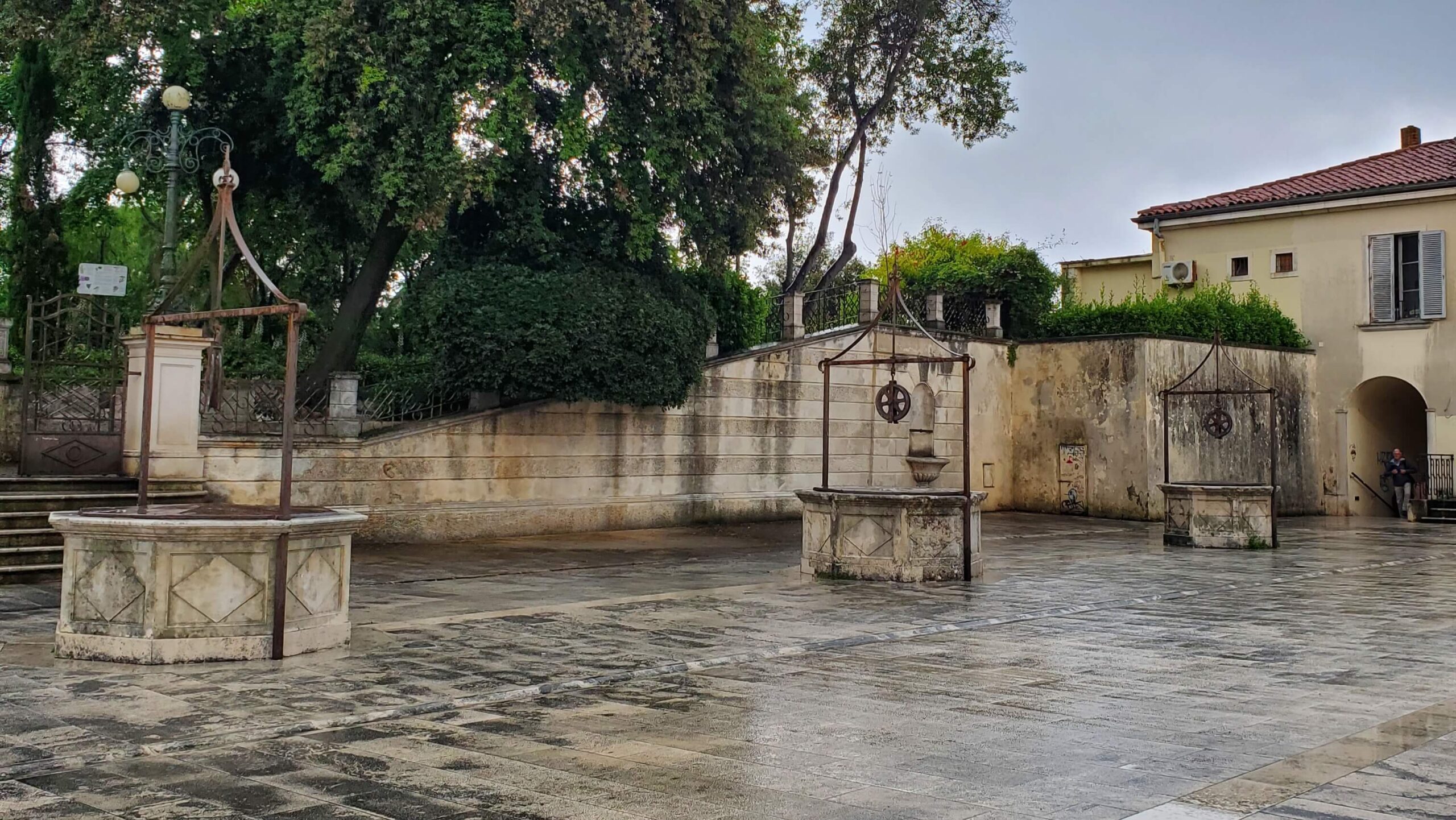
    For some reason, the image I associated most with Zadar before coming here was the 5 Wells Square.

    As you might guess, it’s a large open-air area with five identical wells. They’re no longer functional, though. The buckets are gone, and they’re locked with metal covers now, but they for sure are beautiful. Plus these wells have already served their time, back in the day, providing Zadar with water during turbulent times.

    5 wells square Zadar

    In the background, you can see Captain’s Tower, which was once part of the city’s defence system. And on the right, you’ll find the city walls and an entrance to Queen Jelena Madijevka Park – the oldest one in the town.

    Zadar’s Churches

    Location: St. Donatus church

    There is a lot to unpack in this scene. As there are 2 intriguing churches fighting for your attention in the same place.

    The smaller, round one is the Church of St. Donatus, dating back to the 9th century. What I find fascinating is that some of the parts from the old Roman Forum, on which it was built, were used in its construction.

    And that beautiful tower belongs to St. Anastasia’s Cathedral. I saw a blog post describing this church as “elegant,” and I couldn’t agree more. Just look at those ornaments above the window arches!

    Zadar Church of St. Donatus and bell tower of St. Anastasia's

    Climbing the bell tower is a top tourist activity in Zadar. It was on my bucket list too. But due to our plan of escaping the rain we thought we would come back to it later. But we never did. So if you do climb it, please let me know how it was!

    What to See in Zadar Promenade?

    Although I love Split’s palm trees, Zadar’s promenade might just be my favourite from all the promenades I visited during my Croatia road trip.

    Sunset on Zadar Promenade

    Location: Zadar promenade

    You start your walk on a narrow pathway by the old town walls and then come to this open area by the sea where the pavement stretches as far as the eye can see. I bet it’s beautiful any time of day, but it’s perfect for an evening stroll to catch the sunset.

    Let’s just take a moment to enjoy the peace and quiet.

    Zadar promenade

    The closer we get to the end of the promenade, the busier it becomes. We had this brilliant idea to watch the sunset from here, but guess who else had the same idea? Literally everyone else in Zadar.

    By now, the Sea Organ—a mystical musical instrument that plays haunting sounds created by the waves—was swarmed with tourists. No chance of getting a seat to hear its melody. So here is a pro tip: come at a different time of day to really enjoy it.

    Luckily, there’s plenty of space at the end of the promenade where we can sit. We watch the sun dip below the horizon, and the ships sail by. When a larger ferry passes, its waves give a boost to the Sea organ and we hear a long lonely howl from up here too. 

    And for those wondering—the sunset in Zadar is indeed beautiful.

    Zadar sunset

    Greeting to the Sun

    Location: Greeting to the Sun

    Once the sun sets, everyone, almost like they’re part of an organised group, moves to the next attraction.

    On Zadar’s promenade, there’s an installation of solar panels that collect light during the day and turn it into a playful light show after dark.

    People gather around it, forming a big circle, waiting for the “Greeting to the Sun” to come to life. At first, everyone seems a bit shy, hesitant to step onto the panels. Only the kids are having the time of their life, running around and doing tricks.

    A must see in Zadar - the Greeting to the sun

    The lights start off a bit shy too, but as the night grows darker, they shine brighter, displaying various colourful patterns. Visitors loosen up as well, eventually stepping onto the installation to snap that perfect selfie.

    Zadar Greeting to the sun

    What a perfect way to end the day in Zadar.

    What to See in zadar in 360 video

    !!!! This is a 360 video, so you can drag the screen around when the video is playing and the camera will move around to show you different angles. Also you may need to adjust the quality of video to higher in video the settings.

    FAQs About traveling to Zadar

    Zadar vs Split. Which one to choose?

    Both cities boast charming old towns, stunning beaches, and mouthwatering seafood, so you really can’t go wrong with either.

    Now, I’ve heard that Zadar is supposed to be less touristy than Split, but honestly, from what I experienced, the crowds seemed pretty similar. The number of people wandering the attractions and streets felt about the same, and prices didn’t differ much either. That being said, I visited in the beginning of June, so the situation may be different in peak season.

    For me, the biggest difference between the two cities lies in the day trips they offer. If you’re dreaming of exploring Plitvice Lakes or Kornati National Park, Zadar is your best bet—it’s closer to both of these natural wonders than Split. Plus, Šibenik is just a short drive away from Zadar, making it an easy and worthwhile trip.

    How did we get around during our trip to Zadar?

    Although we had a rental car, Zadar’s old town is pedestrian only, so we left the car in one of the paid parking lots and explored by foot. The price of the parking lot was within our budget, but make sure you have cash on hand when traveling to Zadar, as the one we parked at was cash only.

    What to see in Zadar if you have time to visit only one place?

    There are more places to see in Zadar than we had time to explore in one day. But if I had to pick a one must-see in Zadar it would have to be the promenade with the Greeting to the sun due how to how unique it is.


    Is Zadar worth visiting?

    As I mentioned earlier, we had very little time to explore Zadar due to our side quest to Nin. I’d rather call this visit a “starter” than the main course. But from what I saw, Zadar is yet another beautiful Croatian town with historic buildings and arguably the most walk-friendly promenade I’ve experienced on this trip.

    Liked our post on what to see in Zadar?

    Kravicas ūdenskritums Bosnijā un Hercegovinā

    View my full Croatia – Bosnia and Herzegovina itinerary

  • Krka National Park, Croatia. What to See Beyond the Main Waterfall

    Krka National Park, Croatia. What to See Beyond the Main Waterfall

    I’ve heard a lot of discussions about whether it is worth visiting both Krka National Park and Plitvice on your Croatia trip. So, we have to figure that out! Rumour has it that Krka is worth visiting if you explore more than just the main waterfall. So, we’re setting that as our goal for the day. We are starting with the stunning foot trail to Skradinski Buk and then moving on to other exciting things like a boat ride to a monastery hidden away on an island, visiting beautiful old water mills, enjoying another waterfall, and exploring a cave.

    Hope you have your hiking shoes on!

    Duration

    1 day

    Cost

    Paid admission

    Transportation

    Car

    What to see in Krka National Park:

    What To See At Lozovac Entrance Of Krka National Park

    Picture-Perfect Foot Trail to Krka’s Crown Jewel – Skradinski Buk

    At 8 AM, the crowds aren’t here yet, but they are coming. So, we start with the most popular part of Krka National Park first—the walking path to the main waterfall.

    As we are starting from the Lozovac entrance, we’ll explore the paths first and then see the waterfall itself as the cherry on top of the cake.

    I have to say—Krka is stunning. You’re walking on a mix of wooden and gravel paths shaded by lush green trees. On both sides, there’s clear water where you can spot little fish.

    Krka Nature Park foottrail

    The frogs are singing, and the birds are joining the choir too. Time after time, there are tiny waterfalls or wannabe waterfalls (aka rapids) bubbling away. It’s nature’s symphony.

    Clear water in Krka National Park

    Chasing The Tiny-falls And Waterfalls in Krka National Park

    Also, Krka knows how to tease you. 

    After a while of enjoying some tiny-falls we come across a spot where you can see the big waterfall in the distance. There are more people queuing up here. And for whatever reason the water seems bluer from up here too.

    View to waterfall in distance in Krka Nature park

    And after that we come across this beautiful, old building overgrown with ivy, behind which a larger waterfall is bubbling away. This one has multiple streams of water running over mossy green rocks. Does it get more romantic than that?

    Waterfall

    Possibly. We also saw a waterfall that seems to have dried out, leaving only a cave behind it. But you can still see the pattern water has carved into the sand.

    Dried out waterfall in Krka

    Snatching The Perfect Pic At Skradinski Buk

    And then we reach the main attraction – the famous Skradinski buk.

    It’s a pretty multi-level waterfall that runs with a huge force. You can no longer swim here, but there is a nice walkway to get closer to the falls to snatch that perfect picture. 

    It is beautiful. However, if I have to compare it to waterfalls in Plitvice and Kravice waterfalls in nearby Bosnia and Herzegovina, I have to say that this one is smaller and simpler.

    But that is why we are doing more than just visiting the waterfall. And even if we wouldn’t – the walk leading up to Skradinski Buk was perfect.

    Skradinski Buk waterfall in Krka

    In the nearby area one can also stumble across a couple of small, historic expositions of traditional cookware, local crafts and watermills. 

    Historic objects

    But we have walked for a couple of hours already. I believe it has been 5,5 km. So I think this would be a good time to chill a bit to recharge our batteries. Preferably on a boat.

    Krka Boat Ride To Visovac Island

    In Krka, there’s a monastery so remote from the rest of the world that you have to take a boat ride to get there. Intriguing, right?

    Actually, there are a couple of boat ride options to choose from in Krka, but heads up, they’re not included in the ticket price, so you’ll need to pay extra to enjoy them. Today we are trying out a two-hour round trip, which takes you to the Visovac island and back.

    The boat ride in Krka National Park itself is very calming.

    Around you there is just blue water and some hills that are overgrown with trees. No hustle and bustle to be seen. Some may call it a bit monotonous. I will call it chill. 

    Boatr ride in Krka National Park

    Does one have to take the boat ride to enjoy Krka? No. But if you have the means and want to sit down for a bit, to enjoy some views without putting in a lot of effort, it’s a nice way to rest for a bit.  

    A Place For Peace And Prayer

    After a ~40-minute ride, you’ll spot the Visovac island.

    It’s not exactly as it appears in marketing materials for Krka, as you can’t see most of the church behind the trees, but you can spot a tower peeking out. When the boat stops, you get a quick rundown of what you can explore for the next 30 minutes.

    Church behind trees

    On the small island you can wander around the gardens where you can see fruit and vegetables growing.

    There is also a museum displaying religious artefacts and a very beautiful old church. The aura on the little island is as chill as on the water. Such a thing as rush doesn’t exist here. I can see why it’s a perfect place for worship.

    Monastery on Visovac island, Krka

    When the little tour comes to an end the boat takes you back to the starting point.

    After recharging our batteries it is time to jump in a car and drive to Roški Slap entrance which is ~30-40 min away to explore some other cool places.

    What To See at Roški Slap Entrance of Krka

    Exploring The Old Watermills Of Krka

    There is something romantic about a rustic stone house with an old carriage enjoying its retirement in front of it.

    Some of the buildings in the Krka mill complex have been given a modern twist—there’s a restaurant and a souvenir shop, but the real gems are the parts that function as an open-air museum. So let’s take a peek inside.

    Watermills in Krka National Park

    Have you seen a watermill before? Now, I’ve seen exactly one. And that one had a giant wheel, turning since the dawn of time and probably set to spin until the end of eternity.

    So, I was expecting the wood beams and the un-plastered walls, but I wasn’t prepared for a whole lineup of these copy-paste millstones, just sitting silently next to each other. It’s giving a bit of a shut-down factory vibe.

    Watermills

    And then there’s this room with big buckets in the ground. Look down, and you’ll see water swirling around in them. They’re kinda cool. But what on earth are they for?

    Barel in the ground

    Off the Beaten Path 

    (Not in the video)

    We also tried to walk the nature trail from the watermills for a bit. However, what we found was mostly a path through the trees with some cliffs in the distance and what looked like a cabbage field and some gardens on the side.

    Clifs in Krka National Park

    As this was too similar to the nature trails we can enjoy at home after around 2 km we decided to skip this one, to make some time for other attractions in Krka. Let me know if we missed out on something big here.

    Nature trail in Krka

    Stunning Cascades Of Roški Slap

    The big question of the day: where’s Roški Slap waterfall? According to the map, it should be somewhere between the bridge we crossed to get to the car park and the watermills.

    I could swear I heard it bubbling away, teasing us. But despite our best efforts, there was no path in sight leading to it. Defeated, we decided to call it quits and followed the sign to Oziđana Pećina Cave instead.

    But to get to the cave, we need to climb these very, very high stairs. And I am not going to lie—those stairs look scary.

    Stairs to Oziđana pećina cave in Krka Nature Park

    Somewhere midway up, I am already out of breath. Miks is strongly in the lead, while I am somewhere many steps behind, regretting my life choices. Until, a beautiful view of Roški Slap unfolds.

    Look to the left, and you’ll see a series of little cascades following each other in a beautiful, wave-like pattern. The greenery on the rocks blends seamlessly into the trees on the shore, which then blend into the cliff behind it. Gorgeous!

    Roski slap waterfall in Krka

    So it turns out Roški slap is not a folktale no one can find – it just needs to be enjoyed from above. Now we know.

    Did You Know There Is a Cave In Krka Nature Park? Oziđana Pećina

    We did it! We conquered the endless stairs. Pat yourself on the back.

    One may expect a little grotto in the rock. But it looks like it’s actually a long tunnel that takes you quite deep under the cliff. Hope you’re not claustrophobic! And luckily for us – there is electric lighting.

    Oziđana pećina cave in Krka

    But what’s that? There is someone in there.

    Just kidding – it is a statue.

    A very creepy statue of a cave person.

    I wouldn’t want to come across this guy during the dark, but it is a nice way to draw your attention to the fact that this cave (despite it’s difficult to reach placement) was inhabited and there are various archeological remains found here.

    Statue of a cave person

    Are You Ready To Climb Some More Stairs For The Views From The Top?

    (Not included in the video)

    At this point one could call it a day and climb down the stairs. Or one could gather the remaining strengths to conquer a couple more steps to the top of the hill. Guess which one we are doing?

    On the top you get an epic view of cliffs, tree tops and the rest of the world below.

    And if you are looking for a quiet spot to enjoy nature – this is it. As not many travellers seem to climb higher than the cave.

    View from the top

    The Bridge Between The Fig Trees (Other Spot To Enjoy Rošk slap From )

    Ever since leaving our car near the Krka watermills, we have been playing a chase with the rain. And now it has caught us, so it is time to return to the car. But where is the fun in walking back the same way we came?

    From the top you might have spotted that there is a bridge crossing the river. I bet one can catch some good views from there too, so that’s where we are heading. 

    On both sides of the bridge there are lush fig trees. It’s not the season yet, so at this point the fruit are little fig babies that still need some time to grow.

    But If you turn to the left, you’ll catch a glimpse of Roški slap’s cascades from here, too. The view might not be as jaw-dropping as the one from above, but it’s definitely a contender. Plus, it’s way more accessible than climbing who knows how many staircase steps.

    But now – as beautiful as Krka is, let’s run to the car as we are soaking wet. 

    What to see in Krka National Park in 360 video

    !!!! This is a 360 video, so you can drag the screen around when the video is playing and the camera will move around to show you different angles. Also you may need to adjust the quality of video to higher in video the settings.

    FAQ’s of visiting Krka National park

    These are the questions I had before visiting Krka National Park and the answers I found.

    Can I visit the entrance I have purchased the ticket for (e.g. Lozovac) and then go out and come back in at another entrance?

    Yes, you can. Just keep the entrance ticket as they will validate it.

    If I start at Lozovac / Skradin entrance, how do I get to Roski slap?

    I believe you either have to exit the park and drive (30-40 min by a car) or you could take the long (4h) boat ride.

    Where can I buy tickets for a boat ride in Krka National Park?

    As mentioned before – boat rides in Krka are extra cost. You can not buy the tickets online. They are sold in the ticket booth inside the park. You can, however, check the prices online.

    Can I swim in Skradinski Buk?

    No, that is no longer allowed. If you see pictures of people swimming, those have been taken before the restrictions.If you are looking for a swimming experience you could check out Kravice waterfall in nearby Bosnia and Herzegovina.

    What route of Krka National Park we chose?

    Here are the routes we walked, but this is definitely not all Krka. But it is definitely not all Krka has to offer. 

    1) Lazovac > Skradinski buk > Boat dock > Visovac island (by boat) > Boat dock > Lazovac

    2) Roški slap entrance > Watermills > Part off Nature trail to Utvrda Kaamicka (only did 2 km each way and called it quits) > Oziđana Pećina cave > Across the bridge > Roski slap entrance

    Screenshot of a walk from Garmin

    5.19 km

    Screenshot of a walk from Garmin

    8.89 km

    Why we chose to go on our own instead of taking a tour?

    Tours have limited time at the park and we wanted to spend as much time as possible in the perk to see as much as we could.

    Is there parking space available near the entrance?

    We chose Lozovec entrance, because it has a big parking lot. On Roški slap entrance you need to park on the side of the road, but there is space for multiple cars.


    Is Krka National Park worth visiting?

    The verdict is that Krka is absolutely gorgeous and it is worth putting it on your bucket list. And if you do have the chance and the energy I do recommend visiting both of the entrances as there are some quite unique views on Rošk slap side as well. Ah, and apparently there are some other alternatives of places you could choose to explore in Krka. There was just simply not enough hours a day for us to explore it all.

    Kravicas ūdenskritums Bosnijā un Hercegovinā

    View my full Croatia – Bosnia and Herzegovina itinerary

  • Our Experience: Snorkeling Cruise from Split. Blue Lagoon & Underwater Museum

    Our Experience: Snorkeling Cruise from Split. Blue Lagoon & Underwater Museum

    What’s the first thing that comes to mind when you think of travelling in Croatia? Let’s say it in three: 1, 2, 3… Swimming in the crystal-clear waters! And what better way to wrap up an active vacation like ours than by taking a relaxing snorkeling cruise from Split? One where you can chill on the board enjoying the views and then jump into an adventure (aka the water) from the deck to cool off and explore some underwater life? Sign me up!

    There are many snorkeling cruises from Split to choose from. We picked “Blue Lagoon Boat Tour with Underwater Museum and Lunch Included” aka the one that looks like the pirate ship. And I believe we made a good choice. So to ease up the decision for you as well, this is going to be a bit of a review of a snorkeling cruise from Split to Blue Lagoon and Underwater Museum. We’ll talk about the good and the bad.

    Duration

    1 day

    Cost

    Paid admission

    Operator

    Cruise we picked

    Location

    Split city center


    What to expect on Snorkeling cruise from Split to Blue Lagoon:

    All On Board! Let’s Set Course to the Blue Lagoon, Croatia

    On entering the pirate ship you have to make 2 choices. One is the meal you would like to have (fish, chicken or vegetarian). And the other one is where you’re going to sit.

    On the second one you may not have that many options to choose from if you are on the end of the queue, so arriving at the last minute may not be your best move. I believe how enjoyable your snorkelling cruise from Split will be is based on what seat you get.

    If you are on the sundeck – you’re having the time of your life. If you’re not (and you wanted to), you may get a bit grumpy. Although on hotter days the lover deck offers nice shade, so I can see why some people would choose that too. 

    Views of Split from a ship

    We are lucky enough to snatch a seat on the sun deck, and with pirate music playing in the background the adventure can start.  

    The surroundings are stunning. While sailing away from the shore (same as when returning) you can see Split’s houses and many little sailboats and yachts docked near the shore. Further in the sea there are cliffs and islands. Some are more green-ish. Some look burnt out with naked trees bearing no leaves.

    Cliffs in the water

    The sun is shining. The water in front of you is almost as blue as it gets (will get bluer). It’s very peaceful. Very chill. You can even see that some people, who probably had a late night, have fallen asleep in their sun chairs.

    What to Expect on Stop 1 of the Snorkeling Cruise From Split- The Warm Up

    Time flies. And after some sightseeing and chilling in the sun the first snorkelling stop is announced. The snorkelling gear is provided in exchange to a monetary deposit or an ID. Don’t worry, those are returned to you in the end of the trip as long as you return the snorkel. 

    I call this a warm up spot as although it is beautiful – a blue water bay – there isn’t that much to it both above the water and below. 

    View of bay from a snorkelling cruise ship

    Nevertheless, although it’s not super hot, everyone is itching to jump in the clear blue water. It just looks… welcoming. And refreshing. And fun.

    We dive in. 

    For me this is my first time snorkelling, so I feel ridiculously excited when I see my first marine creature. Guess what it is? A sea urchin chilling on the rocks.

    The swim was perfect. And after such a good swim one must be hungry. The cruise company must know it as the next item on the itinerary is lunch.

    Lunch on the Board

    I gotta say, based on the mixed reviews I was a bit scared of the lunch. 

    As Croatia is famous for its seafood I thought the grilled fish would be my best bet. And I do stand by my choice, as in my opinion it was pretty tasty. You get a whole grilled fish, a bit of cabbage salad & some bread. The fish is cooked through and seasoned. So no complaints from my side. But I also am not a gourmet.  

    There was also unlimited wine offered with lunch, but I have to admit that I did not like the taste of it, so I question the quality. Sorry, but I have to be honest. 

    After lunch it is time to enjoy the views again on the way to the Blue lagoon. And this time we have company. Or maybe we are haunted? As there are tens of seagulls following our boat! This gives some apocalyptic movie vibes. 

    Sequels following a ship

    What to Expect on Stop 2 on Snorkeling Cruise From Split – Blue Lagoon

    I wasn’t sure what to expect from the Blue lagoon. It is described as a bay with perfect, clear blue water that is great for snorkelling and swimming.. And that’s about it.

    I mean – the description is right. But interestingly – it’s not one big blob of turquoise water. From the distance you can see that there are some darker blue sports too, that creates an interesting pattern. And then the pattern is enhanced with many little (and not so little) white yachts.

    The views from the deck are truly picture perfect. 

    View of water from ship

    Unfortunately the winds are strong and most of the people are opting to sunbathe on the deck rather than fighting the waves. And as we are parked far away from the coast there isn’t much else to do then enjoying the views. 

    Sometimes you win, sometimes you lose, I guess. So let’s take the best of it and try to catch some tan. Also I have high hopes for the next spot on our snorkelling cruise – the underwater museum.

    What to Expect on Stop 3 of Snorkeling Cruise from Split – Underwater Museum

    From the deck you can see there is something in the water. It’s a darker spot. A mystery.

    But first we need to get into the water. And this is where the bravest of us show off their skills by jumping off the upper deck. I get chills watching their backflips. Do you dare? 

    Those of us who are a bit less adventurous can still climb in the water using the stairs or in this stop you can actually climb off on dry land and go to the beach to either sunbathe or chill in a bit shallower waters. 

    And here I have a confession. I didn’t see a single sculpture. Because it turns out I am not a good enough swimmer to actually stay on water for long enough to safely get to the area where the sculptures are. So my biggest snorkelling adventure was checking out the little fish swimming around the ship. What a fail! 

    But the good news – Miks is a good swimmer. So here is a little interview with him.

    Person swimming in a clear water

    Are there really sculptures at the bottom? 

    Yes, there are. And it is just like in National Geographic. You dive in and see a sculpture depicting a religious figure. It is overgrown with a bit of seaweed. There are little fish swimming near it. And then you spot a crab. Have you ever seen a crab in its natural habitat? 

    I am so jealous. That sounds epic. At least we can get some taste of the experience by checking out the pictures in the Underwater museums website. There is a nice photo gallery there.

    End of The Snorkeling Cruise From Split: It’s Time to Party

    On other occasions leaving a place like this would be quite sad. But not on the pirate ship! 

    Some of the upper deck chairs are removed to free up a space for a little DJ table and the summer hits can start. Thumbs up for mixing some Mama Mia songs in. 

    This time there are some party girls dancing in a circle with some cocktails they have purchased on the ship’s bar and there is also a corner of people just chilling and enjoying the music and the views. Neither seem to be disturbing others’ joy.

    Person sitting on sundeck

    In this cheerful atmosphere we sail back to Split.

    What to bring with you on Snorkelling cruise from Split to Underwater museum and Blue lagoon

    Here are some things I consider must haves: 

    • Cash or ID to use as a deposit for snorkelling gear. Cash will also be useful if you wish to purchase something in ships bar.  
    • Water shoes (remember I met a sea urchin).
    • Towel, swimwear, cover up. In May it was a bit chilly in the early morning. 
    • Sunscreen. 
    • A bag for your wet stuff when you change at the end of the cruise.
    • As there is only 1 meal during the day you may want to bring some light snacks with you.

    Is Snorekling cruise from Split to Blue lagoon worth it?

    I loved the Blue lagoon snorkelling cruise from Split – it was the perfect chill ending to our very active Croatia trip. But I do have a suspicion that me being so hyped about it is highly related to the set up we had. As at the end of May the ship wasn’t overcrowded, the weather was nice and we were able to snatch a spot on the top deck. I could, however, see how not having one of those boxes ticked could result in a less fun experience.

  • What to see in Trogir, Croatia? All about the little details

    What to see in Trogir, Croatia? All about the little details

    Today, we’re figuring out what to see in Trogir. If you enjoy architecture and hunting for beautiful little details hidden in plain sight, you’ll love this Croatian town. Located on a tiny island, Trogir’s old town is very compact. So much so that there are two main places where everyone and everything is concentrated: the Central Square and the Promenade. Plus, you get to wander through some charming little streets.

    This makes it a perfect day trip destination from Split. We, however, are stopping in Trogir on our way back from Zadar to Split to break up the long car ride. It works wonderfully for that scenario too. So without further ado, let’s start our Trogir itinerary.

    Duration

    ~2h

    Pace

    Fast

    Transportation

    Car

    Trogir attractions at a glance:

    What to See in Trogir Central Square

    Location: Trogir squere

    Alright, we’ll start our what to see in Trogir guide by heading to Trogir Central Square. This place is all about the details. Everywhere you look, there’s something fascinating to see. So, I challenge you to keep an eye out for some gems.

    While exploring, try to spot:

    • A painted ceiling
    • Decorated window arches
    • At least one stone head
    • Two churches

    Trogir Cathedral of St. Lawrence

    I bet the cathedral’s bell tower caught your eye from a distance, didn’t it? Adorned with intricate stone lace, it’s a true masterpiece.

    The rest of the cream-colored facade of this Trogir attraction is just as impressive, with various reliefs, columns, and drains shaped like heads.

    Climbing the bell tower is a popular activity. However we were not dressed appropriately for a church, so we had to pass. But it sure sounds fun!

    Trogiras Sv. Laurenca katedrāle

    City Hall of Trogir

    Next up, the stunning City Hall (or Rector’s Palace, I am really getting lost in all the different names on the internet ). Again, the detailing here is what brings it to life. My favourite part is the window trims. What’s yours?

    Apparently, there’s also a beautiful courtyard. I totally missed it, so you’ll have to check it out on your own and let me know how it is!

    Trogiras rātsnams

    Church of St. Sebastiana in Trogir

    Remember that task to find two churches? The cathedral was obvious, but the second one is sneakier. Look closely. Do you see the tower with the big clock?

    I thought it was a clock tower. Turns out it’s a church of St. Sebastian. The figures of Christ and St. Sebastian above the door are giving the secret away.

    Trogiras Sv. Sebastiāna baznīca

    Town Loggia of Trogir

    First, a church that looks like a clock tower, and now a loggia that’s also a court?

    Trogir sure knows how to keep you on your toes. In my opinion, the loggia is one of the most beautiful parts of the square. I didn’t want to give any hints, but… look at the painted ceiling. They are simply stunning. 

    Griesti Trogiras pilsētas lodžija

    And the columns are beautiful too.  Plus, there’s this massive stone judge’s desk with a detailed relief backdrop. Can you picture an important-looking judge sitting there making decisions? I sure can.

    Akemns galds ar cilni fonā

    Cipicos palace, Trogir

    (not in video)

    Opposite the cathedral, there’s a door. If you take a peek inside the door you will find a grand, but empty room. This is Cipiko Palace, an estate that once belonged to Trogir’s wealthiest family in the 15th century.

    Cipicos rezidence

    Exploring Trogir Old Town Streets

    After the Central Square, the next best thing to do in Trogir (in my opinion)  is to wander around the little streets of Trogir Old Town. Who knows what you’ll find around the next corner? Maybe another charming street, a little souvenir shop, or even an angel.

    Trogiras eņģeļi

    This definitely gives flashbacks of Šibenik. However, Trogir feels a bit more… polished. Šibeniks beauty is in it’s simplicity. But Trogir is also more touristy. I truly enjoyed both, though.

    Trogiras vecpilsētas ieliņa

    What to See on Trogir Promenade (Riva)

    Location: Trogir riva

    Have you noticed every big city on the Dalmatian coast we have visited has a promenade? They all feature blue water, palm trees, and cafes. This one also has a silhouette of a fortress peaking in the distance. We definitely have to investigate that!

    You might think that after a few promenade visits, they’d get boring. Nope, not a chance.

    Trogiras promināde

    Kamerlengo Castle, Trogir

    Location: Kula Kamerlengo

    There’s something about the contrast between these dark, monolithic walls and the bright, cheerful Trogir promenade.

    On one hand, it feels like this castle belongs to a different time (which it does, as it was built in the 15th century). On the other hand, it perfectly complements the promenade, giving it a unique touch.

    Kamerlengo pils

    If you buy an entrance ticket, you can explore the grounds. From closer inspection, we noticed that the centre of the fortress is hollow, functioning more as a viewing platform.

    Kula St. Marka, Trogir

    Location: Kula Sv. Marka

    While exploring the promenade we also spot another lonely tower in the distance.

    It seems to be a small fortress of sorts. But a quick Google reveals that St. Marks tower once was an important part of city fortifications.

    Trogiras Sv. Marka cietoksnis

    It seems to be closed now.

    With this little discovery, our Trogir visit comes to an end.

    What to See in Trogir in 360 Video


    Is Trogir worth visiting on a day trip?

    Trogir matched my expectations of a “beautiful, historic town” as it is often described. It is for sure touristy, full of restaurants and souvenir shops. But I was expecting that, and it doesn’t bother me personally. I liked the architecture. The vibes were good. My only regret is that I didn’t climb the bell tower.

    So hopefully my guide on what to see in Trogir will help you plan your own Trogir itinerary.

  • What to See in Šibenik, Croatia: Guide to Hidden Treasures in Old Town

    What to See in Šibenik, Croatia: Guide to Hidden Treasures in Old Town

    Today, we’re going to explore the beautiful old town of Šibenik. It’s a perfect maze of gorgeous stone houses and small streets where you can truly get lost. And sometimes getting lost is part of the fun. Today we’re diving in with almost no plan. We’ve got a couple of places pinned on our map—like the UNESCO listed cathedral and a secret courtyard garden—but mostly, we’re going to see where the day takes us!

    Oh, and there’s a catch – we only have 3 hours to explore. But you can check out our full Croatia itinerary to see what else we’re up to after we discover what to see in Šibenik.

    Duration

    ~3h

    Pace

    Fast

    Transportation

    Car

    What to see in Šibenik at a glance:

    What to See in Šibenik if You Only Have a Couple of Hours

    Playing Hide and Seek in Šibenik’s Old Town Streets

    I feel like the tourist attractions of Šibenik are playing hide and seek with us. There are so many charming little streets and passageways that it takes at least three tries to find something. The first two, you’ll just wander off the path to check out another beautiful stone building.

    Old houses in Šibenik

    Our goal is to find Šibenik’s St. James Cathedral. But where do the streets take us? To this quiet park. It has an old-world feel to it, especially the fountains. I believe it’s called Roberto de Visiani’s Park.

    Fountain ir park in Šibenik

    The smaller vegetation in the park seems quite beaten by the heat, and there’s no grass in sight. So Šibenik must be suffering from droughts often. But the fountains and the shade of the trees make this a nice hideaway spot.

    Charm of Šibeniks architecture

    I believe Šibenik is considered a medieval town (but don’t quote me on that). And medieval period is where this labyrinth-like layout comes from. There are a lot of ups and downs, twists and turns, and many steps to conquer. No issues to reach your step goals here.

    Rustick rock houses in Šibenik

    However, when you look at the buildings around you, there seems to be a good mix of different styles and textures.

    Most houses are quite rustic—big stone blocks with small windows and some succulents growing in the cracks. But others have more detailed features, like columns for staircases and little balconies. They all have their own charm though.

    Church in Šibenik

    Oh, and keep an eye out for cats! In Croatia, there’s always a chance to stumble across a content kitty napping in the sun.

    But I believe we have finally found one of the Šibenik attractions we were seeking.

    Can You Find the Secret Medieval Garden of Šibenik?

    After at least five wrong turns (and I don’t regret any of them), we managed to find a map. It told us that to reach the courtyard garden of St. Lawrence Monastery, we have to make just one more turn. And there it is, hidden behind a little restaurant.

    Medieval garden

    It’s a tiny green oasis filled with a variety of plants. The monastery garden may be small, but seeing the drought in the park earlier makes this lush greenery much more impressive, doesn’t it?

    And it gives you a sneak peek at how a medieval garden might have looked, as the herbs planted here are the ones that would have been used in medieval medicine and cooking.

    Also, did you notice the shape of the garden? Yes, it’s a cross. Very fitting.

    But now it is time to dive into the maze of Šibenik old town streets again.

    Walking by the St. Michaels fortress of Šibenik for some panoramic views

    Fortress in Šibenik

    Many steps and streets later, we stumble across one of the four fortresses of Šibenik. Yes, there are four fortresses in one town. No messing around here!

    One can obviously buy an entrance ticket and explore the grounds. But we have very limited time, so we just wanted to see if we could walk by the fortress to check out the massive walls. And it looks like we can.

    I don’t know if it is the dried-out grass or the bare rock walls of the fortress or the heat radiating from the sun, but this place, same as the park earlier, is giving desert vibes.

    Until you come to the other side where you can see a nice panoramic view of the sea and the orange roofs of Šibenik houses sitting on the opposite hill, which, you guessed, also has a fortress on top of it.

    Panorama view of Šibenik

    The views are picturesque. But we do need to find that cathedral, and we are running out of time, so let’s move on.

    Check out the Interesting Details of the Church of St. Barbara in Šibenik

    While chasing the cathedral, we stumble across another church with some interesting exterior details.

    St. Barbara church, Šibenik

    You may notice its asymmetric layout, but what stands out to me is the clock. Instead of 12 hours, it has 24 hours depicted in Roman numerals and one o’clock is placed in a completely different spot than I would expect. Try decoding this one!

    And in addition to that—it looks like we have finally won the hide and seek! The cathedral is around the corner.

    Finally Finding St. James Cathedral of Šibenik

    What makes St. James Cathedral of Šibenik unique is that it’s built entirely from rock. There is no mortar or other binding materials used.

    St. James cathedral, Šibenik

    The builders carved the stones to fit together perfectly on their own. Even for the dome.

    Try wrapping your head around that! It’s like a puzzle on steroids.

    And talking about the heads… A unique feature of the facade is the line of stone heads. Each one seems to be an individual.

    They are a bit creepy. But I wonder what one had to do to have their face commemorated on the facade of Šibenik Cathedral.

    Heads on cathedral wall

    I would have liked to go inside, but unfortunately there was a sign that one needs to be properly dressed (no shorts), so keep that in mind when planning your outfit for the day.

    But  while you’re here, don’t forget to turn your own head the other way and check out the Renaissance building with the rounded arches—it’s Šibenik’s town hall.

    Beautiful buildings in Šibenik

    The timer is buzzing now, indicating that 2.5 hours have gone by. So it is time to say goodbye to this lovely place and head out for the next one.

    What to See in Šibenik in 360 video

    This is a 360 video, so you can drag the screen around when the video is playing and the camera will move around to show you different angles. Also you may need to adjust the quality of video to higher in video the settings.

    Liked Our Story on What to See in Šibenik?

    FAQs about visiting Šibenik, Croatia

    How we got around Šibenik?

    We used our rental car to get to Šibeniks center and left it in the paid parking near Old town. Then we walked from one attraction in Šibenik old town to other on feet. The old town are seemed to be pedestrian/service cars only.

    What to see in Šibenik if you only have time to see 1 place?

    If I had to pick my top place to see in Šibenik… it wouldn’t be a landmark. It would be the little streets of the old town. They were super fun to explore.


    Is Šibenik worth visiting on a day trip?

    Šibenik is a touristy town with many ice cream shops and souvenir boutiques, but somehow it feels less touristy than Split or Zadar. What is nice about Šibenik is that it is relatively quiet (at least at the end of May) which is perfect for wandering and exploring without a plan. And for me, the joy of finding another interesting street or building or detail that was not a pre-pinned point on the map is what made the experience special.

    If that is something that sparks joy for you—you should like it too. Although there may be too many steps to climb on a hot day for some, so keep that in mind.

    Kravicas ūdenskritums Bosnijā un Hercegovinā

    View my full Croatia – Bosnia and Herzegovina itinerary

  • What to Expect at Tito’s Bunker in Bosnia and Herzegovina?

    What to Expect at Tito’s Bunker in Bosnia and Herzegovina?

    Tito’s nuclear bunker is like a time machine hidden deep under a mountain. It’s time to fulfill your spy movie fantasies, as this place in Bosnia and Herzegovina transports you back in time to the Cold War era, offering a glimpse into what the chilling reality of people hiding in this mega-shelter would have been.

    The secret mission starts now!

    Duration

    1 day

    Cost

    Paid admission

    Transportation

    Car

    Location

    Location

    !!!Tour usually happens only 3x a day 9:00; 12:00; 15:00

    What to expect at Tito’s Bunker:

    Finding the Hidden Entrance to Tito’s Bunker

    As the tour begins, the gates open, and we drive into the restricted area. Makes you feel like a super-spy on a top-secret mission, doesn’t it? A walk through the forest follows, and so far, nothing hints at one of the biggest secrets of the former Yugoslavia buried here. But that’s the point.

    After a while, we stop next to what looks like an ordinary building. You’d probably pass it by without a second glance. Nothing special about it. Or is there?

    There is! This is one of the three hidden entrances to Tito’s bunker, and here, our adventure officially begins.

    The Creepy Side of Tito’s Bunker

    We follow the guide into a slightly creepy tunnel. Wires run through it, linoleum underfoot is severely chipped, and it’s impossible to tell where the tunnel leads. Now it starts to feel a bit like one of those post-apocalyptic computer games.

    Person standing in tunnel in Tito' s bunker

    Our knowledgeable guide shares fascinating details about the history of Tito’s bunker and leads us to what I consider the creepiest part of the bunker, at least from what is shown in the tours: Tito’s bunker’s water supply system.

    We step into a small room with two features – little stairs leading to small doors and a big metal door with a massive lock, that looks like it is intended to keep something big and scary jailed in. Which one to explore first?

    Let’s do the big door. Behind it lies another concrete tunnel lined with metal pipes. According to the guide, there is a well at the end. No monsters trapped in here, though.

    Next, let’s take a peek behind the small door. What’s there? Very, very, very old water. It’s the water reservoir. It looks quite gross. Definitely not drinkable anymore, and I don’t like the feeling of not knowing what’s at the bottom.

    Let’s move on.

    Creepy tunel in Tito's bunker in Bosnia and Herzegovina

    The Tech-Savvy Side of Tito’s Bunker

    Here’s a little quiz for you: What systems are needed to support human life sealed away from the world for up to six months?

    10 points if you guessed water. We already saw that. But one also needs air to breathe, food to eat, communications to understand what’s happening, and medical equipment in case someone needs surgery. Additionally, a source of electricity is necessary to keep this whole masterpiece going.

    Tito’s bunker had it all when it was built. Nowadays, the food and medical equipment are gone. ’80s medical gear would add a whole new level of horror movie vibes. But you can still visit the power block, ventilation block, and communications block.

    So let’s head there.

    Tito's bunker

    First, we walk by the big containers where fuel was stored for generating electricity if the generators failed. You can feel the apocalyptic computer game aura here as well.  Then you come across the huge ventilation system, which is still in operation today. It’s extremely loud. Our guide explains that it now brings in fresh air, but during a crisis, the bunker would be hermetically sealed, and the system would be circulating and cleaning the air inside. Now that’s impressive!

    But there is still a lot to explore.

    A Nuclear Bunker That Tries to Be Home-like. What?

    As we just saw, the life-sustaining blocks in Tito’s bunker are what you’d expect in a nuclear shelter – big metal doors, wires, switches, and creepy tunnels. But the bedrooms? They tell a different story. Whoever decorated them tried to make them cozy with wallpaper, wood panels and everyday furniture. A nuclear war bunker trying to be homey? What a strange thing to wrap your head around!

    Everything is, of course, ’80s prime, frozen in time. Depending on which part of the world you come from, you may recognize some of the shelving units or chairs as similar to what you’ve seen in your grandma’s house.

    Old landline phone
    Tito's bunker

    Tito’s bunkers conference rooms – where the most important decisions would be made

    The conference room is where you truly feel like you’ve traveled back in time. The furniture style is the same as in the living quarters, but instead of modern technology you would expect to see in the command centre nowadays, there are paper maps and landline phones. And there is, of course, a picture of Tito himself on the wall.

    So sit down in one of the old-school yellow upholstered chairs to listen to more commentary from your guide.

    Portrait in Tito's bunker

    Communication Center of Tito’s Bunker

    If you’re fascinated by old technology, here’s a treat for you. What is this? Some kind of typing machine? There’s a whole room filled with them. Again, it feels more like an apocalyptic computer game than a real place.

    But it was real.

    Some type of machine Tito's bunker

    Back to Reality

    Finally, we step outside into the warm sunshine, perhaps with a bit more appreciation for the life we have. It’s comforting to know that our time in a place like this is limited to just one tour.

    What to know before visiting Tito’ s bunker

    How to Get Tickets to Tito’s Bunker?

    You have to purchase tickets to Tito’s bunker in advance. There are multiple places in Konjic and online where you can buy them. As we were going by our own car, we just walked into a seller’s office, and they kindly accommodated us.

    When can I visit Tito’s bunker?

    You can visit only with a guide. But You wouldn’t want to be alone there anyway. There are usually 3 tours per day at 9:00, 12:00 and 15:00. 

    Is it allowed to take photos / film in the bunker?

    As this is a restricted area you can not film in there. But you can take photos inside the bunker (outside area is restricted too, so no photos outside).

    What else to see nearby?

    Tito’s bunker is located half way between Mostar and Sarajevo – both are definitely worth a visit. But in Konjic itself there is a beautiful Ottoman bridge Stara Ćuprija as well as you can walk the Konjic riverside promenade.


    Is Titos bunker in Bosnia and Herzegovina worth visiting?

    I found it very intriguing. It might be because it was a first-time experience for me, but I also feel like I learned a lot about former Yugoslavia too. M. said he was expecting something even more grand, but still found the information interesting. 

  • Bosnia and Herzegovina Food: Food and Culture Tour in Sarajevo

    Bosnia and Herzegovina Food: Food and Culture Tour in Sarajevo

    They say the best way to truly understand a country is through all your senses. While the Sarajevo food and culture tour focuses on tantalizing your taste buds with the most delicious food Bosnia’s capital has to offer, it also engages your other senses. You’ll hear fascinating stories about Bosnia and Herzegovina food traditions and snippets of its history from a local guide. You’ll see vibrant market stalls, smell the rich aroma of freshly brewed Bosnian coffee, and feel the warmth of freshly baked bread in your hands.

    Sounds perfect? Then come along with me as we explore what are the must try foods in Bosnia and Herzegovina.

    Duration

    4h

    Cost

    Paid admission

    Operator

    Tour we chose

    Location

    Sarajevo city center

    What to expect in Sarajevo food tour

    Why We Choose to Learn about Bosnia and Herzegovina Food Through a Guided Food Tour in Sarajevo?

    There is more to food than just the taste. 

    A lot of regional foods come with traditions that are both hundreds of years old and at the same time – still practised in everyday lives. Sometimes the recipes are handed from generation to generation in a handwritten recipe book but other times they are adopted to fit the needs of the modern lifestyle.

    And what better way to learn about these traditions than from a local? Our guide, Ahmet, did a fantastic job not only teaching us how to properly enjoy some must-try foods in Bosnia and Herzegovina but also sharing intriguing historical and cultural tidbits about the country.

    Plus – this Sarajevo food tour takes you to beloved local spots often overlooked by tourist guides, making it an authentic and unforgettable experience.

    Turkish delights

    The Lively Baščaršija Market in Sarajevo: A Paradise for Foodies and Explorers

    Sarajevo bustles with life and colour, and the heart of this vibrant city is its bustling market. It’s the perfect place to sample many Bosnia and Herzegovina foods and soak in the local atmosphere.

    As you wander through the market, you pass by numerous small shops selling traditional coffee makers, jewellery, souvenirs, and mouth-watering Turkish sweets.

    Although, at first a lot of the items seem the same, if you look carefully you will understand each shop is unique with its own character and charm. The two hand made bracelets in the blacksmith shop are cousins but not twins. And each vendor’s personality shows in the displays – one vendor arranges everything neatly, while another embraces a creative chaos.

    Street in Sarajevo market

    While we are window shopping our guide tells us about Bosnia and Herzegovina’s traditional crafts—some forgotten after the industrial revolution and others still practiced today. Did you know there’s a handmade bottle brush shop in Sarajevo still operating? 

    Unfortunately, the owner is out at the moment, so we miss the chance to peek inside.

    But don’t worry – it is time for a snack, anyways.

    1st must try food in Bosnia and Herzegovina: Sarajevo Has Their Own Variety of Baklava?

    We stop by a little shop with a variety of baklava displayed in the window—square, rose-shaped, and tube-shaped, all soaking in sweet, sticky syrup. According to Ahmet, everyone in Sarajevo knows how to make baklava, and everyone believes their mom’s baklava is the best. However, nowadays buying baklava from specialty shops instead of making it at home is accepted too. 

    If you have visited Turkey you may be familiar with this layered, nutty desert. There are a lot of Turkish influences in Bosnia and Herzegovina food scene. However, Bosnians do offer their unique spin on it by presenting Džandar baklava. It’s the one that looks like a pastry tube filled with delightful cream. The biggest difference between Sarajevo and the Turkish baklava is the nuts used. The one we are about to try has variation with almond, walnut and hazel as the base nut.

    Sarajevo Baklava

    As per guide’s recommendation – let’s sample the almond one. It is sticky from the syrup, but not overly sticky. It is sweet. But not as sweet as other baklavas. In my opinion it strikes the perfect balance.

    Now, for our next treat we need to leave the market for a bit.

    But trust me – it will be worth it. 

    2nd must try food in Bosnia and Herzegovina: Freshly Baked Somun Bread

    There is a place you may not even notice when passing by.

    It’s a little bakery. That has a simple A4 menu next to the door and when you look at the menu it features just one item – a bread.

    But what a bread that is!

    Our guide calls a Ramadan bread, as it is typically the first thing locals eat to break the fasting in the end of the day during Ramadan. Apparently, it’s so delicious that during Ramadan, people in Sarajevo queue up in long lines just to buy it.

    Flat bread

    Let’s try it! 

    When you take the flat bread in your hands you realise it is still warm. Freshly baked.From outside it has a bit of lovely chard from baking in the oven and the inside is soft and fluffy.

    I’m not ashamed to admit I devoured two of these in a row, without any toppings, and even came back for more before we left Sarajevo. It’s that good!

    But we have now walked for a while, so it is time for a little pick me up.

    3rd must try food in Bosnia and Herzegovina: Bosnian Coffee the Bosnian Way

    When should you drink coffee? According to Bosnians – any time.

    In Bosnia, coffee is more than a morning shot of caffeine; it’s a social ritual, a way to slow down and connect with friends and family. As you stroll through Sarajevo , you’ll spot countless café tables adorned with ornate coffee sets, little plates of Turkish delights, and sugar cubes—even late into the evening.

    Our guide takes us to a special place where most of the visitors seem to be locals enjoying the coffee and conversations. It’s definitely a more authentic experience than any coffee shop I could have googled myself. And that is why it is great to have a tour like this.

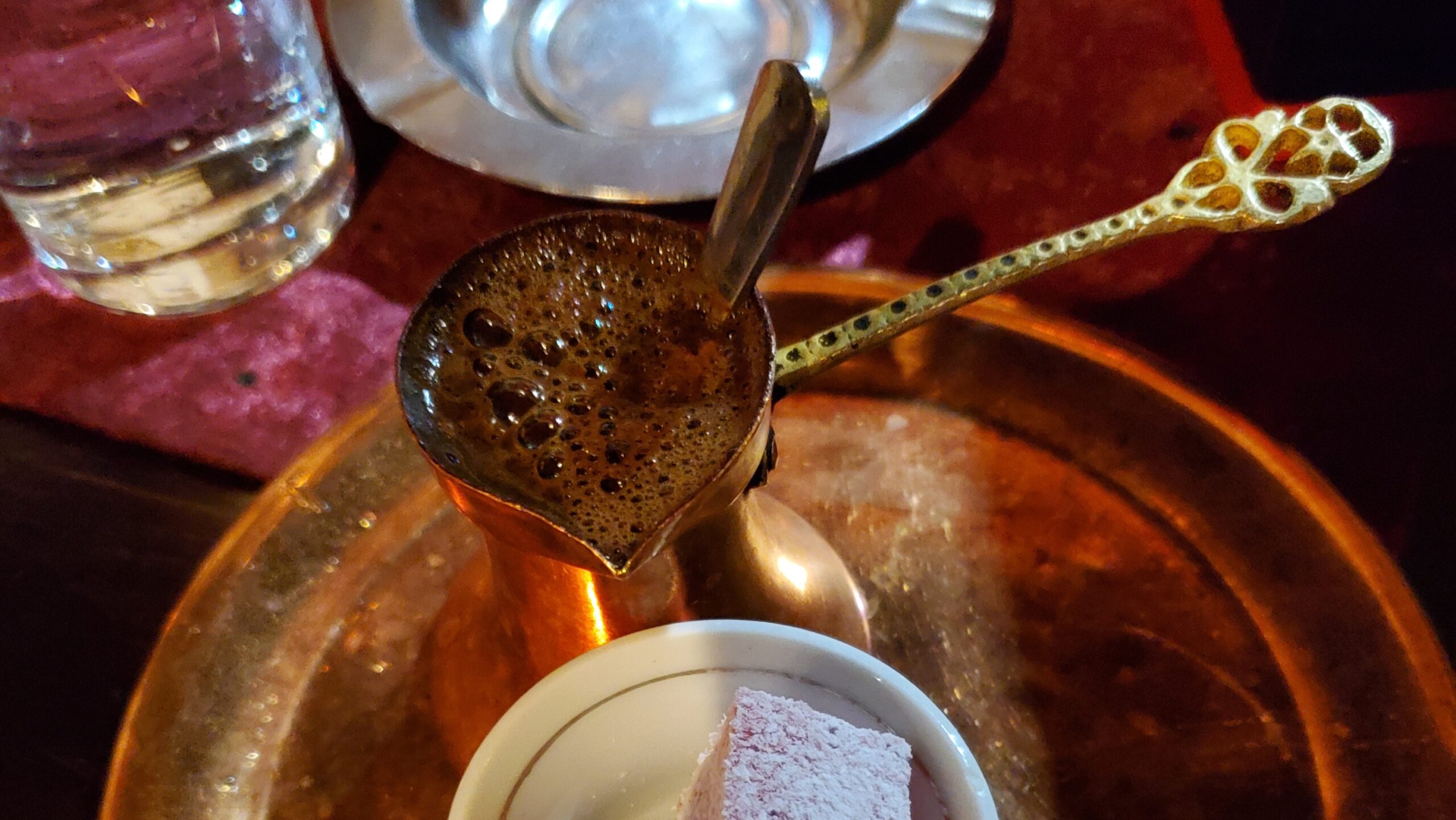
    Bosnian coffee

    The Art of Drinking Bosnian Coffee

    So, how do you properly enjoy Bosnian coffee? First off, don’t call it Turkish coffee. Yes, they’re similar, but in Sarajevo, it’s proudly Bosnian. And whatever you do, don’t down it like an espresso shot! This isn’t about a caffeine spike; it’s about the experience.

    Bosnian coffee is typically served together with a sugar cube, a Turkish delight, and a glass of water. It seems to be a bit of a gamble on what flavour of the sweet you will get. I think this one must be a rose. 

    Here’s the insider tip from our guide: take the sugar cube, pop it in your mouth, let it dissolve a bit, and then take a sip of the strong, bitter coffee. That’s how you get the exquisite balance of flavours.

    The coffee itself is robust and somewhat gritty, brewed directly from the grounds in the džezva (the pot with the long handle). It has a strong, earthy flavor that may not be everyone’s cup of tea (or coffee), but it’s an experience you can’t miss when in Bosnia and Herzegovina.

    Now that we are rejuvenated by some caffeine it is time to eat some more.

    It is lunch time now, so let’s try a popular main course meal in Bosnia and Herzegovina. 

    Bosnian coffee sets

    4th Must try food in Bosnia and Herzogevina: Iconic Chevapi

    For lunch, we head to a place where Ahmet’s grandparents love to eat chevapi, so you know it’s going to be good. Chevapi is an assemble-your-own type of meal. You get grilled beef-lamb sausages, flatbread, raw onions, and kajmak.

    What’s that? It is a bit difficult to explain. The texture of kajmak is similar to a whipped butter. But it is not butter. It is the cream that forms on top of the milk when milk is slowly simmered. The taste is mild, quite buttery. If you want to sample some more – head to the food market where they sell it both sweetened and unsweetened. 

    But for now, chevapi is the star of the show and kajmak is a supporting actor. So tear off a piece of bread, spread some kajmak on, wrap a chevapi sausage in it, and enjoy!

    Chevapi
    Note: This image is not taken by me. This one is from Pixaby.com. As I forgot to take a pic on the tour. Rest of the images on this post are mine 🙂

    Do you still have room in your stomach? Because we have more. 

    It’s time for one more iconic Bosnia and Herzegovina dish. Can you guess what it is?

    Is There a Burek With Cheese?

    If you really want to see a Bosnian’s eyes flare up, just ask for “burek with cheese.” But be ready for a duel! In Bosnia and Herzegovina, there’s no such thing. Burek is strictly a meat-filled pastry. Any similar pastry filled with cheese, spinach, or potatoes that you thought is also named burek ? Those are called “pastries” or  “pitas.”

    So, let’s embark on this culinary adventure and sample both the legendary burek and its cheese-filled relative. The best way to savour these delights? With a generous side of yogurt, of course.

    Cheese pastry
    Note: I forgot to take picture of burek while on tour, so here is another cheese filled (not-burek) pastry from earlier

    First up, the burek. As you take your first bite, the flaky, golden pastry shatters delightfully, giving way to a rich, savoury filling of ground meat. Now, onto the not-burek. Inside, you find a filling reminiscent of cottage cheese—rich, fatty, and crumbly. Both of these Bosnia and Herzegovina foods are salty, flaky and fatty. Although it is a pastry it could easily be eaten as a meal. 

    What To Know About Picking This Food Tour in Sarajevo?

    Is the food included in the price?

    Yes, for this particular tour all the food items I mentioned were included in the price and in the end we also got some recommendations on where to eat on our own if we were to spend more time in Sarajevo.

    What landmarks of Sarajevo does the tour include?

    The tour is mostly focused on the market, but we also saw exteriors of some historic buildings like mosque and bell tower. However, I would recommend planning time to explore the landmarks separately or look into complimenting this tour with another walking tour as this one is more focused on food and crafts.  


    Is food tour in Sarajevo worth it?

    I feel like this Sarajevo food tour was a feast of Bosnia and Herzegovina cuisine with some history and culture in the desert. From the sweet, nutty baklava and freshly baked somun bread to the rich, strong Bosnian coffee and the iconic meat-filled burek, each bite offers a taste of tradition. I recommend it!

    You might have noticed – I did not share any specific places where we ate. I did not want to reveal their secrets, so that you have some incentive to join the tour yourself. It was truly a lot of fun. As well there were a couple of other snacks we sampled along the way that are not listed here. 

  • How Much Does a Trip to Croatia and Bosnia and Herzegovina Cost? 2024

    How Much Does a Trip to Croatia and Bosnia and Herzegovina Cost? 2024

    When I tell people about any trip, the common answer I get is: “Amazing. But how much did it cost?” So, I have prepared a detailed cost breakdown for our Croatia – Bosnia trip. But do keep in mind that this is a snapshot frozen in time and prices do change as the time goes on as well as they fluctuate through seasons and are affected by the level of comfort you wish to have when travelling. So you can use this as a rough idea of the expenses involved, but do expect your final price to be a bit different in the end. Anyways, I hope you find this helpful.

    When

    Last week of May 2024 to the first week of June 2024

    How long

    11 nights / 12 days

    Who

    2 adults


    Breakdown of Our Croatia – Bosnia and Herzegovina Road Trip Costs

    Cost of Activities and Sightseeing

    ActivityCost per 1 person (EUR)
    Rafting60
    Krka nature park entrance40
    Boat ride in Krka nature park15
    Plitvice lakes entrance ticket40
    Food & Crafts tour in Sarajevo40
    Snorkeling cruise55
    Klis fortress10
    Sarajevo cable car15
    Sarajevo Town hall5
    Tito’s Bunker10.5

    Total: ~290.50 EUR per person

    Accommodation Costs

    During our 11-night trip, we stayed in a mix of hotels and Airbnb rentals. We went for the cheaper end, but made sure the places had free on site parking and the hotels had breakfasts included in the price as well. 

    AccomodationCost for 2 people (EUR)
    Hotel in Split (2 nights)207
    Hotel in Mostar59
    Hotel in Konjic61
    Hotel in Lozavec near Krka park93
    Airbnb Zadar (3 nights)183.81
    Airbnb Split (2 nights)124.1
    Airbnb Sarajevo35
    City tax in Split8
    Tourist tax in Lozovec3.4

    Total: ~774.3 EUR per 2 grown ups

    Transportation Costs

    Our main method of transportation was a rental car which we had for 8 days, but we also walked a lot to avoid spending money on public transport when possible. 

    Public transport in SplitCost per person (EUR)
    Public buss from Split to city center3.1
    Airport shuttle8.4
    CarCost (EUR)
    Rental car with basic insurance145
    Car wash2.5
    ~74 l of gasoline*~120

    Total: ~290.50 EUR

    *We had a gasoline car that uses 5,7 liters per 100 km and our total distance was 1288km therefore we needed ~73,4 liters of gasoline. Average price at the time was around 1,64 (a bit cheaper in Bosnia and a bit more expensive in Croatia

    Toll Roads and Parking Costs

    I believe in most cases there are free road alternatives to these, but they take more time. So we prioritizes less time spent on the road over cost saving.

    Toal roadsCost (EUR)
    When driving from Split to Bosnia border10,5
    When driving from Bosnia border to Mostar2,4
    When driving from Mostar to Bosnia border2,4
    When driving from Bosnia border to Klis10,5
    When driving from Zadar to Plitvice lakes6,2
    When driving from Plitvice lakes to Zadar6,2
    When driving from Zadar to Šibenik3,5

    Total: ~41.7 EUR

    Paid parkingCost (EUR) per hourHours spentTotal (EUR)
    Sarajevo1,5710.5
    Plitvice1,5710.5
    Nid224
    Trogir326
    Blagaj212
    Šibenik224
    Zadar0,843.2

    Total: ~40.2 EUR

    In Mostar & near Krka we left car in the hotels free parking when we were exploring.

    Also the costs of parking may very per season.

    Other

    Commission for money withdrawal from ATM abroad*12.99

    I believe this also depends on the bank you use.

    The costs that are not shown above but one does have when travelling to Croatia and Bosnia:

    • Flight costs (as they depend from your country of departure)
    • Insurance
    • Roaming abroad
    • Cost for food and drinks. For example in Croatia in lower budget places fried squid with fries was somewhere from 17-20 euros per portion, grilled fish was 20 euros and more, burek was ~2.50 etc. In Bosnia the prices were much more affordable ~5 euros per chevapi and ~ 9 euros for other meat dishes. 
    Money tree

    Tips on how to make your Croatia – Bosnia trip more budget friendly

    As you can see – our trip to Croatia and Bosnia and Herzegovina wasn’t cheap. Therefore here are some tips on how you could try to bring the overall cost down.

    Looking for what to see in Croatia and Bosnia and Herzegovina?

    Check out the itinerary from our trip